Best HVAC Filter for Wildfire Smoke: MERV 13 Minimum, Checked Weekly, Not Quarterly

Wildfire smoke’s dangerous fraction is PM2.5 and finer — particles from roughly 0.03 to 2.5 µm — which is precisely the band where MERV 13 is the minimum effective rating (MERV 8–11 catch visible ash but pass most smoke). Two rules matter as much as the rating: during active smoke days a filter loads 3–5× faster than normal, so you inspect weekly, not quarterly; and the “recirculate” setting on your HVAC is your first move, because no filter cleans air that hasn’t reached it while your system is busy pulling in more smoke.
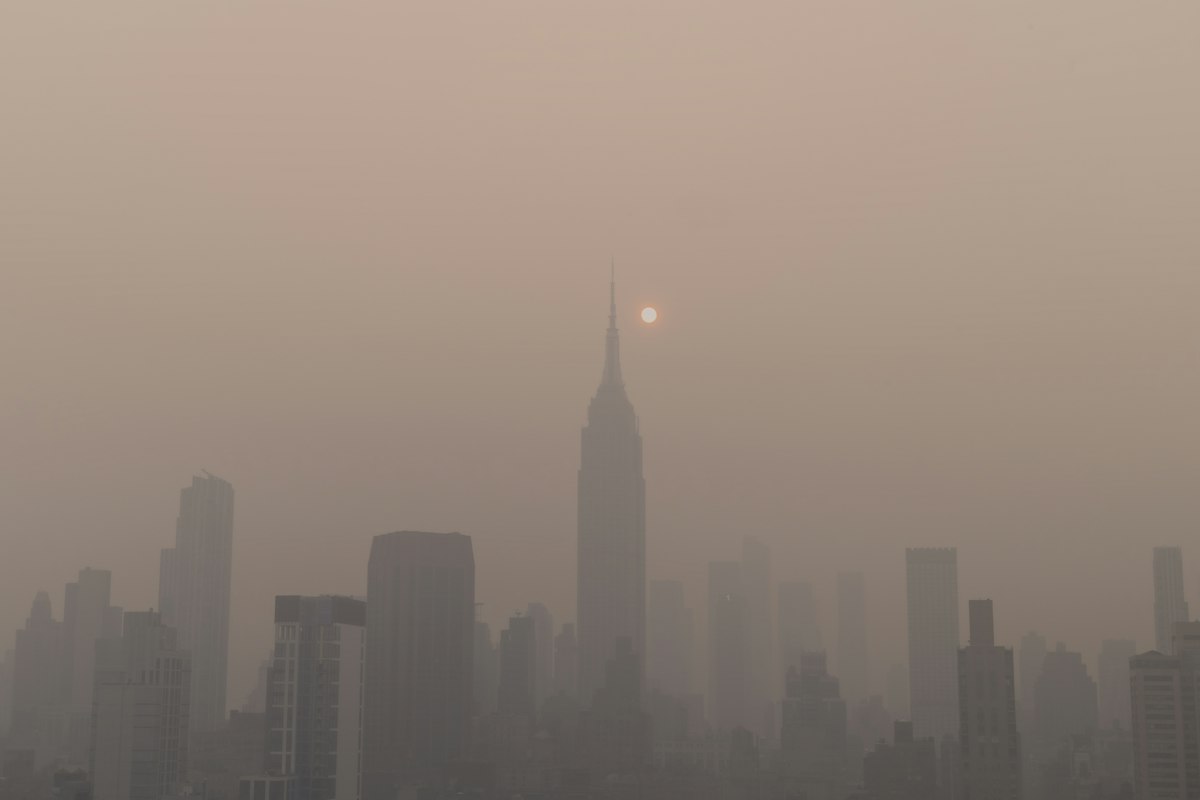
Every wildfire season, the same sequence plays out: the sky goes orange on Tuesday, filter shelves and search spikes follow by Wednesday, and by the weekend people are installing MERV 8 “dust filters” against a particulate load that’s mostly sub-micron combustion aerosol. The smoke-visible ash on your car is the fraction any filter catches. What a MERV 13 catches — and a MERV 8 returns to your living room — is the invisible 90% of the plume: the smoldering-phase organic aerosol in the E1/E2 bands.
Quick Answer: Smoke Particle → MERV Requirement

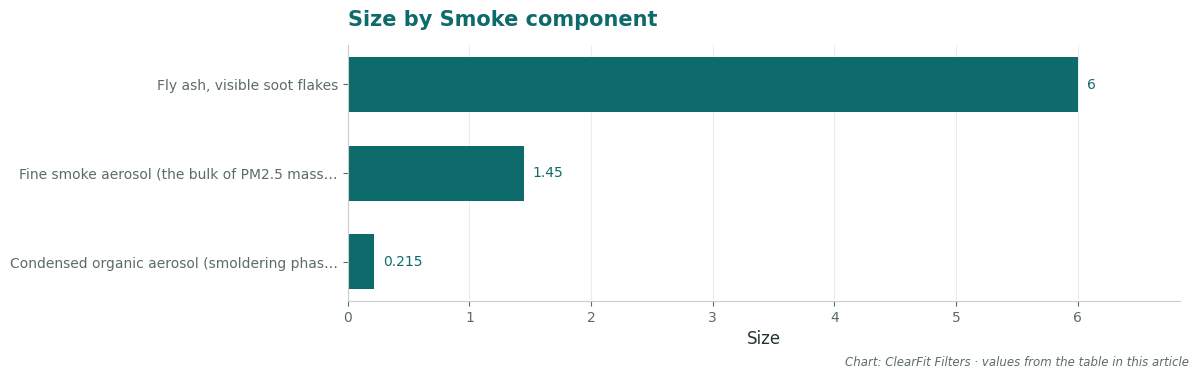
| Smoke component | Size | MERV needed | Caught by MERV 8? |
|---|---|---|---|
| Fly ash, visible soot flakes | 2–10 µm+ | MERV 8+ | Yes — the easy fraction |
| Fine smoke aerosol (the bulk of PM2.5 mass) | 0.4–2.5 µm | MERV 11 partial / MERV 13 effective | Mostly no |
| Condensed organic aerosol (smoldering phase) | 0.03–0.4 µm | MERV 13 (E1 band capture) | No |
| Odor gases (VOCs from smoke) | molecular | No MERV — activated carbon only | No — any rating |
The odor row matters: smoke smell is a VOC problem, and MERV is a particle standard. A MERV 13 takes the particles out while the smell persists until the air exchanges or carbon scrubs it. VOCs in home air covers that half of the problem.
The Rating Case in Three Layers
Why 13, specifically. MERV ratings describe worst-case capture in three size bands: E3 (3–10 µm), E2 (1–3 µm), E1 (0.3–1 µm). MERV 11 tops out with strong E3/E2 capture and minimal E1; MERV 13 holds >85% in E2 and brings real E1 capture. Wildfire PM2.5 mass concentrates in the 0.4–1 µm range — smoldering combustion produces its heaviest aerosol load exactly where MERV 11’s capture falls off and MERV 13’s begins. That’s not marketing; it’s the shape of the smoke distribution meeting the shape of the rating scale. Full scale: MERV rating explained.
What independent testing found. Consumer Reports’ high-MERV testing (paywalled in detail, publicly summarized) consistently shows MERV 13-class filters capturing fine smoke particles at levels MERV 8-class filters don’t approach; EPA’s wildfire-smoke guidance independently recommends MERV 13 or higher for HVAC filtration during smoke events. When a consumer-testing organization and the regulator agree, the grade question is settled — the remaining questions are fit and logistics, below.
The fit caveat (unchanged from non-smoke use). MERV 13 in a 1″ slot raises static pressure and shortens filter life — and during smoke season both effects amplify. If you have a 4″ media cabinet, this is its moment: same MERV 13 capture at half the pressure drop and triple the dust-holding capacity (1 vs 4 inch). If you’re stuck with 1″, buy MERV 13 in multipacks and expect 30–45 day changes during smoke events rather than 90.
The 3–5× Loading Math (Why “Quarterly” Dies in Smoke Season)
A filter’s life is dust mass ÷ capture rate. Normal residential air carries roughly 20–40 µg/m³ of particulate on ordinary days; a bad smoke day runs 150–500+ µg/m³ outdoors, and even a well-sealed house holds a meaningful fraction of that indoors. Your blower moves the whole house volume through the filter every 1–4 hours.
The arithmetic: a filter that would have coasted to day 90 in clean air can load to end-of-life in 2–4 weeks of sustained smoke — which is exactly the 3–5× acceleration field reports and HVAC-tech threads describe every season. The practical protocol for smoke weeks:
- Inspect weekly: pull the filter, hold it to light (no light through most of the media = replace), and check the system’s airflow at a register.
- Pre-change before the season if you’re within 3 weeks of due — starting a smoke event on a half-loaded filter is starting a marathon on a flat tire.
- Watch for the airflow symptom: weak register flow during a smoke event almost always means a smoke-loaded filter, not a broken blower. Check the cheap thing first.
The Home Filter Calendar handles the cadence shift — set a smoke-season check frequency rather than a single change date, and pair it with your region’s air-quality alerts (AQI explained; live conditions for your city via our air-quality pages).
The Non-Filter Half: Recirculate, Seal, and the Clean Room
The filter is one tool in a three-tool response; the other two cost nothing:
- Set the HVAC to recirculate. Any fresh-air intake or economizer mode pulls outside smoke straight into the path you’re trying to clean. Recirculate mode filters indoor air over and over instead.
- Seal the leaky paths. A typical house exchanges all its air every 1–4 hours through infiltration (0.5–1.5 ACH). Attic hatches, window weatherstripping, and bathroom-fan backdrafts are the big three; sealing shifts the indoor/outdoor particle ratio dramatically during multi-day events. The full infiltration math and clean-room setup: how wildfire smoke gets indoors.
- Run the fan ON, not AUTO. The filter only works when air moves through it; continuous circulation during event days multiplies effective passes through the media.
For bedroom-level protection during the worst nights, a portable HEPA unit in one room (sized by CADR to that room) is the complement — air purifier vs HVAC filter covers when each tool wins.
FAQ
Will an HVAC air filter help with cigarette smoke indoors?
Partially — and less than with wildfire smoke. Cigarette smoke particles (0.01–1 µm, dominated by the sub-0.3 µm fraction from sidestream burning) sit even deeper in the E1 band, so a MERV 13 catches much of the particle load on recirculate, and that helps with the haze and the tar-film component. What no MERV rating touches is the residual: the odor and irritant fraction of tobacco smoke is a VOC cocktail that particles carry and surfaces re-emit for days — which is why the smell outlives the haze. For a smoking household the working stack is MERV 13 changed frequently + activated carbon (HVAC cartridge for background, purifier carbon stage for the room where smoking happens) + source ventilation. Wildfire events are episodic and outdoor-sealed; indoor cigarette smoke is continuous and indoor-generated — filters help most in the first case, least as the sole tool in the second.
Does an HVAC filter help with wildfire smoke?
Only at the right rating. Smoke’s harmful fraction is PM2.5 and finer (0.03–2.5 µm); MERV 8–11 catch the visible ash but pass most of it, while MERV 13 captures across the E1/E2 bands where smoke mass concentrates. EPA’s wildfire guidance recommends MERV 13+ — running recirculate mode and keeping windows closed matters as much as the filter itself.
MERV 11 vs 13 for wildfire smoke — which one?
MERV 13. MERV 11 captures well in the 1–3 µm band but falls off below 1 µm, where a large share of smoke aerosol mass sits. If your system genuinely can’t handle 13 (weak airflow after swapping, older PSC blower), MERV 11 changed very frequently is the fallback — a fresh 11 beats a loaded 13.
How fast does a filter load during wildfire smoke?
Plan on 3–5× the normal loading rate: a 90-day filter can reach end-of-life in 2–4 weeks of sustained smoke. Inspect weekly during events (hold-to-light test), pre-change if you’re within weeks of due, and expect 30–45 day intervals on 1″ MERV 13 through the season.
Do smoke odor gases get filtered out by MERV filters?
No — odor is VOCs (gas molecules), and MERV is a particle standard. The particle filter clears the smoke’s health hazard while the smell lingers until air exchanges or activated carbon adsorbs it. Carbon-impregnated filters or a purifier carbon stage handle odor; the MERV rating handles particles.
Should I run the fan ON during smoke days?
Yes. AUTO mode only filters while heating or cooling calls run; ON circulates air through the filter continuously, which is exactly what multi-day smoke events require. Pair it with recirculate mode so you’re not pulling fresh smoke into the loop.
Sources & References
- EPA wildfire smoke guidance — MERV 13+ recommendation for residential HVAC filtration during smoke events. Official documentation (explicit).
- Consumer Reports high-MERV fine-particle test summaries — 13-class vs 8-class capture differences. Industry expert analysis (public summaries of paywalled findings, explicit).
- Wildfire smoke aerosol size-distribution literature (0.4–1 µm mass concentration in smoldering-phase plumes). Industry expert analysis (explicit: size-distribution findings).
- ASHRAE 52.2-2017 — E1/E2/E3 capture-band definitions. Official documentation (explicit).
- r/HVAC smoke-season threads — weekly-load filter photos; “weak airflow = check the filter first” pattern. Community discussion (paraphrased).
Related Guides
- How Wildfire Smoke Gets Indoors & What to Do — the physics pair to this page.
- What Is PM2.5? — the pollutant itself.
- What Is AQI? — the alerts that start this protocol.
- MERV Rating Explained — the scale behind the recommendation.
Shop this guide: MERV 13 filters – smoke grade