Best Sand for Pool Filters: Silica vs Glass vs Filter Balls vs Zeolite (the Honest Matrix)

The default answer is #20 graded silica sand (.45–.55 mm) — $8–15 per 50-lb bag, a 3–5 year service life, and a 20–40 micron filtration floor that handles what sand filters are asked to do. The upgrade paths: crushed glass (sharper grains, filtration often cited in the 10–20 micron class, less frequent backwashing, ~3× the price, long-life claims), zeolite (a mineral media with ammonia adsorption on top of mechanical filtration), and filter balls — the controversial one: lightweight polyester/microfiber products claiming sand-equivalent filtration at a fraction of the weight, which some pool professionals and communities endorse and others report as unvalidated underperformance. And the one rule with no controversy: never play sand — too fine, too silty, wrong job entirely.
This is a category where the honest answer is “the disagreements are real.” The Trouble Free Pool community — the most technically serious pool forum on the internet — runs long threads debating glass longevity claims and filter-ball capture performance, with testing-minded members skeptical of both, while regional pool services install glass media routinely and report the backwash savings as fact. This page lays out what each media verifiably does, what’s claimed, and how to choose by your water, your backwash budget, and your tolerance for unvalidated performance claims — rather than picking a winner the data doesn’t support.
Quick Answer: The Four-Media Matrix

| Media | Filtration floor (typ. claims) | Cost per load (18″ tank) | Service life | Backwash water | The honest position |
|---|---|---|---|---|---|
| #20 silica sand | 20–40 µm | $25–50 | 3–5 yr | Baseline | The default — proven, cheap, known |
| Crushed glass | 10–20 µm (claimed) | $75–150 | 5–10 yr claimed | 20–30% less (claimed) | Real upgrade for hard-water/backwash-sensitive pools; validate the longevity claim locally |
| Zeolite (clinoptilolite) | ~5 µm claimed, plus ammonia adsorption | $50–100 | 4–6 yr (recharge cycles) | Similar to sand | The ammonia angle is its unique, verifiable feature (see below) |
| Filter balls | “Sand-equivalent” (vendor) | $60–120 | 1–3 yr | Less (lighter bed) | Contested: light weight is real; capture equivalence is not independently established — see the controversy section |
| ~~Play sand~~ | — | — | — | — | Never: silt and clay cloud the pool and dead-end the bed |
Read every filtration-floor number above as a claim class, not a certified spec: media performance depends on bed depth, flow rate, and loading in ways vendor numbers flatten. Sand’s 20–40 µm is the field-proven anchor everything else is measured against.
#20 Silica: the Default and Why It Stays the Default
Pool-filter sand is a graded industrial product: #20 means the .45–.55 mm sieve fraction, washed and kiln-dried, specifically so the bed packs at the density that gives sand filtration its known behavior. The grain sharpness (angular, crushed-or-natural silica) is the capture mechanism — debris lodges against grain edges and in the interstitial spaces of the packed bed. Over 3–5 years, flow and chemistry round the grains and calcium cements channels; the media is consumed in place (the change-it guide).
Why it stays the default despite flashier alternatives: the entire sand-filter engineering world — tank design, backwash flow rates, lateral sizing — was built around its density and hydraulic behavior. A 300-lb silica bed behaves the way the filter was designed for; the alternatives are all substitutions into that engineered system, with benefits and questions following from the substitution.
Crushed Glass: the Legitimate Upgrade Lane
Crushed (not recycled-rounded) glass media substitutes grain-for-grain with silica, usually at a reduced total load (glass is lighter per volume — follow the manufacturer’s weight guidance, typically ~20% less than sand). The claimed advantages, in order of how solid they are:
- Grain shape: crushed glass keeps sharp, angular faces that resist rounding — the mechanism behind both finer capture claims (10–20 µm class) and longer service life (5–10 years claimed).
- Backwash savings: sharper media releases captured debris more completely per backwash cycle, cited at 20–30% less backwash water — the claim regional installers report as field-observed.
- Lower calcium bonding: glass surfaces reportedly resist calcium cementing better than silica, extending the change interval.
Where the honesty label belongs: the longevity and micron numbers above vary by manufacturer, and independent verification at scale is thin — TFP’s testing-minded members keep the claims at arm’s length. The reasonable buyer stance: if backwash water costs or discharge rules matter in your situation, glass’s upside is real enough to try once; buy the load by weight guidance, not by volume translation from sand.
Filter Balls: the Controversy, Both Sides
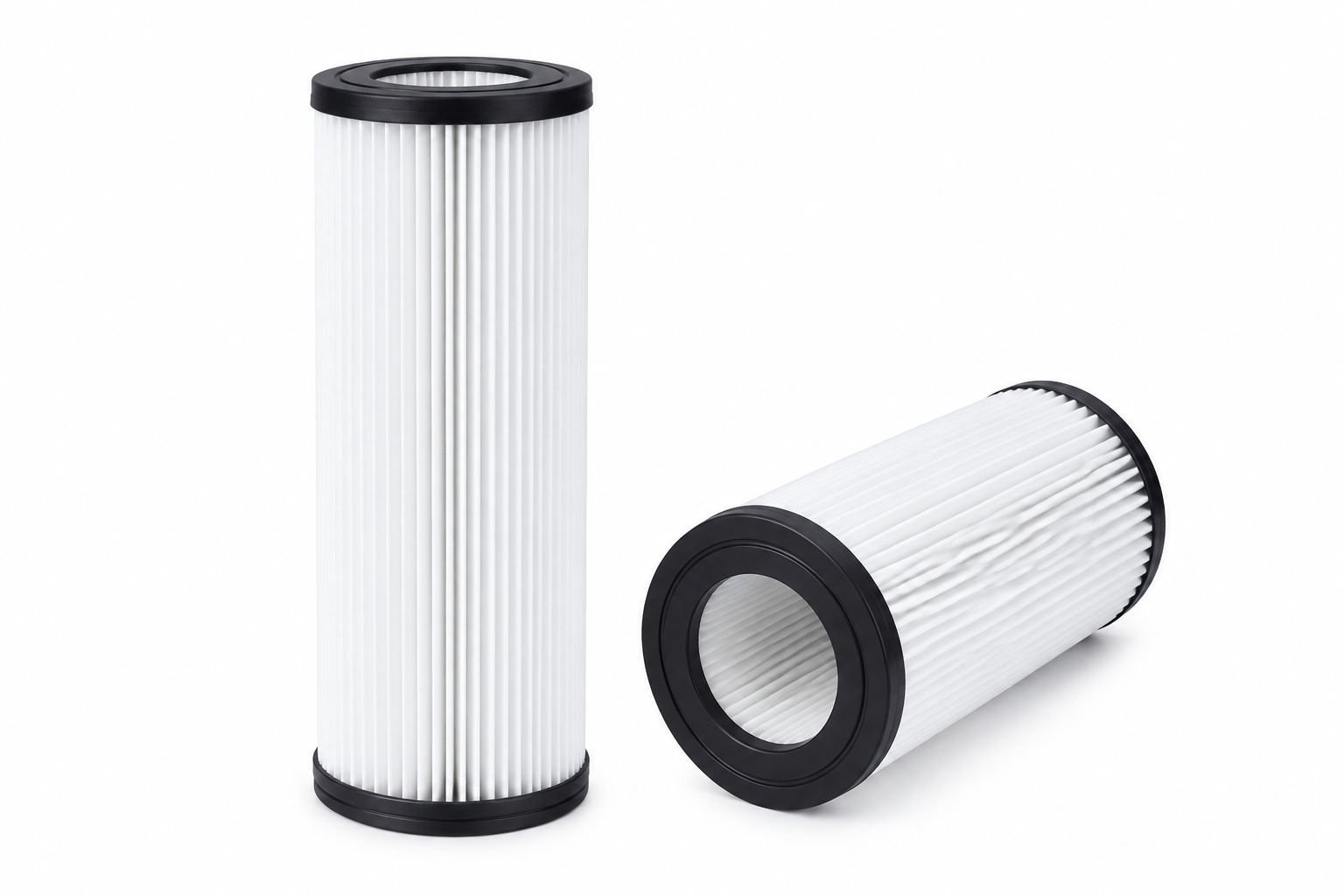
The product class: lightweight polymer microfiber balls (~3–7 lb replacing ~250 lb of sand), marketed on ease (carry the whole media load in one arm), lower backwash frequency, and “same filtration as sand.” What’s not disputed: the weight and handling advantage is real and dramatic. What’s contested: capture performance — sand’s granular bed filters through depth and interstitial spaces; balls filter through fiber mass, and whether a fiber mass at sand-bed dimensions matches 20–40 µm capture has not been established by independent testing. Community field reports split: some owners report years of satisfactory operation; others report cloudiness that resolved only on returning to sand.
The fair conclusion this page commits to: filter balls are a convenience product with an unvalidated performance claim, not a proven upgrade. For a lightly-used above-ground pool where dragging 200 lb of sand is the binding constraint, the trade may be worth it knowingly. For an in-ground pool where clarity is the point, the burden of proof sits with the product, and the incumbent is cheap. (One mechanical note that crosses all communities: chlorine degrades polymer fibers over time — the 1–3 year replacement economics are part of the comparison, not a footnote.)
Zeolite: the Charged Media with a Real Superpower
Zeolite (the clinoptilolite mineral class) is a porous volcanic mineral with a genuine second capability no other media on this page has: cation exchange — it adsorbs ammonia. That matters in pools because combined-chlorine (chloramine) problems route through ammonia chemistry: a zeolite bed measurably reduces the ammonia load that chlorine otherwise oxidizes into combined forms, which is why some pool services spec it for chronic chloramine complaints (indoor pools, heavy bather loads). Its claimed filtration floor (~5 µm, attributed to the mineral’s micro-porosity) exceeds sand’s — the claim is plausible mechanistically, with the same field-variation caveats as glass.
The two zeolite-specific cautions: the media loads by weight differently than sand (typically a ~20% reduction — follow the bag’s pool-filter table), and the ammonia capacity exhausts — beds benefit from periodic recharge protocols (salt-brine soaks per the manufacturer’s guidance) to release accumulated ammonia back out of service. For ammonia-driven water chemistry problems, it’s the only media in the matrix with a targeted mechanism; for everyone else, it’s a fine alternative with one more maintenance concept to learn.
The Reload Math (Whichever Media You Pick)
| Tank diameter | Silica load | Glass load (approx., −20%) | Balls (per vendor tables) |
|---|---|---|---|
| 16″ | ~100 lb | ~80 lb | per product chart |
| 18″ | ~150 lb | ~120 lb | per product chart |
| 21″ | ~200 lb | ~160 lb | per product chart |
| 24″ | ~300 lb | ~240 lb | per product chart |
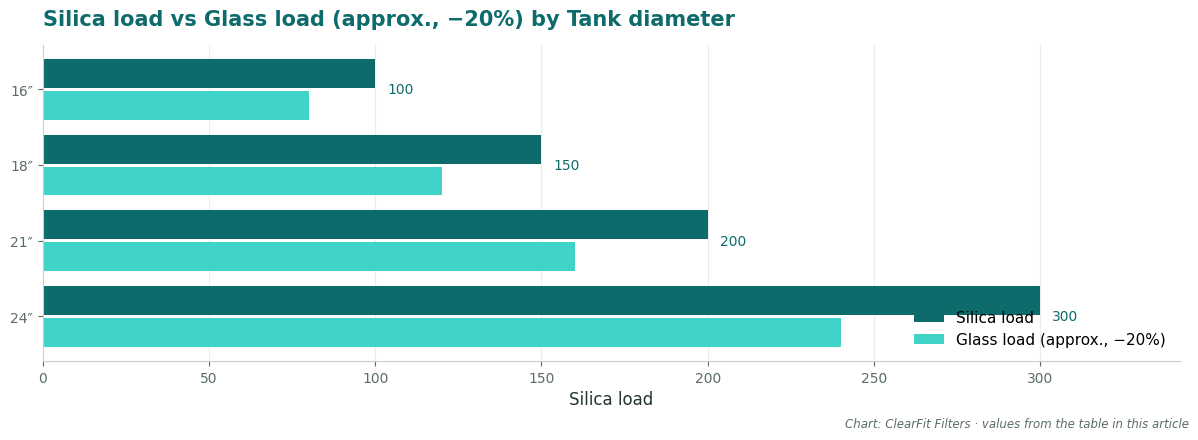
The tank label’s number governs; the reload procedure — drain, lateral protection, layering, the post-load backwash — is identical across media and covered in how to change pool filter sand. Note that mixing media (half sand, half glass, etc.) has no engineering basis — beds stratify by hydraulic behavior, and you get the worst of both capture profiles; commit to one media per load.
FAQ
Does it matter what sand I use in my pool filter?
Yes — pool-filter sand is a graded product (#20, .45–.55 mm, washed): the grade determines how the bed packs, filters, and backwashes. Play sand and builders’ sand are finer and silty; they cloud the pool, channel the bed, and can pass into laterals. Within genuine filter sand, brand matters little; grade matters entirely.
What type of sand is used in swimming pool filters?
#20 industrial silica sand — the .45–.55 mm sieve fraction, washed and kiln-dried, sold explicitly as “pool filter sand.” The alternatives in the same tanks: crushed glass media (load ~20% lighter per the vendor tables), zeolite mineral media, and the polymer filter-ball products (contested — see the matrix above).
How often should I change the silica sand in my pool filter?
Every 3–5 years, judged by symptoms: rising backwash frequency, cloudiness that survives backwashing, and pressure that won’t settle to baseline after a cycle (full criteria and procedure). Glass media claims longer service (5–10 years); zeolite runs 4–6 years with periodic recharge.
What size sand filter do I need for a 10,000 gallon pool?
A 21″–24″ tank class for a 10,000-gallon in-ground pool is the standard sizing (filter capacity scales with surface area, and manufacturers’ flow tables match 21″+ to that volume at typical turnover rates); above-ground 10,000-gallon setups commonly run 18″–21″. Size the filter generously when in doubt — oversize costs little and backwashes less often. For full system trade-offs: sand vs cartridge vs DE.
Sources & References
- Media retailer catalog data (silica grade specs, glass load tables, zeolite recharge protocols, ball-vendor claims). Official documentation (explicit; performance figures are manufacturer-stated).
- Trouble Free Pool community threads — glass longevity skepticism, filter-ball field reports both ways. Community discussion (paraphrased).
- Zeolite cation-exchange chemistry — clinoptilolite ammonia adsorption in water treatment. Industry analysis (explicit mechanism).
- Regional pool-service installation reports — glass backwash-savings field observations. Industry convention (paraphrased).
Related Guides
- How to Change Sand in a Pool Filter — the procedure behind every media choice.
- Sand vs Cartridge vs DE Pool Filters — the system decision upstream of media.
- How to Backwash a Pool Filter — how your media gets cleaned.
Find your filter: Pool & spa filter cartridges