DE Pool Filters Explained: What Diatomaceous Earth Is, How to Clean and Recharge One

A DE pool filter passes water through diatomaceous earth — the fossilized skeletal remains of diatoms, microscopic algae whose silica frames form a porous powder that coats fabric grids and filters down to the 2–5 micron class — the finest of the three residential filter types (sand manages 20–40 µm, cartridge 10–15 µm nominal, DE the clearest water of the three). The ownership rhythm that defines the DE experience: backwash when the gauge reads +8–10 psi over clean baseline, recharge the powder after every backwash at roughly 1 lb per 10 square feet of grid area, and once a year open the tank and clean the grids properly. The trade for the clarity is maintenance engagement: DE rewards owners who like their water glassy and don’t mind a monthly fifteen-minute ritual.
Reddit’s recurring DE thread is a person on the fence: “Is a DE filter worth it? Would you choose one again?” — and the replies split cleanly along temperament lines, not facts. The facts everyone agrees on: DE makes the clearest water, the powder is an ongoing consumable, the annual grid-cleaning is a real job, and the filter demands you understand its recharge cycle. The people who’d choose it again are the ones who wanted aquarium-clear water and found the ritual trivial; the defectors wanted set-and-forget. This page is the full mechanics of the filter that both camps are describing.
Quick Answer: What DE Is and What Ownership Looks Like

| Question | Answer |
|---|---|
| What is DE? | Diatomaceous earth — fossilized diatom skeletons (silica), mined and milled into a fine powder; “pool grade” DE for filters, distinct from food-grade (see safety below) |
| How does it filter? | The powder coats a set of fabric-covered grids; water passes through the powder layer, which traps down to the 2–5 µm class — finer than sand or cartridge |
| What does it cost to run? | Powder: ~$20–40/yr at typical recharge rates (5–8 lbs per backwash on a 48–60 sq ft filter, a few cycles a season) |
| The maintenance rhythm? | Backwash at +8–10 psi → recharge powder → annually: disassemble, hose and chemically clean the grids, inspect |
| Who it’s for | Clarity-first owners, pools near trees/debris (fine capture), anyone who enjoys tuned equipment |
| Who it’s not for | Set-and-forget owners — cartridge is their system |
What DE Actually Is (and Why It Filters So Fine)
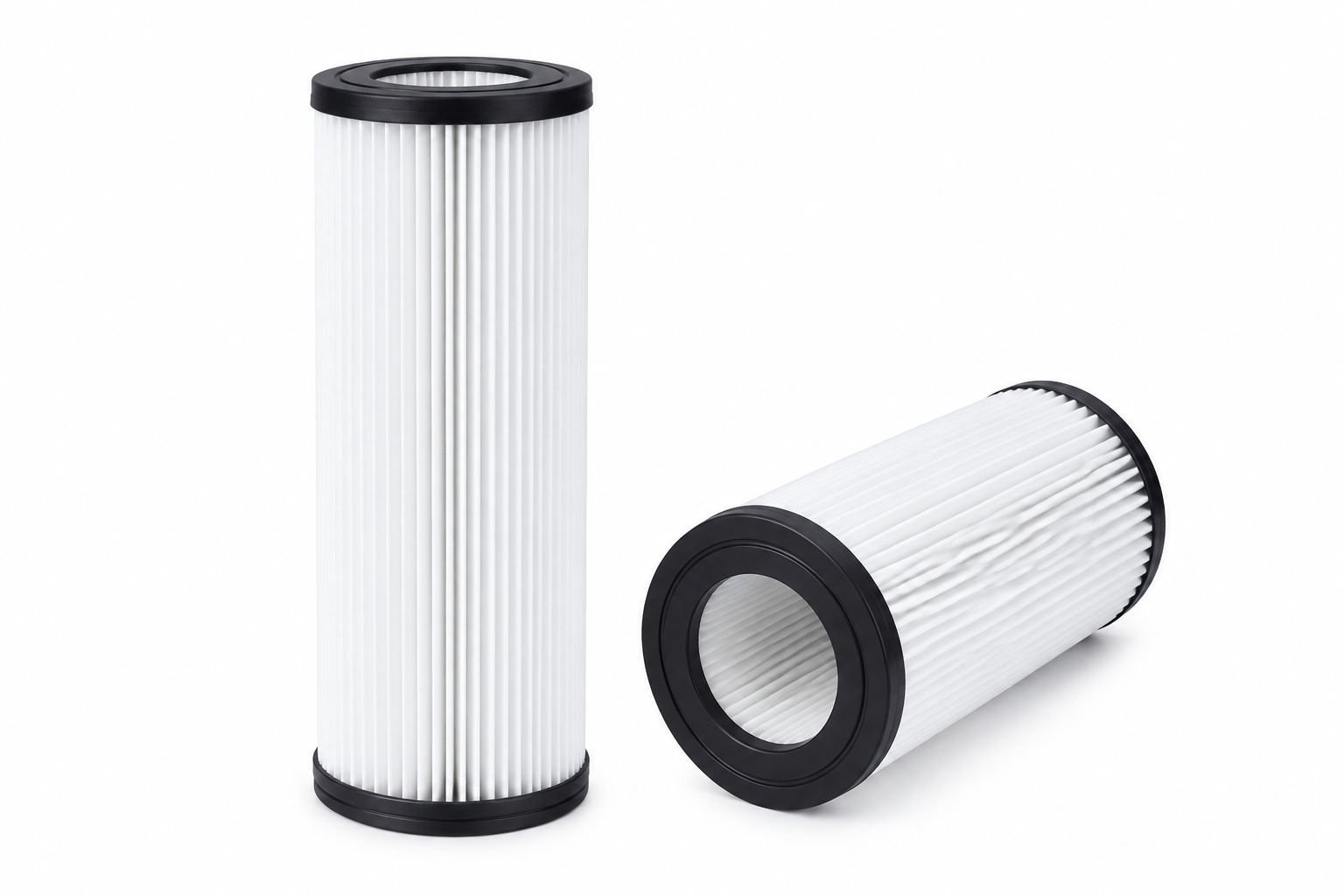
Diatoms are microscopic algae that build skeletons of amorphous silica — intricate, perforated shells. Deposits of these skeletons, mined and milled, produce a powder whose particles are themselves covered in the diatoms’ original micro-porosity: an enormous surface area per gram, dense with channels far smaller than any sand grain’s interstitial spaces. Coated onto a filter’s grids (usually 4–8 fabric-covered panels arranged around a manifold), the powder layer becomes the working filter — water goes through the fossil skeletons, and 2–5 µm particles don’t. That’s the entire trick: the filter is the powder; the grids are just the scaffold it hangs on.
Which is why the recharge discipline is not optional. A DE filter running without its powder coat is fabric grids straining water — a fraction of the designed capture, loading the cloth with debris it wasn’t built to hold. After every backwash strips the (dirty) coating, fresh powder must go in through the skimmer (pump running) or pre-mixed into the pump basket, at the tank’s rated amount.
The Operating Cycle: Backwash, Recharge, Bump
Backwash + recharge (the standard multiport flow, full procedure in the backwash guide): pump off, valve to BACKWASH, run until the sight glass clears, RINSE, return to FILTER — then recharge ~1 lb of DE per 10 sq ft of grid area (a 48 sq ft filter: 4–5 lbs). Skimmer method: with the pump on FILTER, sprinkle the measured powder into the skimmer slowly; it draws through and coats the grids. A note on amounts: slight under-charging is the conservative move when in doubt (over-charging can cake the grids and bump pressure).
The bump method (Perflex-class filters with a bump handle): rather than a full backwash, a few firm strokes of the external bump handle flex the internal tube/leaf assembly, cracking the dirty cake off the grids into the tank’s bottom for waste-flushing. Bumping extends the intervals between full backwashes and recharges — it’s the design feature that makes the small-cylinder Perflex filters livable. Between bump cycles the recharge amount drops (a bump wastes less powder than a full backwash): follow the model’s bump-and-charge schedule, typically a fraction of the full charge after a bump, a full charge after a backwash.
The annual (or seasonal) teardown: open the tank, pull the grid assembly, and hose each grid clean from top to bottom (a dedicated grid-cleaning nozzle on a firm jet makes this a twenty-minute job). Then inspect: torn fabric, cracked frames, brittle grid edges, and the manifold’s O-rings. Once a season (more in oil-heavy pools), soak the grids in a cartridge/DE cleaner to strip body oils and scale embedded in the cloth (the cleaner chemistry covers the products) — the same alkaline-then-acid logic as cartridge care (the cleaning guide).
Safety: Pool Grade vs Food Grade, and Handling
Two DE grades appear in stores, and the distinction matters at the scale you’ll handle it: pool-filter DE is calcined (heat-treated) — its crystalline silica content makes it hazardous to breathe as a dry dust (it’s the reason for the handling rules), while food-grade DE is the un-calcined, amorphous form sold as a dietary/insect-control product. For filters, buy filter-grade, and treat the powder respectfully:
- Avoid breathing the dust: wear a dust mask when scooping dry powder, especially pouring on windy days; add it where drift is minimal;
- Wet-mix method reduces dust: pre-mix the charge in a bucket of water and pour the slurry into the skimmer;
- Disposal: used DE (backwashed-out cake) goes to the waste line with your backwash water; keep it out of the pool itself and don’t dump buckets of wet DE onto garden beds in quantity.
The hazard is the dust, not the wet media in your filter — the handling rules are about the transfer moments.
Is DE Worth It? (the Two-Camps Verdict, Honestly)
The case for: the clearest residential water available, full stop — the 2–5 µm class catches algae fines and fine silt that keep sand-filtered pools in a perpetual faint haze after storms. DE also shines in debris-heavy settings where fine capture preserves sparkle between service visits.
The case against: it’s the highest-engagement system — powder to buy and dose, backwashes that require recharge, an annual teardown, and the filter’s waste stream includes the powder (some jurisdictions treat DE-laden backwash water differently; check local discharge rules). If your pool philosophy is “run it and look at it,” DE is a hobby you didn’t ask for.
The synthesis this page actually recommends: decide on temperament, then verify the plumbing. Clarity-first owners with sane equipment access: DE, and you’ll be in the would-choose-again camp. Everyone else: the three-system comparison exists because cartridge’s rinse-and-soak rhythm and sand’s backwash-and-forget rhythm serve the other two temperaments.
FAQ
Is a DE pool filter worth it?
If water clarity is the point of the pool for you — and you’ll accept a fifteen-minute monthly ritual plus an annual grid-cleaning afternoon — yes: nothing else filters as fine, and the would-choose-again owners are the ones who wanted glassy water. If you want set-and-forget, no: the powder-and-teardown rhythm will feel like a tax, and cartridge (the comparison) delivers most of the practical clarity with far less ceremony.
How often should you add DE to a pool filter?
After every backwash (the cycle strips the coating) — at roughly 1 lb per 10 sq ft of grid area per your tank’s rating — and after full cleanings. Bump-style filters take partial charges after bumps. If you find yourself adding DE more often than you’re backwashing, suspect a grid tear or manifold leak (leak diagnosis): powder escaping the filter shows up as DE traces at the returns.
Is a sand filter better than a DE filter?
“Better” forks by priority: sand is cheaper to run, simpler to own, and more forgiving of neglect; DE delivers visibly clearer water at the cost of powder management and annual teardown. Sand filters 20–40 µm; DE filters 2–5 µm — that gap is the entire decision. The full six-dimension trade-off: sand vs cartridge vs DE.
Do I need to add DE every time I backwash?
Yes — backwashing exists to strip the dirty DE cake off the grids, so the filter runs on bare fabric until recharged. The exception is bump-type filters, where a bump partially redistributes existing media and only full backwashes need the full recharge. Running a DE filter uncharged after backwash means unfiltered-water clarity until the next dose.
Sources & References
- DE filter retailer catalog data (grid ratings, recharge rates, bump-handle guidance, teardown intervals). Official documentation (explicit; per tank label/manual).
- Diatomite material references — fossil silica microstructure, calcined vs natural grades. Industry analysis (explicit mechanism).
- Crystalline-silica dust handling guidance — respirable-dust precautions. Official documentation (explicit, occupational-safety context).
- r/pools and r/swimmingpools “would you choose DE again” threads — the two-camps field verdicts. Community discussion (paraphrased).
Related Guides
- How to Backwash a Pool Filter — the cycle your recharge attaches to.
- Sand vs Cartridge vs DE Pool Filters — the system-level decision.
- Best Pool Filter Cleaners Compared — the annual grid-cleaning chemistry.
Shop this guide: Pool & spa filter cartridges