How Wildfire Smoke Gets Indoors (and What Actually Keeps It Out): The Air-Exchange Account

Your house exchanges its entire air volume with outdoors every 1–4 hours — 0.5–1.5 air changes per hour in typical US construction — which is why smoke gets in even with every window shut. That number, more than any product, sets the ceiling on what you can achieve: a sealed-up house still imports 25–75% of outdoor PM2.5 over a smoke day unless filtration is pulling it back down. The priority order below — recirculate, seal, filter, clean-room — is the sequence EPA and lung-health sources converge on; this page adds the arithmetic they don’t. Related: Best HVAC Filter for Wildfire Smoke.
Quick Answer: A typical house exchanges all its air every 1–4 hours (0.5–1.5 ACH natural infiltration) — smoke enters through leakage even closed-up. Priority order: set HVAC to recirculate, seal the leakiest paths (attic hatch, weatherstripping), run MERV 13+ filtration or a DIY box-fan filter continuously, and establish one clean room. Expect indoor smoke 25–75% of outdoor without filtration.
| House airtightness | Natural ACH | 12 h after outdoor AQI 200 (~150 µg/m³), no filtration: indoor PM2.5 |
|---|---|---|
| Older, leaky | ~1.5 | ~100–115 µg/m³ (roughly 70–75% of outdoor) |
| Average | ~0.7 | ~80–90 µg/m³ (~55–60%) |
| Tight/new, sealed | ~0.3 | ~55–70 µg/m³ (~35–45%) |
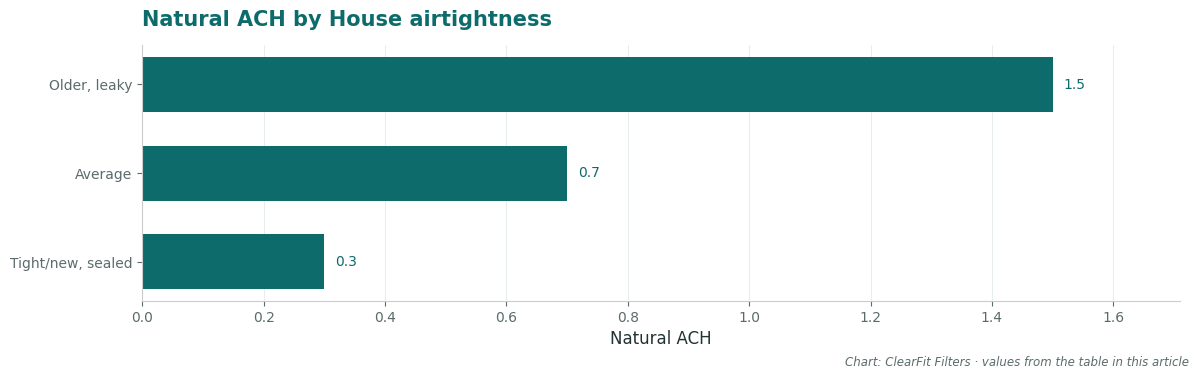
(Engineering estimates from standard mass-balance modeling with typical penetration factors; individual houses vary with wind, stack effect, and leak distribution.)
The pattern in every wildfire thread on r/HomeImprovement and r/airpurifiers: the first smoke week, people close windows and feel safe; by week two, the same people are buying purifiers because closing windows measurably wasn’t enough. Both instincts are correct at their layer — sealing slows the flood, filtration drains it — and the table above is why “close the windows” alone has never once been the whole answer.
ACH: The Number That Governs Everything

Air changes per hour (ACH) is how many times per hour a house’s full air volume swaps with outside through unintentional leakage. The professional measurement (blower-door test, reported as ACH50 — air changes at 50 pascal test pressure) roughly divides by 15–20 for a rule-of-thumb natural infiltration rate: a house testing 10 ACH50 (typical older stock) runs ~0.5–0.7 natural ACH; a tight new build at 3 ACH50 runs ~0.15–0.2. Wind and indoor-outdoor temperature difference (stack effect) pump it higher on cold, windy smoke days.
The mass-balance consequence, simplified: at steady state, indoor concentration = outdoor × P/(P + removal) — where P is particle penetration through leaks and removal is your filtration’s clean-air rate. Higher ACH pushes indoor toward outdoor; higher filtration rate pulls indoor toward zero. Every smoke-day strategy is a move on those two variables, and the recirculate-seal-filter order below attacks them in descending order of impact.
The Priority Order (Highest-Impact First)
1. Recirculate. HVAC and car systems on recirculate stop importing outdoor air through the equipment path. In the car, this is the single fastest win during a smoke drive. At home, the system setting matters less than the filter inside it (next).
2. Seal the big leaks. The attic hatch (worst in most houses — stack effect exhausts warm indoor air and pulls smoke in low), fireplace damper (close it — an open chimney is a smoke snorkel), weatherstripped doors, and any bathroom/kitchen exhaust flaps that don’t close. Cheap materials, one afternoon.
3. Filter continuously. Three honest options, costed:
- Central HVAC MERV 13+ with fan ON (not Auto — filtration stops when the fan stops): filter cost $15–25, but a smoke-season filter loads 3–5× faster than normal (the loading account: smoke filter page).
- Portable HEPA purifier, bedroom-sized: the effective-size rule is CADR ≥ ⅔ × room area in sq ft (a 300 CADR unit serves ~450 sq ft); noise matters more than spec sheets admit — buy for sleeping-loud tolerance.
- DIY box-fan filter (20″ box fan + 20×20 MERV 13 filter, tape): EPA researchers have tested and validated the design as a legitimate budget instrument (~$40–50 per unit); it is the sanctioned hack of every wildfire forum, with the caveat to use a modern fan (post-2012 fans have thermal cutoffs) and check fan heat in continuous duty.
4. One clean room, not a clean house. The lung-health framework, executed: pick the bedroom (small, door-closable, where you spend 8 hours), add the purifier’s full CADR to that one room, towel the door gap, and accept that the rest of the house runs dirtier. A single $150 purifier reaching 5 ACH in one room beats three underpowered purifiers reaching 1.5 ACH everywhere — the CADR-to-volume arithmetic is in purifier vs HVAC filter.
What Not to Do (The Equipment Folklore)
Avoid the two recurring forum mistakes: ozone “purifiers” (ozone is itself a lung irritant — California bans consumer ozone generators for exactly this reason), and single-room HEPA expectations from a whole-house approach — a central filter cleans the whole house slowly but no single room fast; the bedroom clean-room does the opposite. During smoke episodes also skip: vacuuming without HEPA exhaust (re-aerosolizes settled ash), candle burning (adds PM), and exercising indoors hard (raises your effective dose). Full smoke-filter selection including the MERV 13 vs 13A subtlety: the smoke filter guide; the pollutant physics: What Is PM2.5?.
FAQ
How long will wildfire smoke linger?
Hours to weeks depending on fire distance and weather. Local smoke events often clear in 1–3 days with a wind shift; regional siege events (persistent fire complexes under stagnant air) can recur for weeks. Indoors, fine particles settle out or decay over hours-to-days once outdoor air improves — run filtration another day after the sky clears to scrub the residual.
Should I run an air conditioner during a wildfire?
Yes, if it recirculates. Central AC and window units on recirculate mode cool and filter simultaneously; the caution is evaporative (swamp) coolers, which import outdoor air to evaporate water — run those as little as possible in smoke. Check that the filter behind the AC airflow is MERV 13+ during the event.
What makes wildfire smoke go away?
Weather, at human timescales: wind shifts, rain, and dispersion. Nothing indoors makes outdoor smoke go away; indoor strategy is containment (sealing) and removal (filtration) until weather ends the event. Fireline containment ends the source; the smoke itself answers only to meteorology.
How can I protect my lungs from wildfire smoke indoors?
The stack: seal + filter + clean room (above), plus an N95 for necessary outdoor time (cloth and surgical masks don’t filter PM2.5 meaningfully), plus the often-missed move of keeping indoor PM down by not generating it — no candles, no frying, HEPA vacuum only. If you have asthma/COPD, have your action plan medications current before the season, not during the first red day.
Sources & References
- EPA — wildfire smoke indoor guidance; DIY box-fan filtration research validation; recirculate/seal/filter recommendations. Official documentation.
- American Lung Association — clean room framework; sensitive-group guidance. Industry expert analysis.
- Building-science literature (ACH50, natural infiltration, penetration factors) — mass-balance estimates in the table. Peer-reviewed research.
- CARB — consumer ozone-generator regulation context. Official regulation.
- Reddit r/HomeImprovement, r/airpurifiers — week-one-closing / week-two-buying behavioral arc. Community discussion.
Related Guides
- Best HVAC Filter for Wildfire Smoke — the buying half of this pair.
- What Is PM2.5? — why this exact particle size is the threat.
- What Is AQI and How to Read It — the number that tells you when to act.
Shop this guide: MERV 13 filters – smoke grade