1 vs 4 Inch Furnace Filter: the Media-Cabinet Upgrade, Priced Out Over Five Years

A 4-inch media filter carries 4–6× the pleated cloth of a 1-inch filter at the same face size, which means it loads slower, runs at roughly half the static pressure, and lasts 6–12 months instead of 60–90 days. Over five years, the counterintuitive result is that the 4-inch setup is often cheaper than the 1-inch it replaces — fewer cartridges, lower blower energy, and ten fewer trips up the basement stairs. The honest rule: 1-inch is the correct default for an existing 1-inch slot; 4-inch pays off when you’re installing a media cabinet, upgrading MERV past 11, or buying a system that ships with one.
The 4-inch size cluster is quietly one of the biggest filter markets online — 20×25×4 alone draws about 6,600 searches a month, with 16×25×4 (≈2,900) and 20×20×4 (≈2,400) behind it. Yet almost nobody searching those numbers has ever seen the math on why 4 inches exists. The ranking pages stop at “thicker lasts longer.” The actual physics is more interesting, and it changes what you should buy.
Top Picks at a Glance (2026)

If the comparison ends with “your air handler only has a 1-inch slot,” these are the three 1-inch pleats worth shortlisting on spec:
| Pick | Product | Why it wins |
|---|---|---|
| Best low static (MERV 8) | 16x25x1 MERV 8 pleated 1-pack | Pleated synthetic media at the lowest pressure-drop tier of the 1-inch range; rated for the standard 90-day cadence on the spec sheet. |
| Best balance (MERV 11) | 20x20x1 MERV 11 pleated 1-pack | The spec sheet lists pet dander, mold spores and pollen capture at this tier, with actual size 19-1/2 x 19-1/2 in for the nominal slot. |
| Best fine capture (MERV 13) | 16x25x1 MERV 13 pleated 1-pack | The finest capture tier available in a 1-inch pleat for smoke-season and PM2.5 days; plan the cadence closer to 60 days. |
Quick Answer: The Full Comparison
| 1″ pleated | 2″ pleated | 4″ media | 5″ media | |
|---|---|---|---|---|
| Unfolded media area (20×25 face) | ~1.5–2 ft² | ~3–4 ft² | ~7–9 ft² | ~9–12 ft² |
| Life at MERV 8–11, normal home | 60–90 days | ~90–120 days | 6–9 months | 9–12 months |
| Clean pressure drop | 0.05–0.10 in. WC | ~0.08–0.15 | 0.10–0.20 | 0.10–0.20 |
| Max practical MERV | 13 (with life penalty) | 13 | 13–16 comfortably | 13–16 |
| Cartridges / 5 years | 20–30 | ~15–20 | 5–10 | 5–7 |
| Requires cabinet change | — | maybe (slot depth) | yes (media cabinet) | yes |

The Physics: Why 4 Inches Isn’t “More Filter,” It’s the Same Job Spread Thinner
A pleated filter is folded cloth. What determines its life is not the cardboard face you see — 20×25 either way — but the unfolded media area hiding in the pleats. Four-inch pleats run roughly seven times deeper than 1-inch pleats (3.5″ vs 0.5″ effective depth), so the same 20×25 face hides 7–9 ft² of working cloth instead of 1.5–2 ft².
Dust load spreads across whatever cloth exists. Your house generates a roughly fixed amount of dust per blower hour; on 1.7 ft² of media that load reaches choke-inducing density in ~90 days, while on 8 ft² the same dust is a light seasoning that takes 8–10 months to matter. Thicker is not “stronger” — it’s the same capture spread over 4–6× the real estate, which is why the life multiplies almost exactly in proportion.
The static pressure half of the story
Velocity is the other half. Push 2,000 CFM through a 20×25 face and the air must move at a certain speed through the media — unless the media area is 5× bigger, in which case air velocity through the cloth drops to a fifth. Pressure drop through filter media scales with velocity, so the 4″ cartridge runs at roughly half the resistance of even a clean 1″, and holds that advantage as it loads. A 1″ MERV 13 loaded toward end-of-life can hit 0.5 in. WC on its own — the entire TESP budget a residential blower is designed around (0.50 in. WC, per ACCA design practice). A 4″ MERV 13 at the same dust load sits comfortably under 0.25. That difference is the whole reason MERV 13–16 is practical in 4″ and borderline in 1″.
Should You Upgrade an Existing 1″ Slot? The Three Honest Cases
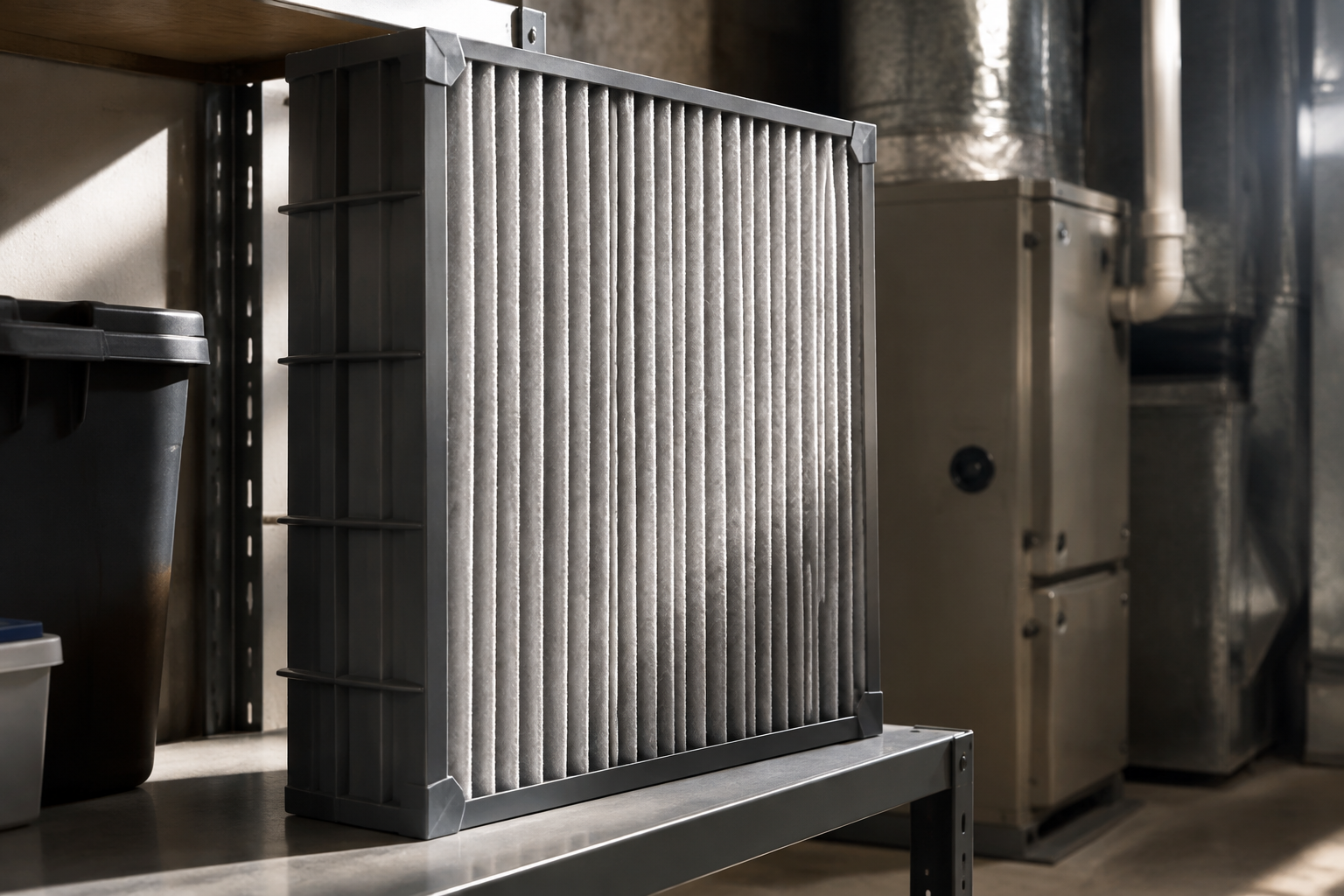
Case 1 — your system shipped with a media cabinet (Carrier/Trane/Lennox/Goodman/AprilAire boxes bolted to the air handler): you already have a 4″–5″ system. Order OEM-numbered or cross-referenced cartridges (Honeywell FC100A, Lennox X6673 class parts — dimensions are cabinet-specific; see how to measure air filter size for the brand-exception table). Do not stuff 1″ filters in a media cabinet track.
Case 2 — you have a plain 1″ slot and want MERV 13+: the upgrade pencil can work. A 4″ media cabinet (AprilAire/Space-Gard-style or a generic) installs in the return duct for roughly $150–400 in parts, or a few hundred more with an HVAC tech (a job that takes a pro under two hours). It’s genuinely worth doing if you’re running MERV 11+ for allergies, pets, or smoke — the cabinet converts an airflow-straining 1″ MERV 13 into a 6–12-month, low-pressure cartridge. r/HVAC contractor consensus: worthwhile at MERV 11+, skip it if you’re happy at MERV 8.
Case 3 — you’re happy with MERV 8 and quarterly changes: stay at 1″. A 1″ MERV 8 changed on time does its job fine, and the five-year economics (below) only favor 4″ modestly at MERV 8. The upgrade is justified by MERV ambition or convenience, not by raw savings at low ratings.
One configuration note: a 4″ cabinet needs duct space on the return side — usually fine, occasionally awkward in tight closets or older horizontal attic runs. Measure (or have your tech measure) before ordering the cabinet.
The Five-Year Account (Where 4″ Wins the Money Argument)
Assume a normal household, MERV 11, buying mid-tier cartridges:
| 1″ MERV 11 quarterly | 4″ MERV 11 (with cabinet amortized) | |
|---|---|---|
| Cartridges / 5 yr | 20 × $10 = $200 | 8 × $25 = $200 (+$250 one-time cabinet ÷ 5 = $50/yr) |
| Blower energy penalty | running ~0.1–0.2 in. WC higher average resistance — a few dollars a month in season | lower average resistance |
| Change labor | 20 swaps | 8 swaps |
| Failure modes from overdue filters | 20 opportunities to forget | 8 |
At MERV 8 the 1″ setup stays roughly cost-neutral. At MERV 13 the 4″ wins outright: a 1″ MERV 13 needs 45–60-day changes to avoid pressure trouble ($250–330 over five years in cartridges alone, with coil-risk if you slip), while the 4″ MERV 13 runs its full 6–12 months at half the pressure. The higher your filtration target, the more the 4-inch pays.
The 4″ Size Pages (and What People Actually Search)
If you already know your cabinet size, the size pages carry every MERV option with fit specs — the four-inch cluster is where the media-cabinet economics above become a shopping list:
- 20×25×4 — the flagship 4″ size (~6,600 searches/mo; MERV 11 is its most-demanded grade)
- 16×25×4 (~2,900/mo — Honeywell FC100A-family territory; order by part number)
- 20×20×4 (~2,400/mo)
For everything else, the filter finder maps your measurement to nominal size and grade. And whichever thickness you land on: the day the new filter seats is the day its clock starts — 90 days for a 1″, six months to a year for media. The Home Filter Calendar tracks both, which matters more at 4″ intervals, because “when did I last change it” is a lot harder to remember at month nine than at month two.
ClearFit cuts the same 16x20x1 MERV 8 pleated media to OEM specifications – the 16x20x1 MERV 8 replacement filter, sized to confirm against your old filter before ordering.
FAQ
Is a 4-inch filter better than a 1-inch?
At the same MERV, yes — 4–6× the media area means longer life, lower static pressure, and gentler treatment of the blower. But “better” is conditional: in a 1″ slot, a 4″ filter doesn’t fit without a media cabinet retrofit, and at MERV 8 the performance gain doesn’t justify the hardware. The 4″ advantage becomes decisive at MERV 11+.
Are 1-inch and 4-inch furnace filters interchangeable?
No — they need different slots. A 4″ (or 5″) media cartridge requires a media cabinet on the return side; a 1″ filter slides into a standard 1″ track. Stacking 1″ filters to simulate depth doubles pressure drop and is not a substitute.
How long does a 4-inch furnace filter really last?
6–9 months at MERV 8–11 in a normal household; 9–12 months for 5″ cartridges and light-load homes. Heavy pet load, wildfire smoke, or near-continuous blower runtime can halve it — inspect quarterly even when the calendar says the cartridge has time left.
Can I put a 4-inch filter on a 1-inch slot?
Not directly — the retrofit is a media cabinet ($150–400 parts) installed in the return duct. It’s worth it if you want MERV 11+ without the 1″ pressure penalty; skip it if MERV 8 on a 90-day cadence meets your needs.
Why is my 4-inch filter more expensive than four 1-inch filters?
Per cartridge, yes — but per year it’s typically cheaper: one $25 cartridge versus 4–6 × $10, plus lower average blower resistance. The 4″ pricing rewards are volume and interval, not sticker price.
Sources & References
- ASHRAE 52.2-2017 — media velocity and pressure-drop behavior basis. Official documentation (inference: applied calculation from standard principles).
- ACCA Manual J/Q / blower design practice — 0.50 in. WC TESP budget convention. Industry convention (explicit).
- OEM media-cabinet literature (AprilAire, Honeywell, Carrier, Lennox) — cabinet pricing bands and cartridge intervals. Official documentation (explicit range).
- r/HVAC media-cabinet threads — contractor retrofit consensus at MERV 11+. Community discussion (paraphrased).
- DataForSEO search-volume pull (2026-08-19) — 4″ size-cluster demand figures. API data (explicit).
Related Guides
- How Often to Change Your HVAC Filter — the interval science this page builds on.
- MERV Rating Explained — the rating scale before you pick a grade.
- How to Measure Your Air Filter Size — cabinet-specific sizing exceptions.
- Best HVAC Filter for Allergies — the use-case where 4″ earns its keep.