Where Is My Furnace Filter? Location by System Type and Brand (Five Places, One Checklist)


Your furnace filter is in one of five places, and the system type picks it: a return-air wall grille (the big vent that sucks — check there first, it’s the #1 hiding spot), the furnace’s lower cabinet (upflow units), the furnace top or side (horizontal attic/crawlspace units), inside the air handler (heat pump and condo systems), or at the blower compartment door itself on older downflow units. If you’ve checked the furnace and found nothing, you have a wall-grille system — half the confusion in this search is people looking for a filter at the furnace when their house filters at the return.
Reddit’s r/HomeMaintenance gets this question weekly from new homeowners, and the recurring detail is the same: they found the furnace, opened the obvious panel, saw no slot, and concluded their house has no filter (it does — two rooms away, behind a grille that looks exactly like a supply vent). The giveaway is physics: a return grille pulls paper to it when the blower runs; a supply vent pushes. Hold a tissue at the vent — thirty seconds, no tools, and you know which half of the air circuit you’re standing at.
Top Picks at a Glance (2026)
Found the slot — the cartridge decision is nominal size plus MERV tier. The three picks that settle both in one order:
| Pick | Product | Why it wins |
|---|---|---|
| Best overall | 16x20x1 MERV 8 pleated | The most common nominal size at the baseline tier; 90-day rated life, lowest static of the ladder. |
| Best for pet households | 20x20x1 MERV 11 pleated | Spec sheet lists pet dander, mold spores and pollen; the tier most cat-and-dog homes land on. |
| Best for smoke season | 16x20x1 MERV 13 pleated | Fine-particle tier for wildfire weeks; swap it in for the season and shorten the change window toward 60 days. |
Quick Answer: The Five Locations by System Type
| System type | Filter location | How to recognize it |
|---|---|---|
| Central furnace + ducted returns | Return-air wall/ceiling grille | Large grille, often centrally located; tissue gets pulled toward it |
| Upflow furnace (most basements) | Lower front cabinet, behind a removable panel or hinged door | Slot at the blower intake, below the burners |
| Horizontal furnace (attic/crawl) | End or top of the cabinet, sometimes in an external rack | Arrow markings on the housing; power off before reaching in |
| Heat pump / air handler (no furnace) | Inside the AHU, usually behind a side access panel | Filter slot at the return side of the internal blower |
| Older downflow / package units | At or behind the blower door, sometimes a filter rack at the duct connection | Check both the unit door and the adjoining duct collar |
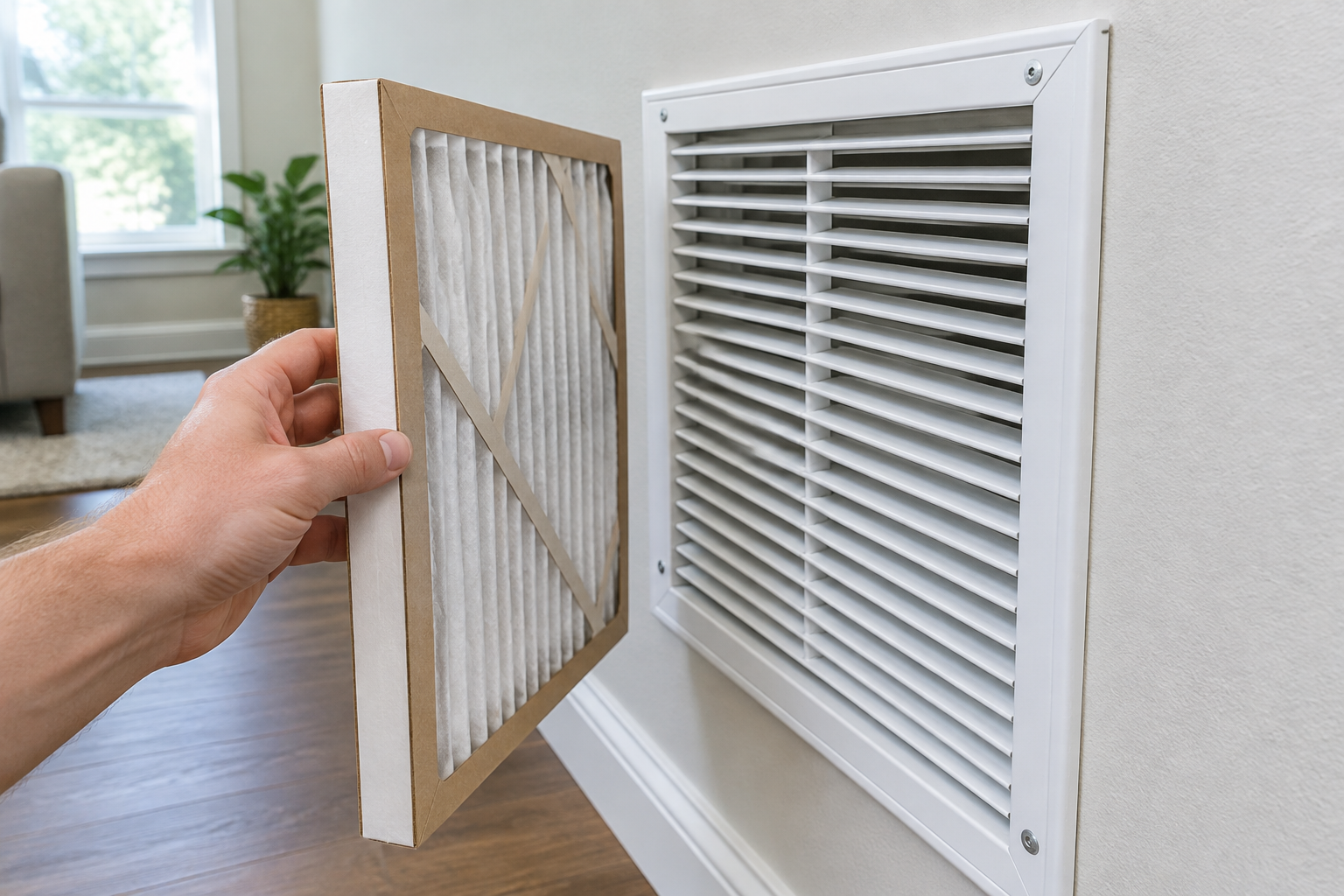
Two-filter warning before you order replacements: zoned homes and homes with both a furnace and a separate air handler frequently have two filters in two sizes. Count yours before buying a multipack.
ClearFit cuts the same 16x20x1 MERV 8 pleated media to OEM specifications – the 16x20x1 MERV 8 replacement filter, sized to confirm against your old filter before ordering.
The Tissue Test (Find the Return in 30 Seconds)
Every ducted house has two vent populations: returns (air going in to be heated/cooled and filtered) and supplies (conditioned air coming out). The filter lives at a return. To tell them apart with the blower running:
- Hold a tissue or strip of toilet paper flat against the grille.
- Pulled against the grille and held there = return. Open it (usually wing nuts, latches, or hidden clips) — the filter sits behind, or slides in from a slot on the side or top of the frame.
- Blown away from the grille = supply. No filter here, ever; don’t disassemble supply registers looking for one.
Large central returns (a 20×25 grille in a hallway ceiling is the classic) are the most common single filter location in US homes, which is why “I checked the furnace and there’s no filter” is such a common report: the filter isn’t at the machine.
At the Unit: Reading the Cabinet by Type
Upflow basement furnace (the most traditional setup): the filter sits at the bottom of the cabinet, where return ducts enter below the blower. Look for a sheet-metal panel or hinged door below the burner compartment — the slot is behind it, filter standing on edge with the airflow arrow pointing up, toward the blower. Some upflows instead filter at an external rack where the return duct meets the cabinet — the slot will be visible as a horizontal opening in the sheet metal collar.
Horizontal attic or crawlspace unit: filters load from the end face or top of the cabinet. The discipline here is safety-first: attic units mean off-balance reaches over the unit or between rafters — kill the breaker (and the attic light switch if it’s on the same circuit) before your hands go in, and if the slot requires kneeling on the unit, don’t; get a platform. Attic slots are also where sizing mistakes happen, because the cartridge often sits in a rack whose label has faded — measure the old one (how to measure) rather than trusting the rack.
Heat pump / air handler (no furnace — common in condos, the South, and all-electric homes): the “furnace filter” nomenclature misleads here, because there is no furnace. The filter is inside the air handler, typically behind a panel on the return side. If your thermostat says heat pump and you’ve been searching for a furnace filter — the AHU panel is your location. (Whether a heat pump system’s filter is “the same thing” as a furnace filter: yes — the naming explained.)
Brand Quick Reference (Where Each Maker Usually Puts It)
Slots vary by installation more than by brand — the installing contractor often adds or omits an external filter rack — but the manufacturer defaults:
- Goodman / Amana: lower front cabinet on upflow units; door drops or lifts off. The single most common DIY-friendly arrangement.
- Carrier / Bryant: blower compartment door on upflows — the filter stands just inside; some models use a side rack at the return duct entry.
- Trane / American Standard: return-side rack or cabinet slot; on air handlers, behind the left or right access panel.
- Lennox: cabinet slot on upflows, often with a hinged media-cabinet option on newer high-efficiency systems (the 4–5″ cartridges — see the media cabinet change guide for the Aprilaire-class equivalent).
- Older houses, any brand: no manufacturer slot at all — see below.
Treat these as search-order hints, not gospel; the unit’s installation manual (find it by the model number on the nameplate inside the burner or blower compartment) is definitive.
“There’s No Filter Slot At All” (Older Homes, and the Fix)
Some older gravity-hot-air and early forced-air houses genuinely have no filter slot anywhere — the system was built unfiltered, decades before filtration became standard. The retrofit is cheap and worth doing (an unfiltered blower and heat exchanger collect exactly the dust you’d rather capture):
- Return-grille filter frames ($15–40 at any home store): a shallow frame that mounts behind an existing large return grille and holds a standard 1″ filter. The grille depth needs ~1″ of clearance behind it — most central returns have it.
- Duct-collar filter racks (sheet-metal collar with an internal slot, installed by an HVAC tech in under an hour): the right answer when returns are too shallow or too numerous.
- What not to do: don’t wedge a filter loosely inside a grille without a frame — an unsecured filter can pull into the blower. The frame isn’t optional hardware; it’s the retention system.
FAQ
My furnace doesn’t have a filter slot. What should I do?
Either the filter lives elsewhere (a return-air wall grille — run the tissue test in the section above; this is the most common answer) or the system genuinely predates filtration and needs a retrofit (return-grille frame or duct-collar rack, $15–40 plus optionally an hour of tech time). Running a system with no filter at all sends every ounce of household dust through the blower wheel and heat exchanger — the long-term cost lands in what happens when filters are neglected.
How do I know if my furnace filter is clogged?
Visual: gray felt through the media and dust bridges across the pleat valleys (the grading guide with levels). Performance: weak airflow from supply registers, longer heating/cooling cycles, more blower noise. Either signal is sufficient — and if you can’t remember the last change, that fact alone qualifies.
Does every furnace have a filter on it?
Every ducted system should, but not every system filters at the furnace — roughly half of US homes filter at a remote return grille instead, and some very old systems were built with no slot anywhere. If there’s no slot at the unit and no large return grille in the living space, check the air handler (heat pumps) and the duct collar before concluding anything is missing.
Why can’t I find my air filter in my house?
Because you’re looking at supply vents. The filter sits in the return path — the grille that sucks. Run the tissue test: paper pulled toward a grille marks the return; behind that grille (or in a slot at its frame) is the filter. In homes with multiple returns, the filter is usually at the largest, most central one; smaller perimeter returns are often unfiltered by design.
Sources & References
- Retailer catalog installation data (Goodman/Carrier/Trane/Lennox default slot placements). Official documentation (explicit; model-level differences per manual).
- PNNL building-science guidance on return-side filtration — return-grille filtering as a standard retrofit. Official documentation (explicit).
- r/HomeMaintenance new-homeowner threads — the checked-the-furnace-found-nothing pattern. Community discussion (paraphrased).
Related Guides
- How to Measure an Air Filter — the next step after finding the slot.
- Furnace Filter Sizes Chart — ordering the right cartridge.
- How to Change a Furnace Filter — the swap itself.
Find your filter: All HVAC filter sizes