Does Medicare Cover CPAP Supplies? The Coverage Path, the Timelines, and What’s Left to Pay

Yes — Medicare Part B covers CPAP therapy and its replacement supplies as durable medical equipment (DME) when three conditions hold: a doctor’s prescription, a qualifying sleep study diagnosing obstructive sleep apnea, and an enrolled Medicare supplier (you pay 20% coinsurance after the Part B deductible, and the equipment runs a 13-month rental-to-ownership track for the machine). The path has gates: a 3-month initial compliance period requiring ≥4 hours of use on ≥70% of nights across a 30-day window, a follow-up visit, and then — after month 13 — recurring supplies (filters, tubing, masks, water chambers) that Medicare allows on its own replacement frequency schedule, which varies by item and by plan administration. ResMed’s own consumer guidance puts it plainly: “different insurers cover different replacement schedules, so talk to your provider.” This page walks the whole timeline and prices the self-pay alternative. Supplies themselves: CPAP replacement parts →.
Quick Answer: Yes, under Part B as DME with prescription + sleep study + enrolled supplier. The machine rents for 13 months then becomes yours; during the first 90 days you must prove adherence (4+ hours/night on 70% of nights over 30 days). After ownership, replacement supplies are covered on Medicare’s allowed frequency (roughly monthly filters, quarterly masks/tubing — confirm with your supplier). You pay 20% coinsurance after deductible. Medicare Advantage plans apply their own supplier networks and rules.
| Phase | What happens | What you should do |
|---|---|---|
| Diagnosis & Rx | Sleep study (lab or home test) confirms OSA; doctor prescribes CPAP | Keep the study report — suppliers need it |
| Months 0–3 | Machine + mask rent via supplier; adherence window opens | Use ≥4 h on ≥70% of nights (30-day window); schedule the 90-day follow-up visit |
| ~Month 4 | Compliance check; coverage continues | Doctor documents benefit in the follow-up visit |
| Months 4–13 | Rental continues | Replace initial mask parts if needed (allowed) |
| Month 13 | Rental-to-ownership: the machine is yours | Title transfers; keep usage steady — benefit is established |
| After 13 | Recurring supplies on Medicare’s allowed frequencies | Order through your supplier; track schedules (see the replacement table) |
This page is general information about insurance rules, not legal, billing, or medical advice. Coverage details vary by plan, state, and supplier contract — confirm specifics with Medicare (1-800-MEDICARE), your plan, and your DME supplier before making decisions.
The most common failure mode in this whole pathway isn’t money — it’s paperwork and the compliance window. New users who aren’t told about the 4-hour/70% rule sometimes use the machine sporadically for two months, fail the window, and lose coverage for a device they were just starting to tolerate. Everything on this page is in service of not being that person: know the gates, clear them, then let the replacement schedule run.
What Medicare Actually Covers, Item by Item

The machine and its essentials. The CPAP device, humidifier, and initial mask setup are covered as a rental bundle under DME billing codes (HCPCS: E0601 for the base CPAP device). Heated humidifiers and tubing bill under their own codes; suppliers assemble the covered set.
Replacement supplies after ownership follow Medicare’s allowed replacement frequencies — commonly understood as roughly: filters ~monthly (disposable fine filters; hypoallergenic variants have their own code), mask cushions and tubing ~every 3 months, mask systems and headgear ~every 6 months, water chambers ~every 6 months. Two honest caveats: exact allowed frequencies sit in supplier billing schedules and shift with plan administration (Original Medicare vs Advantage), and “allowed frequency” means you may receive one at that interval at covered cost — not that the supplier auto-ships. Ask your supplier for the schedule they bill against; ResMed’s consumer pages defer to exactly this (“check with your provider”).
What Medicare does not cover here: machines without the OSA diagnosis (plain snoring is not a coverage indication — that’s a clinical determination, not a purchase opinion), machines from non-enrolled suppliers (the coverage falls apart), and typically ozone/UV “cleaning” devices, which bill as convenience items and carry an FDA safety communication — soap and vinegar remain the covered-grade answer (cleaning guide →).
Medicare Advantage Changes the Rules
If you’re on a Medicare Advantage plan, the same therapy is covered but through the plan’s rules: network-locked DME suppliers (out-of-network may not be covered at all), prior authorization steps for equipment, and plan-specific replacement schedules that can be stricter or more generous than Original Medicare’s. Before ordering anything on an Advantage plan, the two questions for the plan’s line: which suppliers are in-network for DME, and what replacement frequency does the plan authorize for filters/masks/tubing. The 4-hour/70% adherence gate applies across plan types.
The Self-Pay Math (What Supplies Cost Without Anyone’s Help)
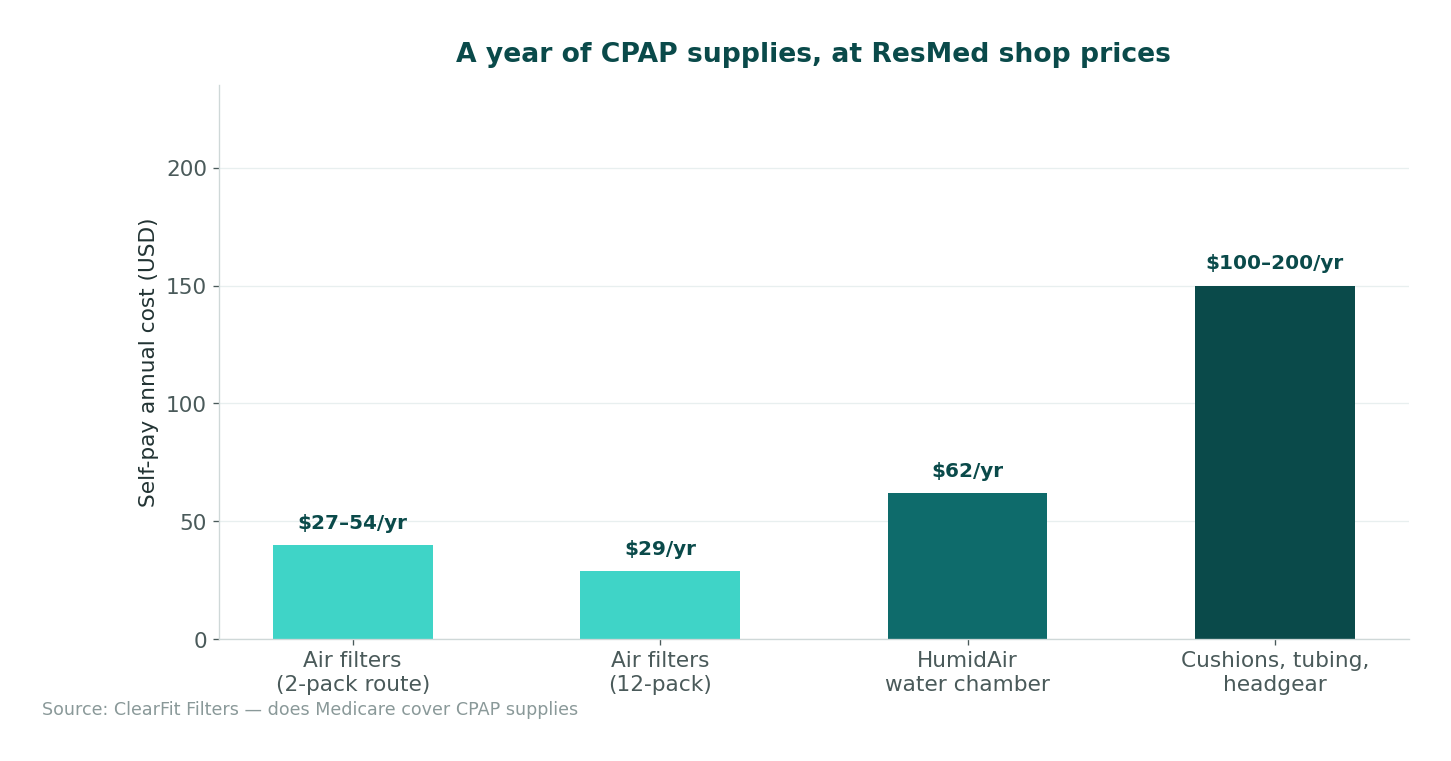
For context — and for the population whose plans don’t cover resupply, or who prefer buying their own — the official shelf prices anchor the whole market:
| Item | Official price (ResMed shop) | Typical replace | Self-pay annual |
|---|---|---|---|
| Standard air filters, 2-pack | $9.00 (SKU 39301) | 1–2 months | $27–54 |
| Standard air filters, 12-pack | $29.00 (SKU 39302) | — | $29 (year sorted) |
| HumidAir water chamber (AS11/AC11) | $31.00 (SKU 39100) | ~6 months | $62 |
| Mask cushions, tubing, headgear | varies by mask family | 3–6 months | ~$100–200 |
A realistic all-in self-pay year for a diligent replacer runs roughly $150–300 depending on mask family. Compare against the 20% coinsurance on covered supplies plus supplier scheduling friction, and many covered users still choose cash for filters (a $29 12-pack from ResMed’s own shop undercuts most copay stacks for the year).
HSA/FSA note: CPAP supplies are generally HSA/FSA-eligible expenses (the therapy is physician-prescribed) — that includes filters, chambers, tubing, masks bought out-of-pocket. Keep receipts and the prescription on file.
FAQ
How often can you get CPAP supplies on Medicare?
On the commonly billed schedule: disposable filters about monthly, mask cushions and tubing about every 3 months, complete mask systems and headgear and water chambers about every 6 months — administered by your DME supplier and confirmed against your specific plan. “Allowed” is a ceiling, not an automatic shipment: you or your supplier initiate each order. ResMed’s own consumer guidance: insurers differ; ask your provider for the schedule they bill.
What are the four things Medicare doesn’t cover?
The classic list (hearing aids, dental, routine vision, long-term custodial care) rarely changes — and none of those is CPAP; CPAP is covered when diagnosed and compliant. In the CPAP lane, the practical non-coverage list is: equipment from non-enrolled suppliers, machines absent an OSA diagnosis, and cleaning gadgets (ozone/UV devices — convenience items, with an FDA safety communication attached). Coverage-adjacent surprise: some users hit it on replacement timing — ordering before the allowed frequency means self-pay for that item.
How do I get Medicare to pay for CPAP supplies?
Four steps in order: (1) diagnosed via qualifying sleep study and prescribed; (2) get equipment from a Medicare-enrolled DME supplier (ask before signing anything); (3) clear the adherence window — ≥4 hours/night, ≥70% of nights, 30-day span in the first 90 days, plus a follow-up doctor visit; (4) after month 13’s ownership transfer, order replacement supplies through the same enrolled supplier on the allowed frequencies. Miss a step and the payment path is what breaks, not the therapy.
Why do so many people quit CPAP?
The studied pattern: early discomfort (mask fit, pressure sensation, air leaks) drives mask-off nights in the first weeks — exactly the window coverage rules watch. Replacing mask parts on schedule and tuning comfort settings (EPR, ramp, humidity — settings guide →) address the mechanical side of that dropout curve; persistent trouble is a provider-visit item. This page covers the insurance mechanics; therapy decisions belong with your clinician.
Sources & References
- Medicare.gov — CPAP therapy coverage page (SERP #1 for this query) — Part B/DME basis, 3-month trial, 13-month rental, adherence requirement. Official documentation.
- ResMed “Replacing CPAP supplies and equipment” — “different insurers cover different replacement schedules” guidance. Official documentation (verified 2026-08-21).
- ResMed eshop (verified 2026-08-21) — filter 2-pack $9 / 12-pack $29 / Air11 chamber $31. Official documentation.
- Benjafield A et al., AJRCCM 2018;197 — resupply-and-adherence context (dropout PAA). Peer-reviewed literature.
- US FDA (2021) — ozone/UV cleaner safety communication (non-coverage rationale). Official documentation.
- SERP top-10 cross-reference: medicare.gov, uhc.com, sleepapnea.org, humana.com, gohealth.com, sleepfoundation.org, wellcare.com (DataForSEO live SERP, US/2840, 2026-08-21). PAA questions: 4/4 incorporated.
- Disclaimer: General insurance information only — not legal, billing, or medical advice; verify with Medicare, your plan, and your supplier. Coverage rules change; page content checked 2026-08.