What Happens If You Never Change Your Air Filter (a Timeline of the Damage, in Order of Arrival)

Skip filter changes and the damage arrives in a fixed order: airflow efficiency drops first (weeks 4–12), then the blower works harder and your electric bill climbs 5–15%, then the evaporator coil freezes or the heat exchanger overheats — a $1,500–3,000 repair — and in the end-stage cases the caked filter gets sucked into the blower wheel itself. The filter you “saved” $15 on costs you a coil. This page is about home HVAC systems (furnaces, air handlers, central AC) — car engine air filters have their own failure logic and their own articles.
The never-change filter question has a natural home on forums, and the forum answer is usually a horror photo: a filter caked solid, a blower wheel felted gray, an ice-covered coil in July. Those photos are the end of a sequence, not a sudden event. Every stage below announces itself — softer register airflow, longer run times, a warmer-than-usual furnace closet — if you know what to listen for. The expensive versions of this story all share one feature: nobody looked.
Quick Answer: The Failure Timeline


| Time past due | What’s happening inside | What you notice | Cost if it stops here |
|---|---|---|---|
| Weeks 1–4 | Media loading; capture efficiency still fine, static pressure creeping | Nothing | $0 — change it |
| Weeks 4–8 | Static pressure climbing; airflow per register falling | Vents feel softer; rooms heat/cool slower | $0–15 — change it |
| Weeks 8–12 | Blower compensating (ECM ramps up, PSC slows); energy use up 5–15% (DOE’s range for clogged-filter operation) | Higher bill; longer cycles | $15 filter + a month of waste |
| Months 3–6 | Evaporator coil starving → icing in AC mode; heat exchanger running hot in heat mode; drain pan overflow when ice melts | “AC not cooling” call; water near the unit | $150–400 coil clean / $150–300 service visit |
| Months 6–12+ | Heat exchanger stress accumulation (crack risk: $1,500–3,000); compressor strain ($2,000+); filter cake can deform and pull into the blower | The big repair bill | $1,500–8,000 |
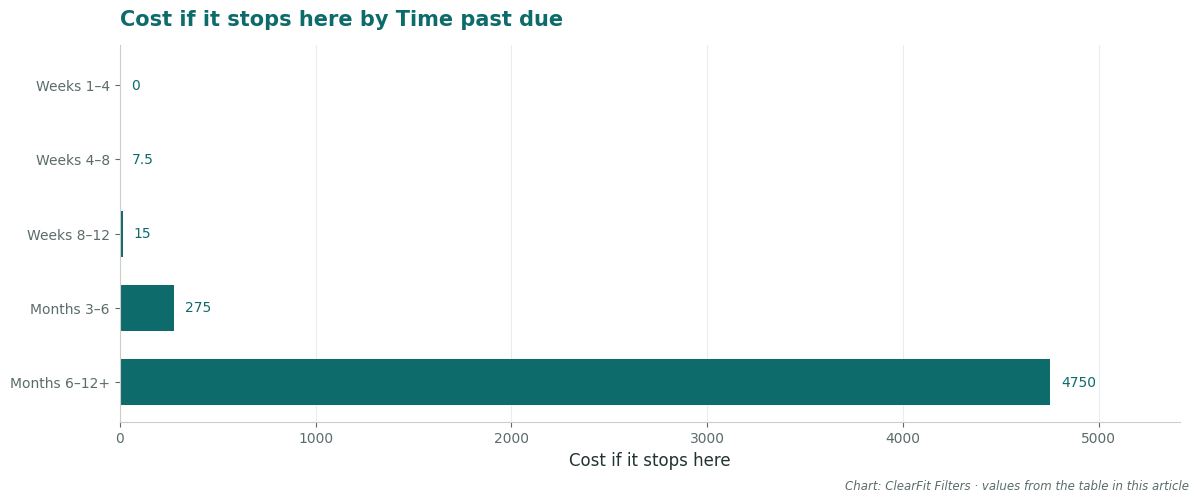
The table’s grammar: every row’s damage is preventable by the previous row’s fix. This is the cheapest-to-most-expensive ladder in home maintenance.
ClearFit cuts the same 16x20x1 MERV 8 pleated media to OEM specifications – the 16x20x1 MERV 8 replacement filter, sized to confirm against your old filter before ordering.
The Physics of Each Stage (Why This Order, Not Another)
Stage 1–2: the loading curve. Filter pressure drop doesn’t rise linearly with dust — it’s flat for the first stretch (media has spare capacity), then bends upward sharply as the media packs. That bend is why “it was fine last month” is true and useless: by the time airflow feels wrong, the curve is already steep.
Stage 3: the energy bill. Two mechanisms, one bill. A PSC (permanent split capacitor) blower — the standard motor in older systems — slows against the resistance, moving less air per watt, so cycles lengthen. An ECM (variable-speed) motor — newer systems — holds airflow by ramping harder, drawing more amps and running hotter. Either way, DOE’s finding covers the outcome: a clogged filter can waste 5–15% of the system’s energy consumption, every billing cycle it persists. On a $200 summer power bill, that’s $10–30 a month the filter is quietly adding.
Stage 4: the coil and the exchanger. In cooling mode, an air-starved evaporator runs below freezing; humidity freezes on it; ice insulates it further, airflow drops more — the death spiral ends with a block of ice and a liquid-flooded compressor. In heating mode, the mirrored failure: a heat exchanger designed to shed heat into moving air instead soaks in it; repeated over-temperature cycles fatigue the metal until it cracks — and a cracked exchanger is a carbon-monoxide path, which is the only line in this article that upgrades “expensive” to “dangerous.”
Stage 5: the exotic failures. The r/HVAC photo gallery: a filter so loaded the cardboard frame bows and the media cake gets drawn into the blower wheel (blower cleaning/replacement, $200–600); return-side ducts collapsing inward under suction on flexible duct systems; and the quiet one — bypass. A badly loaded filter in a slightly loose slot lets air squeeze around the frame, running the system unfiltered exactly when the filter looks most impressive.
The Honest Counterweight: What Does NOT Happen
The internet’s scarier versions oversell a few things. A filter left in place does not “release all the dust back” in any meaningful quantity — loaded media holds its cake; that’s why it’s heavy when you pull it. One missed change does not break anything. Even three months overdue in a pet-free, mild-climate home often costs nothing but some efficiency. The damage economics are cumulative and load-dependent, not instant — which cuts both ways: nothing happens fast, so skipping feels free, and everything above happens eventually, so skipping isn’t free.
The actual risk profile by household: pet homes and high-runtime climates (Gulf Coast summers, desert Southwest) travel the table in months; single-occupant mild-climate homes can take a year to clear stage 3. Your position on that spectrum sets how paranoid to be about the date on the frame.
The Cheap Exit From the Whole Ladder
The entire timeline above is preventable at the cost of a quarterly filter and a reminder system. The base schedule: 1″ pleated every 90 days (60 with pets, 30 for fiberglass, 45–60 for 1″ MERV 13); 4″–5″ media every 6–12 months; wildfire smoke events loading filters 3–5× faster. The full interval science — pleat-area physics, the six household variables, the runtime-hour method — is in how often to change your HVAC filter.
The layer that actually fails in most homes is not knowledge but memory: people don’t skip filters out of philosophy, they skip them out of Tuesdays. Write the date on the frame edge when you install, and put the reminder somewhere that reaches you — the Home Filter Calendar tracks every filter in the house (HVAC, fridge water, pool, RO) with email/SMS reminders and one-click reorder, so the ladder above stops at row one where it belongs.
FAQ
Can a dirty furnace filter cause no heat?
Yes — it’s one of the most common “furnace won’t fire” causes that isn’t the furnace. A loaded filter chokes airflow until the heat exchanger overheats and the high-limit switch trips, which shuts the burners off as a safety measure. The furnace cycles: ignites, runs a few minutes, shuts down, repeats — or locks out entirely. Before assuming a control-board failure on a furnace that runs but won’t stay running, pull the filter. (The AC-side twin: does a dirty AC filter affect cooling? Same mechanism, mirrored — the starved coil ices over and cooling capacity collapses, row four of the timeline.)
Can a dirty air filter make you sick?
Not the way the scary posts claim — a loaded filter doesn’t “grow” illness or dump captured dust back in meaningful amounts. The real health pathway is indirect: a clogged filter that’s also bypassing (air squeezing around a loose, overloaded frame) or a filter removed and never replaced means unfiltered air reaches the coil, the ducts, and the rooms — more dust, more allergen exposure, more symptoms for allergy and asthma households. And the neglected-filter failure chain does end somewhere dangerous: a cracked heat exchanger is a carbon-monoxide path. The honest framing: a fresh filter is health-adjacent maintenance, not medicine.
What happens if you don’t change your air filter?
Airflow drops, blower energy use rises 5–15% (DOE), the evaporator coil eventually ices (AC) or the heat exchanger overheats (heat), and long-term neglect ends in $1,500–3,000 repairs — or the caked filter pulling into the blower. The damage is cumulative and order-of-arrival is predictable; the timeline table above maps it.
Does a dirty air filter really cost more on the electric bill?
Yes — 5–15% higher HVAC energy use is the Department of Energy’s range for clogged-filter operation. The mechanism differs by motor type (PSC moves less air, ECM draws more amps), but the bill direction is the same, every month the filter stays in.
Can a dirty air filter damage the furnace or AC?
It can damage both, indirectly but expensively: starved airflow ices the evaporator coil (compressor strain) in cooling mode and overheats the heat exchanger in heating mode — the latter can crack, creating a carbon-monoxide path. The filter itself is never the broken part; everything downstream of the airflow is.
How long can you go without changing an air filter?
The safe ceiling is your filter’s rated interval: 90 days for a 1″ pleated filter in a light-load home, less with pets or heavy runtime. Physically, filters last longer — months overdue before hard failure — but you’re spending the grace period paying 5–15% energy penalties and accumulating coil/exchanger stress.
Is this about car air filters too?
No — this page covers home HVAC systems. Car engine filters restrict intake airflow (performance/fuel economy, then engine protection), a different mechanism with different timelines. Search “engine air filter” for that ladder.
Sources & References
- U.S. Department of Energy / Energy.gov — 5–15% energy penalty for clogged filters. Official documentation (explicit).
- ACCA / OEM service literature — coil-icing sequences, heat-exchanger over-temperature cracking, TESP budget. Industry convention (explicit).
- r/HVAC neglect-thread photos & tech commentary — blower-felted and filter-sucked-in end states; drain-pan overflows. Community discussion (paraphrased).
- Repair cost ranges (coil clean, service visits, heat exchanger replacement) — typical US market bands. Inference (range estimate).
Related Guides
- How Often to Change Your HVAC Filter — the schedule that prevents all of this.
- How to Change a Furnace Filter — the five-minute fix.
- Best HVAC Filter for Wildfire Smoke — when the timeline compresses to weeks.
- What Happens If You Don’t Change Your Fridge Filter — the water-side version.
Shop this guide: All HVAC filter sizes