Purified vs Distilled vs Filtered Water: Which One Comes Out of Your Filter

These three words are not quality tiers of the same thing — they describe different processes with different endpoints — and the one that matters to you is determined by what’s at the end of your faucet. The short version: filtered water has had specific contaminants selected out (chlorine, particulate, and — depending on the filter — lead and cysts); purified water has been processed to a high total purity standard (the common commercial benchmark is ≤10 ppm TDS, meaning the process removed essentially all dissolved solids, not just selected ones); distilled water is purified by one specific process — boiling and recondensing — and is the mineral-free water that appliances and formulas actually require. Now the part no water-treatment explainer on this search tells you, because none of them sell refrigerator filters: what comes out of your refrigerator’s dispenser is filtered water in the aesthetic sense (NSF 42-class: taste, odor, chlorine), not purified water — and for daily drinking, that is usually exactly what you want. Whether it’s enough depends on your local water report, which this page helps you check.
The Definitions, Precisely


| Filtered | Purified | Distilled | |
|---|---|---|---|
| What it means | Selected contaminants reduced by mechanical/adsorptive media | High-purity water per a measurable standard (commonly ≤10 ppm TDS in bottled-water practice, per USP/EPA-derived benchmarks) | Purity achieved by phase change: boil, recondense |
| Process | Carbon adsorption, sediment media, (RO where present) | RO, distillation, deionization — often in series | Distillation specifically |
| Minerals (TDS) | Mostly retained (carbon doesn’t remove dissolved minerals) | Removed almost entirely | Removed almost entirely |
| Regulatory anchor | NSF/ANSI 42 & 53 claims (point-of-use performance) | FDA bottled-water standards; USP purified-water monograph | FDA bottled-water standard of identity for “distilled” |
| Typical use | Daily drinking, cooking | Formulas, labs, irons/CPAP where low-TDS is required | Same, plus mineral-sensitive appliances |
Two definitional notes that prevent most confusion. First, distilled is purified — it’s one route to it, not a fourth category. Second, “purified” on a bottle is a process-and-measurement claim, not a safety claim: your tap water is already legally safe (utility-tested); purification changes its composition, mainly by removing dissolved minerals along with everything else.
The Process-to-Product Matrix (What Each Machine in Your Life Makes)
| Source | What it actually produces | Purity class |
|---|---|---|
| Refrigerator filter (carbon block) | Filtered water: chlorine, taste, odor reduced; particulate class reduced; lead/cysts only if that specific cartridge carries NSF 53 claims (the 42 vs 53 distinction) | Filtered (aesthetic-class) |
| Pitcher filter (Brita/Pur) | Same class as fridge — filtered, mostly aesthetic; lead claims only on specific models (Brita Longlast) | Filtered |
| Under-sink RO system | Purified: typically 90–95%+ of dissolved solids removed | Purified |
| Whole-house carbon | Filtered (scale: every tap, aesthetic + some chemical reduction) | Filtered |
| Water softener | Neither — it exchanges hardness minerals for sodium; TDS unchanged | Not in this taxonomy |
| Countertop distiller / store distilled | Distilled: near-zero TDS | Purified (distilled) |
| Bottled “purified” (Dasani, Aquafina) | Municipal water + RO/polish | Purified |
| Bottled “spring” | Source water, filtered minimally | Filtered |
The row that surprises people is the softener — and the row that matters to readers of this site is the first one, which deserves its own section.
What Your Refrigerator Filter Actually Produces (The Honest Answer)
A refrigerator cartridge is a compact carbon block — often with a fine sediment wrap — engineered for taste, odor, and chlorine at refrigerator flow rates. Its certification profile tells you its class: NSF/ANSI 42 (aesthetic) is the baseline claim almost every certified cartridge carries; NSF 53 (health effects) claims like lead, cysts, or specific VOCs are cartridge-specific and must be listed on the product’s data sheet. Certified to 42 only, your fridge makes filtered water in the strict sense: better-tasting, chlorine-reduced, particulate-class reduced. Certified to 42 + 53-lead, it makes filtered water with verified lead reduction — materially more valuable in a pre-1986 house. Neither version makes purified water: carbon adsorption does not remove most dissolved minerals, nitrates, or dissolved solids, because that requires a membrane (RO) or phase change. (Why the tiny cartridge can’t match an under-sink unit, physically: the contact-time explanation; the particle-size side: micron ratings explained.)
That’s not a knock. For the drinking-water job most households actually have — municipal water that meets utility standards but tastes of chlorine, plus targeted defense against plumbing-source lead — filtered-at-the-door is the right product class. Purified enters the picture when a specific use demands low-TDS water, which is the next section.
Who Actually Needs Which
- Infant formula: low-mineral water is the standard recommendation — distilled, or purified labeled ≤10 ppm TDS-class; check with your pediatrician on fluoride considerations (formula powder already carries its mineral load). Fridge-filtered is not the documented choice here — not because it’s unsafe, but because its mineral content is uncontrolled.
- CPAP humidifier chambers: distilled, full stop — tap or filtered water leaves mineral scale and supports microbial growth in the tank; that’s a maintenance-and-hygiene issue, not a drinking-safety one.
- Irons, humidifiers, lab/gardening niches: distilled (or RO-permeate) — same scale logic.
- Daily drinking and cooking (most people): filtered is sufficient and preferable — it keeps calcium/magnesium, tastes better than flat low-TDS water to most palates, and costs a fraction of purified. One diligence step upgrades it from “probably fine” to “checked”: read your utility’s annual Consumer Confidence Report for what’s actually in your supply (CCR reading guide), and if lead service lines or specific contaminants show up, choose a cartridge with the matching NSF 53 claim — or step to RO (comparison: RO vs pitcher vs fridge filter).
- Immunocompromised household (per CDC guidance context): the relevant upgrade is a NSF 53 cyst claim or boiling advisory compliance — not “purified” as such; cysts are a particulate-mechanical problem, and carbon-block cartridges with the cyst claim address it.
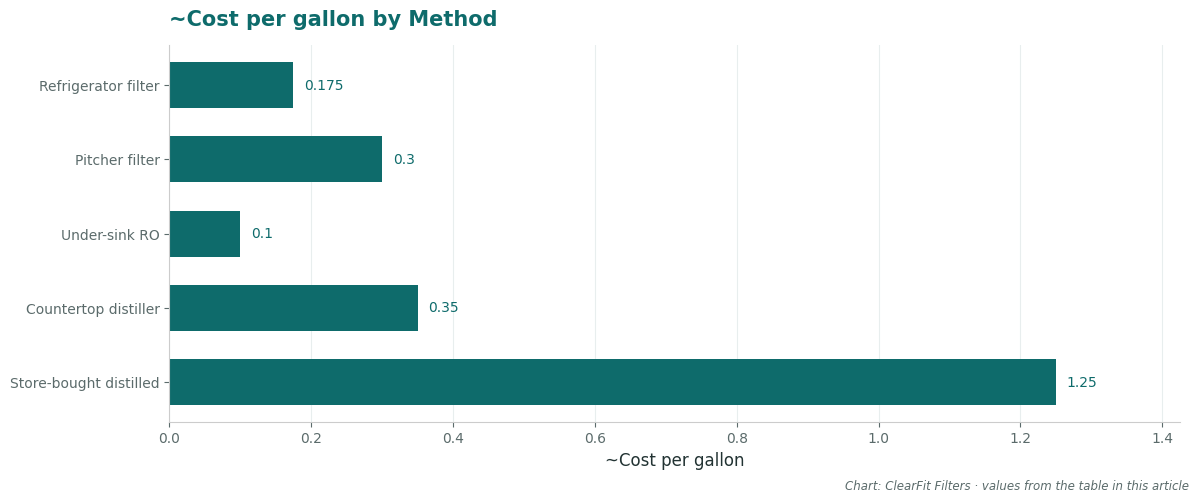
What Each Class Costs Per Gallon (Rough Math, US 2026)
| Method | ~Cost per gallon | Notes |
|---|---|---|
| Refrigerator filter | $0.10–0.25 | OEM cartridges $40–60/200–320 gal; certified generics cut this 60–75% |
| Pitcher filter | $0.20–0.40 | Brita Standard ~$7/40 gal; Longlast better |
| Under-sink RO | $0.05–0.15 lifetime amortized | Plus 3–5 gal waste water per gal made, membrane replacement |
| Countertop distiller | $0.30–0.40 electricity + unit | ~3–4 kWh/gal typical |
| Store-bought distilled | $1.00–1.50 | The convenience premium |
Price figures are typical US retail ranges as of August 2026 — cartridge pricing from our own category pages (current prices there), energy figures from typical distiller spec sheets. Verify current pricing before cost decisions.
The pattern: point-of-use filtering at the fridge is among the cheapest gallons you can make, and purified water from an owned RO system is cheaper lifetime than store distilled — the expensive option is buying purity by the bottle when a $0.15 machine-gallon exists.
FAQ
Is filtered water the same as purified water? No. Filtered water has had selected contaminants removed (chlorine, particulates, and any NSF 53-claimed contaminants like lead); purified water has been processed to remove nearly all dissolved solids (common bottled benchmark: ≤10 ppm TDS) — typically via RO or distillation. Filtered keeps its minerals; purified doesn’t. Both start from water that already meets utility safety standards.
Can I use filtered water instead of distilled? Depends on the use. For drinking: yes, filtered is the normal choice and distilled is unnecessary. For CPAP humidifiers, irons, and infant formula preparation: no — those uses need mineral-free (or verified low-TDS) water, and filtered water retains its dissolved minerals, which is precisely what scaling and formula-sterility guidance is about.
Is fridge water considered purified? No — refrigerator filter output is filtered water (NSF 42-class: chlorine, taste, odor, particulate), not purified. Carbon block media does not remove dissolved solids. Individual cartridges may add NSF 53 health-effect claims (lead, cysts), which makes the output better-filtered, but still not “purified” in the TDS-removal sense. Details: NSF 42 vs 53.
Which is healthiest: filtered, distilled, or purified? For daily drinking with municipal water: filtered — it reduces the contaminants that actually affect tap water while retaining beneficial minerals, and “more pure” isn’t healthier in itself (distilled/purified are process answers to specific uses, not superior drinking water). The health-positive move is matching claims to your local water report, not maximizing purity. With specific contaminant concerns (lead lines, PFAS, nitrates), the answer is the matching NSF 53/58 claim — see the CCR guide linked above.
Sources & References
- NSF/ANSI 42 & 53 — aesthetic vs health-effect claim structure.Official standard (explicit)
- FDA bottled water standards (21 CFR 165) — the “purified”/”distilled” standard names and TDS basis (purified commonly cites the USP water-purity basis of ≤10 ppm class).Official documentation (explicit + summarized)
- USP Purified Water monograph — the process-measurement definition of “purified”.Official standard (explicit)
- EPA/CDC drinking-water guidance background for immunocompromised populations (context for cyst claims/boil advisories).Official documentation (explicit context, not verbatim)
- Cost ranges — own category-page retail prices (2026-08) + typical distiller energy specs (3-4 kWh/gal typical).Own data + industry-typical (inference basis)
- SERP interpretation (culligan/healthline etc.) — DataForSEO 2026-08-21 (
_work_serp_terms.json).Competitor cross-check (verified live)
Related Guides
- NSF 42 vs NSF 53 Certification — the claim-level detail behind “what your fridge removes.”
- RO vs Pitcher vs Fridge Filter — the three-way comparison with full per-gallon costs.
- How to Read Your Water Quality Report (CCR) — the diligence step that decides whether filtered is enough.
- Can You Drink Distilled Water? — the single-question deep dive on distilled.
Full entry: TDS in water – the full entry