MERV 8 vs MERV 11: Which One Your HVAC Can Actually Handle

The choice between MERV 8 and MERV 11 is not an air-quality debate — it is a blower-motor question. One sentence: if your household has allergies, shedding pets, or fine-dust concerns and your system is newer than roughly 2015 or has a 4-inch cabinet, run MERV 11; if your system is an older single-speed (PSC) blower with a 1-inch slot and nobody has special air needs, run MERV 8 and replace it on time — the filtration difference is real but small next to the airflow risk, and the majority of “MERV 11 ruined my furnace” stories trace to a PSC blower that was never asked. The three-step check that settles which motor you have takes two minutes and is the fourth section of this page. (What MERV measures in the first place: MERV Rating Explained.)
Quick Decision Table


| Your situation | Buy |
|---|---|
| No allergies, no smoke exposure, any system | MERV 8 |
| Rental property / landlord buying in bulk | MERV 8 |
| Older furnace (10+ yrs), 1-inch slot, unknown motor | MERV 8 until you do the motor check below |
| Allergies or asthma, system newer than ~2015 | MERV 11 |
| 1–2 shedding pets, any newer system | MERV 11 |
| 4-inch or 5-inch media cabinet, any age | MERV 11 (no meaningful restriction penalty) |
| Urban / roadside address, visible dust load | MERV 11 |
The Three Differences That Matter (Quantified)
| MERV 8 | MERV 11 | What the gap means | |
|---|---|---|---|
| E1 (0.3–1 µm) minimum | — (no requirement) | ≥20% | MERV 11 is the first rating that addresses submicron allergen fragments; MERV 8 makes no promise there |
| E2 (1–3 µm) minimum | ≥20% | ≥65% | The bigger practical jump: fine dust and pollen fragments |
| E3 (3–10 µm) minimum | ≥70% | ≥85% | Both handle dander and spores; 11 does it somewhat better |
| Typical clean pressure drop (1″) | 0.10–0.15″ WG | 0.14–0.20″ WG | ~30–40% more resistance — the entire compatibility question lives here |
| Replacement interval | ~90 days | ~60–90 days | Denser media loads faster |
| Typical street price, 1″ pleated | $4–8/filter | $6–12/filter | A $2–4/filter gap; over a year, roughly $8–16 |
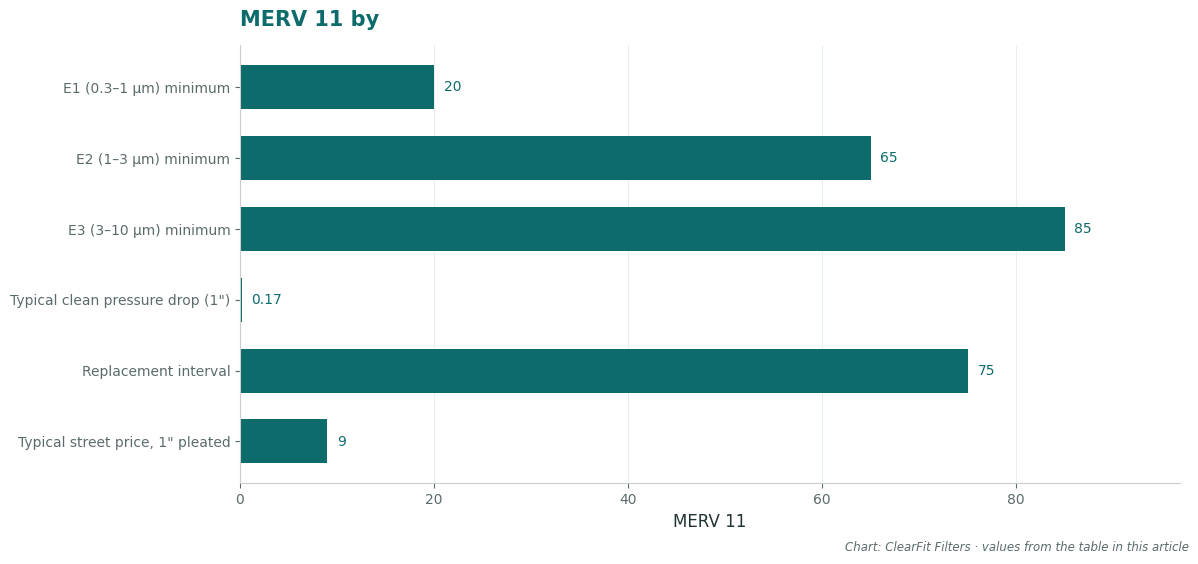
The efficiency numbers are ASHRAE 52.2 minimums; the pressure-drop numbers are typical manufacturer spec-sheet ranges for clean 1-inch pleated media (individual products vary; both climb as the filter loads). The price band is the common U.S. retail range for national-brand and quality-DTC 1-inch pleats — verify current pricing on the MERV 8 and MERV 11 collection pages.
What Actually Decides It: Your Blower Motor (3-Step Check)
The MERV 11 restriction risk is entirely a motor-type story. Here is how to identify yours without opening the blower compartment:
Step 1 — Age of the system. Manufactured before ~2010: overwhelmingly PSC. 2010–2015: mixed; high-efficiency models began shipping ECM. After ~2015: ECM increasingly standard, especially variable-speed and two-stage systems. Check the manufacture date on the condenser’s or furnace’s data plate (often encoded in the serial number; the plate itself usually prints it).
Step 2 — Listen to the startup. A PSC motor comes on at full speed with a distinct thump whoosh — one speed, one sound, every cycle. An ECM motor ramps: a soft spin-up over several seconds, and on two-stage/variable systems it often runs at a quiet low continuous hum. That gentle ramp is the sound of a motor that adjusts torque to hold airflow — the capability that makes MERV 11 a non-event.
Step 3 — Read the spec plate / model number. Google the furnace or air-handler model number plus “manual.” The installation manual states the rated external static pressure and, in most current manuals, the maximum filter MERV. If the manual caps a 1-inch slot at MERV 8, believe it regardless of motor type — the static budget is the budget. (Cross-brand limits table: MERV Rating Explained.)
The result that matters: ECM or manual-approved → MERV 11 with confidence. PSC + 1-inch slot + manual silent on the subject → MERV 8, or convert the slot (next-but-one section).
The Real Cost of Switching (Both Directions)
If you have ECM and run MERV 11: the motor ramps to hold airflow against the extra resistance. The cost is energy — typically a modest single-digit-percent increase in blower energy draw under load, plus slightly more noise at high ramp, plus somewhat faster filter loading. Engineering analyses of ECM static-pressure compensation put the blower-energy penalty in that single-digit range in most residential cases; the exact figure depends on your duct system’s static profile. You will not see it on the bill in any distinguishable way. This is the configuration MERV 11 was designed for.
If you have PSC and run MERV 11 anyway: the motor cannot compensate — airflow simply drops as resistance rises. The sequence that follows is mechanical, not hypothetical: reduced airflow across the evaporator coil → coil runs colder → condensate freezes → ice further blocks airflow → cooling capacity collapses and the compressor slugs liquid; on the heat side, the high-limit switch cycles the burners. Run that way for a season or two and the motor itself overheats — this is the failure path behind the “MERV 11 killed my furnace” forum posts.
The contractor position, taken seriously: a vocal school of HVAC contractors (Mechanical Hub / RASMech’s “pump the brakes” take among them) says most residential duct systems are already over their static budget with a clean MERV 8, and any upgrade should start with a static-pressure measurement, not a filter purchase. They’re not wrong about the ducts — many 1980s–2000s installs are choked at coil and fittings. Where the position overcorrects: for a homeowner without a manometer, the check sequence above (motor type + manual + slot depth) filters out nearly all the real risk, and the 4-inch route (next section) removes the rest. If you want the gold standard, ask a tech for a total external static reading at the next tune-up — under ~0.50″ WG total leaves honest room for MERV 11; near or over it, fix the ducts first.
The Anxiety-Free Upgrade: The 4-Inch Slot
If you have PSC blower + 1-inch slot and want MERV 11 filtration, the answer is not a denser 1-inch filter. It is more media:
- A 4-inch pleated filter holds roughly 3–4× the media area of the same-footprint 1-inch filter — the air moves through more, wider channels.
- Result: 4-inch MERV 11 runs at approximately the resistance of 1-inch MERV 8. You upgrade the filtration without upgrading the strain.
- Paths: many systems accept a 4-inch media cabinet (Honeywell FC series, Carrier/Bryant, Lennox Healthy Climate, Space-Guard successors) as a return-box or slot retrofit; a licensed tech installs it in under an hour in most cases. Once installed you are also done with 90-day changes — 4-inch MERV 11 typically runs 6–12 months per filter.
- Shop the common cabinet sizes: 20x25x4, 16x25x4, 20x20x4, 20x24x4.
This is the single best-value move in residential filtration, and it converts the MERV 8 vs 11 question from a trade-off into a free upgrade.
Scenario Shortcuts
- Allergy sufferer, ECM system → MERV 11, 60–90 days, March–October minimum.
- Two cats, pre-2010 furnace, 1-inch slot → MERV 8 now; price a 4-inch cabinet retrofit at the next service call; then MERV 11 in 4-inch.
- New build or recent replacement, any brand → MERV 11; the systems are designed around it.
- Rental units → MERV 8 in 6- or 12-packs; forgiving of tenant neglect.
- Wildfire region → this debate is beneath your situation; go to MERV 13 (with the same motor check).
FAQ
Is MERV 11 worth the extra money? The per-filter premium is small ($2–4 in 1-inch; less in 4-inch where it’s the natural tier). Whether it’s worth it depends on the E1 floor: for allergy and pet households, MERV 11 is the first rating that addresses the submicron allergen fragments that actually trigger symptoms — that specific benefit is worth every cent of the premium. For households without those concerns, the premium buys filtration you won’t perceive, and MERV 8’s lower resistance is the better trade.
Can I switch from MERV 8 to MERV 11? Yes if your system is newer than ~2015, has an ECM (variable-speed) blower, or your manual approves MERV 11 for the slot — and always yes in a 4–5″ cabinet. On an older PSC-blower system with a 1-inch slot, do the three-step motor check first; if it lands on PSC, either stay at MERV 8 or move to a 4-inch cabinet before upgrading the rating.
Does MERV 11 restrict airflow? More than MERV 8 — typical clean resistance runs about 30–40% higher in a 1-inch slot (0.14–0.20 vs 0.10–0.15″ WG). Whether that matters is motor-dependent: ECM blowers compensate automatically; PSC blowers lose airflow, and a loaded MERV 11 on a PSC system is where coil icing and limit trips start. Depth erases the penalty: 4-inch MERV 11 ≈ 1-inch MERV 8 resistance.
Which is better for allergies, MERV 8 or 11? MERV 11, clearly. Allergenic proteins (Fel d 1, Can f 1, ragweed Amb a 1) ride on particles well below 3 µm, and MERV 8’s rating makes no promise below 1 µm at all. MERV 11’s ≥20% E1 / ≥65% E2 floors are the entry point for rated submicron allergen defense.
Which is better for pets, MERV 8 or 11? Hair and visible dander (5–10 µm): both handle it. The allergenic fraction that makes sensitive people miserable: submicron to low-micron — MERV 11 territory. One short-haired dog and no sensitivities → MERV 8 is genuinely fine. Shedders, multi-pet homes, or any allergy in the house → MERV 11.
What about MERV 8 vs 13, or MERV 11 vs 13? The jump from 11 to 13 is smaller in capture than the jump from 8 to 11, but bigger in resistance. MERV 8→11 adds the E1 floor (≥20% submicron) and ~30–40% more clean pressure drop; 11→13 raises E1 to ≥50% and E2 to ≥85% but roughly doubles the MERV 8 baseline resistance in a 1-inch slot — which is why 13 is the tier where blower compatibility, not preference, decides (the three-step motor check above, and MERV 13 Air Filters for that tier’s full trade). Rule of thumb: 8→11 is an upgrade most systems absorb; 11→13 is an upgrade most 1-inch slots should not attempt — it belongs in a 4–5 inch cabinet.
Sources & References
- ASHRAE Standard 52.2 — E1/E2/E3 minimum efficiencies for both classes (explicit).Official standard
- U.S. EPA — residential MERV guidance background.Official documentation (explicit)
- Pressure-drop ranges and the 4″ equivalence — manufacturer spec-sheet typical ranges + media-area geometric relationship (typical).Industry data (inference-based)
- ECM compensation energy in single-digit percentages — HVAC engineering consensus range (depends on duct static profile), inference basis (typical), no single-point precise value
- RASMech/Mechanical Hub contractor positions — SERP-ranking content (#8), cited as positions rather than fact sources.Industry opinion (position cited explicitly)
- OEM manual MERV ceilings — Carrier/Trane/Lennox/Goodman public installation manual (summarized).Official documentation summary (inference basis)
Related Guides
- MERV Rating Explained — the rating mechanics and the cross-brand OEM limit table.
- MERV Rating Chart (Printable) — every rating and conversion on one page.
- MERV 8 Air Filters and MERV 11 Air Filters — shop each tier by size.
- How Often to Change Your HVAC Filter — why the intervals differ (90 vs 60–90 days).
Related deep dive: MERV 8 Air Filters: The Complete Guide