MERV Rating Chart: The Complete Printable Table (2026)

This is the one-table version of the ASHRAE 52.2 efficiency chart — every rating, all three particle-size bands, plus the MPR/FPR conversion, typical pressure drop, and typical application that every other chart makes you open four tabs to assemble. The commercial ratings you actually shop between are MERV 8 (everyday dust and dander), MERV 11 (allergies and pets), and MERV 13 (smoke and respiratory health) — the differences between them, in one line, are the E1 submicron floor (none → ≥20% → ≥50%) and the pressure drop your blower pays for it. Grab the printable PDF below, or read the three notes that stop people from misreading this chart.
Quick answer for most homes: No special air concerns → MERV 8. Allergies or shedding pets → MERV 11. Smoke, asthma, or COPD → MERV 13, if your blower passes the compatibility check. The full rating mechanics are in MERV Rating Explained; this page is the reference table.
Download: MERV Rating Chart (printable PDF, letter size) — free, no watermark; we’ll email you the updated version each year when ASHRAE or the EPA guidance changes.
The Complete MERV Chart (ASHRAE 52.2 + Conversions + Pressure Drop)


| MERV | E1: 0.3–1 µm | E2: 1–3 µm | E3: 3–10 µm | Typical targets | 3M MPR | Home Depot FPR | Typical clean ΔP (1″) | Typical application |
|---|---|---|---|---|---|---|---|---|
| 1–4 | — | — | <20% | Carpet fiber, sanding grit, dust mites | — | — | <0.10" WG | Window units, throwaway panel |
| 5 | — | — | ≥20% | Pollen, spray paint mist | — | FPR 4 | <0.10" WG | Minimal builder-grade |
| 6 | — | — | ≥35% | Dust, lint, textile fibers | MPR 300 | FPR 4 | ~0.08–0.12″ WG | Basic pleated, rentals |
| 7 | — | — | ≥50% | Coarse mold spores, dander | MPR 300 | FPR 4 | ~0.10–0.14″ WG | Light-duty residential |
| 8 | — | ≥20% | ≥70% | Mold spores, pet dander, dust mite debris | MPR 600 | FPR 5 | 0.10–0.15″ WG | Everyday residential workhorse |
| 9 | — | ≥35% | ≥75% | Legionella carriers | MPR 600–800 | FPR 5–6 | ~0.12–0.16″ WG | Better builder-grade |
| 10 | — | ≥50% | ≥80% | Auto emissions, lead dust | MPR 800–1000 | FPR 6 | ~0.12–0.18″ WG | Pet/light-allergy homes |
| 11 | ≥20% | ≥65% | ≥85% | Fine dust, pollen fragments, PM2.5-range | MPR 1000–1200 | FPR 7 | 0.14–0.20″ WG | Allergy / pet tier |
| 12 | ≥35% | ≥80% | ≥90% | Welding fume, fine allergens | MPR 1500 | FPR 8–9 | ~0.16–0.22″ WG | Light commercial |
| 13 | ≥50% | ≥85% | ≥90% | Smoke, bacteria carriers, droplet nuclei | MPR 1500–1900 | FPR 10 | 0.20–0.30″ WG | Smoke / respiratory tier |
| 14 | ≥75% | ≥90% | ≥95% | Most smoke, finer bacteria | MPR 1900–2500 | — | ~0.25–0.35″ WG | Hospital general |
| 15 | ≥85% | ≥90% | ≥95% | Surgical-suite grade | MPR 2800 | — | ~0.28–0.40″ WG | Commercial clean |
| 16 | ≥95% | ≥95% | ≥95% | Cleanroom pre-filter, surgery | — | — | ~0.30–0.45″ WG | Specialized |
| 17–20 | HEPA-class: 99.97% at 0.3 µm (MPPS, DOE definition — outside the MERV system) | Viruses, radioactive dust | — | — | 0.5″+ (needs its own fan) | Portable purifiers, cleanrooms |
Efficiency columns: U.S. EPA / ASHRAE 52.2 published minimums. Pressure-drop column: typical manufacturer spec-sheet ranges for clean 1-inch pleated media at rated face velocity — individual products vary; 4-inch media runs far lower (next table). MPR/FPR columns: 3M and Home Depot published crosswalks (approximate by design — see the MPR note below).
Sub-Table 1: MERV ↔ MPR ↔ FPR Conversion (Every 3M Tier)
| 3M MPR | MERV (approx.) | Home Depot FPR | Filtrete product tier | What it means |
|---|---|---|---|---|
| 300 | 6 | 4 | Basic Dust & Lint | Coarse dust only |
| 600 | 8 | 5 | Dust & Pollen (Micro Allergen base) | Everyday residential |
| 800 | 10 | 6 | Micro Allergen | Pet households entry |
| 1000 | 11 | 7 | Allergen Defense | Allergy tier |
| 1200 | 11 | 7 | Allergen Performance | Allergy tier+ |
| 1500 | 12–13 | 9–10 | Ultra Allergen | Smoke-sensitive |
| 1900 | 13 | 10 | Healthy Living Ultra | Smoke/bacteria tier |
| 2500 | 14 | — | Maximum Allergen | Better than most homes need |
| 2800 | 15 | — | Maximum Performance Premium | Premium 1″ ceiling |
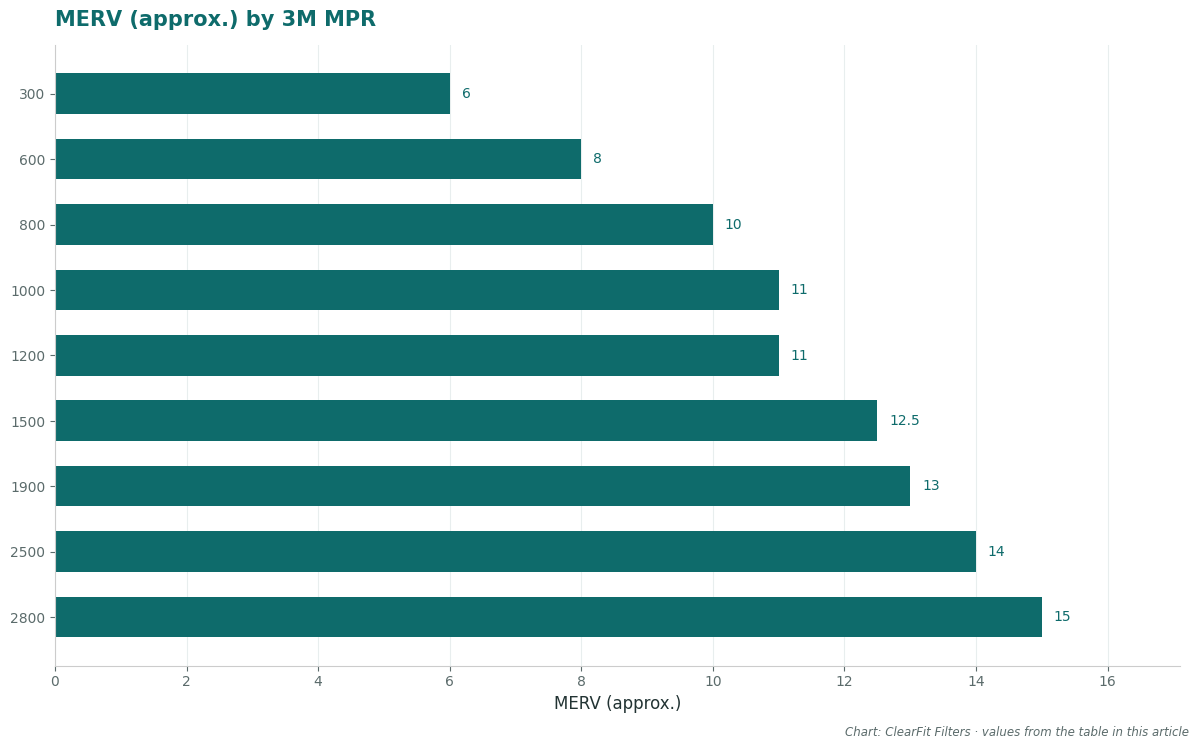
The MPR trap: MPR scores only the 0.3–1 µm band (E1) — the submicron sliver. A MPR 1200 tells you nothing about 3–10 µm performance (the dander and spore band) without the MERV conversion. When a box shows MPR big and MERV small, convert before comparing. Full story: MPR vs FPR vs MERV.
Sub-Table 2: MERV ↔ ISO 16890 (ePM) — For Imported/Commercial Spec Sheets
| ISO 16890 class | Approx. MERV | Captures |
|---|---|---|
| ePM10 ≥50% | 7–9 | Coarse PM (≥10 µm) |
| ePM2.5 ≥50% | 10–11 | PM2.5 and larger |
| ePM1 ≥50% | 12–13 | Submicron PM1 |
| ePM1 70–80% | 14–15 | Hospital-grade general air |
ISO 16890 (2016, replaced EN 779) uses different test aerosols and a different reporting basis — treat the crosswalk as approximate, not a formula. Details in MERV Rating Explained.
Sub-Table 3: Same MERV, Different Depth — Why 4-Inch Filters Change the Math
| Configuration | Typical clean ΔP | Practical meaning |
|---|---|---|
| MERV 8, 1-inch | 0.10–0.15″ WG | Baseline |
| MERV 11, 1-inch | 0.14–0.20″ WG | The jump costs ~30–40% more resistance |
| MERV 13, 1-inch | 0.20–0.30″ WG | Double the MERV 8 baseline — the risk zone for PSC blowers |
| MERV 11, 4-inch | ≈ MERV 8 1-inch | Allergy filtration at workhorse resistance |
| MERV 13, 4-inch | ≈ MERV 11 1-inch | Smoke filtration at allergy-tier resistance |
A 4-inch pleat has roughly 3–4× the media area of the same-footprint 1-inch filter; resistance falls accordingly. If you want the right-hand column of the main chart without the pressure-drop column’s penalty, depth — not brand — is the lever. (See the 4-inch plays on the MERV 11 and MERV 13 pages.)
The Three Rows That Matter: 8 vs 11 vs 13 Snapshot
Nine out of ten shoppers are deciding between exactly three rows. Here they are pulled out of the main chart, aligned for direct comparison — this is the table to screenshot:
| MERV 8 | MERV 11 | MERV 13 | |
|---|---|---|---|
| E1 (0.3–1 µm) floor | — (no requirement) | ≥20% | ≥50% |
| E2 (1–3 µm) floor | ≥20% | ≥65% | ≥85% |
| E3 (3–10 µm) floor | ≥70% | ≥85% | ≥90% |
| Catches | Mold spores, dander, dust mite debris | + Fine dust, pollen fragments, PM2.5-range | + Smoke, bacteria carriers, droplet nuclei |
| Misses | Smoke, submicron fragments | Finest smoke fraction at lower rate | Nothing residential-relevant above its bands — but see pressure drop |
| Clean ΔP (1″) | 0.10–0.15″ WG | 0.14–0.20″ WG | 0.20–0.30″ WG |
| MPR / FPR equivalent | 600 / 5 | 1000–1200 / 7 | 1500–1900 / 10 |
| Typical buyer | Healthy household, any system | Allergies, pets, post-2015 system or 4″ cabinet | Smoke region, asthma/COPD, ECM blower or 4–5″ cabinet |
The one-line logic: 8 protects the house from visible dust, 11 adds the allergen band, 13 adds the smoke band — and each step is paid for in static pressure. If your system cannot pay, the 4-inch column in Sub-Table 3 buys the rating back down.
What the Pressure-Drop Column Doesn’t Show (Yet)
The ΔP column lists clean resistance — a fresh filter out of the box. It is the beginning of the story, not the end:
- Resistance climbs as the filter loads. A MERV 8 1-inch that starts at 0.12″ WG can finish its 90 days at 0.35–0.5″ WG as the captured dust packs the pleats. The loaded number, not the clean one, is what your blower actually fights at month three — and it is why “the filter looked fine when I changed it” and “the filter was choking the system” can both be true.
- The 90-day clock is really a pressure clock. Manufacturers set replacement intervals to keep end-of-life resistance inside typical residential static budgets. A dusty construction site or a shedding-pet household hits the loaded number early; a quiet, low-dust home may not. The calendar is the proxy; the manometer reading (or a strong “is airflow weaker?” check at each register) is the ground truth.
- Higher MERV loads faster at the same dust load. Finer media sieves out more per pass, so MERV 13 1-inch filters often shorten the interval they were upgraded for — one of the two reasons the 4-inch upgrade path in Sub-Table 3 is the real fix (more media area means slower loading and lower clean ΔP).
- The MERV-A footnote applies to the efficiency columns, not this one. Appendix J (MERV-A) tests electrostatically charged media after discharge — the rating some manufacturers prefer not to advertise. If your filter’s fine print says MERV-A, its post-discharge floors are the honest ones. The full mechanism is in MERV Rating Explained.
How to Read This Chart Without Fooling Yourself
1. The numbers are minimums, not averages. A filter earns its MERV by clearing the floor in all three bands simultaneously — its true E3 capture might be far above the floor listed. The rating is set by the lowest qualifying performance. Two “MERV 11” filters can behave differently at specific sizes; neither is mislabeled.
2. Empty E1 cells mean what they say. MERV 8 has no submicron requirement — a MERV 8 filter that happens to catch 30% of 0.3–1 µm particles and one that catches 5% share the rating. If submicron performance matters to you (smoke, allergen fragments), the chart is telling you to start at MERV 11, not to comparison-shop within MERV 8.
3. MERV 17–20 is not a shopping tier. Those rows exist informally for HEPA-class media, but true HEPA is defined by the DOE test (99.97% at the most penetrating particle size), and its resistance means it does not belong in a residential duct slot at all — it belongs in portable purifiers with their own fans. The practical residential ceiling is MERV 13 in a 4–5″ media cabinet.
OEM Factory Max-MERV Quick Reference
Manufacturers publish the filter resistance their equipment was designed around — the data plate beats any chart, including this one:
| OEM (residential) | 1-inch slot, typical max | MERV 11–13 path |
|---|---|---|
| Carrier / Bryant | MERV 10–11 (base) | ECM systems + media cabinet |
| Trane / American Standard | MERV 8–11 (base) | Media cabinet / CleanEffects |
| Lennox | MERV 8–11 (base) | Healthy Climate cabinet (to MERV 16) |
| Goodman / Amana / Daikin | MERV 8 (base 1″) | 4″ cabinet required |
Full six-brand table with system dependencies: MERV Rating Explained.
Which MERV Do You Need? (Three-Line Decision)
- No allergies, no smoke, any-age system → MERV 8 — lowest pressure drop, 90-day clock, done.
- Allergies, pets, or urban dust; system newer than ~2015 or 4″ cabinet → MERV 11 — the submicron floor where allergen defense starts.
- Wildfire smoke, asthma/COPD, immune-sensitive household; ECM blower or 4–5″ cabinet → MERV 13 — after the compatibility check.
Undecided between the first two? The blower-motor test and the real cost math are in MERV 8 vs MERV 11.
FAQ
What MERV rating is best for a home? For most homes: MERV 8 as the default, MERV 11 if anyone has allergies or pets shed heavily, MERV 13 for smoke regions or respiratory illness — with the blower check first. “Best” tracks your household’s air concerns and your system’s limits, not the top of the chart.
Where can I see MERV 8 vs 11 vs 13 side by side? The three bolded rows of the main chart above: E1 floor (— / ≥20% / ≥50%), E2 (≥20% / ≥65% / ≥85%), E3 (≥70% / ≥85% / ≥90%), clean pressure drop (0.10–0.15 / 0.14–0.20 / 0.20–0.30″ WG), MPR (600 / 1000–1200 / 1500–1900). For the narrative version: MERV 8 vs MERV 11.
What is the highest MERV rating for residential use? Practically, MERV 13 — in a 4–5″ media cabinet or on an ECM blower. MERV 14–16 media exists in residential cabinet sizes but is designed for commercial airflow design; in typical residential static budgets it trades too much airflow. HEPA (the informal “17–20”) is not a duct product for homes.
Where’s the MERV pressure drop chart? The “Typical clean ΔP” column of the main table and Sub-Table 3 above — MERV 8 at 0.10–0.15″ WG, MERV 11 at 0.14–0.20″, MERV 13 at 0.20–0.30″ (all 1-inch; 4-inch media roughly halves each row). The pressure-drop column is the reason this chart includes it when most don’t: a rating without its resistance is half a purchase decision. The same numbers govern any furnace filter MERV rating chart reading — the cartridge is identical whatever the season.
Is there a MERV chart by brand (Carrier, Trane, Lennox)? Not on this page by design — OEM maximum-MERV limits are system specs, not chart rows, and they live in MERV Rating Explained with the cross-brand table (Carrier/Bryant 10–16 system-dependent, Goodman base 1-inch MERV 8, Lennox up to 16 with media cabinet). This chart covers the media itself; your data plate and that table decide what your cabinet accepts.
What MERV is MPR 1500? Approximately MERV 12–13 (Home Depot FPR 9–10; Filtrete’s Ultra Allergen tier). The exact landing depends on the full three-band profile, which MPR doesn’t test — that’s why the conversion table says “approximate.” Conversion details: MPR vs FPR vs MERV.
Sources & References
- ASHRAE Standard 52.2 (full E1/E2/E3 minimum-efficiency table; 2017 Appendix J MERV-A).Official standard (explicit)
- U.S. EPA “What is a MERV rating?” (MERV 1-16 table and residential recommendations).Official documentation (explicit)
- 3M Filtrete MPR definition and MERV cross-reference; Home Depot FPR explanation — the approximate nature of the conversion is explicitly acknowledged by both.Official documentation (explicit)
- ISO 16890 (2016, replacing EN 779; ePM classes) — the crosswalk to MERV is an industry approximation.Official standard (explicit) + inference basis
- Pressure-drop ranges (typical clean ranges per class at 1″ and the 4″ equivalence) — synthesis of typical values from major-manufacturer spec sheets, not single-source precise values.Industry data (inference-based)
- OEM table — Carrier/Trane/Lennox/Goodman public installation manual (summarized) (system-dependent).Official documentation summary (inference basis)
Related Guides
- MERV Rating Explained — the concepts behind every column: mechanisms, MERV-A, ISO 16890, OEM limits.
- MERV 8 vs MERV 11 — the decision article for the two rows most shoppers narrow to.
- MPR vs FPR vs MERV — the conversion story, including the Filtrete-to-generic buying path.
- MERV 8 / MERV 11 / MERV 13 — shop each tier by size.
Keep reading: MERV 13 Air Filters: The Complete Guide · MERV 8 Air Filters: The Complete Guide