MERV 8 Air Filters

The Everyday Workhorse Rating — ≥20% of 1–3 µm and ≥70% of 3–10 µm Particles (ASHRAE 52.2)

MERV 8 is the right filter for most homes with no special air-quality concerns. Under ASHRAE Standard 52.2, a MERV 8 filter must capture at least 20% of particles in the 1.0–3.0 µm band (E2) and at least 70% of particles in the 3.0–10 µm band (E3) — which covers mold spores, pet dander, dust mite debris, pollen fragments, and household lint. It carries no submicron (E1) requirement, which is why it runs at the lowest pressure drop of the three common residential ratings and works in virtually any 1-inch filter slot, including older blowers with PSC motors. If you have allergies, pets that shed heavily, or wildfire-smoke exposure, step up to MERV 11 or MERV 13 — the comparison table below shows exactly what each step buys you. For everyone else, MERV 8 is the rating your system was most likely designed around, and the cheapest rating to run on schedule.
Quick answer: Standard 1-inch slot, no allergies, no smoke concerns → MERV 8, replaced every 90 days. Allergy or pet household → MERV 11. Smoke, asthma, or COPD in the house → MERV 13 (check blower compatibility first). Not sure what “MERV” measures at all? Read MERV Rating Explained first — it takes four minutes.
Top Picks at a Glance (2026)
This page is the MERV 8 tier; the picks below are our MERV 8 cartridges across common slots, plus the two-tier upgrade path:
| Pick | Product | Why it wins |
|---|---|---|
| Best overall | 16x20x1 MERV 8 pleated | The tier’s workhorse size; 90-day rated life, lowest pressure drop of any cartridge we stock. |
| Also sized | 20x25x1 MERV 8 pleated | Same tier in the large nominal slot for bigger return grilles. |
| The upgrade path | 20x25x1 MERV 11 pleated | One tier up: dander, spores and pollen join the capture spec — the step to take before jumping to MERV 13. |
Shop MERV 8 Filters by Size
Filter size matters more than brand: a MERV 8 filter that does not seal your slot filters nothing. Find your size below — measured as nominal width × height × thickness in inches (the actual filter is usually about ⅜” smaller than the nominal size on the label; see how to measure your air filter size if the label is gone).
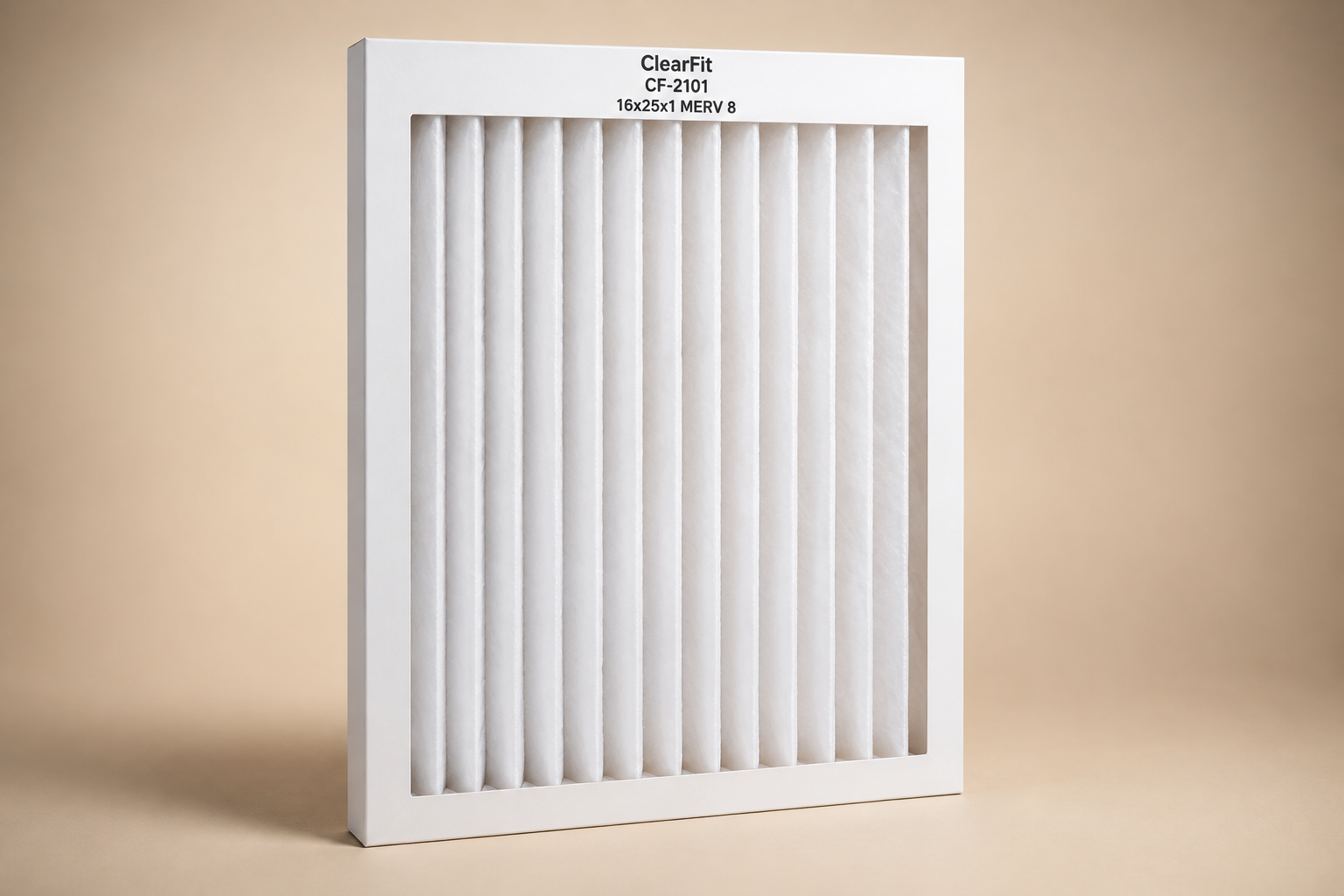
ClearFit cuts the same 16x25x1 MERV 13 pleated media to OEM specifications – the 16x25x1 MERV 13 replacement filter, sized to confirm against your old filter before ordering.
1-Inch Thick (the standard furnace/HVAC slot)
★ = most-ordered MERV 8 size (20x20x1 and 20x25x1 lead every year). Plus 23 more medium-volume 1-inch sizes — browse all sizes.
2-Inch Thick (deeper retro slot)
20x20x2 · 20x25x2 · 16x25x2 · 16x20x2 — plus more in the full size index.
4-Inch Thick (media cabinet)
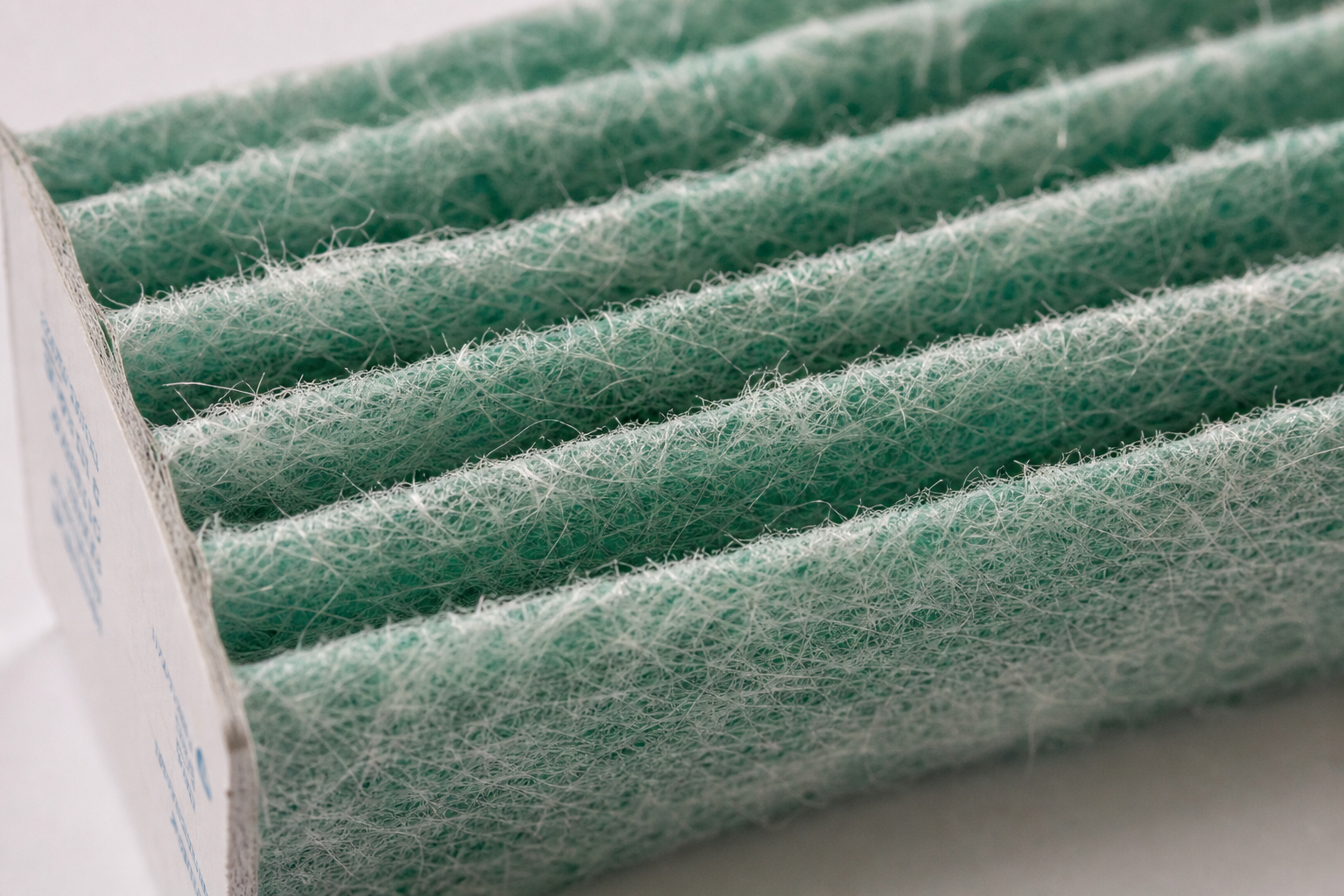
20x25x4 · 16x25x4 · 20x20x4 · 16x20x4 — 4-inch MERV 8 runs at the lowest pressure drop of any configuration on this page; if your cabinet takes it, this is the value play.
Don’t see your size? We cut custom sizes to the quarter-inch — odd slots (20x23x1, 15x20x1) are why that service exists.
What MERV 8 Catches — and What It Doesn’t
A MERV 8 filter’s job is the stuff you can see building up on the media when you pull it out. Here is the honest boundary, with the ASHRAE minimum-capture numbers attached (the rating is a floor each filter must clear, not a marketing percentage):
Captures effectively (E3 band, ≥70% minimum):
- Mold spores — most species cluster at 3–10 µm ✔
- Pet dander (cat and dog) — typically 5–10 µm ✔
- Dust mite debris and body fragments ✔
- Pollen fragments and household dust ✔
- Textile fibers, lint, sanding dust ✔
Captures partially (E2 band, ≥20% minimum):
- Fine dust and auto-emission particles (1–3 µm) — ⚠ caught at the minimum floor, not thoroughly
- Bacteria carriers at the upper end of the band — ⚠ partial only
Does not target (no E1 requirement):
- Submicron particles below 1 µm — tobacco smoke, cooking-oil haze, virus-laden droplet nuclei, wildfire-smoke PM2.5 core — ✖ not what this rating is for. A MERV 8 filter will catch some of this (no filter catches zero), but the rating promises nothing, and a heavily dust-loaded MERV 8 actually catches more submicron particles than a clean one — by accident, not by design. For smoke and submicron concerns, the honest answer is MERV 13.
This gray-zone honesty matters when you read other retailers’ MERV 8 pages. Some list a single capture percentage near 90% — that number is the E3-band (3–10 µm) figure quoted alone. It is not wrong, but it is the flattering column of the ASHRAE table. The full three-band table is in our printable MERV chart.
MERV 8 vs MERV 11 vs MERV 13: The Full Comparison
| MERV 8 | MERV 11 | MERV 13 | |
|---|---|---|---|
| E1 (0.3–1 µm) minimum | — (no requirement) | ≥20% | ≥50% |
| E2 (1–3 µm) minimum | ≥20% | ≥65% | ≥85% |
| E3 (3–10 µm) minimum | ≥70% | ≥85% | ≥90% |
| Typical clean pressure drop, 1-inch (in. WC) | 0.10–0.15 | 0.14–0.20 | 0.20–0.30 |
| 3M MPR equivalent | MPR 600 | MPR 1000–1200 | MPR 1500–1900 |
| Home Depot FPR equivalent | FPR 5 | FPR 7 | FPR 10 |
| Typical systems | Any 1-inch slot, incl. PSC blowers 10+ yrs old | Most systems ≤10 yrs; any 4-inch cabinet | ECM blowers or 4–5″ media cabinets; check OEM limit |
| Best for | Dust, dander, spores — no special needs | Allergies, pets, urban dust | Smoke, asthma/COPD, bacteria carriers |
| Typical replacement interval | 90 days | 60–90 days | 30–60 days |
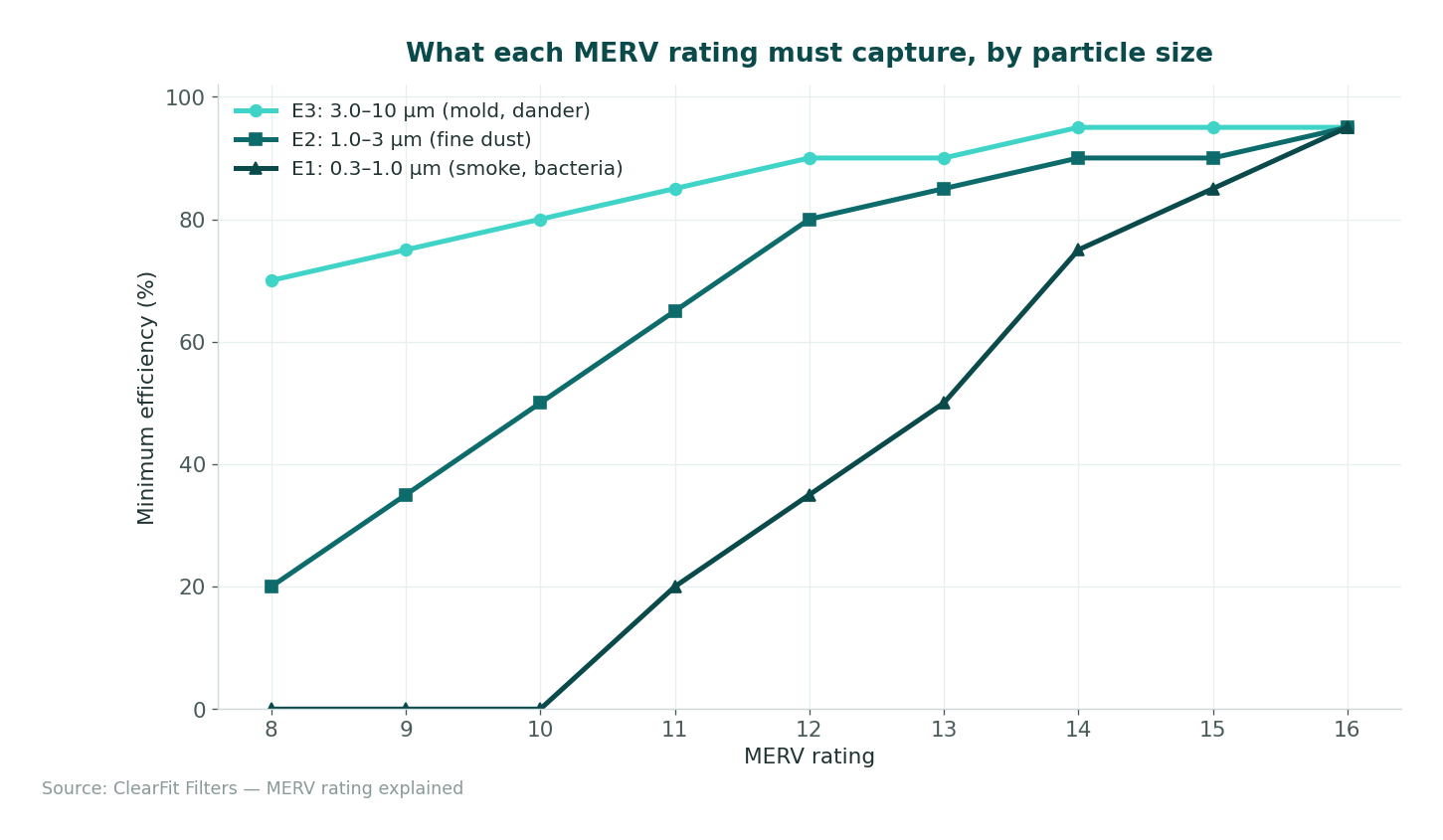
Pressure-drop figures are typical manufacturer spec-sheet ranges for clean 1-inch pleated media at rated face velocity; loaded filters run higher. 4-inch media at the same MERV runs well below the 1-inch figure — see the warning block below.
The full decision process — including the PSC-vs-ECM blower-motor check that decides whether your system can take the jump — is in MERV 8 vs MERV 11: Which One Your HVAC Can Actually Handle, and the rating mechanics behind every number in this table are in MERV Rating Explained.
When MERV 8 Is the Right Choice
1. Your system shipped with it. Most base-model gas furnaces and package units — Goodman and Amana 1-inch-slot units especially — were designed around a MERV 8 maximum at the blower’s rated static pressure. If your owner’s manual or data plate says MERV 8, running MERV 11+ in a 1-inch slot trades airflow you were promised for filtration you were not. The cross-brand OEM limit table is in MERV Rating Explained.
2. Rental properties. Tenants replace filters late; a MERV 8 that runs three extra months clogs slower and strains the blower less than a dense MERV 13 running the same overtime. Cheap to buy in bulk, forgiving in practice — this is the landlord’s rating.
3. Older blowers with PSC motors. The single-speed PSC motors in systems over roughly a decade old deliver less air as filter resistance climbs. MERV 8’s low clean resistance (0.10–0.15″ WG typical) is the safest match. If you want finer filtration on a PSC system, the right move is not a denser 1-inch filter — it is a 4-inch media cabinet (next section).
Pressure Drop and System Compatibility: Read This Before Upsizing
Pressure drop (” WG) is the resistance the filter adds to airflow. Your blower was sized for a budget of total external static pressure — typically around 0.50″ WG total for residential furnaces — and the filter is only one item spending that budget (the coil and ductwork spend most of it). The practical rules:
- A clean MERV 8 1-inch filter at 0.10–0.15″ WG is nearly free. A clean MERV 13 1-inch filter at 0.20–0.30″ WG can consume half the entire static budget before dust even starts loading.
- Loading multiplies resistance. All filters climb in pressure drop as they load. A MERV 13 filter three weeks overdue can restrict more airflow than a MERV 8 filter three months overdue — which is why the “set it and forget it” crowd should stay at MERV 8.
- The 4-inch escape hatch. A 4-inch pleated filter has roughly 3–4× the media area of a 1-inch filter at the same footprint. Running MERV 11 in a 4-inch cabinet typically costs less static pressure than MERV 8 in a 1-inch slot — upgrading filtration without upgrading resistance. This is the single best-value move in residential HVAC filtration, detailed in the MERV 11 landing.
- Watch for MERV-A. If a filter’s box says “MERV 8” and nothing else, check whether the manufacturer also publishes a MERV-A value. Electrostatically charged media can test at MERV 8 new and drift toward the underlying mechanical rating as the charge dissipates. The two-minute version of this trap is in MERV Rating Explained (the MERV-A section).
Symptoms you’ve overshot your system: weaker airflow at registers, evaporator coil freezing in summer, high-limit switch trips in winter, whistling at the filter slot, or an ECM blower that has gotten noticeably louder (it ramps up to fight the restriction). Any of these means come back down a rating or move to deeper media — not buy a denser 1-inch filter and hope.
FAQ
Is a MERV 8 filter good enough? For homes without allergies, respiratory conditions, pets that shed heavily, or smoke exposure — yes. MERV 8 captures the visible particulate load (dander, spores, dust) at the lowest pressure drop and price. It is the rating most base HVAC systems were designed around. It is not sufficient as a targeted response to wildfire smoke or submicron pollution — that is MERV 13 territory.
What’s the difference between MERV 8 and MERV 11? MERV 11 adds a submicron floor (≥20% of 0.3–1 µm particles, where MERV 8 requires nothing) and raises the 1–3 µm minimum from 20% to 65%. In practice: MERV 11 catches pollen fragments, fine dust, and pet allergens more thoroughly, at somewhat higher pressure drop and price. The full breakdown with the blower-motor check is in MERV 8 vs MERV 11.
How often should I replace a MERV 8 filter? Every 90 days in a standard household; every 60 days with pets or during heavy-use seasons; monthly checks during renovation or wildfire season (dust loads spike). The visual test beats any calendar: if you can no longer see the media through the dust, it is overdue.
Is MERV 8 good for pets? Partially. MERV 8 captures pet dander (5–10 µm) and hair effectively — that is the visible part of the problem. The allergenic proteins that trigger reactions (Fel d 1, Can f 1) ride on smaller particles and fragments, where MERV 11’s E1/E2 floors do meaningfully better work. One dog, no allergies → MERV 8 is fine. Allergic household with pets → MERV 11.
Is MERV 8 the same as MPR 600? Yes — 3M’s MPR 600 (Filtrete Basic/Dust & Pollen tier) is the standard crosswalk for MERV 8, and Home Depot’s FPR 5 sits at the same level. Note that MPR only scores the 0.3–1 µm band, so the conversion is approximate, not exact — MPR vs FPR vs MERV explains the conversion table and its one trap.
Never Miss a Change: 90-Day Reminder
The most common failure mode of MERV 8 is not the filter — it is forgetting. A MERV 8 filter six months overdue has paid back its lower price in blower strain. Set a Home Filter Calendar reminder: pick your size, pick your interval, get an email or calendar ping when it is time — and never let the next one slip.
The Other Ratings
- MERV 11 Air Filters — the allergy-sufferer tier, and the 4-inch low-pressure-drop play
- MERV 13 Air Filters — smoke, asthma, and submicron particulate; read the compatibility block first
Sources & References
- ASHRAE Standard 52.2 — MERV 8 minimum-efficiency definitions E2 ≥20% / E3 ≥70% (efficiencies are floors, all three ranges met simultaneously).Official standard (explicit)
- U.S. EPA — “What is a MERV rating?” (epa.gov, indoor air quality page): MERV 1-16 table and residential recommendations.Official documentation (explicit)
- Pressure-drop ranges (0.10-0.15″ WG MERV 8 clean / 0.20-0.30″ WG MERV 13 clean / 0.50″ WG typical residential total external static budget) — typical ranges from major-manufacturer spec sheets and HVAC engineering handbooks, Industry data (inference-based, not single-source precise)
- MPR 600 ↔ MERV 8 / FPR 5 conversion — 3M Filtrete official conversion basis and Home Depot FPR explanation.Official documentation (explicit)
- 4-inch media area ≈3-4× same-size 1-inch — industry-consensus geometric relationship (typical), not a single-manufacturer precise value.Industry analysis (inference)
Related Guides
- MERV Rating Explained — what the rating measures, the MERV-A trap, and the cross-brand OEM limit table.
- MERV 8 vs MERV 11 — the decision article with the three-step PSC/ECM blower check.
- MERV Rating Chart (Printable) — the full 1–16 table with MPR/FPR conversion and pressure-drop columns.
- How Often to Change Your HVAC Filter — why 90 days is the MERV 8 baseline.