Filtrete MPR Decoded: the 300–2800 Series, and Its Honest MERV Conversions

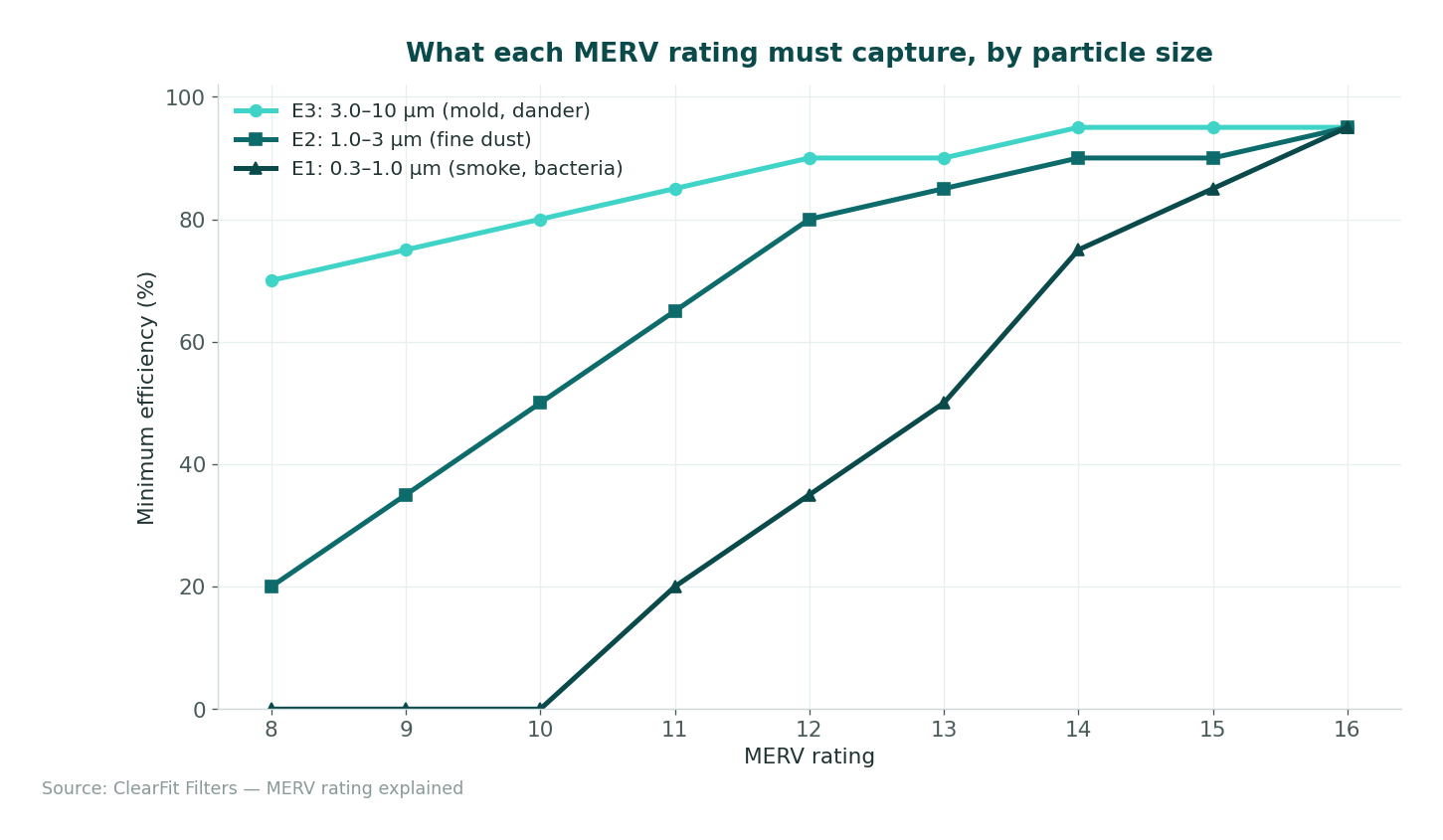
MPR (Micro Particle Performance Rating) is 3M’s private scale for Filtrete filters, measuring capture of 0.3–1.0 micron particles — the hardest band in filtration — and it converts to MERV only as approximate ranges, not a formula. The working table: MPR 300 ≈ MERV 5 / 600 ≈ MERV 7 / 1000 ≈ MERV 11 / 1500–1550 ≈ MERV 12 / 1900 ≈ MERV 13 / 2200–2500 ≈ MERV 13–14 / 2800 ≈ MERV 15-ish territory. The practical sweet spot for most houses is MPR 1000–1900; above 1900 you’re paying 3M’s premium for marginal capture while loading 1″ media faster (the airflow arithmetic).
The reason this page exists is a Target aisle. Reddit’s threads on Filtrete capture the exact moment of confusion: a shopper finds the shelf full of MPR numbers — 300, 1000, 1900, 2500 — no MERV in sight, and no conversion anywhere on the box. That’s not an accident; a proprietary scale is a retail strategy (it makes cross-brand comparison harder and makes “1900” sound premium next to a competitor’s “MERV 13”). Once you know what MPR measures, the aisle reads fine — and once you know the honest conversions, you can decide whether the premium tier is worth it or whether a certified-compatible equivalent at half price does the same job.
Top Picks at a Glance (2026)

Once an MPR number converts to its MERV tier, these are the three cartridges sitting on the MERV side of the chart:
| Pick | Product | Why it wins |
|---|---|---|
| MPR 300-600 class — MERV 8 | 16x20x1 MERV 8 pleated | The dust-and-pollen equivalence band; lowest pressure drop of the ladder, 90-day rated life. |
| MPR 1000-1500 class — MERV 11 | 16x20x1 MERV 11 pleated | The finer band where the spec sheet adds pet dander, mold spores and smoke-class capture. |
| MPR 1900+ class — MERV 13 | 20x25x1 MERV 13 pleated | The top Filtrete band converts to MERV 13, the finest tier stocked in 1-inch residential slots; plan ~60-day changes. |
Quick Answer: The Full Conversion Table
| Filtrete MPR | Approx. MERV equivalent | What it’s for | Realistic household verdict |
|---|---|---|---|
| 300 | ~MERV 5 | Basic dust/lint | Builder-grade; upgrade exists for a reason |
| 600 | ~MERV 7 | Standard dust | Minimum acceptable tier |
| 700–800 | ~MERV 8–10 | Dust + pollen | Solid baseline |
| 1000–1085 | ~MERV 11 | Pet dander, pollen, dust | Sweet-spot entry — the value tier |
| 1500–1550 | ~MERV 12 | Allergy household’s tier | The allergy pick |
| 1900 | ~MERV 13 | Bacteria/virus carriers, smoke, fine particles | Sweet-spot top — MERV-13 class capture |
| 2200 | ~MERV 13+ | Ultra-fine capture marketing tier | Diminishing returns in 1″ media |
| 2500 | ~MERV 14-ish | “Best” shelf position | Marginal over 1900; loads faster |
| 2800 | ~MERV 15-ish | Top-of-wall flex | 4″ media does this class better |
Caveat printed on the table itself: these are approximations, honestly labeled as such. MPR tests one particle band (0.3–1.0 µm) with 3M’s method; MERV is a three-band ASHRAE protocol. A filter can score high on one and differently on another — that’s why no standards body publishes an official conversion, and any chart claiming formula-level precision is overclaiming. Range-level truth is the most truth available, and it’s enough to shop by.
Why MPR Exists (and Why the Box Won’t Translate It for You)
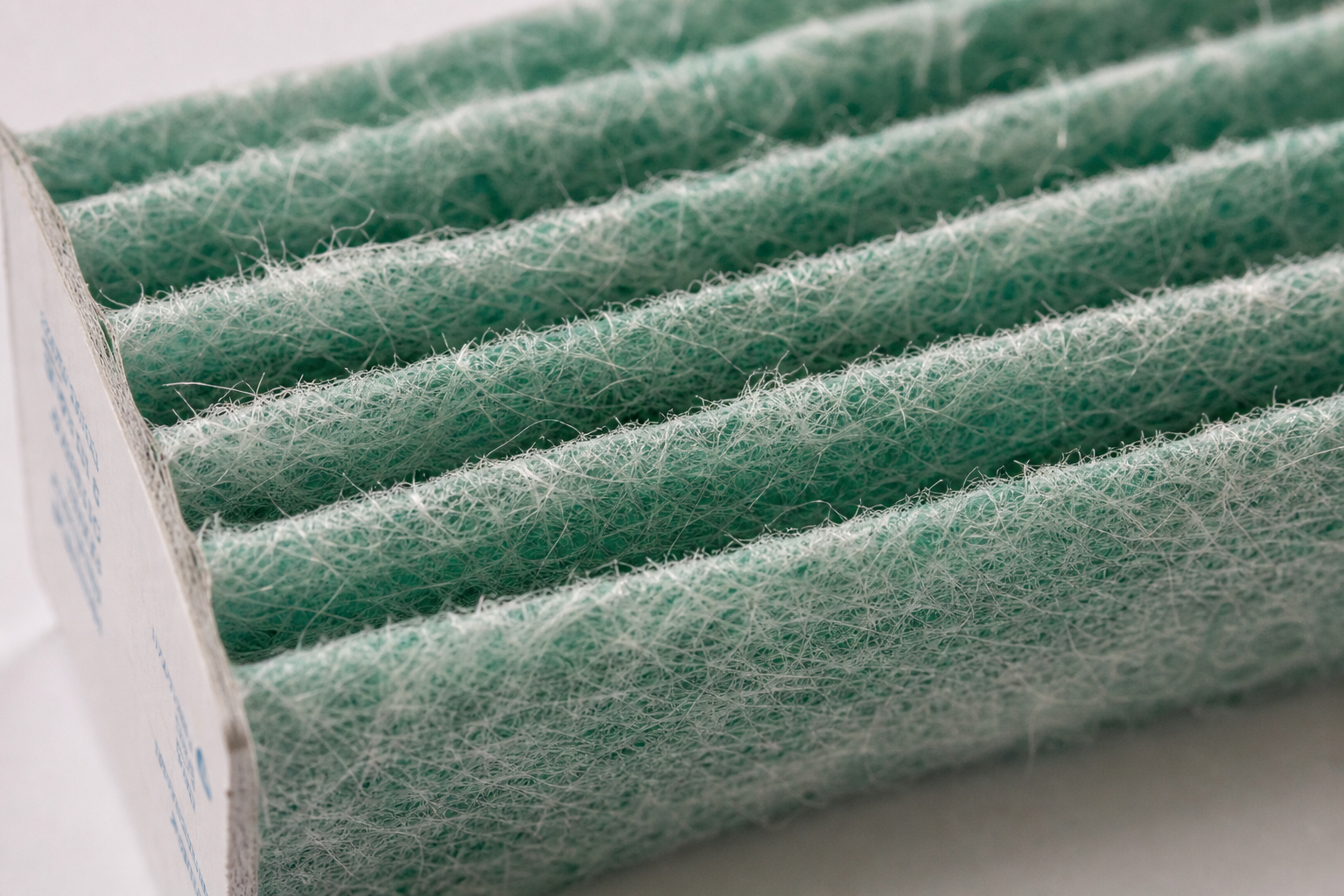
Filtrete’s media is electrostatically charged pleated poly — the charge captures fine particles that plain mechanical media at the same density would pass. 3M built MPR to showcase exactly that: performance in the 0.3–1.0 µm sub-band where their charged media does its best work relative to the field. It’s a true performance claim about a real mechanism — and simultaneously a walled garden: if the box says MPR 1900 and the competitor’s says MERV 13, comparing them requires the conversion table you’re reading now, which the shelf doesn’t provide.
The punchline for shoppers: MPR’s single-band focus is why the numbers run so much higher than MERV’s — 1900 “sounds” like more than 13. Same air, different scoreboards. The defense is knowing both scales’ units: MERV’s three-band minimums (explained here) versus MPR’s one-band score, plus the third scale in the brawl — Home Depot’s FPR — which our ratings comparison maps in one place.
Which MPR Tier Is Actually Worth Buying
MPR 1000–1900 covers the useful range for nearly every home. Below 1000, you’re under-filtering relative to what modern pleated media costs; above 1900, the physics turns against you in a 1″ cartridge — finer capture means faster loading, shorter life, and more static pressure for marginal capture gain over the 1900 class (the numbers). The premium tiers earn their price mainly in two scenarios: heavy smoke exposure seasons and medically-advised maximum filtration, and in both, the better purchase is usually the same filtration class in a 4″ media cartridge (why depth wins) — Aprilaire-class cabinets run MERV 13-equivalent capture at a fraction of the resistance.
The brand-premium question deserves the last word on price: Filtrete MPR 1900 filters commonly run $18–25 each; certified-compatible MERV 13 filters in the same sizes run $12–18 with tested, listed ratings. Whether the 3M media’s electrostatic edge is worth the markup depends on how much you value the brand’s charge-retention claims versus a third-party-tested mechanical filter at the same class — the full analysis is OEM vs aftermarket furnace filters. What the conversion table buys you either way: the ability to compare anything on any shelf, on your terms.
ClearFit cuts the same 16x20x1 MERV 13 pleated media to OEM specifications – the 16x20x1 MERV 13 replacement filter, sized to confirm against your old filter before ordering.
Decoding the Shelf in Practice (Target and Home Depot Edition)
- Find the MPR number on the front of the Filtrete box — usually large, near the “Filtrete” wordmark (“MPR 1900 Premium Allergen”).
- Map it to the table (1900 ≈ MERV 13 class) and to your household profile from the MERV chooser.
- At Home Depot, the FPR scale runs alongside — their house chart puts FPR 10 at the MERV-13-ish tier; the three-scale master table lives in MPR vs FPR vs MERV.
- Check the size and depth before the rating — the right MERV in the wrong size is an expensive bypass lane (sizes).
- Price per filter against the compatible tier before assuming premium is necessary — most profiles land at MPR 1000–1500 equivalents, not 2500+.
FAQ
How many MPR is equivalent to a MERV 11 rating?
MPR 1000 — the entry of Filtrete’s allergen line — sits at the MERV 11 class in the standard conversion ranges (MPR 1000–1085 ≈ MERV 11). It’s the pet-dander and pollen tier, and the value sweet spot of the Filtrete line: the useful capture step up from MPR 600–800 without the premium-shelf pricing of the 1900s.
How do I convert MPR to MERV?
By range, not formula: MPR measures 0.3–1.0 µm capture on 3M’s private protocol, MERV scores three particle bands under ASHRAE 52.2 — no official conversion exists because the tests differ. Use the working table above (300→5, 600→7, 1000→11, 1500→12, 1900→13, 2200–2500→13+, 2800→15-ish), treat the results as the approximations they are, and buy by household profile rather than by chasing the biggest number on either scale.
How many MERV is 1000 MPR?
Approximately MERV 11 — the allergen-and-dander tier. In Filtrete’s line, MPR 1000 (and the 1085 variant) maps to the MERV 11 class in range terms, which is the tier most pet and allergy households should be shopping.
What is the best MPR level for Filtrete air filters?
MPR 1000–1900 for nearly all homes: 1000–1500 for pet/allergy profiles, 1900 for smoke regions and maximum sensible filtration. Above 1900 (the 2200–2800 tier), you pay premium pricing for marginal capture improvement while the 1″ media loads faster and costs more static pressure — money better spent on the same filtration class in a 4″ cartridge if your system takes one.
Sources & References
- 3M/Filtrete product documentation — MPR definition (0.3–1.0 µm micro-particle focus), series lineup (300 through 2800). Official documentation (explicit).
- ASHRAE 52.2 MERV protocol — three-band scoring basis for the range-level conversions. Official documentation (explicit).
- Conversion ranges — cross-referenced from filter-industry comparison practice; labeled approximate by nature. Industry analysis (explicit range, not an official conversion).
- Retail pricing bands — Target/Home Depot/Amazon shelf scans 2026-08. Industry convention (explicit range).
- r/HomeImprovement Filtrete aisle threads — the MPR-not-MERV shelf confusion. Community discussion (paraphrased).
Related Guides
- MPR vs FPR vs MERV — all three scales, one table.
- MERV Rating Explained — the scale the conversion lands in.
- OEM vs Aftermarket Furnace Filters — whether the brand premium survives arithmetic.
Shop this guide: MERV 8 filters · MERV 11 filters