What MERV Rating Do I Need? A Household Selector (Two Steps, Not a Chart Off a Shelf)

Most homes: MERV 8–11. Homes with pets or allergy sufferers: MERV 11. Wildfire-smoke regions, medical sensitivities, or renovation aftermath: MERV 13 — ideally as a 4″ cartridge. Above 13, residential ductwork stops being the right tool. But the rating is only half the answer, because the selector has two steps everyone skips: pick the tier your household profile calls for, then confirm your system can breathe through it (a two-minute check of blower generation and filter depth — the full pressure arithmetic is in our airflow data page). This page runs both steps for the situations that actually diverge: the baby’s room, the shedding dog, the smoke-season upgrade, the allergy household deciding between 11 and 13.
The chooser’s framing problem shows up in the Reddit threads immediately: someone asks “what MERV is right for my furnace” and gets three confident answers — 8 (“all you need”), 11 (“best balance”), 13 (“get the good stuff”) — each stated as universal. All three are right for someone; none is right for everyone, and the missing variable is always the house: its blower, its ducts, its filter depth. The selector below fixes the profile first and the equipment second, because equipment, not preference, sets the ceiling.
Top Picks at a Glance (2026)

The rating you need maps almost one cartridge per tier: MERV 8 for household dust, 11 for dander and pollen, 13 for smoke and PM2.5. The three picks:
| Pick | Product | Why it wins |
|---|---|---|
| Best for dust — MERV 8 | 20x20x1 MERV 8 cartridge | The dust-and-lint tier at the lowest pressure drop of the ladder; 90-day rated life on the spec sheet. |
| Best for pets and pollen — MERV 11 | 20x20x1 MERV 11 cartridge | Spec sheet lists pet dander, mold spores and pollen as the capture class; the usual answer for pet households. |
| Best for smoke — MERV 13 | 20x25x1 MERV 13 cartridge | The fine-fraction tier for wildfire smoke and PM2.5 days; plan the replacement window nearer 60 days. |
Quick Answer: The Profile Selector
| Household profile | Tier | Why | Depth to run it in |
|---|---|---|---|
| Baseline, no special load | MERV 8 | Captures pollen/dust/lint at minimal resistance — the value default | 1″ is fine |
| Pets indoors, general dust unhappiness | MERV 11 | Pet dander sits at ~1–10 µm; 11 captures the band decisively | 1″ ok, 4″ better |
| Allergy sufferers in season | MERV 11 (13 in peak weeks) | Pollen fragments and fine dust; the 0.3–1 µm band starts mattering | 4″ if available |
| Wildfire smoke season | MERV 13, seasonal | Smoke particles concentrate at 0.3–1 µm — 13’s hardest band | 4″ strongly preferred |
| Medical vulnerability, post-surgical, severe asthma | MERV 13 + room HEPA portable | Belt-and-suspenders: system-wide 13 plus per-room 99.97% | 4″ for the system side |
| Renovation in progress | MERV 8–11, changed at 30 days | Volume of coarse dust beats fines; frequency wins this window | 1″ cheap-and-often |
| Older PSC-blower system, unmeasured | MERV 8–11 ceiling | Test before 13 — the pressure numbers |
One asymmetry worth naming: under-filtering is a slow cost (dust, coils, allergies) and over-filtering is a fast cost (airflow, watts, frozen coils) — but the over-filtering risk is easy to retire: it disappears entirely at 4″ depth. When in doubt between two tiers and a 4″ cabinet is on the table, take the higher tier in the deeper cartridge.
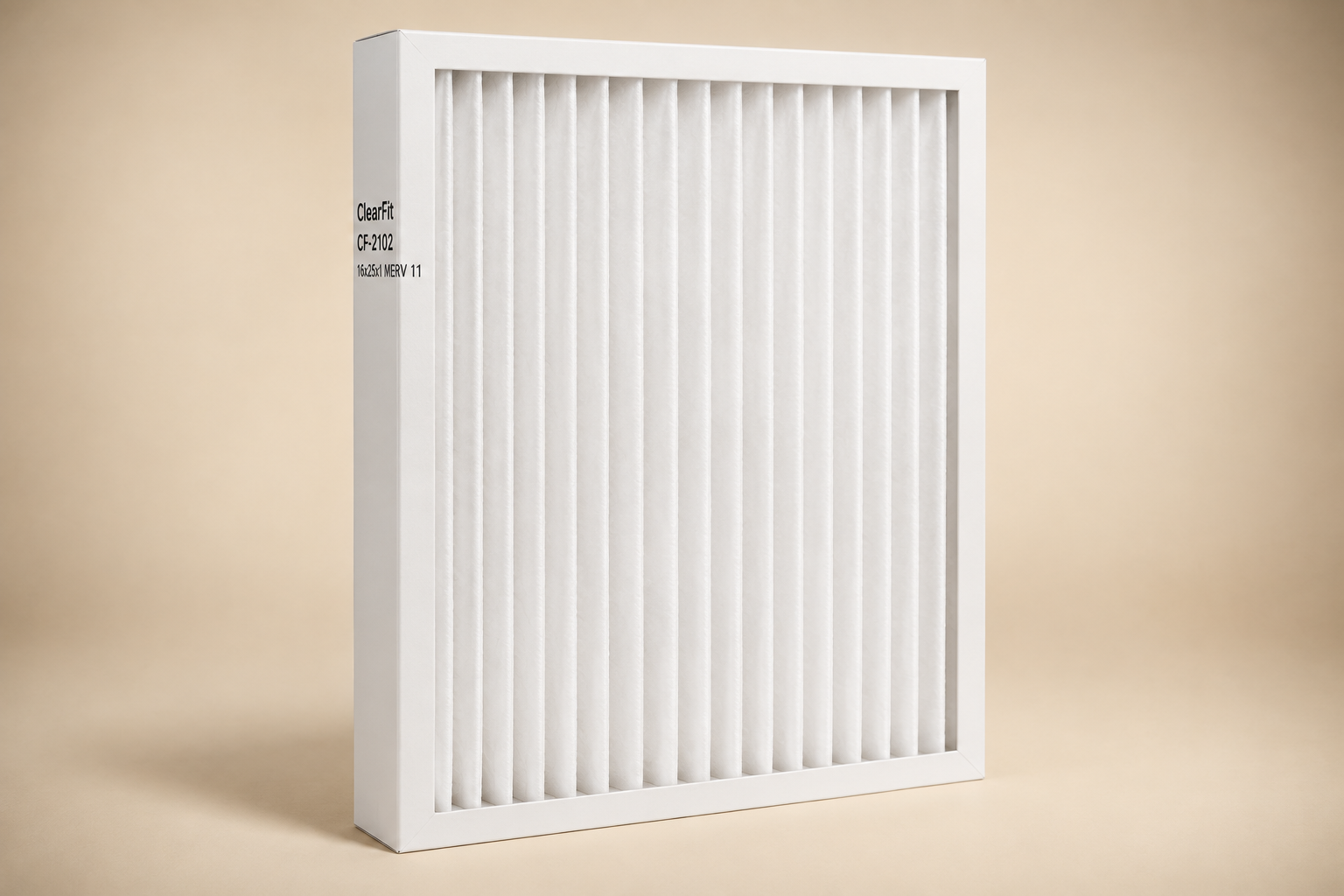
ClearFit cuts the same 16x25x1 MERV 13 pleated media to OEM specifications – the 16x25x1 MERV 13 replacement filter, sized to confirm against your old filter before ordering.
Step Two: The Compatibility Check (Before Believing Any Tier Choice)
- Blower generation. ECM/variable-speed (most high-efficiency systems of the last ~15 years): anything up to MERV 13 with modest energy cost. Older PSC constant-speed: treat MERV 11 as the ceiling for a 1″ slot and confirm with a static-pressure reading before going higher — ask any tech during a tune-up: “what’s my measured TESP?” Under 0.5″ with a MERV 8 installed means budget exists; 0.6″+ means the ducts are the problem, not the filter.
- Filter depth available. If the system takes a 4–5″ media cartridge (Aprilaire-class cabinets and their kin), run MERV 11–13 there — resistance drops to a quarter of the 1″ equivalent (why depth wins). If you’re slot-bound at 1″, MERV 13 is workable but wants a shortened interval.
- Slot seal. A leaky rack wastes any tier — the payoff of going from 8 to 13 evaporates if air skirts the cartridge. Foil tape on the slot edges is the five-minute fix that makes the rating real.
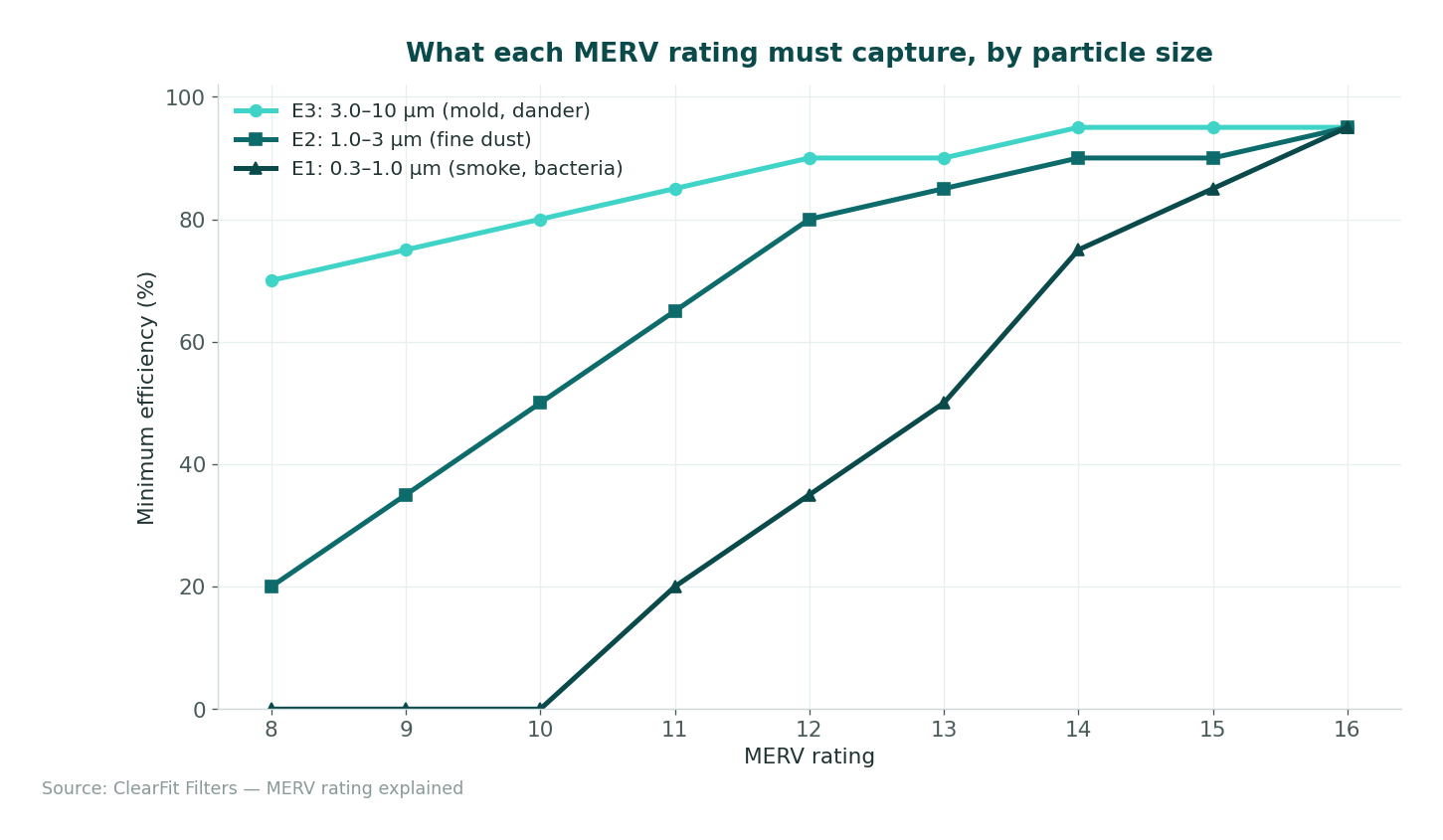
The MERV scale itself — what each band captures, how it’s tested, and what the “A” in MERV-A means — is covered in MERV rating explained; the two most common tier matchups are broken out at MERV 8 vs MERV 11.
The Situations That Deserve Their Own Paragraph
The allergy household (11 vs 13). Pollen grains themselves are big (10–100 µm — any tier catches them); the problem fraction is fragments and fines at 0.3–3 µm, which is where 11 begins and 13 strengthens. Our recommendation for diagnosed allergy sufferers: MERV 11 as the standing tier, 13 during your worst 6–8 weeks, in the deepest cartridge the system takes — full reasoning in best HVAC filter for allergies.
The pet household (11, and the vacuum matters too). Pet dander (especially cat) runs fine — 1–10 µm with fragments below — and MERV 11 is the standard answer (best filter for pet dander). The tier beats the alternative of running 13 in a 1″ slot and suffering the airflow: dander capture is already strong at 11, and the higher tier’s pressure cost lands on exactly the households running the blower most.
The wildfire/smoke household (13, seasonally). Smoke particles concentrate at 0.3–1 µm — MERV 13’s designed band. Two provisions: run it seasonally rather than year-round (return to 8–11 off-season), and pair it with an interim plan for the weeks the AQI is genuinely bad — wildfire smoke filtration covers the room+system split, and the AQI basics page explains when the number should change your behavior.
The medically sensitive household (13 + HEPA portable). For immunocompromised, post-surgical, or severe-asthma rooms, the system-wide MERV 13 is the floor, not the ceiling: add a true-HEPA portable sized to at least 2/3 of the room’s clean-air delivery requirement, run continuously, and keep doors closed during the window that matters. The system filter cleans the whole house adequately; the portable makes one room excellent. (HEPA vs MERV 13 explains why the two tools don’t compete.)
The renovation window (low tier, high frequency). Construction dust is coarse and overwhelming — a MERV 8 changed monthly through the project outperforms a MERV 13 you’re nursing to 90 days. Buy cheap, change often, resume your normal tier when the sawdust settles.
Manufacturer Positions (What the Equipment Makers Actually Say)
The OEM guidance clusters tighter than forum advice does: Carrier, Trane, and Bryant owner guidance lands in the MERV 8–13 window, with the consistent caveats — verify against the specific model’s documentation, prefer deeper media at higher ratings, and replace at interval. Kleenex-adjacent content farms ranking on this query notwithstanding, there is no household-safety case for 14+ in residential ducts: those tiers exist for hospitals and cleanrooms, and a home system asked to run them goes backwards (bypass, strain, energy). The practical top of the residential ladder is 13, and it’s enough — the HEPA comparison covers what genuinely deserves more.
FAQ
Should I buy MERV 8 or 11?
8 if your household has no pets, allergies, or smoke exposure and you want the cheapest adequate filtration; 11 the moment any of those apply or you’d simply rather capture more dander and fine dust for a few dollars a year — the capture step from 8 to 11 is the biggest per-dollar improvement on the scale. The only 8-holdouts who should stay at 8 are systems that a pressure check shows are already budget-tight (the airflow data).
Is MERV 11 too restrictive?
In a healthy residential system, no — it’s the balanced tier most homes should run, and in 4″ depth its resistance is close to a 1″ MERV 8’s. The genuine caution cases are older PSC blowers with marginal static pressure and heavily loaded 1″ slots left past interval; both are checkable, and neither is a reason to stay at 8 forever.
Can my AC unit handle MERV 13?
Most systems of the last ~15 years (especially ECM/variable-speed) can, ideally with the media in a 4″ cartridge; the risk cases are older constant-speed blowers and unmeasured high-static ducts. The two-minute check: blower generation + filter depth + a TESP reading at your next tune-up — the decision table is in the pressure-drop guide.
Is MERV 8 too restrictive for HVAC?
No — MERV 8’s resistance is trivial by design; it’s the default residential tier. If a system shows strain with a MERV 8 installed, the filter is the messenger, not the culprit: undersized returns, a packed coil, or a failing blower are the usual budget-eaters.
Sources & References
- Carrier/Trane/Bryant owner-manual guidance — recommended MERV windows and depth caveats. Official documentation (explicit; model-level per owner’s manual).
- ASHRAE 52.2 band definitions — capture ranges by particle group per tier. Official documentation (explicit).
- EPA residential-filtration guidance — MERV 13 as effective tier for fine particles incl. smoke. Official documentation (explicit).
- r/HVAC “what MERV” threads — the three-confident-answers pattern. Community discussion (paraphrased).
Related Guides
- Does a Higher MERV Rating Restrict Airflow? — the numbers behind Step Two.
- MERV Rating Explained — the scale itself.
- Best HVAC Filter for Pet Dander — the most common profile that selects 11.
Find your filter: MERV 8 filters · MERV 13 filters