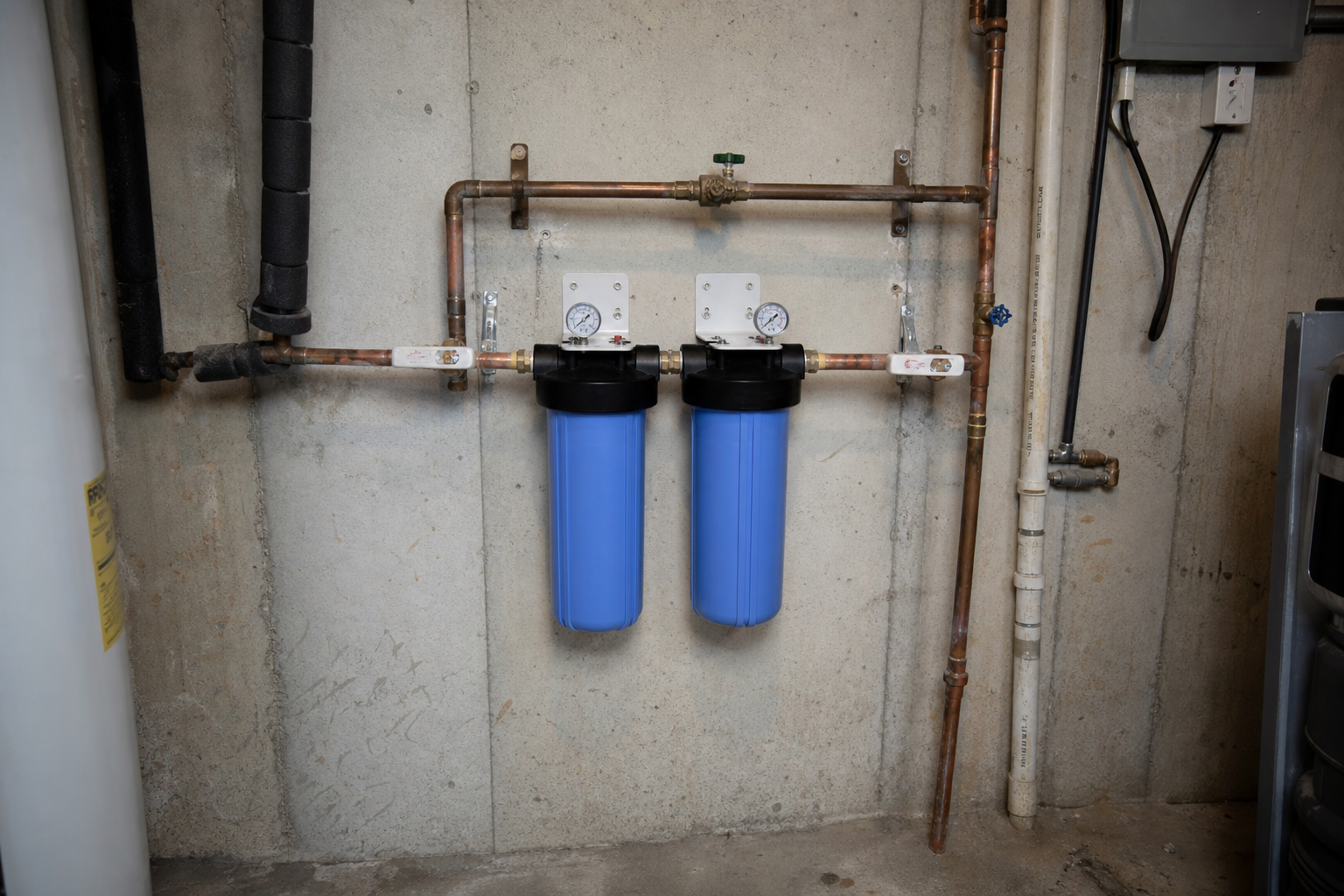
For a quick reference on sediment, see our sediment entry.
Quick answer: Sediment — sand, silt, rust flakes, pipe scale — has no health standard of its own; it is a plumbing and appliance problem, and the fix is a staged micron ladder (coarse washable first, fine disposable second), not one magic cartridge. A spin-down prefilter at 100 μm plus a 25 or 5 μm cartridge covers most homes for $60–150. Carbon filters don’t remove dissolved anything, and letting sediment run straight into an RO membrane is how $100 membranes die early.
Test first — three minutes and a flashlight. Unscrew any whole-house or fridge filter housing and look at the cartridge’s color: orange-red grit = rust from pipes or mains; gray/tan grit = well sand or silt; slimy brown = organics or bacteria (different page, here). No filter installed yet? Fill a white bucket from an outside spigot, shine a flashlight through it, and see what floats. That color reading routes the fix.
Top Picks at a Glance (2026)
Sediment is where carbon-block construction does mechanical work — the three picks by capture platform and rated life:
Three blocks for 18 months of changes; sediment-heavy supplies eat cartridges faster, and pack math absorbs that.
Where Sediment Comes From
1. Private wells (sand and silt). New wells, recently serviced wells, and wells in sandy or fractured-rock aquifers push fine grit that no municipal plant ever filters for you — it’s your pump, your problem. The tell: sediment appears at every tap, worse after heavy use or pump cycling.
2. Aging municipal mains (rust and scale). City water leaves the plant clean; a century of cast-iron main carries next to it. Peak events follow hydrant flushing, main repairs, and fire-fighting draws — sudden rusty water that clears after minutes of flushing.
3. Your own water heater (the hot-only case). If sediment shows up only on the hot side, the tank is shedding its own rust and scale — drain-flush the heater before you buy a single filter, and check the iron page for the chemistry.
“My filter clogs fast” is a diagnosis, not a complaint
Where sediment appears
Likely source
First move
Every tap, all temperatures, steady
Well sand/silt or failing well screen
Spin-down + staged cartridges at point of entry
Every tap, worse in fall/spring or after street work
Water main rust and scale
Flush protocol; cartridge stage at entry; call the utility for hydrant schedules
Hot taps only
Water heater rust/scale sediment
Drain the tank (free); replace the anode if due
One faucet only
Old galvanized branch pipe shedding
Replace or flush that branch; a point-of-use cartridge is a bandage
The clogging speed of your filter is your free diagnostic instrument — a cartridge that browns in three weeks is telling you the upstream story faster than any lab report.
Health Effects — What the Limits Are Protecting
Number
What it is
What it means
0.3 NTU / 1 NTU
Municipal turbidity Treatment Technique (95% of samples ≤0.3, never >1)
Cities must clarify continuously; what happens in the pipes afterward is unpoliced
No private standard
Sediment per se is unregulated
Your home standard is functional: protect appliances and stop clogging
5–100 μm
The household ladder ratings
Coarse washable stage catches the bulk; fine stage polishes
The honest framing: typical U.S. sediment is inert grit — a nuisance and an appliance-killer, not a poison. Its real harm is collateral: grit scars valve seats, packs water heater bottoms, blinds expensive downstream filters, and provides shelter for bacteria that clean water would flush away. You are filtering to protect machines and media, which is exactly why the cheap front-end stages matter most.
Zero recurring cost — flush the screen monthly; protects everything downstream including the next stage
Melt-blown polypropylene cartridges (1–50 μm)
The workhorse rung
$3–10 each
Match micron to the problem: 25 μm for sand, 5 μm for fine silt/rust; swap on pressure drop, not calendar
Backwashing media (NextSand-class)
High-flow whole-house rung
$600–1,500
For wells with continuous heavy grit — self-cleaning, no cartridge treadmill
~~Carbon block as the first line~~
Wrong job
—
Carbon removes chlorine and organics, not grit — and sediment buries its surface, wasting an $8–40 cartridge on $2 worth of dirt. Sediment first, carbon second: that ordering is the whole game
~~RO membrane alone~~
Delicate last resort
—
RO is the worst first responder — membranes foul on grit; feed RO prefiltered water or budget for early membrane replacement
At the point of use for drinking water, an NSF/ANSI 53 certified refrigerator cartridge is the last barrier – the RPWFE-compatible ClearFit cartridge carries the 42/53/401 ratings that cover this contaminant class.
Matched to the Numbers Above
Entry tier ($40–80): Spin-down prefilter at the point of entry — the single highest-value purchase on this page, with zero consumable cost.
Full ladder ($60–150): Spin-down → 25 μm → 5 μm, with carbon only after the sediment stages (that final carbon is for chlorine, not dirt).
Well workhorse ($600–1,500): Backwashing media filter when cartridge swaps exceed quarterly — the payback math is in consumables avoided.
Wait — Is My Refrigerator Filter Enough for Sediment?
No — worse, sediment is what’s killing the filter you have. Fridge cartridges are fine-polish carbon, not grit machines; feeding one unfiltered well water blinds it early, which is why fridge filters in sediment homes “stop working” months before their rated life. A $6 sediment cartridge upstream of a fridge line or ice maker is the cheapest equipment-protection purchase in this entire catalog.
What the fridge filter does after grit is handled upstream: chlorine, taste, odor — its actual job.
Related problems worth checking while you’re here:
Cloudy water — milky-white glass that clears bottom-up is air, not sediment; the one-minute glass test is on that page
Iron in water — orange staining that keeps returning even after filtration is dissolved iron, needing oxidation, not finer pores
Do water filters remove sediment? Yes — sediment is the most filterable problem in water (it’s physical particles versus physical barriers). The failure mode is picking the wrong ladder rung: too fine too early clogs instantly; too coarse too late lets grit through to appliances.
How much sediment in water is too much? No health number exists. The functional standard: if you can see it, taste grit, or your cartridge browns inside a month, that’s too much for the machines — measure by filter-loading, not lab units.
Does boiling water remove sediment? It settles some of it; the dirt remains in the pot. Boiling is a disinfection tool, not a filtration tool.
Is my refrigerator or pitcher filter enough for sediment? No — and it’s the wrong question direction. Sediment destroys fridge cartridges; a $2–6 sediment pre-stage protects the $40+ cartridge you already bought.
Where does a sediment filter go? As close to the point of entry as practical (after the pressure tank on wells), always upstream of softeners, carbon stages, and RO systems — first in line, always, protecting every dollar of equipment that follows it.
How often do I change sediment cartridges? On pressure drop, not calendar: when flow at the far faucet drops noticeably, the cartridge is full. Heavy-grit homes: weeks. Municipal homes with a post-flush spike: the cartridge catches the slug and goes back to months.
Matching the ladder to your diagnosis (the two-minute selector)
Your observation (from the color read)
Ladder configuration
Rough budget
Well sand, steady, every tap
Spin-down 100 μm → 25 μm PP; add 5 μm if fines persist
$60–150
Post-flush municipal rust slugs
Single 25 μm PP at entry (the slug-catcher)
$40–70
Fine sint that bypasses 25 μm
Add the 5 μm stage; consider backwashing media if swaps exceed quarterly
$90–200 (or $600–1,500 media tier)
Hot-only grit
No entry filter fixes this — drain-flush the water heater, then re-evaluate
$0 first
Protecting a fridge/ice line only
Mini spin-down + 5 μm inline before the appliance
$30–60
Two installation notes worth their word count: mount any outdoor or garage point-of-entry stage with freezing in mind (a burst spin-down body in January is the classic omitted line-item — insulated enclosure or drain-down for cold snaps), and always install housings with a pressure-relief button and a wrench-compatible orientation — the $8 difference between a bargain housing and a good one is paid back the first frozen-solid cartridge change.