Iron in Your Water: The Three Forms, the Overnight Glass Test & What Actually Removes It

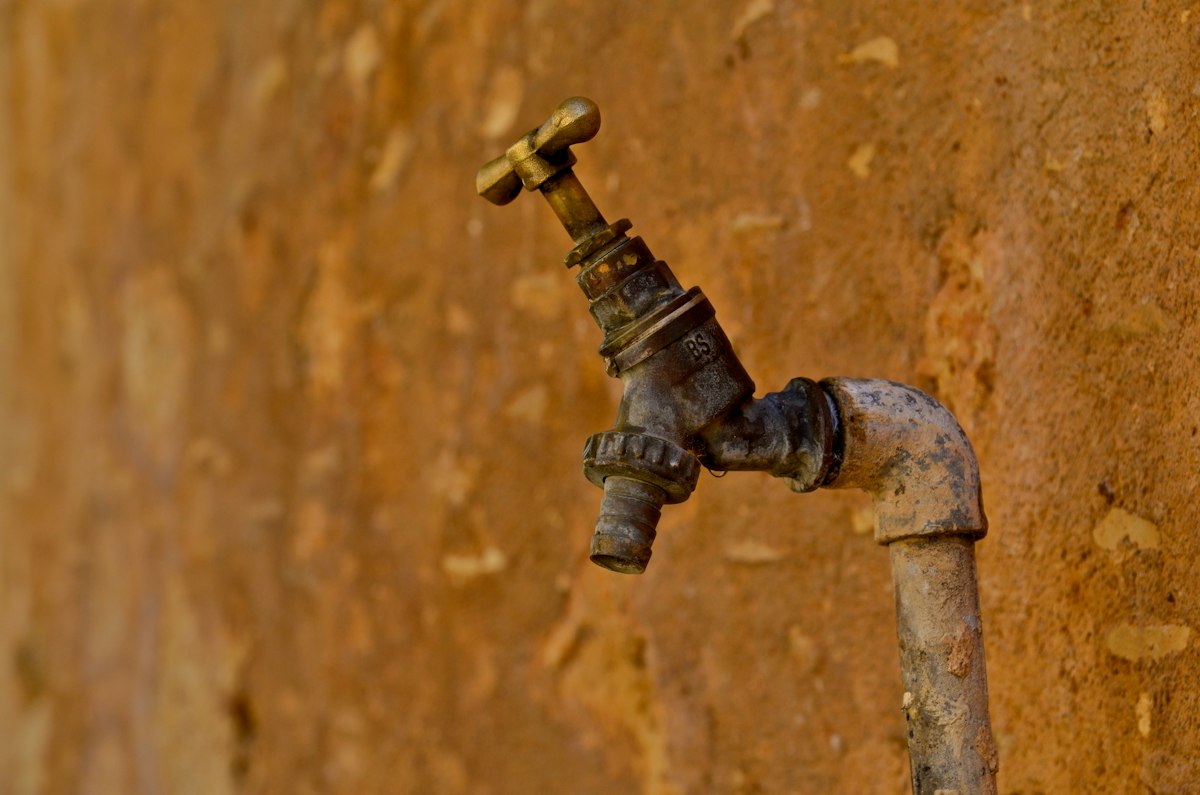
For a quick reference on iron, see our iron entry.
Quick answer: Iron’s federal limit is a secondary (aesthetic) standard of 0.3 mg/L — it stains fixtures and tastes metallic long before it threatens health. Removing it depends entirely on which form you have: dissolved (clear-then-yellow) iron needs oxidation before filtration, particle (rust-red) iron filters directly, and organically bound or iron-bacteria iron needs a different playbook. Carbon fridge filters and boiling do nothing; a water softener only handles small amounts of the dissolved form.
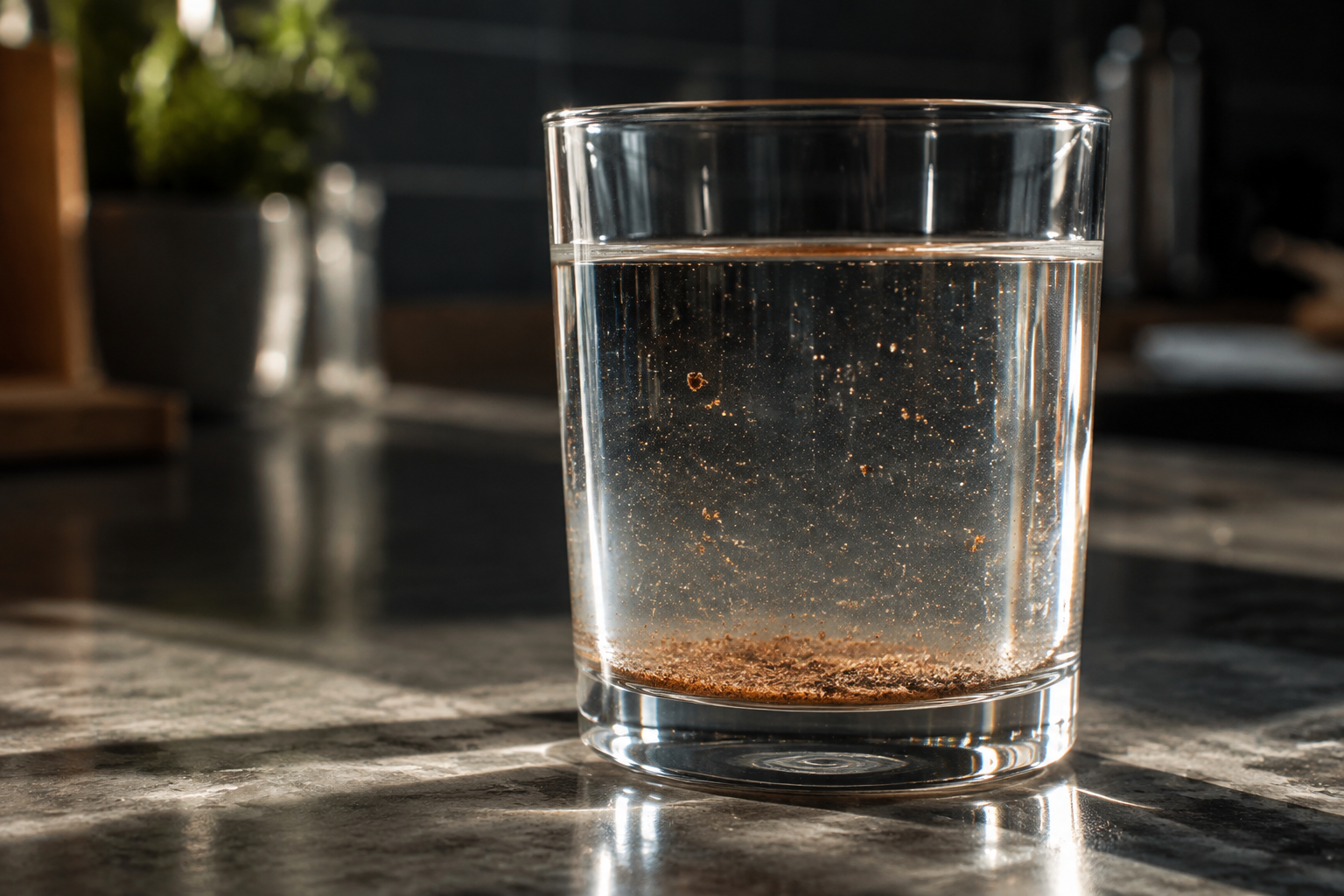
Test first — tonight, for free. Fill a clear glass straight from the tap and one after letting a sample sit overnight. Fresh-poured but yellowed after standing = dissolved iron oxidizing in front of you. Red sediment at the bottom by morning = particle iron. Tea-colored water that never settles, or a slimy film in the toilet tank = organically bound iron or iron bacteria — send that to a lab ($40–80, ask for iron plus iron bacteria presence), because treatment paths differ completely.
Where Iron in Water Comes From

1. Natural geology (wells, overwhelmingly). Iron is the fourth most abundant element in the earth’s crust; water sitting in iron-rich aquifers dissolves it steadily. Private wells across the Midwest, Appalachia, and New England routinely measure 1–5 mg/L — several times the aesthetic threshold — with zero industrial help.
2. Corroding iron pipes and well casings. Older municipal neighborhoods with cast-iron mains deliver rust as a gift from the distribution system itself; the tell is rusty bursts after hydrant flushing or main repairs rather than constant color.
3. Iron bacteria (the sneaky one). Naturally occurring bacteria that feed on dissolved iron leave slime and rainbow sheens in toilet tanks and foul smells — often mistaken for “just bad water” for years. Their presence changes which equipment you buy, which is why the overnight test matters more than any shopping list.
The three-form diagnosis (60 seconds, zero equipment)
| What you observe | Form of iron | First-line treatment |
|---|---|---|
| Water is clear from the tap, yellows after standing; overnight glass has yellow tint, no heavy sediment | Dissolved (ferrous, Fe2+) | Oxidize then filter — air injection + media, manganese dioxide media, or a softener if also hard and iron < ~2 mg/L |
| Water runs rusty/red from the tap; grit settles in the glass within minutes | Particulate (ferric, Fe3+) | Straight filtration — sediment cartridge stage or backwashing media |
| Tea-colored water that never settles; slimy or oily film in toilet tank; musty/swampy smell | Organically bound iron or iron bacteria | Oxidation (chlorine/peroxide injection) or shock treatment, then filtration — a plain iron filter will blind |
This table is worth more than most in-home consultations — the $1,500 mistake we see most often is a particle filter bought for a dissolved-iron problem (clear water passes right through it) or an iron filter bought for a bacteria problem (it silts up in three months).
Health Effects — What the Limits Are Protecting
| Number | What it is | What it means |
|---|---|---|
| 0.3 mg/L | EPA Secondary standard (SMCL) | Staining, metallic taste, and laundry damage begin around here — a property-damage line, not a health line |
| ~0.3 mg/L | Taste threshold | Your palate is roughly as sensitive as the standard |
| 1–2 mg/L | Practical ceiling for softener-assisted removal | Above this, dedicated oxidation/filtration takes over |
The honest health framing: at the concentrations found in any U.S. water system, iron is not a meaningful health hazard — it is an essential nutrient you’d struggle to overdose from water. The case for treating iron is entirely economic and sensory: ruined laundry, orange toilet bowls, premature appliance death, metallic coffee. “Stains on your porcelain are money leaving your plumbing” — a good iron filter pays for itself in fixtures, clothes, and water heater life.
How to Remove Iron — The Honest Comparison
| Method | Works on | Capacity ceiling | Honest notes |
|---|---|---|---|
| Manganese dioxide media (Katalox Light-class) | All three forms after appropriate pre-oxidation; also handles manganese and H2S | To ~15+ mg/L with proper design | The workhorse whole-house media — see the “well water trio” note below |
| Air injection oxidation + filtration | Dissolved iron, H2S | Moderate-high | Chemical-free oxidation; the standard modern well configuration |
| KDF-85 media | Dissolved iron, H2S | Low-moderate | Common in cartridge form; honest fit = light problems, point-of-entry scale |
| Water softener (ion exchange) | Dissolved iron only | ~1–2 mg/L | A softener removing trace iron is a legitimate bonus, never the mission — above 2 mg/L it fouls the resin. This row is yellow, not green: it works inside a narrow band and people over-trust it |
| ~~Carbon cartridges (fridge, pitcher, faucet)~~ | Nothing for dissolved iron | — | Carbon neither oxidizes nor ion-exchanges iron; it will clog on particulate iron without a sediment stage |
| ~~Boiling~~ | Nothing; it concentrates | — | Oxidized iron precipitate is why boiled well water turns orangish |
The well-water trio, one system. Iron almost never travels alone: manganese (black staining) and hydrogen sulfide (rotten-egg smell) share the same oxidation chemistry, which is why manganese-dioxide media systems are sold as three-in-one solutions. If your overnight glass shows iron symptoms, test all three plus hardness before sizing anything — the combined number sets the media volume, and undersized systems fail by month six.
Matched to the Numbers Above
- Testing tier ($40–80): Lab panel covering iron, manganese, hardness, pH, and TDS (iron treatment depends on pH — manganese dioxide media wants a pH above ~6.5–7) — plus an iron-bacteria check if the tank shows slime.
- Point-of-use tier ($60–150): If the problem is one drinking faucet with particulate rust from old mains: a 5 μm → 1 μm sediment duo upstream of a carbon block. Honest scope: spot fix, not whole-water.
- Whole-house tier ($1,200–3,000 installed): Air-injection oxidizing filter with Katalox-class media sized to your lab report — this is where dealer quotes scatter wildly; self-install kits and a plumber’s hour typically undercut the $3,000 in-home-sales version of the same equipment.
Wait — Is My Refrigerator Filter Enough for Iron?
No — and it can be worse than nothing. A fridge carbon cartridge will not touch dissolved iron at all, and unfiltered ferric particles will blind the carbon block early, silently killing the chlorine/taste performance you bought it for. A cheap sediment pre-stage protects the cartridge; removing iron happens upstream of the fridge or not at all.
Related problems worth checking while you’re here:
- Manganese in water — the black-stain twin; same media, test it in the same panel
- Sulfur smell in water — the third member of the well-water trio
- Tannins in water — how to tell tea-colored tannins from tea-colored iron (the bleach test is in that page)
Iron Questions, Answered Straight
How much iron in water is too much? The federal secondary standard is 0.3 mg/L — staining and taste, not health. Wells commonly exceed it several-fold; the question isn’t danger, it’s how fast it’s eating your fixtures and laundry.
Does boiling water remove iron? No. Boiling can oxidize some dissolved iron into particles that settle, but the iron stays in the pot or kettle — concentrated, plus new scale.
Is my refrigerator or pitcher filter enough for iron? No. Carbon doesn’t remove dissolved iron, and particulate iron clogs the cartridge. Iron belongs to whole-house oxidation-filtration (or a softener in its narrow band).
Can a water softener remove iron? Yes, dissolved iron only, up to roughly 1–2 mg/L, as a side benefit of the ion exchange. Higher iron fouls resin — that’s when a dedicated iron filter goes ahead of the softener (“remove the iron first, then soften”).
Is it safe to drink water with high iron? At levels found in wells (even 5–10 mg/L), yes, from a toxicology standpoint — nausea-level iron overdose from water is essentially unheard of in U.S. supplies. People treat iron for their plumbing, laundry, and taste, which are fully sufficient reasons.
Why did my dealer quote $3,000 for an iron filter? Often the same $900–1,500 equipment with in-home sales overhead, extended service contracts, and bundled media. Air-injection systems are well within plumber-install territory — get the lab numbers first, then compare the quote against the equipment it names.
What order should well equipment go in — iron filter, softener, or both? Iron (and its trio-mates) first, softener second: the oxidizing media takes the dissolved iron that would otherwise foul softener resin, and the softener then finishes hardness (while quietly handling any trace iron left, inside its narrow band). UV, if installed, goes last — clearest water wins the dose game. The order is chemistry, not preference.
What’s the best filter for iron in well water? The one matched to your iron’s form — which is why the cheapest way to remove iron is a $30–60 lab test before any equipment. The mapping: dissolved (clear, later stains) → an oxidation-filtration system (air-injection manganese-dioxide media is the well-country standard), whole-house; particulate (red grit immediately) → a 5-micron sediment prefilter at the entry, pennies by comparison; low dissolved iron under ~1–2 mg/L that’s already sharing a softener → the softener’s ion exchange covers it, no dedicated filter needed. Buy the lab picture first, the tank second — the reverse order is how the $3,000 quotes in the earlier question happen.
Sources
- U.S. EPA — Ground Water and Drinking Water — federal drinking-water standards, testing, and treatment guidance
- CDC — Drinking Water — health information on water contaminants, testing, and private wells
Related: Well Water Problems Overview · Whole-House Filter Sizing Guide · Cloudy Water Causes
Data page: Iron – full entry & treatment options