Microplastics in Your Water: What’s Confirmed, What Isn’t & What Actually Filters Them

For a quick reference on microplastics, see our microplastics entry.
Quick answer: There is no federal limit for microplastics in U.S. drinking water (California is building the first monitoring program). Physically, microplastics are large particles on a filtration scale — a reverse osmosis membrane (0.0001 micron) stops them by pure size exclusion, and a 0.5-micron absolute carbon block catches nearly all. Standard fridge and pitcher cartridges have no microplastic claim, and boiling does not remove them (the 2024 “boiling removes microplastics” study had a hard-water catch you should read before trusting it).
Test first — and here’s the honest part: there is no practical home test for microplastics. Certified lab analysis exists but typically costs $200–400 for a single sample — usually more than the under-sink filter you’d buy anyway. The rational order is: identify your biggest exposure source first (the table below may surprise you), then filter at the drinking point.
Top Picks at a Glance (2026)

Microplastics are a particle problem, which makes carbon-block construction and rated life the specs that matter. Three picks:
| Pick | Product | Why it wins |
|---|---|---|
| Best claim coverage | RPWFE-compatible carbon-block cartridge | The deepest claim set in the pool — NSF 42/53 plus 401-listed PFOA/PFOS reduction — on a carbon block that works by physical capture. |
| Best overall | Filter 1-compatible carbon block | NSF/ANSI 42-tested coconut-shell carbon block, 200-gallon rated life; the widest compatibility footprint of any cartridge we stock. |
| Best lead-plus-particle pick | the lead-reduction variant | Same carbon-block platform with the lead-reduction designation — particle-class and dissolved-class coverage in one cartridge. |
Where Microplastics in Water Come From
1. Treated wastewater and environmental cycling. Synthetic textile fibers (polyester, nylon, acrylic) shed in every laundry load; tire dust, fragmenting litter, and industrial pellets wash through watersheds into source water. Municipal treatment removes most large particles but is not designed for sub-micron fragments.
2. Bottled water — the counterintuitive leader. The 2024 PNAS study that made headlines found an average of roughly 240,000 plastic fragments per liter in popular bottled water brands — about 10–100x typical tap counts — most of them nanoplastics generated by the bottle and cap themselves. If you buy bottled water to avoid microplastics, you have optimized in the wrong direction.
3. Your own plumbing and containers. Plastic kettles, fridge reservoirs, and delivery tubing shed polymer particles over time; single-serve containers shed most of all. Exposures add across sources: bottled water > teabags (polymer bags release microfibers in hot water) > table salt > tap water, roughly in that order.
Exposure source ranking — where the particles actually are
| Source | Rough relative contribution | Note |
|---|---|---|
| Bottled water (heavy user) | Highest measured counts | ~240k fragments/L average (PNAS 2024) — bottle material is the source |
| Tea brewed in plastic-nylon bags | High per serving | Billions-scale sub-microfibers per bag in 95°C water (2024 McGill findings) |
| Sea salt | Moderate | 1–2 pinches per meal; micro-particles per kg documented |
| Tap water (U.S.) | Lower | Typically hundreds–thousands of fragments/L; varies by watershed |
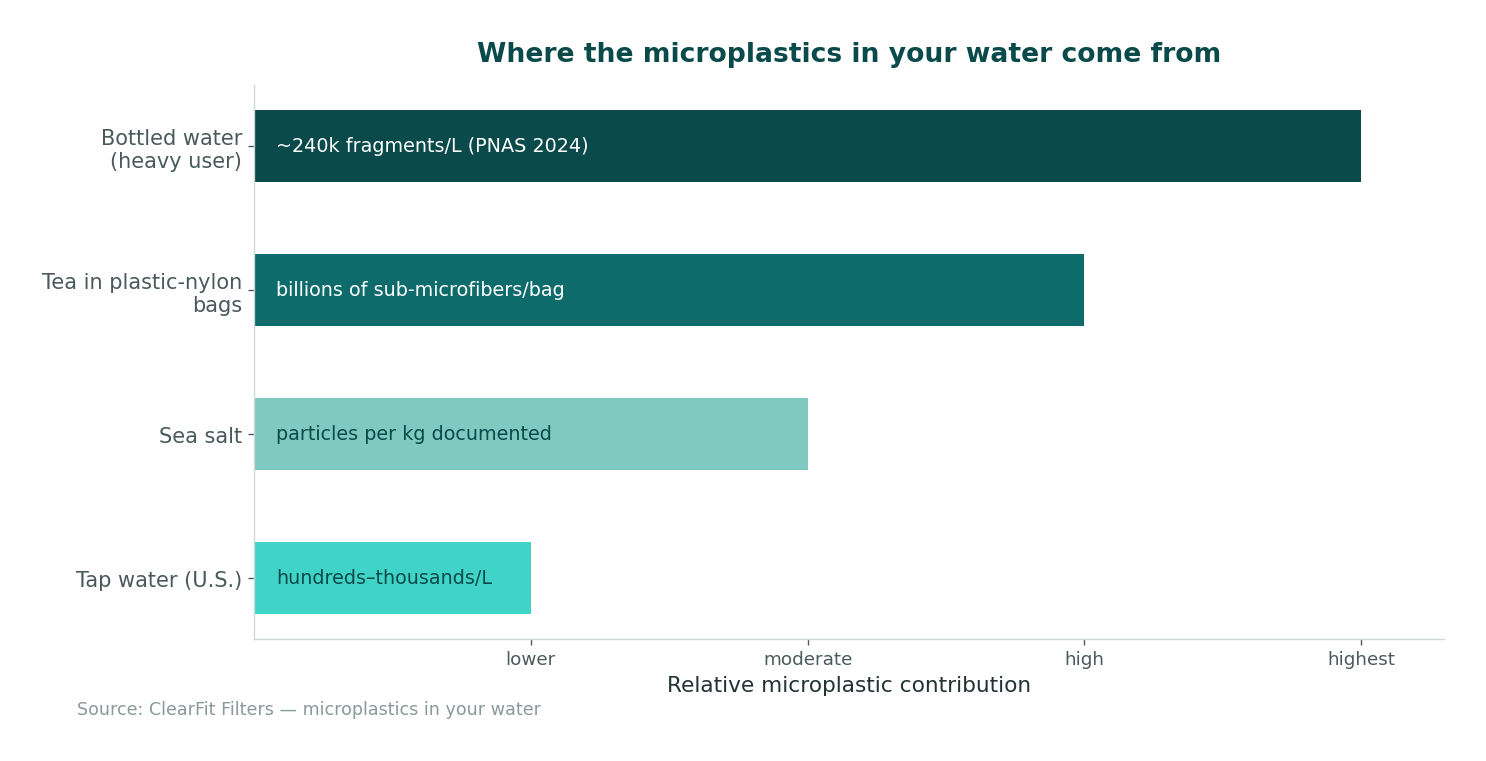
Read that table twice before spending money: the cheapest microplastic intervention is not buying bottled water, which is free and simultaneously lowers the largest measured exposure.
California’s SB 1422 program requires public water systems to monitor microplastics and report results — the first statewide framework in the nation, phased in over the mid-2020s. No federal MCL exists or is close. Last review of this page: August 2026.
Health Effects — What the Limits Are Protecting
| Number | What it is | What it means |
|---|---|---|
| No federal MCL | Unregulated at the federal level | EPA has not set a health limit; hazard research is active and unsettled |
| ~240,000 fragments/L | Bottled-water average (PNAS 2024) | The study that reset the debate — most were nanoplastics |
| 0.0001 μm | Reverse-osmosis membrane pore rating | Physical logic: particles measured in microns cannot cross a membrane rated a thousand times smaller |
The honest state of the science (dated August 2026): human exposure is confirmed everywhere it has been measured — blood, lung tissue, placenta. What is not established is dose-dependent harm at environmental levels: cell and animal studies show inflammation signals; human epidemiology has not connected tap-water-level exposure to disease. Anyone selling you panic or dismissing the question entirely is ahead of the data in opposite directions. For households that want to act anyway, the physical filtration logic is airtight even where the health data is not.
How to Remove Microplastics — The Honest Comparison
| Method | Effect on microplastics | Certification to look for | Honest notes |
|---|---|---|---|
| Reverse osmosis | Near-total by size exclusion | NSF/ANSI 58 (general) — no microplastic-specific claim exists yet | A 0.0001 μm membrane versus micron-scale particles is a cliff, not a contest |
| 0.5 μm absolute carbon block | Very high for micro-fibers and fragments | Look for absolute (not nominal) rating; see our micron rating explainer | “Absolute” is the load-bearing word — nominal ratings are averages full of holes |
| Steam distillation | Near-total | — | Effective but slow; overkill unless you already distill |
| ~~Standard fridge/pitcher cartridges~~ | Unknown to partial | No OEM cartridge carries a microplastic claim | Theoretically a 1 μm-class carbon block intercepts many fibers — but untested and unclaimed means unverified; we won’t pretend a claim that nobody has made |
| ~~Boiling~~ | Conditional, mostly no | — | The 2024 Guangzhou study found hard-water boiling (calcium carbonate encrusting particles) settled 80–90% — in hard water only; soft-water boiling removed essentially nothing. Headlines dropped the hard-water condition; we won’t |
At the point of use for drinking water, an NSF/ANSI 53 certified refrigerator cartridge is the last barrier – the RPWFE-compatible ClearFit cartridge carries the 42/53/401 ratings that cover this contaminant class.
Matched to the Numbers Above
- Zero-cost tier: Stop buying bottled water for microplastic reasons — you remove the largest measured source and save the money.
- Point-of-use tier ($200–400): Under-sink RO — covers microplastics, PFAS, lead, and TDS in one membrane; the rational single purchase for “water anxiety” generally.
- Whole-house tier: Not justified by microplastics alone — dermal exposure evidence is thin; spend at the drinking tap, where ingestion is real.
Wait — Is My Refrigerator Filter Enough for Microplastics?
Honestly: nobody has certified that it is, and we won’t fill that silence with a guess. Fridge cartridges are typically 0.5–1 μm-class carbon blocks, which should physically intercept micro-fibers — but no OEM (GE, Whirlpool, Samsung, LG) lists a microplastic claim, so the honest statement is: probably partial, unverified, and unclaimable. If microplastics are your specific concern, an RO under the sink is the move that comes with physics instead of marketing.
What your fridge filter verifiably does: chlorine, taste/odor, and (on claim-listed models) lead and cysts.
Related problems worth checking while you’re here:
- TDS in water — the meter reading that tells you about everything dissolved, including things it can’t specifically identify
- Sediment in water — the visible cousin: particles big enough to clog filters and cloud glasses
- PFAS in water — the other “new contaminant” headline family, where certification claims do exist and matter
Microplastics Questions, Answered Straight
How much microplastics in water is too much? No one knows — there is no federal or WHO health limit. California’s monitoring program is the first attempt to standardize measurement, which is the step that precedes any limit. Filter at the drinking point if you want to act ahead of the science.
Does boiling water remove microplastics? Only in hard water, partially: the 2024 findings showed calcium carbonate forming crusts around particles that then settled — 80–90% in hard water, essentially nothing in soft water. Boiling soft water does not remove microplastics and concentrates anything else that doesn’t evaporate.
Is my refrigerator or pitcher filter enough for microplastics? Unverified. The carbon block would physically catch many fibers, but no manufacturer claims it — and an unclaimed, untested reduction is not something a filter retailer should assert for you.
Does bottled water have microplastics? Yes — measurably more than tap, on average ~240,000 fragments/L in the 2024 PNAS sampling, mostly nanoplastics from the bottle itself. Switching from bottles to filtered tap is the single largest exposure cut available.
Do Brita-style pitchers remove microplastics? No pitcher carries a microplastic claim. Gravity-fed carbon with nominal filtration is the wrong tool for a claim no one has certified.
The research timeline — how we know what we know (dated, deliberately)
The science on this page has a short, fast-moving history, and knowing the sequence helps you read future headlines with the right skepticism:
| Year | Finding | Why it mattered |
|---|---|---|
| 2019 | WHO’s first microplastics-in-drinking-water review | Concluded “no clear health evidence at current levels” — the official-calibration starting point |
| 2022 | Detection-method breakthroughs (sub-micron imaging) | Revealed nanoplastics in counts 10–100x previous estimates — the methods had been undercounting |
| 2024 | PNAS bottled-water study (~240,000 fragments/L, mostly nanoplastics) | Reset the exposure conversation — and made bottled water the problem, not the refuge |
| 2024 | Guangzhou boiling study (hard-water co-precipitation of 80–90%) | The “boiling removes microplastics” headline — conditionally true in hard water, near-useless in soft |
| 2025–26 | Ongoing toxicology (gut, placenta, inflammatory markers) | Exposure confirmed everywhere; dose-harm still unsettled — the honest state of the science |
The pattern worth internalizing: every couple of years a measurement advance rewrites the exposure numbers, while the harm evidence moves slowly. Pages (and news stories) that blur those two speeds — claiming exposure news as harm news, or harm uncertainty as exposure doubt — are misreading the timeline in one direction or the other.
Sources
- WHO — Drinking-water — WHO drinking-water quality guidance and fact sheets
- U.S. EPA — Ground Water and Drinking Water — federal drinking-water standards, testing, and treatment guidance
- EPA — Contaminant Candidate List (CCL) — unregulated contaminants under evaluation for future drinking-water rules
Related: What Is a Micron Rating? · RO Filter Replacement Schedule · Chlorine in Water
Full entry: Microplastics – full entry & treatment options