MERV 11 Air Filters

The Allergy Tier — the Lowest Rating That Targets Submicron Particles (≥20% of 0.3–1 µm, ASHRAE 52.2)

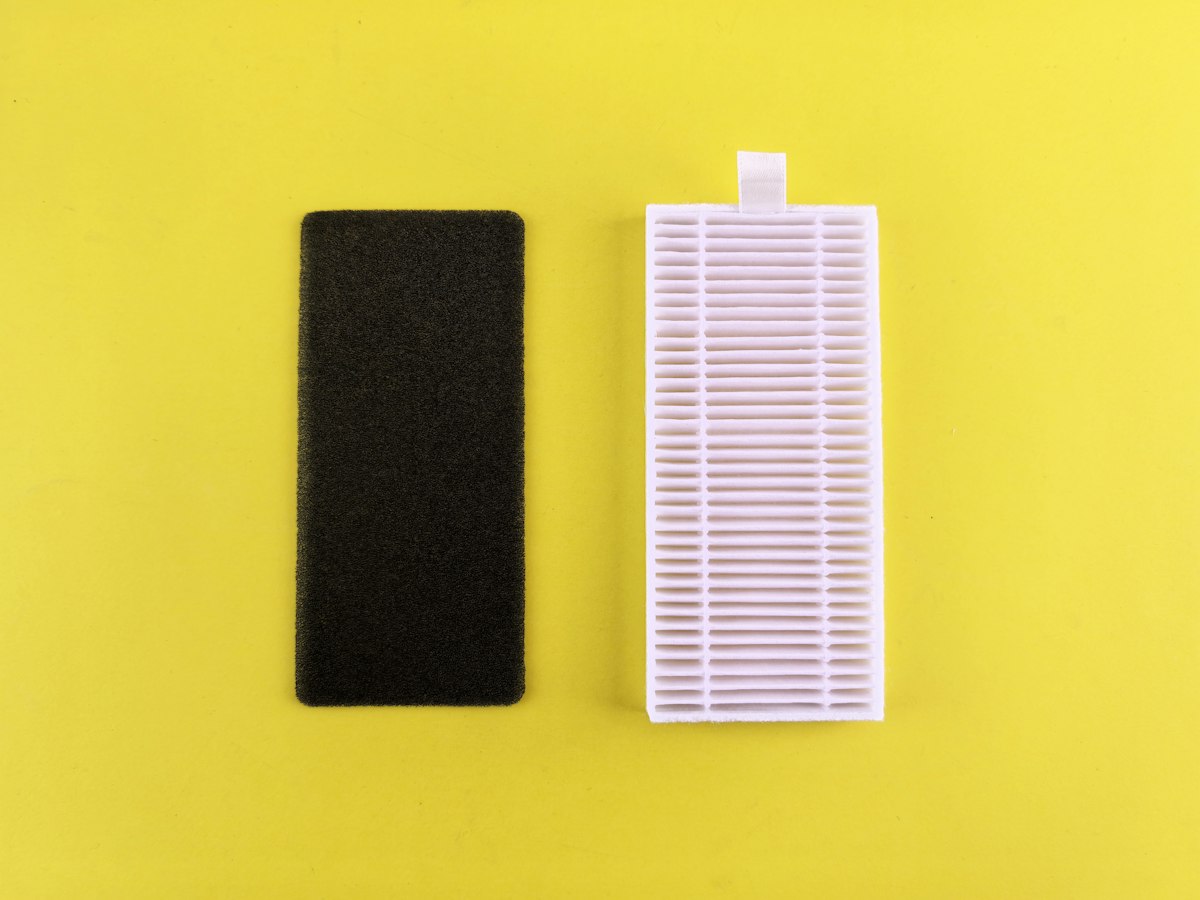
MERV 11 is the sweet spot for allergy sufferers and pet households — and the first rating on the ASHRAE scale with a submicron requirement. Under ASHRAE Standard 52.2, a MERV 11 filter must capture at least 20% of particles in the 0.3–1.0 µm band (E1), 65% of 1.0–3.0 µm (E2), and 85% of 3.0–10 µm (E3). That E1 floor is the whole story: MERV 8 has no submicron requirement at all, so the jump to MERV 11 is where pollen fragments, pet allergen proteins, and fine urban dust first get a rated defense. It fits most systems built in the last decade, and in a 4-inch media cabinet it runs at lower airflow resistance than a 1-inch MERV 8 — the upgrade that doesn’t cost your blower anything. If you’re weighing it against the top tier instead, MERV 13 doubles every floor but demands a system check first; MERV Rating Explained covers the mechanics.
Quick answer: Allergies, shedding pets, or urban dust — and your system is newer than ~2015 or has a 4-inch cabinet → MERV 11 is your rating. Old PSC-blower furnace with a 1-inch slot → check the compatibility block below before committing (or run MERV 8 and rest easy). Smoke or respiratory illness → MERV 13.
Shop MERV 11 Filters by Size

4-Inch Thick — the MERV 11 value layer ★
4-inch MERV 11 is where this rating shines: roughly 3–4× the media area of a 1-inch filter means near-MERV-8 airflow resistance at MERV 11 filtration. If your air handler or return box takes a 4-inch cabinet filter, buy this tier and stop thinking about it. The demand side agrees: the five most-searched 4-inch MERV 11 size combinations each run 110–210 searches a month — the densest size×rating cluster in the category, which is why the 4-inch sizes below carry their own pages rather than one generic listing.
- 20x25x4 MERV 11 ★ most popular — the single most-searched 4-inch MERV 11 combination
- 20x20x4 MERV 11 ★
- 16x25x4 MERV 11 ★
- 20x24x4 · 16x24x4 · 24x24x4 · 14x25x4 · 25x25x4
1-Inch Thick (standard slot)
| 20x20x1 ★ | 20x25x1 ★ | 16x25x1 | 16x20x1 |
| 20x30x1 | 14x25x1 | 14x30x1 | 14x20x1 |
| 14x24x1 | 18x20x1 | 12x24x1 | 20x24x1 |
| 24x24x1 | 16x24x1 | 18x24x1 | 18x30x1 |
| 12x20x1 | 16x30x1 | +23 more sizes | → all 1-inch |
2-Inch Thick (deeper retro slot)
20x25x2 · 20x20x2 · 16x25x2 · 16x20x2 — full size index · odd slot? Custom sizes to the quarter-inch.
★ = most-ordered MERV 11 sizes. Not sure of your dimensions? How to measure your air filter size (nominal vs actual — the ⅜-inch trap).
What MERV 11 Catches — and What It Doesn’t
Captures effectively:
- Pollen fragments and pet allergen carriers — the E1 floor (≥20% of 0.3–1 µm) plus a 65% E2 floor is what makes this the allergy rating; the Fel d 1 / Can f 1 proteins that actually trigger reactions ride on particles in and below these bands ✔
- Fine dust and PM2.5-range particles (1–2.5 µm, E2 band at ≥65%) ✔
- Mold spores, dander, dust mite debris (E3 band at ≥85%) ✔
- Auto-emission particulate and road dust ✔
Captures partially:
- Submicron smoke particles (0.3–1 µm) — ⚠ the ≥20% E1 floor is a start, not a solution; wildfire smoke and cooking haze are partially caught, not targeted. Smoke is MERV 13‘s job (≥50% E1).
- Bacteria carriers and droplet nuclei — ⚠ partial, same band.
Not rated for: viruses as such, gaseous pollutants (VOCs, NO₂ — no particulate filter of any MERV catches gases; that’s activated carbon’s job), or odors.
MERV 8 vs MERV 11 vs MERV 13
| MERV 8 | MERV 11 | MERV 13 | |
|---|---|---|---|
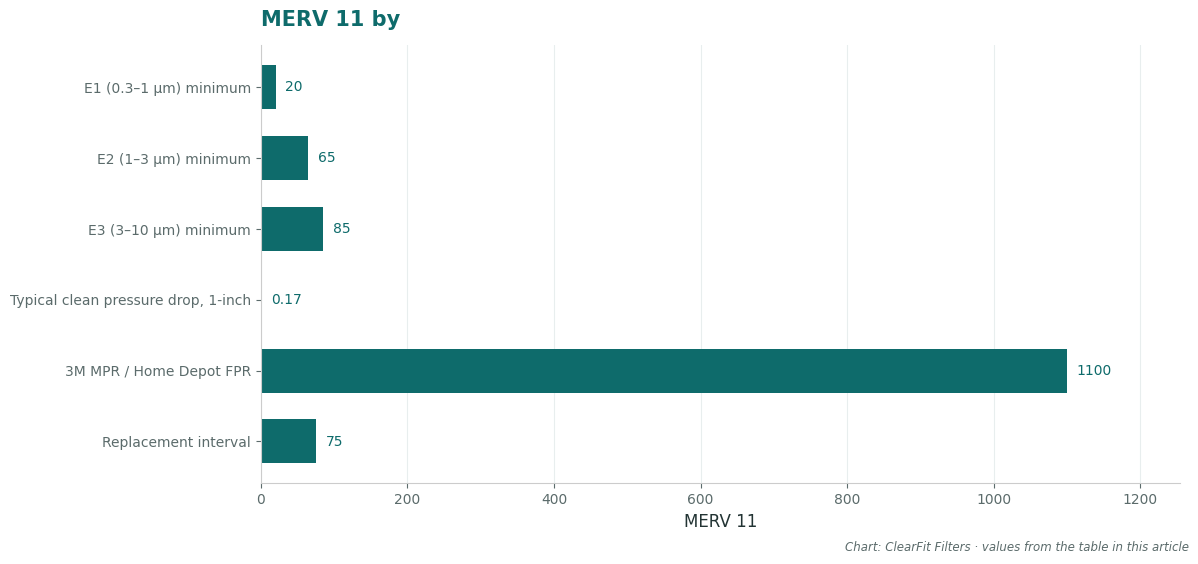
| E1 (0.3–1 µm) minimum | — | ≥20% ← first submicron floor | ≥50% |
| E2 (1–3 µm) minimum | ≥20% | ≥65% | ≥85% |
| E3 (3–10 µm) minimum | ≥70% | ≥85% | ≥90% |
| Typical clean pressure drop, 1-inch | 0.10–0.15″ WG | 0.14–0.20″ WG | 0.20–0.30″ WG |
| Same MERV in a 4-inch cabinet | — | drops to ≈ MERV-8-1″-level resistance | ≈ 1-inch MERV 11 level |
| 3M MPR / Home Depot FPR | 600 / FPR 5 | 1000–1200 / FPR 7 | 1500–1900 / FPR 10 |
| Replacement interval | 90 days | 60–90 days | 30–60 days |
The rating-by-rating decision logic — including the three-step PSC vs ECM blower-motor check — lives in MERV 8 vs MERV 11: Which One Your HVAC Can Actually Handle.
When MERV 11 Is the Right Choice
One strategy note before the list: the rating does not have to be a year-round identity. Households with strong seasonal triggers (pollen spring, harvest dust fall) routinely run MERV 11 for the trigger season and step down to MERV 8 for the quiet months — a legitimate pattern that halves annual filter spend in 1-inch slots, and exactly what a filter calendar is for. The households that should not rotate: smoke regions (wildfire season is MERV 13’s season, not MERV 8’s) and year-round pet/allergy loads.
1. Pollen and seasonal allergies. This is the rating allergists’ practical guidance converges on for forced-air homes: the E1 floor catches the submicron fragments that carry allergen proteins, and the 85% E3 floor keeps the coarse pollen load out of the house entirely. Run it March through October at minimum in pollen country.
2. Pet households. One shedding dog or cat puts a visible load of dander (5–10 µm) and an invisible load of allergen-carrying fragments (0.3–3 µm) into the air. MERV 11 is the first rating that addresses both halves of that sentence.
3. Urban and roadside locations. Traffic-derived PM — brake and tire wear, diesel soot, road dust — sits mostly at 0.3–3 µm, squarely across MERV 11’s E1/E2 floors. If your windows gray up faster than your neighbors’, this is your baseline.
4. Any 4-inch media cabinet. This is the strongest recommendation on this page: in a 4-inch cabinet, MERV 11 is close to free. The extra media area collapses the pressure-drop penalty, so you get allergy-grade filtration at roughly the airflow cost of a 1-inch MERV 8. Most 4-inch cabinets (Carrier/Bryant, Lennox Healthy Climate, Trane Perfect Fit, Honeywell FC series) were designed for exactly this tier. If you have the cabinet and run MERV 8 in it, you are leaving filtration on the table for no airflow benefit.
5. Renovation, move-in, or post-construction periods (temporary upgrade). Drywall sanding dust, demolition debris, and off-gassing-adjacent fine particulate load a house’s air far above its baseline for weeks at a time — and they load the filter too. A common contractor-adjacent pattern: step up to MERV 11 for the duration of the work, shorten the replacement clock to ~30 days while dust is flying, then drop back to your normal tier when the project wraps. It is the same seasonal-rotation logic from the note above, just triggered by a calendar event instead of pollen season — and one more thing a filter calendar reminder handles better than memory.
Is MERV 11 Too Restrictive? (The Honest Answer)
It depends on the slot, not the number:
- 4-inch cabinet: no. Effectively no restriction concern at MERV 11 — this configuration is what the cabinets were engineered around. Replace every 6–12 months and move on.
- 1-inch slot, newer system (ECM variable-speed blower): almost never. ECM motors ramp to hold airflow against higher resistance — you pay a little in energy and noise, not in performance. Most post-2015 systems handle 1-inch MERV 11 without complaint. What “a little” means, quantified: an ECM blower compensating for a loaded 1-inch MERV 11 typically draws on the order of 8–15% more fan energy over the filter’s life — real, but a rounding error next to the coil-freezing risk it prevents. (Some HVAC contractors quote higher figures from the field; the honest range and where it comes from is in MERV 8 vs MERV 11.)
- 1-inch slot, older PSC single-speed blower: check first. PSC motors deliver less air as resistance rises, and a loaded 1-inch MERV 11 in year-ten blower is where coil-freezing and high-limit trips happen. The three-step check (age of unit, startup sound, spec plate) takes two minutes and is described in MERV 8 vs MERV 11. If in doubt on an old PSC system: run MERV 8 in the 1-inch slot, or convert to a 4-inch cabinet and get MERV 11 the safe way.
- What your OEM says beats any blog post. Several manufacturers cap 1-inch-slot recommendations at MERV 8–11 (the cross-brand table is in MERV Rating Explained). If your manual says 11 is fine, it is.
One more buying note specific to this tier: a lot of 1-inch MERV 11 product on big-box shelves is electrostatically charged media — it earns part of its rating from a manufacturing-applied charge that dissipates as the filter loads. Look for a published MERV-A value (sustained efficiency); if the box only says “MERV 11,” assume some drift toward the underlying mechanical rating over its life. The full explanation is the MERV-A section of MERV Rating Explained.
FAQ
Is MERV 11 better than MERV 13? “Better” depends on your system, not the number. MERV 13 doubles the submicron floor (≥50% vs ≥20% of 0.3–1 µm) and is the right call for smoke, asthma, or COPD households if the blower can handle it. MERV 11 delivers the majority of the allergen benefit at meaningfully lower pressure drop and price, and runs safely in far more systems. If you’re choosing between them for allergies rather than smoke, MERV 11 is usually the better system-fit choice.
Can MERV 11 be too restrictive for an old furnace? In a 1-inch slot on a PSC-blower furnace, it can be — the risk is not the clean filter but the loaded one, three weeks overdue. In a 4-inch cabinet, no. The two-minute blower-motor check is in MERV 8 vs MERV 11.
Is MERV 11 good for allergies? Yes — it is the standard allergy recommendation among the three common residential ratings. The E1 floor (≥20% of 0.3–1 µm) is what makes the difference over MERV 8, because the allergenic fragments that actually trigger symptoms ride on submicron and near-micron particles, not on the whole pollen grains MERV 8 was rated around.
Is MERV 11 the same as MPR 1000–1200? That’s the standard crosswalk: 3M MPR 1000–1200 (Filtrete Micro Allergen / Allergen Defense tiers) and Home Depot FPR 7 both map to MERV 11. The conversion is approximate — MPR scores only the 0.3–1 µm band — so when in doubt buy by MERV. Full table: MPR vs FPR vs MERV.
How often should I replace a MERV 11 filter? Every 60–90 days in a 1-inch slot (the denser media loads faster than MERV 8); every 6–12 months in a 4-inch cabinet (more media = more capacity). Pets, renovation dust, or wildfire season: move to the short end of the range. The visual check settles it — no media visible through the dust means now.
Stay on Schedule (It Matters More at MERV 11)
The MERV 11 restriction risk is almost never the clean filter — it’s the overdue one. A Home Filter Calendar reminder closes that gap: 60/90/180-day intervals by slot type, email or calendar ping, and subscription pricing (20% off) so the next filter shows up the week the old one expires.
The Other Ratings
- MERV 8 Air Filters — the low-restriction workhorse for homes without special air-quality needs
- MERV 13 Air Filters — smoke and submicron tier; read the system-compatibility block first
Sources & References
- ASHRAE Standard 52.2 — MERV 11 minimum-efficiency definitions E1 ≥20% / E2 ≥65% / E3 ≥85%; contrasted with MERV 8, which sets no E1 requirement.Official standard (explicit)
- U.S. EPA — “What is a MERV rating?” (residential upgrade recommendations and three-tier table).Official documentation (explicit)
- 4″ media area ≈3-4× and pressure-drop equivalence — industry-typical geometric relationship and manufacturer-spec typical ranges.Industry data (inference-based)
- Pressure-drop ranges (1″ MERV 11 clean 0.14-0.20″ WG typical) — typical ranges from major-manufacturer spec sheets.Industry data (inference-based, not single-source precise)
- MPR 1000-1200 ↔ MERV 11 / FPR 7 conversion — 3M Filtrete official basis.Official documentation (explicit)
- 4″ merv 11 combined-keyword volumes (20x25x4=210/20x20x4=110/16x25x4=110) — this project’s DataForSEO google_ads exact-match pull verified 2026-08-20 (
_merv_t1_volumes.json).Own testing (explicit) - SERP interpretation (amazon/aprilaire/homedepot/discountfilterstore etc.) — DataForSEO live/advanced 2026-08-21 (
_work_serp_terms.json).Competitor structure cross-check (verified live)
Related Guides
- MERV 8 vs MERV 11 — the decision article, with the PSC/ECM three-step check and the real cost of switching tiers.
- MERV Rating Explained — the full rating mechanics, MERV-A trap, and OEM limit table.
- MERV Rating Chart (Printable) — every rating, band floor, MPR/FPR conversion, and pressure-drop range on one page.
- How Often to Change Your HVAC Filter — why MERV 11 intervals differ between 1-inch and 4-inch slots.