MERV 13 Air Filters

The Smoke and Respiratory Tier — ≥50% of 0.3–1 µm, ≥85% of 1–3 µm, ≥90% of 3–10 µm (ASHRAE 52.2)

MERV 13 is the highest rating most homes can realistically run — and the one that actually targets smoke, bacteria carriers, and submicron allergens. Under ASHRAE Standard 52.2, a MERV 13 filter must capture at least 50% of particles in the 0.3–1.0 µm band (E1), 85% of 1.0–3.0 µm (E2), and 90% of 3.0–10 µm (E3). That E1 floor — 2.5× the MERV 11 requirement — is why the EPA names MERV 13 as its minimum recommendation when upgrading filtration for smoke, traffic pollution, or respiratory health, and why ASHRAE’s ventilation guidance during the COVID-19 pandemic landed on the same number for shared buildings. The catch, and the reason Reddit threads titled “is MERV 13 legit or bad for my furnace?” rank on this search: the rating assumes your blower can push air through it. This page gives you both halves — what MERV 13 buys you, and the two-minute engineering check that tells you whether your system can cash it.
Quick answer: Wildfire smoke, asthma/COPD in the house, or submicron pollution — and your system is ≤10 years old or has a 4–5″ media cabinet → MERV 13 is worth it. Older furnace, 1-inch slot, PSC blower, and no smoke concern → MERV 11 gets you most of the benefit at a fraction of the airflow risk. Considering ducted HEPA instead? Read the MERV 13 vs HEPA section below first — it’s usually the wrong tool for residential ductwork.
Shop MERV 13 Filters by Size
4-Inch / 5-Inch Media Cabinets (the safe way to run MERV 13)
- 20x25x4 · 16x25x4 · 20x20x4 · 20x24x4 · 16x24x4 · 24x24x4
- Deep media at MERV 13 runs near the resistance of a 1-inch MERV 11 — this is the configuration the rating was practically made for.
1-Inch Thick (check blower compatibility first)
2-Inch Thick
20x25x2 · 20x20x2 · 16x25x2 · 16x20x2 — full size index · custom sizes to the quarter-inch · how to measure your slot.
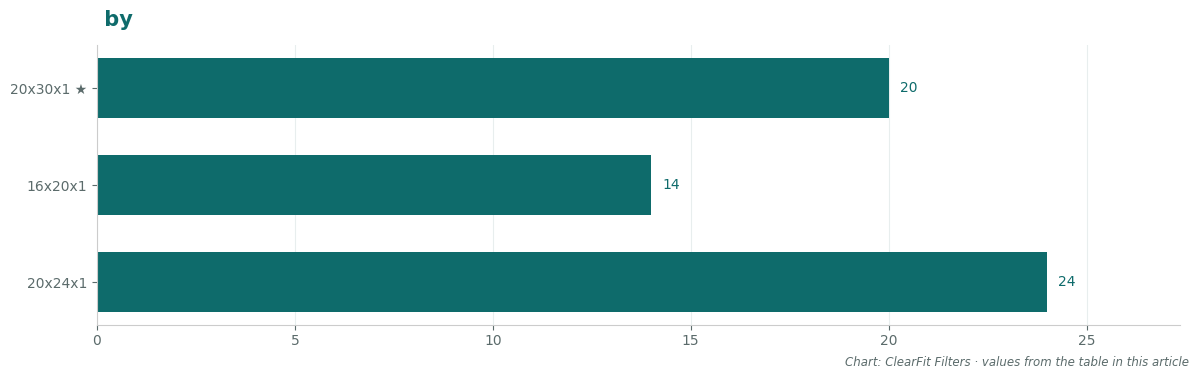
★ = most-ordered MERV 13 size in 1-inch (20x30x1 leads this tier in national search volume — larger slots correlate with newer, higher-blower-capacity systems).
What MERV 13 Catches — and What It Doesn’t
Captures effectively:
- Wildfire smoke PM2.5 — smoke particles cluster at 0.4–2.5 µm, across MERV 13’s ≥50% E1 and ≥85% E2 floors; this is the EPA’s stated basis for its MERV 13 recommendation ✔
- Bacteria carriers and respiratory droplet nuclei (0.3–1 µm at ≥50%) — the basis of ASHRAE’s pandemic-era guidance for schools and shared buildings ✔
- Tobacco and cooking smoke, combustion soot, candle haze ✔
- Fine traffic pollution (tailpipe PM, brake/tire wear at 0.3–3 µm) ✔
- Everything from the lower tiers — pollen, dander, spores, dust — at ≥90% ✔
Partially captures:
- Virus-sized particles — ⚠ MERV 13’s ≥50% at 0.3–1 µm is meaningful reduction, not capture; “MERV 13 catches viruses” oversells what a 50% floor promises. True virus-grade filtration is HEPA’s 99.97%.
- The most penetrating particle size (~0.1–0.3 µm, MPPS) — even HEPA’s rating is set there because it’s the physics bottleneck; no MERV rating is a wall.
Never captures: gases — VOCs, NO₂, ozone, smoke odor molecules. Particulate media of any MERV does nothing for gaseous pollutants; that requires activated carbon (or a portable unit that pairs both). A MERV 13 filter kills smoke particles, not smoke smell.
MERV 13 vs HEPA: Why You Shouldn’t Put HEPA in Your Ducts
The comparison comes up constantly, so here is the short version:
| MERV 13 | True HEPA | |
|---|---|---|
| Rated capture | ≥50% of 0.3–1 µm | 99.97% at 0.3 µm (the MPPS worst case, DOE standard) |
| Pressure drop | High for a duct filter; manageable in 4–5″ media | Roughly 2–5× a MERV 13 at the same face area |
| Fits residential ductwork? | Yes, in a filter slot or media cabinet | No — residential blowers cannot overcome HEPA resistance through a standard slot |
| How it’s actually deployed | Whole-home via HVAC | Portable air purifiers with their own high-static fan, or bypass units |
HEPA is a better filter, full stop. It is also the wrong ductwork product: the resistance is so high that a typical residential blower either can’t move rated airflow through it (starving the coil, freezing, tripping limits — the failure list from the next section) or, with an ECM motor, ramps to max wattage fighting it and burns energy and motor life. The engineering consensus approach for smoke-season or immune-compromised households: MERV 13 in the ducts + a portable HEPA unit in the bedrooms. Each technology where it belongs. (The full filtration-physics version — including why HEPA is rated at the most penetrating particle size — is in MERV Rating Explained.)
The System-Compatibility Check (Do This Before Buying)
The Reddit threads are right to be nervous, and wrong about the conclusion: MERV 13 doesn’t damage systems that can handle it, and the check for “can handle it” is short.
Step 1 — What kind of blower motor? ECM (variable-speed, post-~2010 high-efficiency systems): ramps up to hold airflow — you pay single-digit-percent energy, not performance. PSC (single-speed, older and base models): delivers less air as resistance climbs — this is where MERV 13 in a 1-inch slot goes wrong. Not sure? The three-step identification (unit age, startup sound, spec plate) is in MERV 8 vs MERV 11.
Step 2 — What does your OEM allow? Simplified from the cross-brand table in MERV Rating Explained:
| OEM (residential) | Typical 1-inch-slot guidance | MERV 13 path |
|---|---|---|
| Carrier / Bryant | MERV 10–11 base models | Infinity/Ecm systems + media cabinet ✔ |
| Trane / American Standard | MERV 8–11 base | Media cabinet / CleanEffects ✔ |
| Lennox | MERV 8–11 base | Healthy Climate media cabinet (up to 16) ✔ |
| Goodman / Amana / Daikin | MERV 8 base | 4″ cabinet required for 11–13 |
The pattern: every brand’s MERV 13 story runs through a 4–5″ media cabinet, not a 1-inch slot.
Step 3 — Slot depth. 4″ or 5″ cabinet → run MERV 13 with confidence (resistance ≈ a 1-inch MERV 11). 1-inch slot + ECM → acceptable, watch the replacement clock. 1-inch slot + PSC → MERV 11 is the honest ceiling unless your manual says otherwise.
The failure list you’re avoiding (PSC + 1-inch MERV 13, loaded): weak register airflow → evaporator coil icing in cooling season → high-limit switch trips in heating season → long-term blower overheating. Every one of these shows up months before motor death, which is why “MERV 13 ruined my furnace” posts describe preventable overload, not filter chemistry.
And check the box for MERV-A. This tier is where the electrostatic-charge trap bites hardest: a MERV 13 that earns part of its rating from a manufacturing-applied charge can drift toward MERV 8-ish mechanical performance as the charge dissipates with loading — sometimes within weeks in smoky, dusty air. Look for a published MERV-A (sustained) value on the spec sheet; if only “MERV 13” appears, assume some drift. One electrostatically charged media product ranking well on this very search is marketed heavily on that technology; nothing wrong with the chemistry, but buy it with the MERV-A number in view. Full mechanics: MERV Rating Explained, MERV-A section.
When MERV 13 Is Worth It
1. Wildfire smoke regions. The EPA’s smoke-season guidance for forced-air homes is MERV 13+; smoke’s mass concentration sits at 0.4–2.5 µm where the ≥50%/≥85% floors actually work. Run it May–October in the West and Interior West; pair with bedroom HEPA portables on bad-air days (see Best HVAC Filter for Wildfire Smoke and What Is PM2.5?).
2. Asthma and COPD households. The submicron fraction of indoor particulate — cooking residue, candle soot, infiltration smoke — is what drives respiratory irritation, and it is precisely the band MERV 13 doubles down on versus MERV 11 (≥50% vs ≥20% E1).
3. Post-illness / immune-sensitive homes. The same droplet-nuclei capture that drove ASHRAE’s school-building guidance applies at home: ≥50% of 0.3–1 µm carriers is a real reduction in recirculated microbial load, with the honest caveat that it is a 50% floor, not a barrier.
4. High-traffic and industrial-adjacent addresses. Near-highway diesel PM and brake-wear metals (0.3–1 µm) are the urban version of the smoke problem; MERV 13 is the matching response.
5. Homes hosting medically fragile or elderly family members. Between the droplet-nuclei logic of scenario 3 and the cardiovascular literature on fine PM, the households that benefit most from MERV 13’s E1 floor are often making the change for someone else’s lungs — an aging parent moving in, a post-surgical recovery period, a medically complex child. Two practical notes for that decision: first, this is the case where pairing the duct filter with one or two correctly-sized HEPA portables (the two-thirds-of-CADR rule) outperforms any single layer — the duct filter works on recirculated whole-house air, the portable works on the room that matters most; second, run the change past the HVAC reality check above first, because a filter that chokes airflow undermines the recovery environment it was bought to protect.
If none of these describe your household, MERV 11 is the better purchase — same E2/E3 coverage, less blower risk, lower cost.
FAQ
Is MERV 13 worth it? Yes if wildfire smoke, respiratory conditions, or heavy traffic pollution affect your home AND your system passes the three-step check above. No as a default upgrade — for ordinary dust/allergen needs MERV 11 delivers most of the health benefit at lower static pressure, price, and replacement frequency. “Worth it” is a system question, not a filter question.
Can a MERV 13 filter damage your furnace? Not the filter itself — the airflow restriction, and only in the wrong configuration: 1-inch MERV 13 on an older PSC-blower system, especially loaded past its interval. Symptoms (coil icing, limit trips, weak registers) appear long before damage. In a 4–5″ media cabinet, or on an ECM system, MERV 13 does not damage anything; the OEM tables above show it’s the configuration most brands engineer for.
Is MERV 13 as good as HEPA? No — HEPA captures 99.97% at the most penetrating particle size; MERV 13 guarantees ≥50% of 0.3–1 µm. But HEPA belongs in portable purifiers (with fans built for its resistance), not residential ducts. The practical best-of-both: MERV 13 whole-home + HEPA portables in bedrooms.
Does MERV 13 help with wildfire smoke? Yes — it is the EPA-recommended minimum for smoke, and smoke’s particle mass lands right on MERV 13’s strongest bands (≥50% at 0.3–1 µm, ≥85% at 1–3 µm). Pair with portables for bedrooms on bad days, replace the filter immediately after a smoke episode (it will load fast — the loaded-filter restriction, not the smoke, is the risk), and expect some residual gas-phase odor, which particulate media cannot catch.
Is MERV 13 the same as MPR 1500–1900? Yes, that’s the standard crosswalk: 3M MPR 1500–1900 (Filtrete Allergen / Healthy Living Ultra Allergen tiers) and Home Depot FPR 10 map to MERV 13. Approximate by nature — MPR scores only 0.3–1 µm. Full table: MPR vs FPR vs MERV.
Smoke Season Runs on a Calendar, Not on Memory
MERV 13 loads fast exactly when you need it most — a week of wildfire smoke can age a filter a season’s worth. Set a Home Filter Calendar reminder for a 30–60 day cycle (shorter during smoke events), and subscribe (20% off) so the replacement is in the house before the air quality index spikes.
The Other Ratings
- MERV 8 Air Filters — the low-restriction default for homes without special air-quality needs
- MERV 11 Air Filters — the allergy tier; most of MERV 13’s benefit at a fraction of the airflow risk
Sources & References
- ASHRAE Standard 52.2 — MERV 13 definitions E1 ≥50% / E2 ≥85% / E3 ≥90%.Official standard (explicit)
- U.S. EPA — “What is a MERV rating?”: MERV 13+ recommended for upgrade purposes (smoke/traffic pollution/respiratory health); wildfire-smoke guidance.Official documentation (explicit)
- ASHRAE epidemic task force / CDC school ventilation guidance (2020-2021) — background on MERV 13 as the shared-building minimum.Official documentation (explicit, historical guidance)
- HEPA definition (DOE: 99.97% @ 0.3 µm MPPS) and HEPA pressure drop at several times MERV 13 — Official standard (explicit); the multiple range is industry-typical.inference basis
- Wildfire-smoke particle-size distribution, 0.4-2.5 µm main mass fraction — EPA/wildfire-smoke literature consensus.Official documentation (inference basis)
- OEM maximum-MERV table (four-row simplification) — Carrier/Trane/Lennox/Goodman public installation manual (summarized) (“typical, system-dependent”; per the unit nameplate).Official documentation summary + inference basis
- SERP interpretation(homedepot/bnx/reddit/iso-aire/nordicpure)——DataForSEO live/advanced 2026-08-21(
_work_serp_terms.json)。Competitor structure cross-check (verified live)
Related Guides
- MERV Rating Explained — full MERV-A mechanics, the HEPA physics, and the complete OEM limit table.
- Best HVAC Filter for Wildfire Smoke — seasonal deep-dive on the MERV 13 smoke use case.
- What Is PM2.5? — the pollutant class that defines this rating’s job.
- MERV 8 vs MERV 11 — includes the PSC/ECM blower check used in Step 1 above.