Lead in Your Water: The 15 ppb Rule, Why It’s Not a Safety Line & How to Remove It


For a quick reference on lead, see our lead entry.
Quick answer: Lead has no safe level — EPA’s maximum contaminant level goal is zero. The famous “15 ppb” is an action level keyed to the 90th-percentile of tap samples, not a health-based safety line. Carbon block is the one honest exception among cheap filters: a cartridge certified to NSF/ANSI 53 with a lead claim genuinely removes it. Test before you buy — first-draw lead from your own pipes is invisible, tasteless, and free to misjudge.
Test first. Lead comes mostly from your building’s plumbing, so your CCR says little about your kitchen tap. A lab lead test ($30–60, first-draw sample after 6+ hours of stagnation) is the only number that counts. Free alternative: many counties lend lead test kits; and if your home was built after 1986, your risk profile just dropped substantially (see the dating box below).
Top Picks at a Glance (2026)

Lead is NSF/ANSI 53 territory, so the picks follow the claim lines on the spec sheets:
| Pick | Product | Why it wins |
|---|---|---|
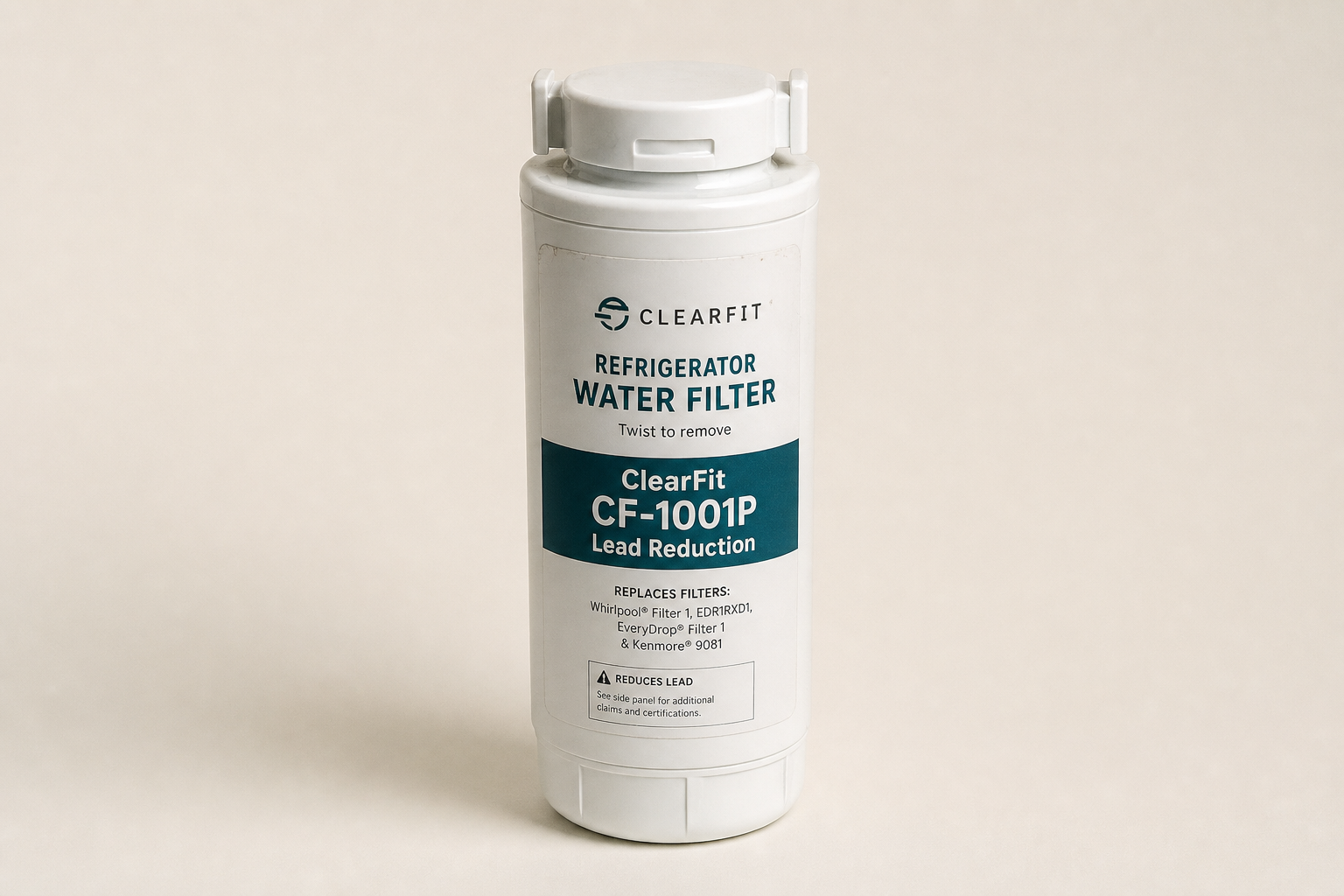
| Best lead-designated pick | lead-reduction Filter 1 cartridge | Listed as the lead-reduction variant of the EDR1RXD1-compatible line; the claim is in the product title for a reason. |
| Best for GE premium bays | RPWFE-compatible cartridge | NSF 42/53 claim coverage with PFOA/PFOS reduction on the 401 list; the deepest claim set we stock. |
| Best for 2020+ GE models | XWFE-compatible cartridge | NSF 42/53-claim cartridge for the current GE housing generation; the correct fit where RPWFE will not seat. |
Where Lead in Water Comes From
1. Your own service line and premise plumbing (the big one). Homes built before 1986 commonly contain lead service lines, lead solder on copper joints (“50/50” solder was legal until then), or brass fixtures with high lead content. Municipal water leaves the plant lead-free; it picks the metal up on the way to your glass.
2. Disturbed water mains and partial line replacements. Construction and meter swaps shake loose scale particles that carry startling lead concentrations — a major reason lead spikes appear in older neighborhoods for weeks after street work.
3. Well pump components and legacy brass. Submersible pumps, older brass well fittings, and some soldered joints in private systems leach lead too, usually alongside copper — and worsened by acidic water that corrodes metals faster.
The 1986 line — a 60-second age check on your home
- Built before 1920: assume a lead service line is possible; verify with your water utility (many now keep public inventories under the new federal rule) and a scratch test at the pipe entry (soft, dull gray, shines when scratched with a coin).
- 1920–1986: lead solder and leaded brass are the norm. Solder joints that look dull gray and smear bright under a coin are suspect.
- After 1986 (SDWA amendments): lead pipes and >8% lead brass banned. Post-2014 fixtures meet the “lead-free” 0.25% wetted-surface rule. Risk shifts toward older fixtures replaced secondhand — rare, not zero.
The Lead and Copper Rule Improvements (finalized October 2024) require utilities to inventory and replace lead service lines, with compliance actions phased from 2027 — this page tracks that timeline quarterly. Last review: August 2026.
Health Effects — What the Limits Are Protecting
| Number | What it is | What it means |
|---|---|---|
| 0 | MCLG — EPA‘s health goal | No amount of lead is known to be safe; the goal is zero |
| 15 ppb | Action level (90th percentile) | A regulatory trigger: if 10% of sampled taps in a system exceed it, the utility must take corrective action — it is not a “safe below this” line |
| 1986 | SDWA amendment banning leaded plumbing | The practical dating line for assessing your own home |
Who bears the risk. Lead is a cumulative neurotoxin; fetuses, infants, and children under six are the sensitive populations — developing nervous systems, and formula mixed with tap water is the classic exposure route for babies. Adults absorb far less (roughly 10–15% versus ~50% in toddlers), but hypertension and kidney effects are documented at chronic exposures. Symptoms in children are usually absent at the levels homes typically find — which is the entire argument for testing rather than waiting for a signal.
Reading the semantics correctly — because most pages get this wrong. “My water is below 15 so it’s fine” is a misreading: 15 ppb is an enforcement statistic about the system, and any single tap can spike far above it the morning after water main work. Conversely, a first-draw of 20 ppb does not mean your family is poisoned — it means you now have a number and owe yourself a fix: flush, filter, and a follow-up test. Numbers first, alarm never.
How to Remove Lead — The Honest Comparison
| Method | Typical reduction | Certification to look for | Honest notes |
|---|---|---|---|
| NSF/ANSI 53 carbon block (lead claim) | 99%+ while within rated capacity | NSF/ANSI 53 with lead specifically listed — 53 alone covers dozens of claims; lead must be named on the spec sheet | The most economical point-of-use fix; capacity matters — replace on schedule, because a spent cartridge can dump what it trapped |
| Reverse osmosis | 95%+ | NSF/ANSI 58 with lead claim | Overkill if lead is your only issue, sensible if TDS, arsenic, or nitrates ride along |
| Whole-house KDF-55 + carbon | Varies by blend | Look for the system-level 53 lead claim | KDF media alone isn’t a certification; the assembled system’s claim is what counts |
| Service line replacement | Removes the source | Utility programs often subsidize | The permanent fix; filters are the bridge until then |
| ~~Boiling~~ | Negative | — | Lead does not evaporate — boiling concentrates it ~proportionally to water lost |
| ~~Standard pitcher filters without a lead claim~~ | Little to none | “Tested to NSF 42” ≠ lead | Basic cartridges are certified for chlorine/taste only; lead must be a named claim |
Matched to the Numbers Above
- Testing tier ($30–60): First-draw lead test — the sample must sit 6+ hours unused, overnight is easiest. Two-tap protocol (kitchen first-draw + fully flushed) tells you whether the source is your fixture or the service line.
- Point-of-use tier ($80–250): NSF/ANSI 53 lead-claim carbon system at the kitchen tap — the workhorse answer for the drinking-and-cooking pathway.
- Whole-house / structural tier ($1,500–5,000+): Service line replacement (check utility subsidies — many are heavily discounted or free under the 2024 rule) plus, meanwhile, certified filtration.
Wait — Is My Refrigerator Filter Enough for Lead?
Conditionally, yes — and this is the one contaminant where that answer is real. Several refrigerator cartridges — including certain GE RPWFE/XWFE and Whirlpool EveryDrop models — carry NSF/ANSI 53 certifications that list lead. If your fridge’s spec sheet names lead, the dispenser is a legitimate drinking-water stopgap. If it doesn’t list lead, assume it does nothing for lead: the base 42 certification is chlorine and taste only. Check the exact cartridge’s claim sheet, not the marketing page — our cross-reference index lists claims cartridge by cartridge.
Interim habits that cost nothing: run the tap 30–60 seconds after any 6+ hour stagnation; use cold water only for drinking and cooking (hot water dissolves metals faster); and after street work in your neighborhood, flush longer.
Related problems worth checking while you’re here:
- Low pH water — acidic water is the root cause that makes plumbing leach lead and copper; treat the pH, shrink the problem
- Copper in water — travels with lead from the same corrosive chemistry, shows up as blue-green stains
- Nitrates in water — the other contaminant that belongs in any well-water test bundle for young families
Lead Questions, Answered Straight
How much lead in water is too much? The health goal is zero; the regulatory action level is 15 ppb at the 90th percentile of system samples. Any detectable lead in a first-draw home test deserves a fix — faucet filtration at minimum, source investigation if repeated.
Does boiling water remove lead? No — it concentrates it. Lead stays in the pot while water evaporates, and hot water dissolves more lead from plumbing in the first place.
Is my refrigerator or pitcher filter enough for lead? Only if the cartridge’s certification sheet explicitly lists lead under NSF/ANSI 53 (some do). Otherwise no — and a “tested to NSF/ANSI 42” label is taste/chlorine only.
How long does a lead water test take? Most accredited labs return results in 3–10 business days. Same-week matters less than the sampling protocol: first-draw after 6+ hours stagnation, or the number tells you almost nothing.
Can I shower and wash dishes in lead-containing water? Yes — lead is not absorbed through intact skin, and dish washing doesn’t transfer meaningful amounts. The exposure pathway is drinking and cooking water (and formula).
What was the 2024 federal lead rule about? The Lead and Copper Rule Improvements require nationwide service line inventories and replacement of lead lines on a 10-year horizon with compliance activity starting 2027 — meaning your utility may already know whether your address has a lead line. Ask them; it’s the cheapest investigation you will ever run.
Sources
- U.S. EPA — Lead — federal lead program: exposure routes, service lines, and the Lead and Copper Rule
- U.S. EPA — National Primary Drinking Water Regulations — the enforceable federal MCL table for every regulated contaminant
- CDC — Drinking Water — health information on water contaminants, testing, and private wells
- NSF — Certified Drinking Water Treatment Systems — the official lookup database for NSF/ANSI certified filter claims
Related: How to Change a GE Refrigerator Water Filter · NSF 42 vs NSF 53 Certification · Well Water Problems Overview
Reference page: Lead – full entry & treatment options