Hard Water in Your Home: What It Is, What It Costs You & the Only Real Fix

For a quick reference on hard water, see our hard water entry.
Quick answer: Hard water is dissolved calcium and magnesium — measured in grains per gallon (gpg), not “contaminants in ppb” — and it is not a health risk. It is a wallet problem: scale in water heaters, soap that won’t lather, spots on everything glass. The only whole-home fix is ion exchange (a water softener); salt-free template-crystallization media (Filtersorb SP3-type) handles low-to-moderate hardness; RO fixes it at one faucet. No filter cartridge of any kind softens water, and your fridge filter does nothing about it.
Test first — free version. Your CCR reports hardness or “total hardness as CaCO3.” Lather test: if plain bar soap barely suds and leaves a scum ring, you are likely above 7 gpg. A $15–20 hardness test kit or a water hardness test strip pack confirms the grain number in minutes — that single number decides whether you need treatment at all.

Where Hard Water Comes From
1. Geology, nothing else. Rain picks up CO2, becomes mildly acidic, and dissolves limestone (calcium carbonate) and dolomite (magnesium carbonate) as it percolates through aquifers. Midwest limestone belts, Texas hill country, Florida, and the arid Southwest produce the hardest water in the country; Pacific Northwest and New England granite produce some of the softest.
2. Municipal supply inherits it. Most cities do not soften (softening every gallon for lawn and fire hydrant use would be absurd), so your tap hardness roughly equals the source water’s. A few large utilities soften to ~85–120 mg/L; most pass it through.
3. Your own water heater concentrates it. Every heating cycle precipitates a little more calcium carbonate onto the heating elements — which is why the first sign of hardness is usually a water heater that sounds like it’s popping popcorn.
What the gradations mean (USGS classification)
| Grains per gallon | mg/L as CaCO3 | USGS label | What you notice |
|---|---|---|---|
| 0–3.5 | 0–60 | Soft | Soap lathers; nothing to manage |
| 3.5–7.0 | 61–120 | Moderately hard | Spotting on glassware begins |
| 7.0–10.5 | 121–180 | Hard | Scale on fixtures, soap scum, dry skin |
| 10.5+ | 180+ | Very hard | Water heater scale, appliance wear, soap failure |
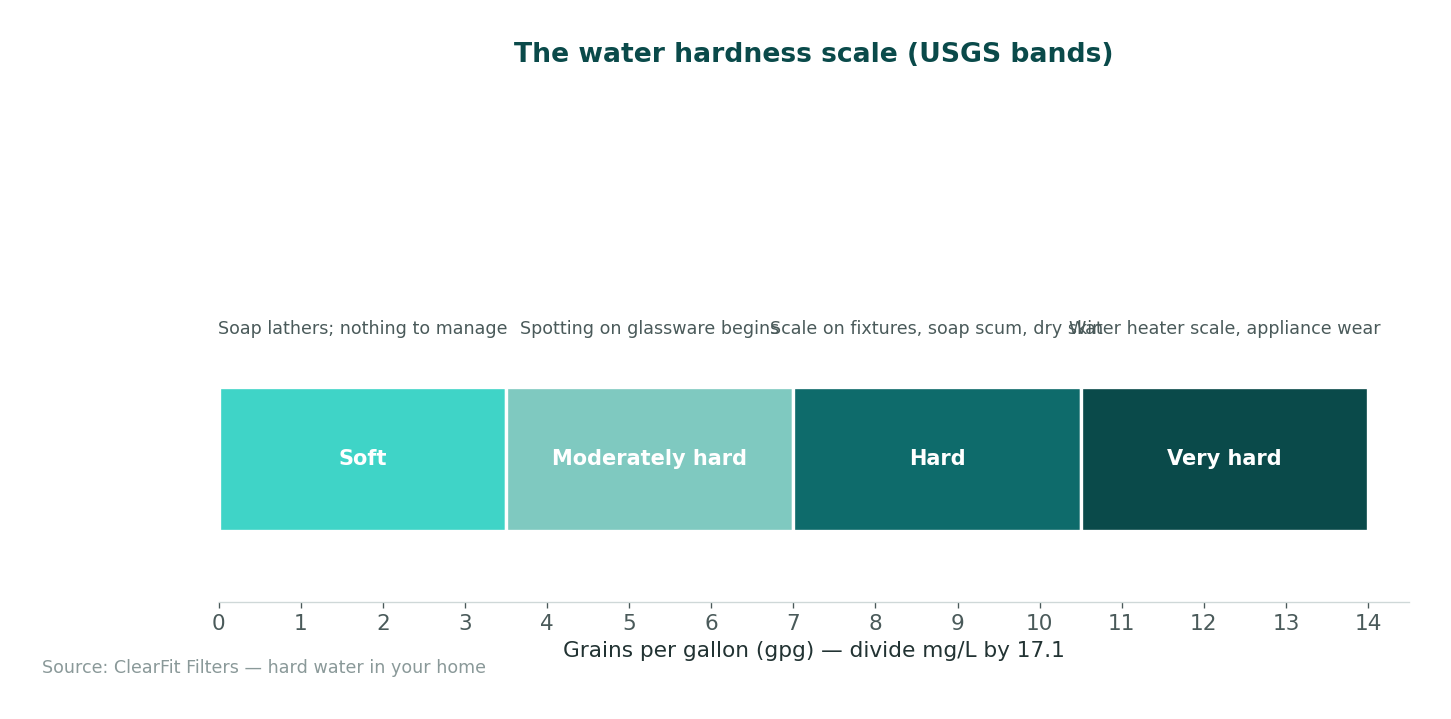
(1 gpg = 17.1 mg/L — utilities report mg/L, softener dealers speak gpg; multiply mg/L by 0.0585 to convert.)
Health Effects — What the Limits Are Protecting
| Number | What it is | What it means |
|---|---|---|
| No federal MCL | Hardness has no primary standard — EPA does not treat it as a contaminant | There is nothing to “protect” against medically; calcium and magnesium are dietary minerals |
| 7 gpg (~120 mg/L) | Where most households start noticing | Scale, scum, and appliance costs become visible |
| ~180 mg/L and up | USGS “very hard” | Water heater efficiency loss and fixture damage accelerate |
The honest health framing: hard water is not bad for you. There is no credible evidence linking it to disease, and small epidemiological literatures even associate moderately hard water with cardiovascular benefit (contested, not established). What hard water does is quietly tax you: scale-coated heating elements raise water heater energy use, coffee makers and dishwashers die early, laundry detergent needs 2–3x the dose in very hard water, and tankless water heater warranties are void above specified hardness. That is a budget problem wearing a plumbing costume — don’t let anyone sell you health anxiety about it.
How to Treat Hard Water — The Honest Comparison
| Method | What it does | Certification to look for | Honest notes |
|---|---|---|---|
| Ion-exchange softener | Swaps Ca/Mg for sodium (or potassium) ions — the only true softening | NSF/ANSI 44 certified softener | Whole-house; adds ~8 mg/L sodium per gpg removed (a heart-health note for sodium-restricted diets); needs salt refills and periodic cleaning |
| Salt-free template media (Filtersorb SP3-type) | Converts hardness crystals so they don’t stick — scale control, not softening | Look for third-party scale-reduction data | Honest boundary: effective for moderate hardness; does not create the “slick” soft-water feel; existing scale slowly sheds |
| Reverse osmosis | Rejects hardness ions along with everything else | NSF/ANSI 58 system | Drinking-point only — no one softens a whole house with RO; but if your only goal is kettle and coffee scale, an RO at the kitchen sink may be enough |
| ~~Carbon filters, fridge filters, pitchers~~ | Nothing | No hardness claim exists anywhere | Ion exchange can’t happen inside carbon; hardness is not a filtration problem |
| ~~Boiling~~ | Makes it worse for scaling | — | Boiling drives out CO2 and precipitates the hardness as the scale in your kettle |
Softener or RO — which one do you actually need?
This is the single highest-value decision on this page, and almost no retailer will lay it out because they only sell one of the two:
- Buy a softener if: your problem is house-wide — scale, appliances, laundry, dry skin. Softeners address gallons, cheaply, but do not reduce TDS or improve drinking taste; sodium rises slightly.
- Buy an RO if: your problem is what you drink and cook — taste, chlorine, plus dissolved solids at one faucet.
- Many hard-water homes eventually own both, and that is normal: softener for the house, RO polishing at the kitchen sink. Anyone telling you one device does both jobs is selling you something that does neither well.
Matched to the Numbers Above
- Testing tier ($15–30): Hardness test strips or a drop-count kit — or free, from your CCR. Below ~5 gpg, stop reading this page; you don’t have a problem worth money.
- Point-of-use tier ($200–400): Under-sink RO for drinking/cooking water in homes whose only complaint is the kettle.
- Whole-house tier ($900–2,500 installed): Demand-initiated regenerating softener sized to your gpg and household count — oversized tanks waste salt, undersized ones exhaust early.
Wait — Is My Refrigerator Filter Enough for Hard Water?
No. No fridge cartridge softens, sequesters, or meaningfully alters hardness — carbon does not participate in ion exchange, and no OEM cartridge carries a hardness claim. If scale is building in the ice maker, the fix is upstream (softener) or at the supply line, not inside the fridge.
What your fridge filter does handle: chlorine taste and odor at the dispenser. For scale specifically, see the softener-vs-RO block above.
Related problems worth checking while you’re here:
- TDS in water — how “dissolved solids” and “hardness” overlap and differ, and why a softener doesn’t lower a TDS meter reading
- Chloride and salty taste — the softener’s sodium addition, quantified
- Iron in water — softeners remove small amounts of dissolved iron; here’s the boundary
Hard Water Questions, Answered Straight
How much hardness in water is too much? There is no health limit. The practical thresholds: below 3.5 gpg almost nobody treats; 7 gpg is where scale and soap complaints get loud; 10.5 gpg+ is where appliance damage argues for a softener.
Does boiling water remove hardness? It removes temporary hardness by precipitating it — as the white crust in your kettle. Boiled water is marginally softer and the scale has to live somewhere. It is not a treatment strategy.
Is my refrigerator or pitcher filter enough for hard water? No. Hardness requires ion exchange (softener), template crystallization media, or RO — none of which exist in fridge or pitcher cartridges.
Is hard water bad for you? No established health harm; calcium and magnesium are nutrients. The case for treating it is economic and comfort (scale, soap, skin), not medical.
Can I drink softened water if I’m on a low-sodium diet? Each grain of hardness removed adds roughly 8 mg of sodium per liter — at 15 gpg that’s ~120 mg/L, worth discussing with your doctor. Bypass the softener for the kitchen cold line or add an RO faucet (which also strips the sodium back out) if this concerns you.
Why does my skin feel dry or “slippery” with hard (or softened) water? Hard water leaves soap scum on skin that feels like residue; true soft water lets soap rinse fully, which paradoxically feels “slippery” for the first two weeks. Both sensations are cosmetic.
How does hard water actually damage appliances — and which ones go first? Scale is an insulator: a heating element wrapped in calcium runs hotter to deliver the same heat, which shortens element life and raises energy use — water heaters (tank and especially tankless, whose warranties carry hardness limits), dishwashers and coffee makers (internal passages narrow), and washing machines (heating plus detergent interference) fail in roughly that order. The appliance-replacement math is the honest economic case for a softener at 10 gpg+: the system amortizes against the machines it protects.
Sources
- U.S. EPA — Ground Water and Drinking Water — federal drinking-water standards, testing, and treatment guidance
- WHO — Drinking-water — WHO drinking-water quality guidance and fact sheets
- NSF — Certified Drinking Water Treatment Systems — the official lookup database for NSF/ANSI certified filter claims
Related: Whole-House Filter Sizing Guide · Sulfate in water · Low pH water
Reference page: Hard water – full entry & treatment options