Fluoride in Your Water: Sources, Health Limits & Honest Removal Options

For a quick reference on fluoride, see our fluoride entry.
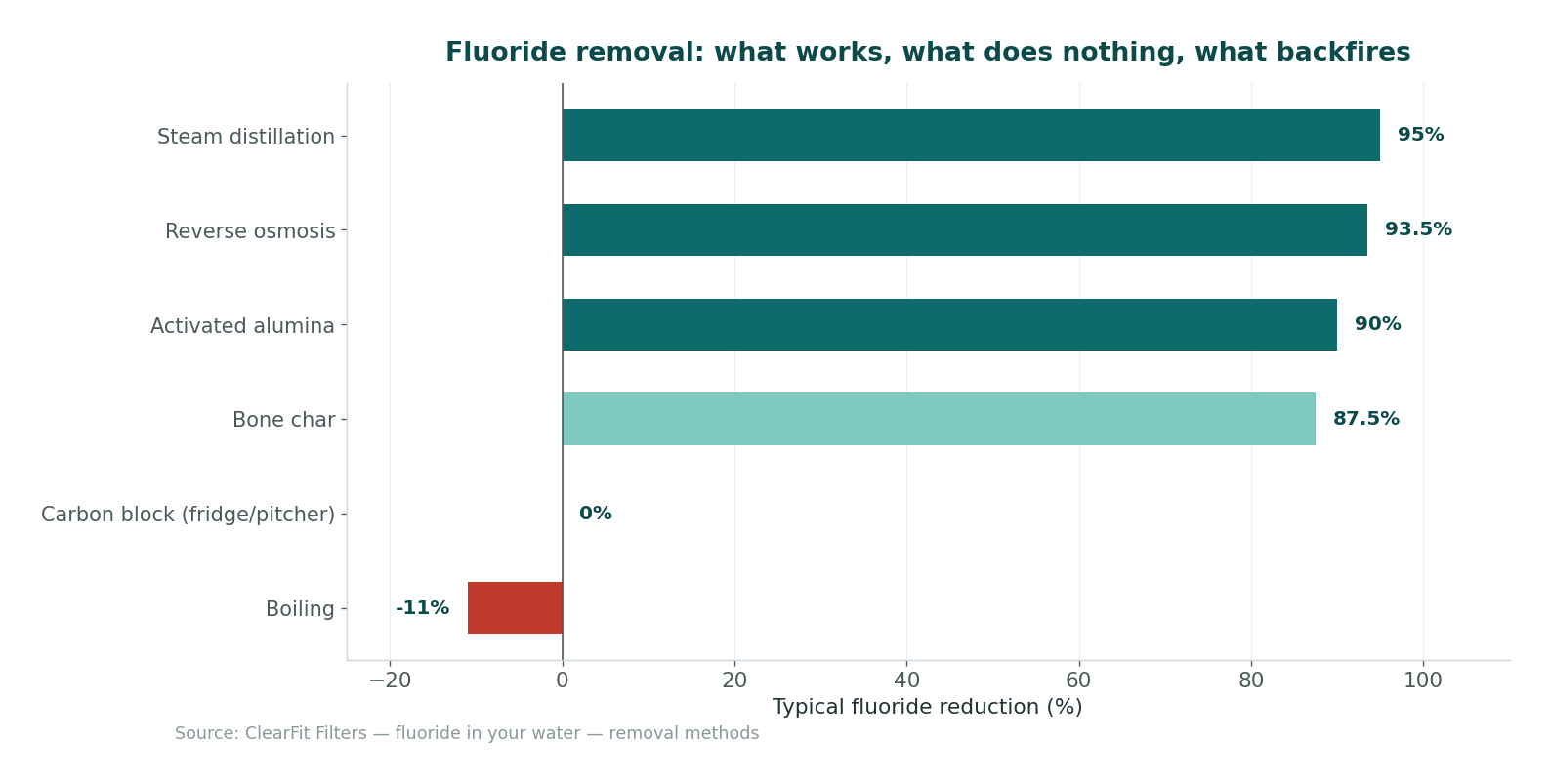
Quick answer: No refrigerator or pitcher carbon filter removes fluoride — no OEM cartridge on the market carries a fluoride reduction claim. The methods that actually work are reverse osmosis (92–95%+ reduction, NSF/ANSI 58 fluoride claim), steam distillation (95%+), activated alumina media (85–95%, NSF/ANSI 53 claim on certified systems), and bone char (80–95%). Boiling does the opposite: it concentrates fluoride as water evaporates. Before you buy anything, read your free annual water quality report and find out what your number actually is.
Test first. If you are on city water, your Consumer Confidence Report (CCR) lists your fluoride level for free — search “[your city] CCR water quality report.” If you are on a well, a lab mail-in fluoride test costs $30–50 and takes about a week. Fluoride removal equipment is priced 10–30x a test, so get the number before the hardware.
Where Fluoride in Water Comes From

1. Natural geology (wells). Fluoride is a naturally occurring ion that dissolves out of fluorite deposits and certain granite formations. Private wells in parts of the Southwest, Midwest, and New England routinely run 0.2–1.0 mg/L, and some wells exceed 2–4 mg/L with no industrial source anywhere nearby. If your water never touches a treatment plant, geology is your source.
2. Community water fluoridation (cities). Roughly 73% of the U.S. population served by community systems receives fluoridated water, adjusted to a Public Health Service target of 0.7 mg/L — a level set in 2015 to balance cavity prevention against cosmetic fluorosis risk. This is deliberate addition, not contamination, and it is the reason most people searching “fluoride in water” are searching at all.
3. Industrial discharge (rare, localized). Phosphate fertilizer plants and historical aluminum smelting operations released fluoride-rich emissions and runoff. A few groundwater plumes near these sites still carry elevated fluoride, usually alongside arsenic — if you live near one, county environmental health records will say so.
The policy box — facts only, no sides taken
Fluoride policy is moving at the state level, and this page is reviewed quarterly — last review: August 2026.
- Federal limits: EPA enforces a maximum of 4.0 mg/L (MCL) and a secondary cosmetic threshold of 2.0 mg/L (SMCL). The Public Health Service recommends 0.7 mg/L for systems that fluoridate.
- Pro-fluoridation position: CDC lists water fluoridation among the ten great public health achievements of the 20th century; the ADA and most dental associations support it at 0.7 mg/L.
- Cautionary position: The NTP’s 2024 monograph found, with high confidence, an association between higher fluoride exposure (roughly above ~1.5 mg/L in the reviewed studies) and lower IQ in children. Utah in 2025 became the first state to end mandatory community fluoridation (HB 81), with Florida following; litigation and state bills continue on both sides.
- Our position: none. We sell fluoride removal equipment, which is exactly why you should not take a filter retailer’s word on the health debate. Read the sources above, read the NTP monograph and CDC pages directly, and decide for yourself. What we can do — honestly and precisely — is tell you what each removal technology actually achieves.
Health Effects — What the Limits Are Protecting
| Number | What it is | What it protects against |
|---|---|---|
| 4.0 mg/L | EPA enforceable MCL | Skeletal fluorosis — bone and joint damage from drinking 4+ mg/L for many years |
| 2.0 mg/L | EPA Secondary (SMCL) | Cosmetic dental fluorosis — white spots or pitting on children’s permanent teeth (the sensitive window is age 0–8) |
| 0.7 mg/L | PHS fluoridation target | The operating level for ~73% of U.S. municipal systems |
The two sides of the ledger. On one side: at levels below 2.0 mg/L, the documented risk in adults is essentially cosmetic, and dental benefits at 0.7 mg/L are the stated basis for decades of fluoridation policy. On the other: the NTP 2024 review and a body of epidemiological work associate higher exposures with effects on children’s cognitive development — which is why parents of infants and young children tend to be the ones buying removal systems, and why formula mixed with water is the scenario pediatric guidance flags first.
The gap between 0.7 and 2.0 is where your personal decision lives. A nursing mother on a 1.2 mg/L well and a single adult on 0.7 mg/L city water do not have the same question. Your number, your household, your call — our job is only to make sure the number is real (test it) and the equipment you choose matches it.
Why carbon can’t touch fluoride — 30 seconds of chemistry
Activated carbon removes things by adsorption: contaminant molecules stick to the walls of microscopic carbon pores. This works beautifully for chlorine, volatile organics, and odor compounds — molecules that are large, carbon-based, and non-polar. Fluoride is none of those things. It is a tiny, electrically charged, strongly water-loving ion. There is nothing for carbon pores to grab onto, which is why no fridge filter, no pitcher filter, and no standard carbon block has ever carried a fluoride claim. Removal requires a different mechanism entirely — membrane rejection (RO), phase change (distillation), or media specifically engineered to bind fluoride ions (activated alumina, bone char hydroxyapatite).
How to Remove Fluoride — The Honest Comparison
| Method | Typical reduction | Certification to look for | Honest notes |
|---|---|---|---|
| Reverse osmosis | 92–95%+ | NSF/ANSI 58 with fluoride claim (check the model’s spec sheet — 58 alone is not enough) | Drinking-point only; produces 1–4 gal of concentrate per clean gallon; also cuts TDS, arsenic, lead |
| Activated alumina | 85–95% | NSF/ANSI 53 with fluoride claim (point-of-use systems) | Best performance in a slightly acidic pH 5.5–6.5 window; the workhorse for whole-house well systems |
| Bone char | 80–95% | No unified NSF fluoride standard — buy only with third-party lab data | Natural hydroxyapatite media; not vegetarian; usually blended with GAC |
| Steam distillation | 95%+ | — | Near-total removal, but ~4 hours per gallon and a counter full of electricity — fine for drinking and formula, unrealistic for cooking volume |
| ~~Carbon block (fridge, pitcher, faucet)~~ | ≈0% | No carbon cartridge on the market claims fluoride | Physically cannot adsorb a small hydrated ion — see the chemistry note above |
| ~~Boiling~~ | Negative | — | Water leaves, fluoride stays: boil off 10% of the volume and concentration rises ~11% |
What we don’t sell also doesn’t work. Water softeners exchange calcium and magnesium for sodium — fluoride ions are untouched. “Alkaline” or “mineral” pitcher cartridges add ions back and remove none of these. If a listing claims fluoride removal for a $30 carbon cartridge and cites no test data, that listing is wrong, and you now know how to spot it in three seconds.
Matched to the Numbers Above
- Testing tier ($30–50): Lab mail-in fluoride test — or zero dollars, by reading your CCR — before any purchase. A number below 1.0 mg/L changes this entire conversation.
- Point-of-use tier ($200–450): Under-sink RO system with an NSF/ANSI 58 fluoride claim — the right size for drinking, cooking, and baby formula in most households.
- Whole-house tier ($1,200–2,800): Activated alumina tank system for wells measuring high natural fluoride (2 mg/L+), sized and pH-checked by the lab report — the same media family used for arsenic wells.
Wait — Is My Refrigerator Filter Enough for Fluoride?
No — and this is one of the most-searched questions in water filtration. The GE XWFE/RPWFE, Whirlpool EDR series, Samsung HAF series, and LG LT series cartridges are all carbon block filters certified for chlorine, taste/odor, and (on some models) lead and cysts. Fluoride: not listed — on every one of them. We break down each cartridge’s actual claim sheet in Does Your Refrigerator Water Filter Remove Fluoride?
What your fridge filter is for: chlorine taste at the dispenser door, and — if your specific model carries the claim — lead and cysts. To get fluoride-free water at the fridge door, the practical route is an under-sink RO feeding the refrigerator line, which we cover in the same article.
Related problems worth checking while you’re here:
- Arsenic in water — shares the activated alumina treatment family, and co-occurs with fluoride in some New England and Southwest wells
- Lead in water — the other “test before you buy” contaminant, and the one case where a carbon cartridge genuinely works
- Chloramine in water — the opposite honesty case: most carbon is partially effective there, and partial is its own trap
Fluoride Questions, Answered Straight
How much fluoride in water is too much? The enforceable federal maximum is 4.0 mg/L; above 2.0 mg/L cosmetic fluorosis risk builds in children under 8; municipal systems that fluoridate target 0.7 mg/L. If your well or report shows more than 2.0, treatment is the standard recommendation; between 0.7 and 2.0 is a judgment call that belongs to your household, not to a filter retailer.
Does boiling water remove fluoride? No — boiling concentrates it. Fluoride ions do not evaporate; steam is pure water. Ten minutes of hard boiling that loses 10% of the volume raises the remaining fluoride by roughly 11%. This matters most for parents preparing formula with boiled water.
Is my refrigerator or pitcher filter enough for fluoride? No. Every mainstream OEM cartridge and every standard pitcher is activated carbon without a fluoride claim. Reverse osmosis, distillation, activated alumina, or bone char are the only home methods with real reduction data.
Does a refrigerator water filter remove fluoride? No OEM fridge cartridge — GE, Whirlpool, Samsung, LG, Frigidaire — carries a fluoride reduction claim. Full claim-by-claim breakdown in our fridge filter fluoride guide.
How do I know if fluoride is added to my city’s water? Your utility’s annual Consumer Confidence Report lists the average and range of fluoride measured in the distribution system — search “[your city] water quality report.” Wells need a $30–50 lab test.
What is the best fluoride water filter? For drinking water at a sink: an under-sink RO with a verified NSF/ANSI 58 fluoride claim. For high-fluoride wells feeding a whole house: an activated alumina system sized from your lab report. For small volumes: a countertop distiller. There is no single best — there is a match between your measured number and each method’s capacity.
Sources
- U.S. EPA — National Primary Drinking Water Regulations — the enforceable federal MCL table for every regulated contaminant
- CDC — Community Water Fluoridation — CDC’s public-health position and data on water fluoridation
- CDC — Drinking Water — health information on water contaminants, testing, and private wells
- NSF — Certified Drinking Water Treatment Systems — the official lookup database for NSF/ANSI certified filter claims
Related: Is Fluoride in Water Bad for You? (Both Sides) · How to Test Fluoride at Home · Fluoride Removal Methods Compared · NSF 42 vs NSF 53
Data page: Fluoride – full entry & treatment options