Well Water Problems: Your Well, Your Responsibility — the Symptom Router & the Annual Test That Catches Everything

Quick answer: Private wells have no EPA oversight — no utility tests your water, no CCR arrives in the mail, and “the water’s always been fine” is not data. The framework that works: an annual lab panel (10-ish parameters, $150–300), plus event-triggered testing (floods, repairs, illness, new babies), plus this page’s symptom router that maps what you can see, smell, and taste to the specific contaminant page with its fix. Not every well problem is even a water problem — and knowing which is which saves both money and plumbers’ time.
Test first — the annual panel is the whole game. The standard well panel covers coliform bacteria, nitrate, pH, hardness, iron, manganese, TDS, arsenic (in belt counties), and lead/copper (first-draw). $150–300 once a year is the cheapest insurance a well owner buys — and the two moments it matters most are when you move in (baseline before your family drinks the history) and every spring in agricultural areas (nitrate’s seasonal peak, per the nitrates page).
Your Well, Your Responsibility — the Regulatory Reality

Private wells fall outside the Safe Drinking Water Act entirely. EPA’s own private-well guidance says it plainly: you are responsible for testing and treatment. What that means in practice:
- No watchdog. Municipal violations trigger public notice; a contaminated well triggers nothing until someone tests it.
- No CCR. The annual report city residents receive doesn’t exist for you — your “CCR” is the lab panel you commission.
- Mortgage tests aren’t safety tests. The lending inspection (coliform + nitrate + lead, usually) is a transaction snapshot, not a monitoring program. Families inherit wells tested once at closing and never again.
- State and county resources are real. Most state health departments publish well-testing guidance, some subsidize panels, and county extension offices are the best free well consult available. Use them — they’re the closest thing your well has to a utility.
The honest frame: well ownership is self-managed infrastructure. Done routinely (one panel a year, one symptom-router read when something changes), it’s straightforward. Done reactively, it’s how $4,000 systems get sold for $25 problems and how bacteria positives surface in a pediatrician’s office instead of a lab report.
What to Test For, and When
| Trigger | Test | Why |
|---|---|---|
| Annually (every well) | Coliform bacteria, nitrate, pH, TDS, hardness | The cheap core that catches the common failure modes |
| Annually (arsenic/uranium/radium belt counties) | Add arsenic, uranium, or gross alpha screen | Geology doesn’t take years off — the arsenic and uranium pages map the belts |
| Move-in / new baby | Full panel + lead first-draw | Baseline for the household’s most vulnerable members |
| After any flood over the wellhead | Coliform + nitrate, immediately | Floodwater is the classic contamination event — don’t wait for symptoms |
| After well/pump/plumbing work | Coliform | Repairs open pathways (and disturbed biofilms) |
| Sudden illness in household or guests | Coliform + nitrate, same week | GI clusters after gatherings are the classic well signature |
| New taste/color/smell | Use the symptom router below | Symptoms route to the specific panel instead of shotgun testing |
The Symptom Router — What You Notice → Where It Leads
This table is the hub’s core function: one row per symptom, linking to the contaminant page with the diagnosis and treatment detail.
| What you notice | Likely page | First move there |
|---|---|---|
| Water turns yellow/brown, stains orange | Iron | The overnight-glass form test |
| Black stains, gray laundry | Manganese | Stain-color chart |
| Rotten-egg smell | Sulfur smell | Cold/hot split test ($15 fix if hot-only) |
| Tea-colored, never settles | Tannins | Three-color test |
| Milky-white, clears in a minute | Cloudy water | It’s air — the glass test proves it |
| Visible grit, clogging filters | Sediment | Cartridge-color diagnostic |
| Metallic taste | Metallic taste | Who-tastes-it split (body vs. water) |
| Musty, chlorine, fishy, fuel smells | Smelly water | Six-odor router |
| Blue-green stains | Copper (via low pH) | pH test — root cause |
| Salty taste | Chloride | Softener bypass check (coastal/road-salt) |
| Scale everywhere, soap won’t lather | Hard water | gpg reading before any purchase |
| White film, bitter water | TDS / Sulfate | Meter + panel |
| Lab says coliform/E. coli positive | Bacteria / E. coli | Response protocol |
| Nothing noticeable at all | Still test annually | Most well contaminants are invisible — that’s the point of the panel |
Well Problems That Aren’t Contamination Problems
The trust-building section: a meaningful share of “well problems” are plumbing and equipment events that no filter addresses — and routing them to the right professional first is the honest move.
| Symptom | Actual issue | Right professional |
|---|---|---|
| Pressure sags when two taps run | Pressure tank air charge / pump sizing | Well/pump contractor |
| Water runs brown only during heavy use | Well drawing sediment at high flow (screen/casing issue) | Well contractor — filter later, if at all |
| Sputtering taps, momentary air bursts | Pressure tank bladder failure | Pump contractor |
| Water level drops in drought; pump cycles dry | Aquifer/water-table — a water supply problem | Well contractor; conservation; (deepening is the last resort) |
| New noise from the well cap area | Pump/motor | Well contractor |
“How do you know when a well is going bad” is one of the most-searched well questions — and most of its real answers (flow decline, sediment at high draw, pressure cycling) live in this table, not in any contaminant discussion. A filter installed against a failing pump is money drilled into the wrong hole.
Radionuclides & the Full Test Ladder (the Two-Step That Saves Money)
For wells in radium/uranium belts (the radium and uranium pages carry the detail): start with the gross alpha screen ($40–60). Low result — the alpha-emitting family is effectively ruled out; stop. Elevated — then pay for isotope-specific analysis. Screening before confirming is the same diagnostic ladder every medical lab uses, and it’s cheaper than the alternative every time.
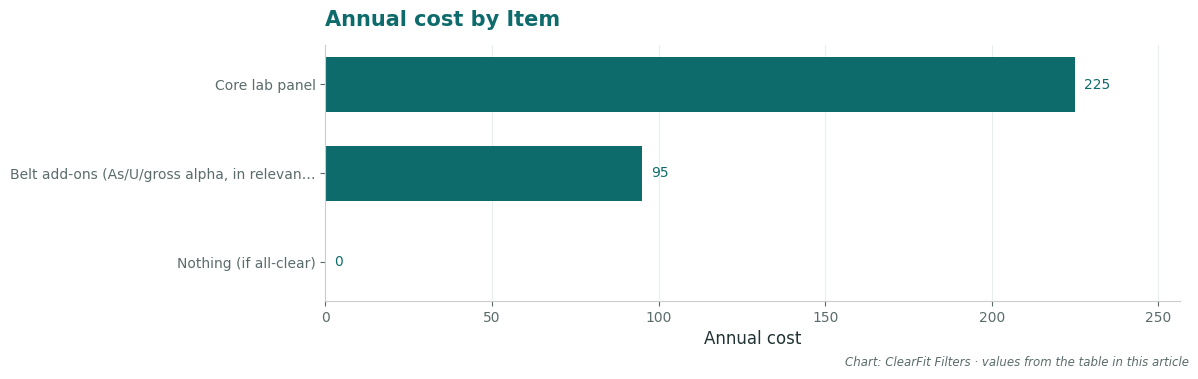
The Annual Cost Ledger (what well stewardship actually runs)
| Item | Annual cost | Notes |
|---|---|---|
| Core lab panel | $150–300 | The non-negotiable |
| Belt add-ons (As/U/gross alpha, in relevant counties) | $40–150 | Rotating add-ons: alternate years if budgets bind |
| Treatment consumables (if installed) | Varies: UV lamp ~$100–150; RO filters ~$100; media amortization | The systems’ real subscription prices — each contaminant page states its own |
| Nothing (if all-clear) | $0 | The most common outcome, and the one worth knowing |
Wait — Is My Refrigerator Filter Enough for Well Water?
A fridge cartridge is a taste polisher, not a well system. On an untreated well, the dispenser runs downstream of zero treatment: the cartridge neither disinfects, softens, nor removes the dissolved contaminants wells carry — and unfiltered sediment shortens its life. The correct order for well households: annual panel → entry-level treatment matched to results (sediment ladder, UV where indicated, softener/iron media per the numbers) → then the fridge filter as the final chlorine-free taste stage. Wells and fridge-only treatment are a bad marriage; this site’s cross-reference section exists precisely to keep the fridge filter in its honest lane.
Well Water Questions, Answered Straight
How do you know when your water well is going bad? Supply-side signs (flow decline, pressure cycling, sediment at high draw) point to pump/aquifer issues — the “not contamination” table above; water-quality signs route through the symptom router. The annual panel covers everything your senses can’t see.
How many years should a well last? A properly constructed well commonly serves 20–50+ years; pumps last 10–15; casings and screens depend on geology. “Well going bad” usually means equipment aging, not the hole itself.
How often should well water be tested? Annually for the core panel; immediately after floods, repairs, or illness; on move-in; with belt add-ons in relevant counties. That cadence is the entire monitoring program a utility would otherwise run for you.
What does a basic well water test cost? $150–300 for the standard panel; bacteria-only runs $30–80. County health departments sometimes subsidize — ask before paying lab list price.
Do I need a whole-house filter for my well? Only your lab results can say. Some wells need nothing; some need one media tank; some need the sediment-UV-softener stack. Buying equipment before the panel is the most expensive order-of-operations error in well ownership.
Is well water safer than city water? Neither categorically — different risk families. City water carries treated-but-monitored risk with public oversight; wells carry unmonitored risk that annual testing converts back into knowledge. Tested wells are excellent water; untested wells are a coin you never look at.
Related: every page in the well symptom router above · Whole-House Filter Sizing Guide · Fridge Filter Change Schedule