Water Softener vs Reverse Osmosis: They’re Not Competing — Here’s When You Need Both

A water softener and a reverse osmosis system solve entirely different problems and are frequently worth installing together. A softener is ion exchange: it swaps dissolved calcium and magnesium (hardness) for sodium, protecting your water heater, pipes, and shower glass from scale — but it removes essentially no lead, fluoride, PFAS, or TDS-beyond-hardness, and its output is whole-house. Reverse osmosis is membrane separation at the kitchen sink: it removes 90–98% of everything dissolved, hardness included — but only for the one faucet, so your water heater never notices. The engineering kicker most comparison pages miss: a softener installed upstream of an RO system protects the RO membrane from scale, which is why hard-water households running both get longer membrane life. Cartridges for the RO side are in the filter library →.
Quick Answer: Softener = whole-house ion exchange (calcium/magnesium → sodium); kills scale, doesn’t purify. RO = point-of-use membrane (−90–98% TDS incl. lead, fluoride, PFAS); purifies, doesn’t protect the house. Hardness above ~10 grains/gallon is the classic trigger to run both: softener first (whole house + membrane protection), RO at the sink for drinking.
| Dimension | Water softener | Reverse osmosis (under sink) |
|---|---|---|
| Mechanism | Ion exchange resin | 0.0001 µm membrane + pressure |
| Removes | Ca²⁺/Mg²⁺ (hardness) — swapped for Na⁺ | 90–98% of all dissolved solids |
| Doesn’t touch | Lead, fluoride, PFAS, nitrate, TDS beyond hardness | Whole-house scale (sink only) |
| Coverage | Whole house (POE) | One faucet + optionally fridge |
| Adds anything | Sodium: ~7.5 mg per 8 oz per grain of hardness removed | Nothing (remineralization stage optional) |
| Waste stream | Regeneration brine to drain + salt refills | Concentrate to drain, 1–4:1 |
| Upfront cost | $800–2,000 installed | $150–600 (DIY-friendly) |
| Ongoing | Salt ($5–10/bag, monthly-ish) | Filters $60–120/yr |
| Fixes the complaint of… | Spotted dishes, scale on heaters, dry skin claims, soap waste | Bad-tasting/contaminated drinking water |
The single most upvoted piece of advice in r/Plumbing threads on this exact question, paraphrased: “Softener for the house, RO for the drinking water. Different tools.” Contractors say it because it’s true — the two systems overlap on almost nothing, and the households that end up buying both usually tried to solve a hardness problem with an RO system (and got scale in the kettle anyway) or tried to solve a drinking-water problem with a softener (and kept tasting dissolved solids).
What Each Machine Actually Does

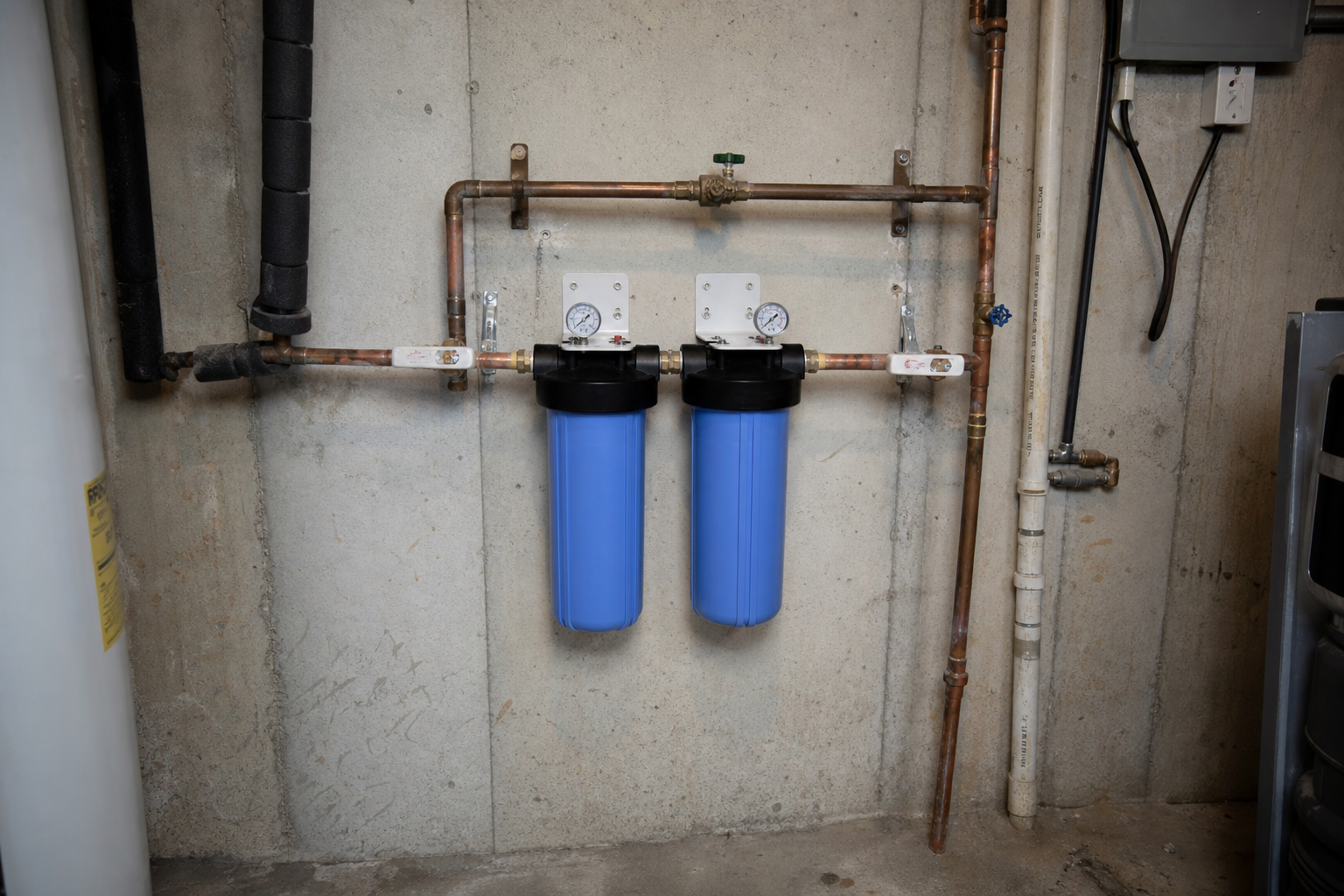
The softener’s job. Hardness — calcium and magnesium dissolved out of rock — is the most expensive “harmless” contaminant in a house: it scales water heaters (a ½-inch scale layer measurably raises energy use), clogs showerheads, films glassware, and burns through soap. A softener’s resin bed captures Ca²⁺/Mg²⁺ ions and releases sodium ions in exchange; periodically the resin backflushes with concentrated brine (that’s the salt you buy and the “regeneration” noise at 2 a.m.). Output water is soft everywhere — but its total dissolved solids are essentially unchanged (you swapped ions, you didn’t remove mass), and everything else in the water rides through untouched: lead, fluoride, nitrate, PFAS, chlorine. A softener is an appliance protector, not a purifier.
The RO system’s job. At one faucet, the membrane rejects essentially everything dissolved — including the calcium and magnesium a softener targets, plus the contaminants a softener ignores. It’s the water-quality endpoint; it does nothing for the 199 other gallons a household uses daily. (Mechanics and stage breakdown: What Is a Reverse Osmosis System? →.)
The Engineering Case for Running Both
Hard water is hostile to RO membranes. On the membrane surface, rejected calcium and magnesium concentrate against the film — the concentration-polarization layer — and when that layer exceeds solubility, it precipitates as scale directly on the membrane, cutting rejection and flow well before the 2–3 year design life. Feed water at 10+ grains per gallon is the practical danger zone; the mitigation ladder is: on-time carbon changes, a softener upstream, and shorter membrane cycles.
A softener upstream of the RO feed takes membrane-scale essentially off the table, which is why well-water households with softeners routinely see membranes last the full 3–5 years while hard-water-without-softener households replace them at 18–24 months. That’s $60–90 of membrane amortization on top of the whole-house scale savings — the softener partially pays for itself at the RO sink. This interaction is documented in the membrane lifecycle guide → alongside the TDS-rejection tests that tell you when scale has actually won.
Do You Need Both? The Decision Fork
- Municipal water, hardness under ~7 gpg, clean CCR → neither, most likely. A carbon filter handles taste. (Check your report — how to read it →.)
- Hardness 7–15 gpg, clean otherwise → softener only; drinking water fine as-is, or a carbon block if chlorine taste annoys you. RO optional.
- Hardness 10+ gpg AND drinking-water concerns (lead, PFAS, fluoride, high TDS) → both, softener first. This is the textbook configuration.
- Soft water / low hardness, but drinking-water concerns → RO only. Adding a softener would be backwards (you’d protect a membrane that doesn’t need it and soften water that’s already soft).
- Renters or sink-only needs → countertop RO (AquaTru class) and a showerhead filter; skip the plumbing.
The Sodium Question (And Why RO Answers It)
Every softener discussion eventually raises sodium: the exchange adds roughly 7.5 mg of sodium per 8-oz glass per grain of hardness removed — a 20-gpg household lands around 150 mg/glass of added sodium, which matters to low-sodium diets (a conversation for a clinician or dietitian, not a plumber). Two practical facts: most of the house’s sodium intake route is the kitchen cold tap and fridge — exactly the two outlets an RO system replaces — and RO membranes reject sodium like any other monovalent ion (~90–95%). Households that run both get soft water everywhere and near-zero-sodium drinking water at the kitchen; it’s a solved problem, not a dilemma. (For kidney-disease or sodium-restricted households, route the water-vs-diet question through your clinician — not medical advice.)
Internal link: Already have a softener and wondering what it did to your drinking water? A $15 TDS meter answers in ten seconds — softener output reads the same TDS as the incoming line; RO output reads 90%+ lower. The hard water testing guide → covers the strip-and-meter workflow.
FAQ
What is the healthiest water filtration system?
There isn’t a single “healthiest” — there’s the right-sized one for your water report. Carbon filtration handles chlorine/taste on compliant municipal water; RO adds lead/PFAS/fluoride/nitrate reduction at the sink; softening is an appliance-and-scale intervention, not a health one. Start from your CCR report, not from a product category.
What is a major downside of reverse osmosis water?
Point-of-use scope (the rest of the house is untouched), the waste ratio on tank systems, and mineral removal — all quantified in Is RO Water Good for You? →. The softener-combo configuration fixes none of these but compounds none of them either; the systems simply don’t compete.
Is RO water hard on the kidneys?
No evidence supports the claim for healthy adults — low-mineral water on a normal diet is a non-event for kidneys, which regulate electrolytes continuously. Diagnosed kidney disease with fluid/mineral restrictions is a clinician conversation about diet, not a filter-spec question. Not medical advice.
Do I need RO if I have a water softener?
If your drinking-water concerns are only about taste and your CCR is clean, no — softener output is fine to drink for most people (watch the sodium math above if you’re sodium-restricted). If you have lead, PFAS, fluoride, or high-TDS concerns, yes: the softener did nothing about any of those. The fork is decision-tree step 2 vs step 3 above.
Sources & References
- USGS water hardness classifications / Water Quality Association (WQA) — grains-per-gallon tiers and softener salt-contribution references (~7.5 mg Na per 8 oz per gpg). Official / industry organization.
- NSF/ANSI 44 (cation exchange softeners) & 58 (RO) — the two certification regimes compared. Official documentation.
- Membrane-scaling literature (DuPont FilmTec technical bulletins) — concentration polarization and hardness scaling on polyamide membranes. Retailer catalog technical data.
- Reddit r/Plumbing recurring softener-vs-RO threads — “different tools” contractor consensus; referenced, not quoted. Community discussion.
- SERP top-10 cross-reference: reddit.com, culligan.com, puronics.com, cooltoday.com, eastonwater.com, waterdropfilter.com, mayuwater.com (DataForSEO live SERP, US/2840, 2026-08-21). PAA questions: 4/4 incorporated.
Related Guides
Data page: Hard water – the full entry