How to Test for Hard Water: The Free Soap Shake Test, Strips, Titration Kits, and the CCR Shortcut Nobody Uses

You have four ways to find your hardness number, spanning $0 to $30 and ten minutes to an hour: the soap-shake test (free, qualitative, and chemically legitimate — soap precipitates with hardness before it suds), test strips ($10–15, ±10%-ish, reads 0–425 ppm), drop-count titration kits ($20–30, the same method labs use, resolution to about 1 gpg), and the one nobody remembers — your utility’s annual water quality report, which lists hardness in mg/L for free (divide by 17.1 for grains). Which you need depends on the decision waiting on the number: curiosity survives the soap test; a softener purchase deserves titration. Related: How to Remove Hard Water Stains.
Quick Answer: Free: shake a sealed bottle ⅓-full of water plus a few drops of pure liquid soap (not detergent) — fluffy suds fast = soft; cloudy scum = hard, and every extra drop needed ≈ another grain of hardness. $10–15 strips: 0–425 ppm, ±10%. $20–30 titration kits: 1-drop resolution ≈ 1 gpg — the lab method at kitchen scale. $0 and exact: your utility’s CCR lists hardness (mg/L ÷ 17.1 = gpg) — well owners don’t get this and must test (see the well-water page).
| Method | Cost | Time | Resolution | Best for |
|---|---|---|---|---|
| CCR lookup (utility report) | $0 | 10 min | Plant-level, mg/L | Municipal customers wanting the number now |
| Soap-shake test | $0 | 5 min | Qualitative + rough gpg estimate | Curiosity, demonstration, no purchase pending |
| Hardness test strips | $10–15 | 1 min | ±10%, 0–425 ppm banding | Confirming a band; quick checks post-softener |
| Drop-count titration kit | $20–30 | 10 min | ~1 gpg per drop | Softener sizing, borderline results |
| Independent lab hardness test | $25–60 | Days | Certified number | Well owners, disputes, real-estate transactions |
The r/HomeImprovement pattern this page exists for: a homeowner posts “how do I know if I have hard water” with a photo of a chalky faucet, and the thread’s answer ladder is this table in comment form — someone links the utility report, someone describes the soap bottle trick their grandmother used, and a plumber says “buy the $25 kit before you shop softeners, because the sizing math needs gpg.” The grandmother’s method deserves more respect than it gets: it’s a genuine titration, running on the same soap-scum chemistry that made hardness a household word in the first place.
The Soap-Shake Test: a Real Titration in a Bottle


The chemistry: classic soap is sodium stearate (and friends) — an anionic surfactant. Calcium and magnesium ions grab two soap molecules each and precipitate as calcium/magnesium stearate — the insoluble scum ring itself: 2 C₁₇H₃₅COO⁻Na⁺ + Ca²⁺ → (C₁₇H₃₅COO)₂Ca↓ + 2 Na⁺. No free soap molecules survive to align at the water surface until the hardness ions are all consumed — which is why soft water suds instantly and hard water makes curdled cloud first. Each additional soap drop you add goes to consuming another increment of hardness; the drop-count-to-first-suds is therefore a genuine, if coarse, measurement.
The procedure: any clear bottle with a cap, fill one-third with the water to test, add 2–3 drops of pure liquid soap (castile or the old-fashioned soap-based products — modern “soap” that’s actually detergent/syndet will suds in hard water and lie to you), cap, shake hard for 10 seconds, and observe. Fluffy white suds layer with clear water beneath = soft. Cloudy, curdled, gray-white liquid with a flat scum layer = hard. Keep adding drops one at a time, shaking between, until suds persist — a rough working scale equates each extra 2–3 drops with another few grains of hardness. It distinguishes “soft / moderate / very hard” reliably; it does not resolve 8 versus 10 gpg. (The PAA’s “can you use Dawn to test” — no: Dawn is detergent, engineered to foam in hard water; the test needs real soap.)
Strips and Titration: the Paid Tiers
Test strips (the pool-aisle and hardware variety) hold a pad impregnated with a chelating indicator that shifts color as it binds Ca²⁺/Mg²⁺. Dip, wait, match against the bottle’s color chart: 0–425 ppm in bands (0, 25, 50, 120, 250, 425 typical). Accuracy is honest-enough (±10% territory; band-reading adds slop) — perfect for “which band am I in” and for verifying a softener’s output is behaving (post-softener should read 0–1 gpg ≈ 0–17 ppm), less perfect for the borderline calls. They expire and they hate humidity — date and store them dry.
Drop-count titration kits (Hach and clones) are the step up: a measured water sample, an indicator buffer that turns the sample a color, then EDTA-style titrant drops until a sharp color change. Each drop = 1 gpg. This is mechanistically the same method a water lab runs, packaged for kitchens, and its resolution is what softener sizing actually wants — because resin capacity and regeneration settings key off gpg, and the difference between 12 and 15 gpg changes the equipment math.
Independent lab ($25–60) is for the populations with standing reasons: private well owners (no CCR exists for them — the annual testing discipline lives on the well page), and anyone in a transaction or dispute where a certified chain-of-custody number matters.
The Free Shortcut: Your CCR Already Has the Number
Municipal customers: your water quality report (“CCR,” required annually by July 1) lists hardness — usually as mg/L as CaCO₃, sometimes as gpg. The lookup is ten minutes: utility name + “water quality report,” open the PDF, search “hardness.” The conversion is the one constant this page wants you to keep: 1 gpg = 17.1 mg/L, so 120 mg/L ≈ 7 gpg (moderately hard), 180 mg/L ≈ 10.5 gpg (the “very hard” threshold’s doorstep). One caveat the CCR carries: it reports the system’s distributed average — your street, building, or well-free neighbor’s actual can differ; and if you’re on a private well there is no CCR at all, which is the entire reason the paid tiers exist. The full CCR-reading method (including the two tables that matter more than hardness) is on the report-reading page.
Reading the Number: the USGS Bands
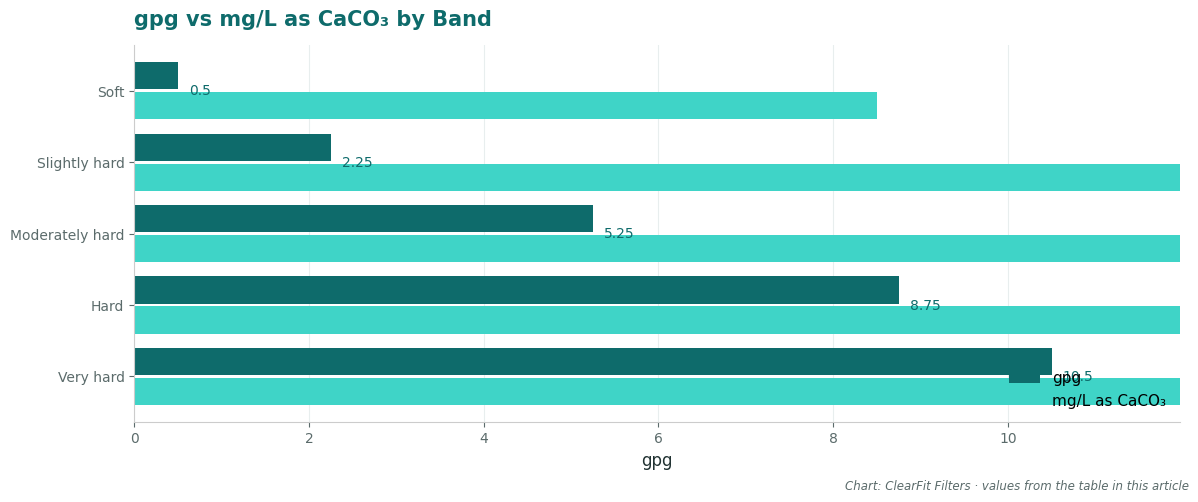
| Band | gpg | mg/L as CaCO₃ | What you’ll notice |
|---|---|---|---|
| Soft | 0–1 | 0–17 | Soap suds extravagantly; scaling rare |
| Slightly hard | 1–3.5 | 17–60 | Occasional spotting |
| Moderately hard | 3.5–7 | 60–120 | Spotted dishes; shower film begins |
| Hard | 7–10.5 | 120–180 | Visible scale; soap consumption; humidifier dust |
| Very hard | 10.5+ | 180+ | The full treadmill — see the 4.7 kg/year shower arithmetic |
From Number to Decision
Under 7 gpg: the stains-and-soap annoyances are manageable with the cleaning chemistry on the removal page — prevention purchases are optional lifestyle calls. 7–10.5: run the appliance math (water heater scale, detergent doubling, humidifier wicks — that page’s tank arithmetic); a softener starts paying but slowly. Over 10.5: the softener’s case is arithmetic, not preference — and its sizing starts with your titration number, which is why this page put the $25 kit above the strips for that purchase. The “cheapest way to soften” question the PAA asks: it isn’t a gadget — the lowest-cost real reductions are a softener rental (~$20–40/month, no capital), a portable exchange tank service (they haul regenerated tanks), or, for point-of-use relief only, the chelating-shampoo and distilled-jug moves from the hair page. Magnetic/electronic “water conditioners” occupy the claims-without-mechanism tier — no consistent hardness reduction in independent testing, which is the difference between softening water and selling hope.
FAQ
Can you use Dawn to test for hard water?
No — Dawn is a detergent (synthetic surfactant), engineered specifically to foam in hard water; it defeats the soap-scum reaction the test runs on. Use pure soap (castile). The dish-soap version of the folk test produces suds in any water and tells you nothing. A related honest hack: dish soap behavior does reveal hardness indirectly — needing more and more to cut grease tracks your gpg — but that’s a vibe, not a measurement.
Is hard water bad for your hair?
Mechanically yes, biologically no — deposits roughen and weaken the shaft (breakage, dullness), but follicles keep producing and the damage reverses with changed conditions. The full evidence breakdown, the WASH-trial skin reversal, and the intervention ladder are on the hard-water health page.
How do I fix hard water in my house?
Ranked by what the number says: under 7 gpg — cleaning chemistry and soap choice handle it; 7+ — a softener (purchase $600–2,000 installed, or rental $20–40/month; sizing keys off your gpg from this page’s titration), with a bypass line at the kitchen cold tap if you want unsoftened drinking water (the sodium arithmetic is on the sources page); point-of-use alternatives (shower filter, distilled jugs for the humidifier and iron) shrink the blast radius without the capital. Well owners: test the full panel first — hardness rides with iron and pH problems that change the treatment train.
What is the cheapest way to soften hard water?
By true cost: portable exchange-tank service (no equipment purchase, they regenerate off-site), softener rental (monthly, no capital), then basic timer-based softeners ($400–600 hardware) if you’ll do your own salt logistics. Below those: don’t soften everything — soften the problem (chelating shampoo for hair, distilled water for the humidifier, vinegar cadence for the shower door). And skip the magnet/electronic conditioners — the claims don’t survive independent testing, which makes them the most expensive option at any price.
Sources & References
- USGS — water hardness classification (soft through very hard bands; 1 gpg = 17.1 mg/L as CaCO₃). Official documentation.
- Soap chemistry references — stearate precipitation (2RCOO⁻ + Ca²⁺ → (RCOO)₂Ca↓) as the basis of the shake test. Official documentation (chemistry literature).
- Hach / titration kit methodology documentation — EDTA-type drop-count hardness determination. Official documentation.
- EPA — CCR rule (annual reports by July 1; hardness reporting practice). Official documentation.
- WQA — softener sizing by gpg; exchange-tank service model. Industry expert analysis.
Related Guides
- How to Remove Hard Water Stains — the cleaning chemistry this number schedules.
- How to Read Your Water Quality Report — the free method behind tier one.
Full entry: Hard water – the full entry