How to Test Water Quality at Home: Match the Test to the Question

Home water testing fails in a predictable way: people buy the wrong test for their question. A $12 strip cannot see lead; a $20 TDS meter cannot see anything that matters for safety; and a $250 lab panel is overkill for “does my new filter remove chlorine.” This page is a decision tree first, products second — three tiers, what each one can and cannot detect, and the two sampling rules (first-draw for lead, the paired-sample method) that separate a valid test from an expensive guess. Related: How to Read Your Water Quality Report.
Quick Answer: Match the test to the question: $12–20 test strips screen chlorine, pH, hardness; a $20 TDS meter tracks dissolved-solids trends (RO membrane health) but detects no safety contaminants; a $150–300 certified lab kit is the only tier that measures lead, bacteria, and PFAS with defensible numbers. For lead, sample first-draw morning water — random afternoon samples routinely miss it.
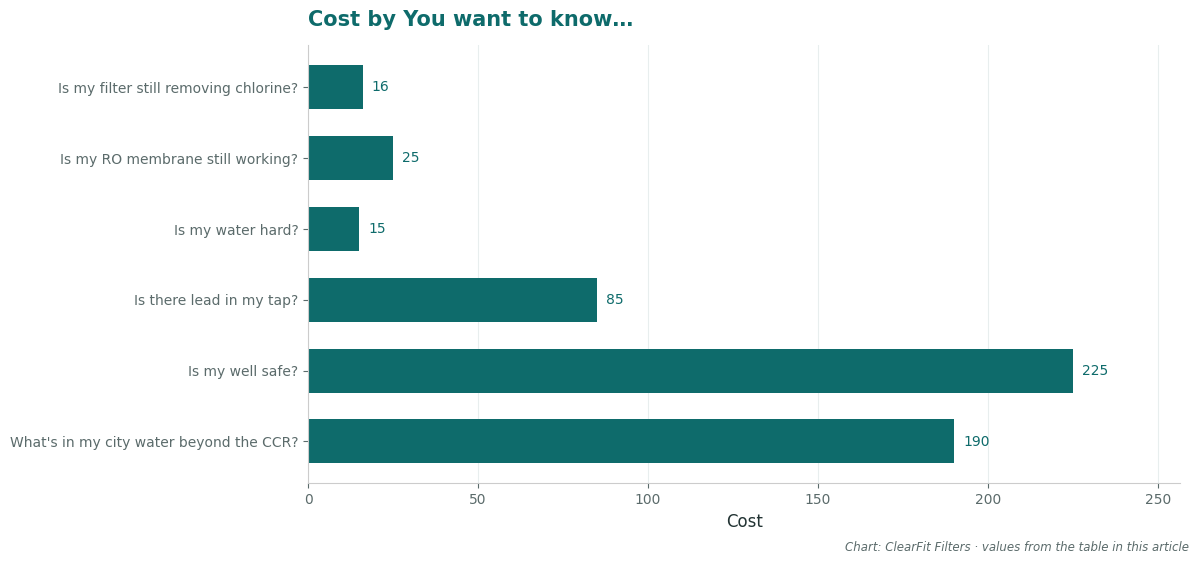
| You want to know… | Right tool | Cost | Can it see lead? |
|---|---|---|---|
| Is my filter still removing chlorine? | Test strips | $12–20 | No |
| Is my RO membrane still working? | TDS meter | $20–30 | No |
| Is my water hard? | Strips or hardness titration | $10–20 | No |
| Is there lead in my tap? | Lab first-draw panel | $40–130 | Yes |
| Is my well safe? | Annual lab panel | $150–300 | Yes (+bacteria, nitrate) |
| What’s in my city water beyond the CCR? | Lab tap panel | $130–250 | Yes (+PFAS if added) |
Wirecutter’s top pick in this category is a lab kit, and Culligan’s page funnels everything toward a sales visit — but the Reddit threads (r/water, r/HomeImprovement) show what people actually do: they buy the $15 strip kit off Amazon first, get a scary-or-comforting-but-meaningless reading, then ask the forum what any of it meant. The tiers below are ordered so that the cheap tools are used for the questions they can actually answer.
Tier 1: Test Strips ($12–20) — Screening Only

Strips measure the fast chemistry: free chlorine, total chlorine, pH, total hardness, alkalinity, and sometimes iron or nitrate (semi-quantitatively). Two legitimate jobs: verifying a carbon filter still removes chlorine (test before/after the filter — the “after” strip should show near-zero), and confirming hardness before buying a softener or deciding if scale explains your appliance problems.
What strips cannot do: detect lead at meaningful levels (their lead pads top out far above the 5–15 ppb range you care about), detect bacteria at all, or quantify anything to lab precision. A strip reading is a category answer — “chlorine present / absent,” “hard / soft” — never a number to act on legally.
Tier 2: The TDS Meter ($20–30) — Trend Instrument, Not Safety Instrument
The TDS pen measures electrical conductivity and converts it to “total dissolved solids.” Its honest uses are narrow: verifying an RO membrane is still rejecting 90%+ of feed TDS (compare feed vs product water — a ratio, which cancels the meter’s calibration sloppiness) and tracking whether your supply’s dissolved load is drifting seasonally.
The trap deserves its own paragraph: low TDS does not mean safe water, and high TDS does not mean dangerous water. Distilled water and contaminated-with-lead water can both read “low TDS” — lead at 15 ppb moves a TDS meter by less than its error margin. Bacteria, PFAS, and pharmaceuticals are invisible to conductivity. The TDS-zero paranoia that fuels “my tap reads 200, should I panic?” posts is a measurement-category error; the meter was never looking at those threats. What TDS actually is and when it matters: the TDS entry.
Tier 3: Certified Lab Kits ($150–300) — The Only Defensible Numbers
For any question involving lead, bacteria (total coliform/E. coli), nitrate, arsenic, or PFAS, the answer is a state-certified lab panel. Kits (Tap Score, PENN-VIRGINIA-style regional labs, extension-service programs) ship you sampling bottles with preservatives and instructions; results return in 1–3 weeks with concentrations in µg/L and comparisons against MCLs.
The first-draw rule for lead: sample the water that sat in your pipes overnight — first thing in the morning, before any tap in the house runs. Lead leaching is a stagnation phenomenon; a mid-day sample after the pipes have flushed can read clean while the morning glass your kids drink is the problem. For rigor, the paired-sample method: one first-draw, one after 2 minutes of flushing — if first-draw is high and flushed is low, the source is your plumbing; if both are high, the problem is upstream of the house. That single pair of results tells you more than any single sample, because it locates the problem, not just flags it.
When to Go Straight to the Lab
Skip the strips and order the panel if any of these apply: private well (annual coliform + nitrate minimum, per EPA well guidance), pregnancy or an infant on formula in a pre-1986 home, visible corrosion, blue-green stains, or metallic taste (see the metallic-taste diagnosis), or a CCR lead row you want verified at your own faucet rather than the system’s sampling points.
From Results to Action
Map findings to responses the same way the CCR mapping works: chlorine residual present after your filter → replace the cartridge; lead confirmed at your tap → NSF 53 lead-certified filter (certification meaning explained in NSF 42 vs 53); nitrate near 10 ppm for a formula household → RO or bottled; bacteria positive on a well → shock chlorination per well-contractor protocol, then retest. And the negative result is also an action: a clean lab panel is a license to stop spending — an outcome the filter-retail internet rarely volunteers.
FAQ
What is TDS and pH in water?
TDS (total dissolved solids) is the summed mass of everything dissolved — minerals mostly — estimated from electrical conductivity; pH measures acidity on the 0–14 scale. Neither is a safety test: TDS is a taste/scaling indicator, and EPA treats pH 6.5–8.5 as an aesthetic guideline.
What are the 5 main indicators of water quality?
The standard panel: microbiological (coliform), chemical (nitrate, lead, arsenic), physical (turbidity, pH, TDS), disinfectant residual (chlorine), and radiological (in affected regions). For homeowners, the operative five from any lab order form are coliform, nitrate, lead, pH, and hardness.
What are the 5 qualities of good water?
Practical version: no detected coliform; lead below 5 ppb at your tap; nitrate under 5 ppm; pH between 6.5 and 8.5; and taste/odor you don’t have to overcome. “Good” is a panel of thresholds, not one score.
How to check if water is drinkable?
You cannot fully verify drinkability at home — the definitive check is a certified lab panel. The practical sequence: read your CCR (free), run the lead-pipe check if pre-1986, and lab-test once to establish your baseline; repeat testing only when something changes (new well, new fixtures, advisory).
Sources & References
- EPA — private well testing guidance (annual coliform + nitrate recommendation); lead sampling protocols. Official documentation.
- State-certified lab programs — the lab-tier reference standard (NELAC/ISO 17025 accreditation context). Official standard.
- NYT Wirecutter — best water test kit reviews (category reference, lab-kit orientation). Industry expert analysis.
- Reddit r/water, r/HomeImprovement — strip-kit purchasing behavior and misreading patterns. Community discussion.
Related Guides
- How to Read Your Water Quality Report (CCR) — the free 10-minute precursor to any kit.
- What Is TDS in Water? — the trend instrument’s proper scope.
- Why Does My Water Taste Metallic? — when a symptom short-circuits the decision tree.