Does Boiling Water Remove Chlorine? (Timeline, Chloramine Catch, and the Concentration Risk)

Boiling removes free chlorine on a predictable timeline — roughly half in 10 minutes of rolling boil, most of it in 20 — but the method has two failure modes nobody’s blog covers together: if your utility switched to chloramine, boiling barely works, and if your concern is lead or nitrates, boiling makes the water worse, not better. This page gives the evaporation timeline at four temperatures, the 10-minute way to find out which disinfectant your utility uses, and the numbers on what boiling concentrates. Related: Chlorine in Tap Water and Chloramine: The Disinfectant Boiling Can’t Beat.
Quick Answer: Yes — boiling drives off free chlorine: roughly 50% in 10 minutes at a rolling boil, ~90% in 20 minutes (faster above 140°F). It does not remove chloramine, used by roughly 1 in 5 US utilities. And boiling concentrates lead and nitrates rather than removing them — never use prolonged boiling as a lead or nitrate mitigation.
| Method | Time | Free chlorine removed | Chloramine removed |
|---|---|---|---|
| Let it stand, open container | 24 h | ~most (typical) | barely any |
| Warming to 140°F+ | 20–30 min | substantial | minimal |
| Rolling boil | 10 min | ~50% | minimal |
| Rolling boil | 20 min | ~90% | partial at best |
| NSF 42 carbon filter | seconds | >90% (certified) | only catalytic carbon |
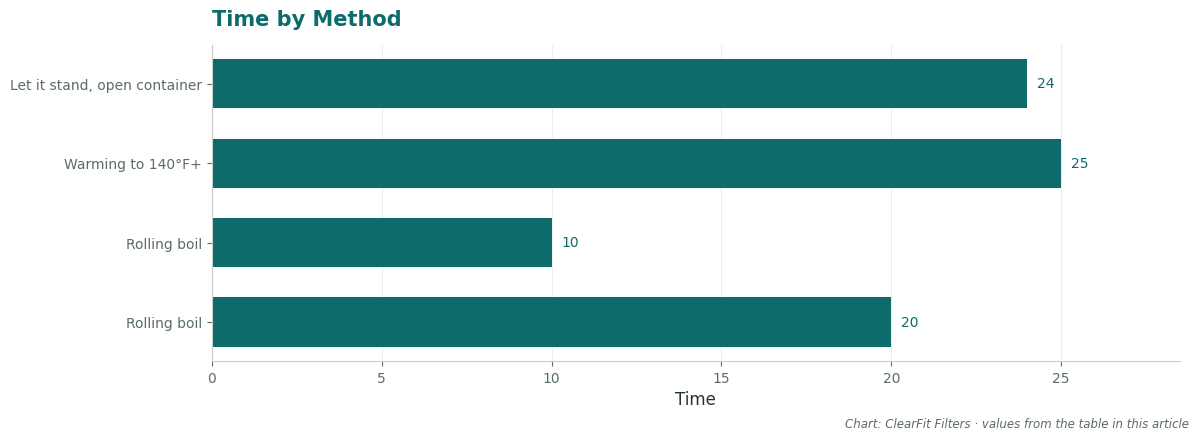
The evaporation percentages above are consistent with typical aquaculture and brewing-industry measurements (fish keepers and home brewers are the two communities that have actually quantified this, because chlorine kills fish and ruins beer). One r/Aquariums regular’s method: fill a bucket Sunday night, run an airstone overnight, water change Monday morning. It works for free chlorine — and fails completely in chloramine cities, which is exactly how many aquarists discover their utility switched disinfectants without them noticing.
The Timeline: What Happens Hour by Hour

Free chlorine (hypochlorous acid and hypochlorite) is a dissolved gas in equilibrium with the air above it. At room temperature in an open container, a full glass loses most of its chlorine within 24 hours; a wide pot loses it faster than a narrow jug because the escape route is surface area. Warm it to 140°F and the equilibrium shifts sharply — Henry’s law working in your favor — and at a rolling boil, 10 minutes removes roughly half and 20 minutes removes the vast majority.
These are typical values, not lab-certified constants: your starting chlorine level matters (EPA allows up to 4 mg/L residual, most systems deliver 0.2–1.0 mg/L at the tap), and your pot geometry matters. If you need certainty rather than “roughly,” a $12 chlorine test strip answers the question for your specific water in 30 seconds.
The Chloramine Catch: Find Out Before You Boil

Chloramine (chlorine bound to ammonia) is far more stable than free chlorine — that is precisely why utilities adopt it. It persists for days in an open bucket instead of hours, and standard boiling barely dents it. Roughly one in five US surface-water systems now uses chloramine, including most major metros that switched for disinfection-byproduct control.
The check takes one minute and costs nothing: open your annual CCR and search for “chloramine” in the disinfectant column, or call the utility. If the answer is chloramine, boiling is the wrong tool entirely — you want catalytic carbon filtration, the media specifically certified for chloramine reduction (standard activated carbon removes some; catalytic carbon removes it fast enough to matter at fridge-filter flow rates). The full comparison is in our chloramine guide.
The Reverse Risk: What Boiling Concentrates
Boiling is pure subtraction of water vapor — everything dissolved stays, in less water. Lead and nitrates do not evaporate; a 20-minute boil that halves the water volume doubles their concentration. For formula preparation, CDC’s actual guidance is precise about this: boil water briefly (1 minute, rolling) for microbial safety, let it cool, then mix — the short boil is about germs, not chemistry, and prolonged boiling is never recommended for nitrate- or lead-affected supplies.
The same logic applies to anyone considering “boil it longer” as a lead mitigation after a service line scare. Boiling is the right tool for exactly one water problem — microorganisms — and the wrong tool for essentially every dissolved contaminant.
Faster Alternatives (With the Comparison That Actually Matters)
For drinking-water taste, the honest ranking:
- Any NSF 42 carbon filter — fridge, pitcher, or faucet-mount — removes chlorine in seconds of contact time, at single-digit cents per gallon. This is what NSF 42 certification means: aesthetic chlorine reduction to a certified standard.
- 24-hour standing — free but slow, works only for free chlorine, and trades chlorine for a 24-hour open container (see how long water can sit out before the bacteria question takes over).
- Boiling — the option that made sense in 1950 and now mostly makes sense for cooking water you’re heating anyway.
Camp showers and kettles aside, if chlorine taste is a daily annoyance, the filter math beats the kettle math within about two weeks of use.
FAQ
How long do you have to boil water to remove chlorine?
Roughly 10 minutes of rolling boil removes about half the free chlorine; 20 minutes removes ~90% (typical values for tap-water chlorine levels). Pre-warming helps less than surface area does — a wide, shallow pan outperforms a tall pot.
What is the best way to remove chlorine from tap water?
For volume: an NSF 42 certified carbon filter (seconds, cents per gallon). For free: let it stand 24 hours in an open container — effective for free chlorine only. For chloramine: neither standing nor boiling is adequate; use a catalytic-carbon filter.
Will a Brita filter remove chlorine?
Yes — Brita pitchers are NSF 42 certified for chlorine taste/odor reduction, like essentially all carbon-based fridge and pitcher filters. Chloramine reduction is a different claim; check the specific model’s certification, since standard carbon media handles chloramine only slowly.
Does chlorine stay in water after boiling?
Some does. Free chlorine is driven down dramatically but not to zero in typical kitchen boiling times; chloramine persists through boiling largely intact. A chlorine test strip confirms what’s left in your specific water.
Sources & References
- EPA — MRDL for chlorine (4 mg/L) and chloramine (4.0 mg/L as Cl2); typical residual ranges. Official documentation.
- CDC — infant formula preparation guidance (brief boil for microbial safety). Official documentation.
- Aquaculture & brewing industry references — chlorine off-gassing timelines (typical measured values, not certified constants). Industry expert analysis.
- NSF/ANSI 42 — chlorine taste/odor reduction certification scope. Official standard.
Related Guides
- Chlorine in Tap Water — why it’s there and what it does.
- Chloramine in Tap Water — the boiling-proof disinfectant and catalytic carbon.
- How Long Can Water Sit Out? — the other end of the 24-hour-stand method.