How Much Does a Reverse Osmosis System Cost? (System + Install + 5-Year Filters, Actually Totaled)

A quality under sink reverse osmosis system costs $150–$600 upfront depending on architecture — tank systems (iSpring RCC7, APEC ROES-50, Express Water RO5DX class) at $150–300, tankless (Waterdrop G3P800 class) at $400–600 — plus $60–120 per year in replacement filters and a membrane amortized over 2–3 years. Installed by a plumber, add $150–$300; DIY is free beyond a $4 tube of silicone grease. Over five years a tank system totals roughly $600–800 all-in, which this page puts against the two alternatives it replaces (bottled water and pitcher filters) in the TCO table no SERP competitor calculates. Current cartridge prices by system are in the RO filter library →.
Quick Answer: Expect $150–300 for a tank-style under sink RO system (iSpring RCC7 ~$200, APEC ROES-50 ~$200, Express Water RO5DX ~$200 class), $400–600 tankless, $300–400 countertop (AquaTru class). Installation: $0 DIY (2–3 hrs) or $150–300 plumber. Consumables: $60–120/year. Five-year total cost of ownership for a tank system: ~$600–800 — cheaper than bottled water from year 2.
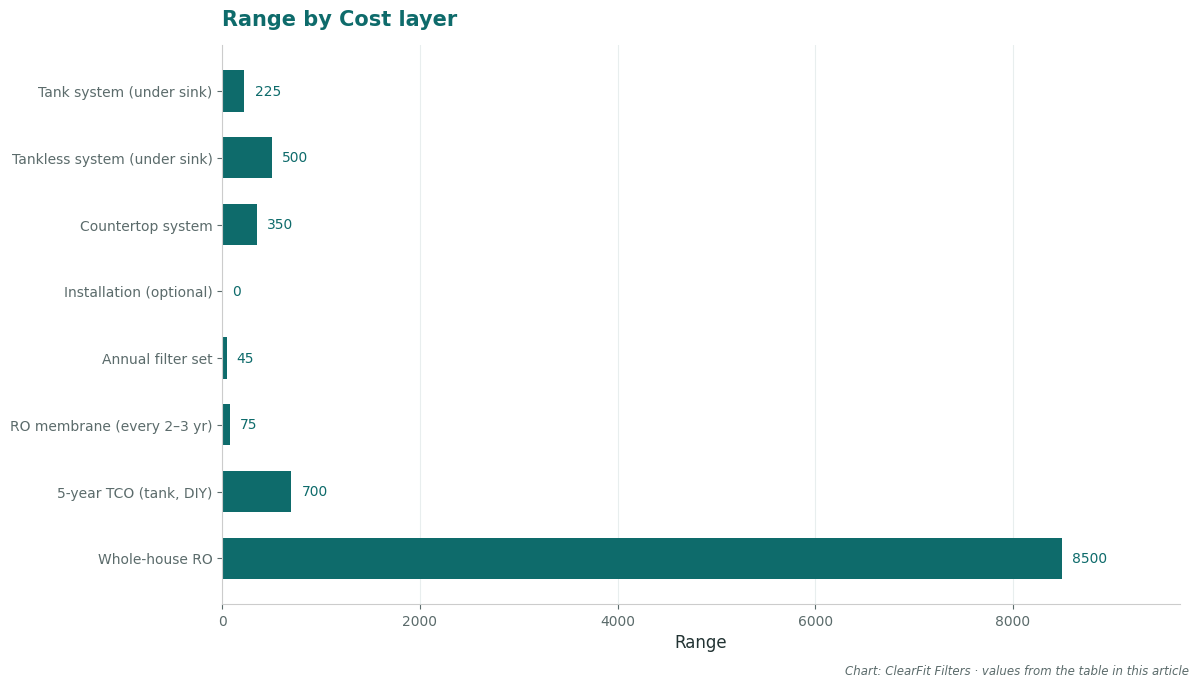
| Cost layer | Range | What moves it |
|---|---|---|
| Tank system (under sink) | $150–300 | GPD rating, brand, stage count (5 vs 6) |
| Tankless system (under sink) | $400–600 | Pump, electronics, waste ratio |
| Countertop system | $300–400 | AquaTru class; zero installation |
| Installation (optional) | $0 / $150–300 | DIY vs plumber; outlet needed for tankless |
| Annual filter set | $30–60 | Sediment + carbon ×2, post-carbon |
| RO membrane (every 2–3 yr) | $60–90 | GPD rating; amortize $20–40/yr |
| 5-year TCO (tank, DIY) | ~$600–800 | $200 system + ~$350 filters + membrane +$90 |
| Whole-house RO | $2,000–15,000+ | Storage tank, delivery pump, drain load |
A pattern that shows up constantly in r/Frugal and r/water threads: a family tired of lugging cases of bottled water prices a $200 RO system, balks, keeps buying bottles — and never runs the multi-year comparison. The TCO section below runs it. The one-line spoiler: at two gallons a week of drinking water, bottled beats RO only in year one; by year three the RO household is several hundred dollars ahead, and by year five the margin buys the next two years of filters.
The System Tiers, With Real Models

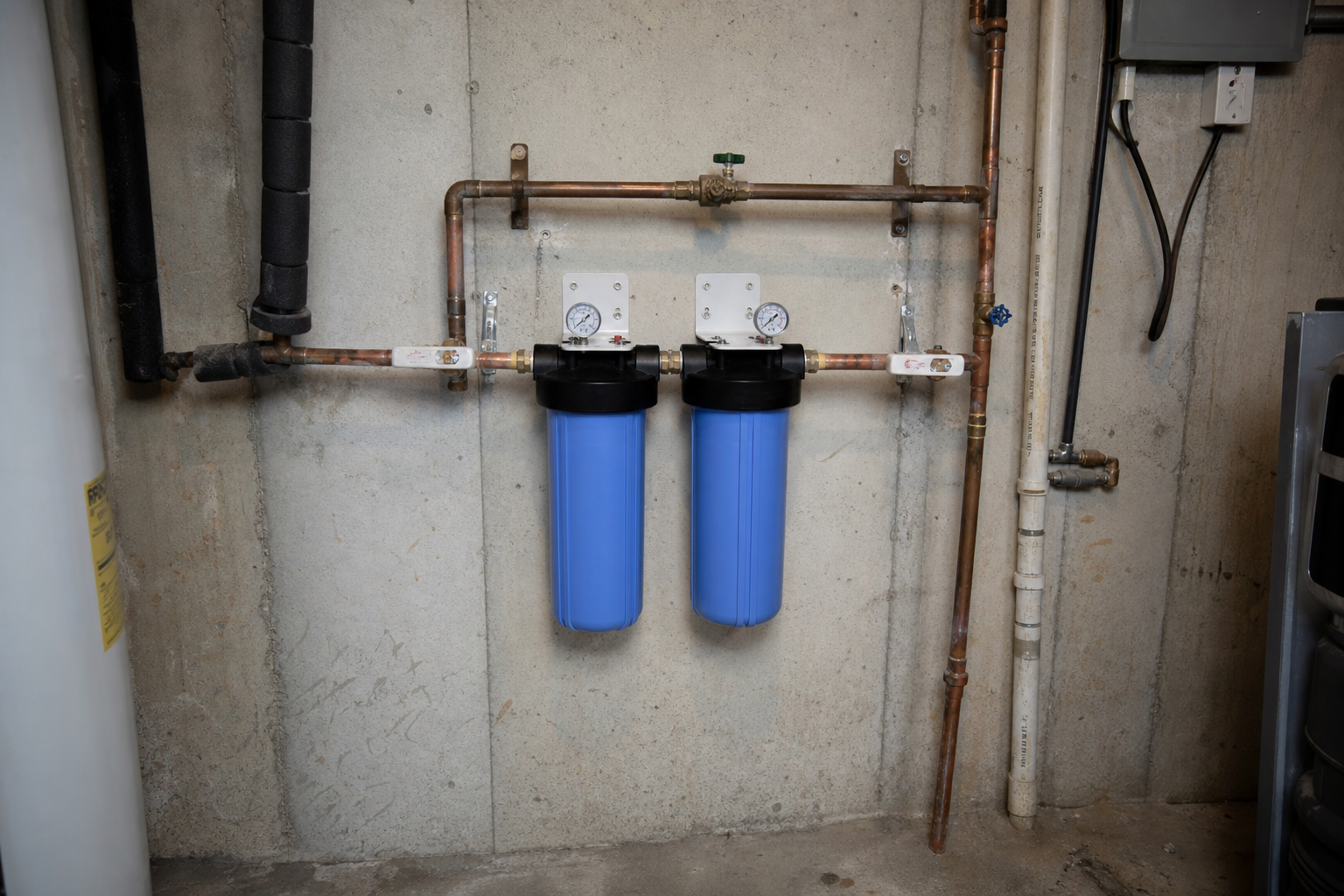
Tank systems, $150–300. The value tier. The iSpring RCC7 (its model family pulls ~1,300 searches/month), APEC ROES-50 (~260), and Express Water RO5DX are the three most-owned units in this class — all 5-stage, 75 GPD-class, NSF/ANSI 58-certified platforms with inexpensive annual filter sets ($30–60) and 2–3 year membranes ($60–90). Differences that matter: GPD (50 vs 75), inclusion of a faucet and feed adapter in the box, and filter-set pricing — Express Water and iSpring kits undercut APEC’s by a few dollars per stage.
Tankless systems, $400–600. Waterdrop’s G3P600/G3P800 lead this tier (390–480 searches/month respectively). You pay for the internal booster pump, 600–800 GPD instant production, a better waste ratio (~1–2:1 vs 3–4:1), and cabinet space. Operating costs run higher: cartridge sets are proprietary and pricier, and the unit needs an electrical outlet in the sink cabinet. The architecture trade-offs are compared in Tankless vs Tank RO Systems →.
Countertop systems, $300–400. The AquaTru class (3,600 searches/month — bigger than any single under sink model) trades counter space for zero installation: no faucet hole, no drain saddle, no plumbing. Filter economics are the worst per gallon, but for renters the install-free property is worth it.
Whole-house RO, $2,000–15,000+. Included here as a scope warning, not a recommendation. Whole-house RO means sizing for 200+ gallons/day, a pressurized storage tank, a delivery pump, and remineralization to protect plumbing — appropriate for specific high-contaminant well situations, otherwise a purchase to talk down a family member from. For drinking-water goals, an under sink unit plus a water test answers the actual question for 5% of that budget.
Installation: The $150–300 Line Item You Can Delete
Every under sink RO kit is designed for no-solder, no-glue DIY installation: five connection points, quick-connect tubing, 2–3 hours for a first-timer. The step-by-step install guide → covers the whole sequence including the three variants (tankless needs an outlet; basement installs need tubing runs and possibly a delivery pump; countertop units need nothing). Pay the plumber if the sink is stone (drilling anxiety is legitimate), the cabinet lacks an outlet and you don’t want an electrician, or your time is genuinely worth more than $100/hour — otherwise this line item is deletable.
The Five-Year TCO Table (The Account Nobody Runs)
Assumptions: 2 gallons/week drinking water production; filter prices at mid-range; bottled water at $0.30/gal in bulk cases (the optimistic case — single-serve bottles run $1.00+/gal); pitcher filters replaced per manufacturer schedule.
| Option | Year 1 | Year 5 cumulative | Notes |
|---|---|---|---|
| Bottled water (bulk cases) | ~$30 system-free | ~$780–800 | 2 gal/wk × $0.30/gal × 260 wk; excludes lugging/plastic |
| Bottled water (single-serve) | ~$0 | ~$2,600 | At $1.00/gal; the real habit cost |
| Pitcher filter | $30 + $40 | ~$230 | But no TDS/lead/PFAS reduction — different tool |
| RO tank system, DIY | $200 + $70 | ~$740 | Includes 2 membranes and 5 filter-years |
| RO tank system, plumber | $350 + $70 | ~$890 | Still undercuts single-serve bottled by year 2 |
| RO tankless | $500 + $110 | ~$1,100 | Buys space + waste ratio + instant flow |
| RO countertop | $350 + $90 | ~$820 | Renter’s route |
Three honest reads from the table: (1) the pitcher column isn’t really comparable — it solves chlorine taste, not TDS/lead/PFAS, and pretending a $230 pitcher equals a $740 RO system misframes the question (the fork logic is in What Is a Reverse Osmosis System? →); (2) bulk-case bottled water is genuinely cheap and the ROI case for RO against that specific habit is multi-year and partly non-financial (no lugging, no plastic, on-demand); (3) every RO row pays its “premium” mostly in year 1 — from year 2 forward an RO system costs about $12–25/month to operate, which is the number to remember at the shelf.
Keeping Year-6-Plus Costs Down
The subscription-tier savings are boring but real: buying filter sets as annual kits instead of individual cartridges cuts 15–25% off consumables (iSpring/APEC/Express Water all sell annual bundles; our filter library lists the kit SKU per system). Second lever: don’t replace the membrane on the calendar — replace it on TDS rejection evidence →, which stretches a healthy membrane to year 3–5 and saves $60–90 per avoided cycle. Third: protect the membrane with on-time carbon changes (a $15 cartridge preventing a $75 casualty — the mechanics are in the replacement schedule).
FAQ
How much does it cost to install a reverse osmosis system?
DIY: $0 — the kit contains every fitting, and the process is quick-connect plumbing, not soldering. Professional installation runs $150–$300 (handyman) to $200–$500 (licensed plumber, metro pricing). Tankless systems may add an electrician visit ($100–150) if the sink cabinet lacks an outlet. The full install walkthrough is here →.
Is there a downside to reverse osmosis water?
Minerals removed (diet-replaceable), waste water on tank systems (3–4:1), and the maintenance schedule — all quantified in Is RO Water Good for You? →. None of these change the cost math above; they change whether the output profile is what you want.
Is a reverse osmosis water system worth the money?
If your water needs it — lead lines, high TDS, PFAS, fluoride, nitrate — yes, decisively: it’s the only residential technology that addresses those at the sink for under $1,000 over five years. If your annual water report is clean and your complaint is chlorine taste, a $40 carbon filter is the right-sized purchase and RO is overcapitalization. The fork runs through what’s in your tap water →.
How much should a whole house reverse osmosis system cost?
$2,000–$15,000+ installed, sized by daily flow — including the pressurized storage tank, delivery pump, and typically post-treatment remineralization. It’s justified for specific high-contaminant wells, not as an upgrade from an under sink unit; most households asking this question actually need a water test and an under sink system.
Sources & References
- Retailer catalog pricing and filter-kit data — iSpring RCC7/RCC7AK, APEC ROES-50, Express Water RO5DX, Waterdrop G3P600/G3P800, AquaTru (MSRP and consumable pricing, 2026-08 shelf check). Official documentation.
- NSF/ANSI 58 — certification basis for the systems named. Official documentation.
- HomeAdvisor/Angi-class installer estimates — $150–300 plumber range for under sink RO (handyman vs licensed tiers). Industry data 🟡.
- Reddit r/Frugal, r/water recurring bottled-vs-RO threads — the habit-pricing reality (single-serve vs bulk case); referenced, not quoted. Community discussion.
- SERP top-10 cross-reference: espwaterproducts.com, homedepot.com, nytimes.com (Wirecutter), thisoldhouse.com, modernize.com, waterdropfilter.com (DataForSEO live SERP, US/2840, 2026-08-21). PAA questions: 4/4 incorporated.
Related Guides
- How to Install an Under Sink RO System
- Tankless vs Tank RO Systems
- What Is a Reverse Osmosis System?
Full entry: TDS in water – the full entry