Does Reverse Osmosis Remove Fluoride? (With the Lead, PFAS and Microplastics Numbers on the Same Table)

Yes — a properly maintained reverse osmosis system removes 85–95% of fluoride. That figure isn’t a marketing range: NSF/ANSI 58, the certification standard for RO drinking water systems, includes a specific fluoride-reduction claim, and certified systems are tested against a 8.0 mg/L challenge concentration with a pass threshold at or below the claimed percentage. On typical US fluoridated tap water (0.7 mg/L by Public Health Service recommendation), an RO system delivering 90% reduction takes fluoride to roughly 0.07 mg/L — below most lab detection comfort zones. The same membrane physics removes lead, PFAS, and microplastics, which is why the full contaminant table below — not the fluoride yes/no — is the useful decision document. Our RO filter model library → lists the certified cartridge for each major system.
Quick Answer: Yes — certified RO systems remove 85–95% of fluoride (NSF/ANSI 58 claim basis; tested at an 8 mg/L challenge). Municipal fluoridation targets 0.7 mg/L; RO output typically lands under 0.1 mg/L. EPA’s enforceable limit is 4.0 mg/L (MCL) with a 2.0 mg/L aesthetic standard (SMCL). RO is one of only two practical point-of-use fluoride reducers — activated carbon filters do not remove fluoride.
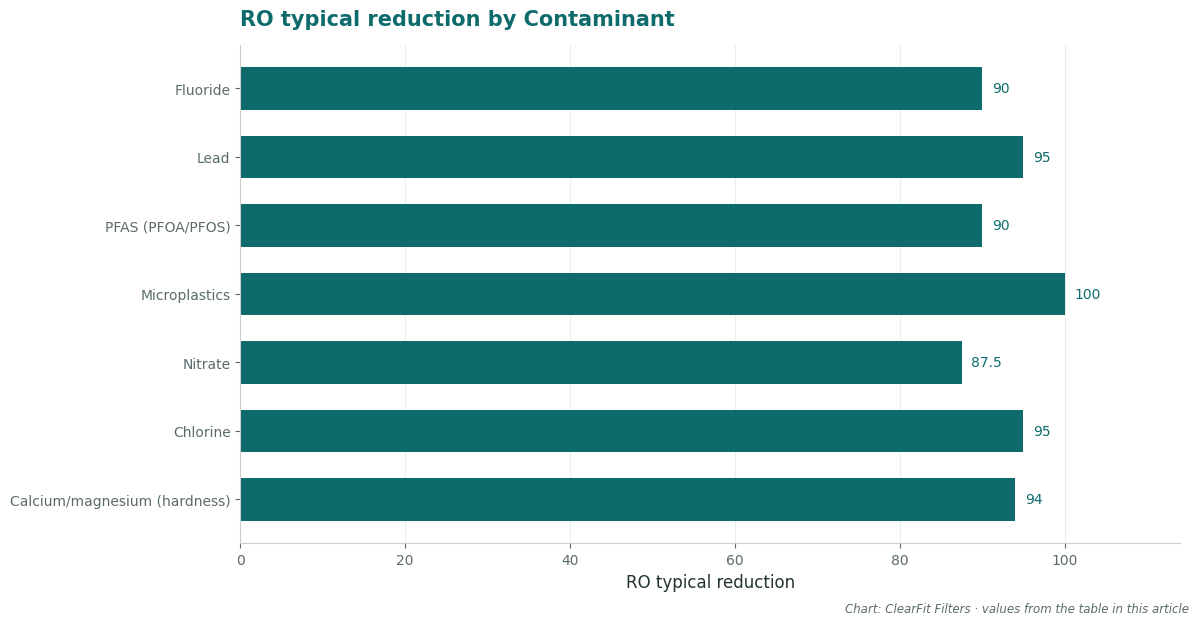
| Contaminant | RO typical reduction | Certification basis | Notes |
|---|---|---|---|
| Fluoride | 85–95% | NSF/ANSI 58 fluoride claim | The only common POU methods: RO, or activated alumina |
| Lead | 95%+ | NSF/ANSI 58 (TDS/lead claims) | Dissolved ionic lead rejected with TDS |
| PFAS (PFOA/PFOS) | 90%+ | NSF/ANSI 58 + P473 references | 2024 EPA MCLs: PFOA/PFOS 4.0 ppt each |
| Microplastics | ~100% theoretical | Pore-size logic: RO ≈ 0.0001 µm | Microplastics are >1 µm by definition — 10,000× larger |
| Nitrate | 80–95% | NSF/ANSI 58 | Agricultural wells; below MCL 10 mg/L target |
| Chlorine | 95%+ (via carbon stage) | NSF/ANSI 42 | Removed mostly by the carbon pre/post-filter, not the membrane |
| Calcium/magnesium (hardness) | 90–98% | Rejected as TDS | Why RO output reads <50 ppm on a TDS meter |
A recurring pattern in r/askdentists and parenting forums: a family buys an RO system for lead or taste reasons, then realizes months later it also stripped fluoride, and now they’re fielding conflicting advice about their kids’ teeth. The honest framing is in the “teeth” section below — both the dental-health consensus and the reduction numbers can be true at once, and pretending either side doesn’t exist is how most competitor pages lose credibility.
Why RO Rejects Fluoride While Carbon Filters Don’t

Fluoride in tap water exists as the fluoride ion (F⁻) — a dissolved, electrically charged particle with no affinity for activated carbon’s adsorption surface. Carbon is a molecular-surface adsorber: it grabs organics, chlorine, VOCs. It has essentially nothing to offer a naked ion. An RO membrane works on a different principle entirely — a semi-permeable film with effective pore size around 0.0001 microns that rejects dissolved ions by charge-and-size exclusion under pressure (40–100 psi of household water pressure driving flow against the natural osmotic gradient). A fluoride ion, hydrated, is physically and electrically excluded; rejection rates of 85–95% reflect the small fraction that slips through membrane imperfections and seal edges.
This is also why fluoride reduction is membrane-dependent: a worn membrane with chlorine damage or scaling sees rejection slide from 90%+ toward 70% and below. If fluoride removal is the reason you own the system, track it with a TDS meter as a proxy (rejection % falling = fluoride rejection falling) and replace the membrane when rejection drops below ~80% — the membrane lifecycle guide → covers the testing cadence.
The two alternatives for point-of-use fluoride reduction, for completeness: activated alumina cartridges (ion-exchange media, effective but capacity-limited and flow-sensitive) and bone char (niche). Distillation also works but at energy costs no household pays for drinking water. Everything else on the shelf — pitcher filters, fridge filters, standard carbon — does not meaningfully reduce fluoride.
The Teeth Question, Stated Fairly
Community water fluoridation at 0.7 mg/L is endorsed by the CDC and the American Dental Association as a safe, effective cavity-prevention measure, and CDC lists it among the ten great public health achievements of the 20th century. At the same time, EPA caps fluoride at 4.0 mg/L (enforceable, to prevent skeletal fluorosis) and 2.0 mg/L (aesthetic, to prevent dental fluorosis staining in children) — high natural fluoride wells exceed these in parts of the Southwest and Midwest, and for those households fluoride removal is the health-positive move, full stop.
Both facts coexist: for a child on fluoridated tap with good dental care, switching to RO water removes one preventive exposure and the family can compensate with fluoride toothpaste and dentist-applied fluoride (a conversation for the dentist, not a filter retailer); for a household whose well tests at 3–6 mg/L natural fluoride, an RO system is standard practice. The Israel example people keep citing — “why did Israel stop water fluoridation?” — is a governance story, not a toxicity story: Israel ended mandatory national fluoridation in 2014 following a ministry reorganization and court challenges, and restored the option to municipalities in 2015–2016; it says nothing about RO plumbing either way.
Point-of-Use, Not Point-of-Entry
One scope note that saves real money: RO is a drinking-water (point-of-use) technology. Whole-house fluoride reduction via RO would mean sizing a system for 200+ gallons/day of shower, laundry, and toilet flow — a $2,000–$15,000 installation with pressurized storage — to protect a exposure route (skin absorption of fluoride) that is not a meaningful pathway. Fluoride concern is an ingestion concern; ingestion is the kitchen faucet and the fridge. Scope the RO to the sink and spend the difference on a proper test of what you actually have.
Internal link: For the non-fluoride items on the table above, the deep dives live in the pollutant entries (sources, health thresholds, and every removal method compared) and in what’s really in your tap water →.
FAQ
How much fluoride does reverse osmosis remove?
Certified systems claim and test to 85–95% reduction (NSF/ANSI 58 basis, 8 mg/L challenge water). On 0.7 mg/L fluoridated tap, output runs under 0.1 mg/L. Actual performance tracks membrane health — a scaled or chlorine-damaged membrane can fall well below the certified claim, which is why rejection should be monitored with a TDS meter.
Is reverse osmosis water good for your teeth?
It removes fluoride, which removes one preventive exposure for kids on fluoridated water — compensable via fluoride toothpaste and dental visits (a dentist conversation). For households on high-fluoride wells (2–6 mg/L), the calculation reverses: RO protects against dental fluorosis. The base numbers: fluoridated tap 0.7 mg/L vs EPA’s 2.0 aesthetic and 4.0 enforceable limits.
Why did Israel stop water fluoridation?
A 2014 ministry decision ended the national mandate after regulatory reorganization and litigation; municipal fluoridation resumed as an option in 2015–2016. It’s frequently cited as a safety reversal; the documented record is a governance change, with health ministry positions broadly supportive throughout.
What is a major downside of reverse osmosis water?
Mineral removal (diet-replaceable), the waste ratio on tank systems (3–4:1, improvable), and the maintenance schedule — three filter stages on different clocks. The full accounting is in Is RO Water Good for You? →; fluoride-wise, the “downside” is exactly the removal this page documents, which is a benefit or a loss depending on which side of 0.7 vs 4.0 mg/L your water sits on.
Sources & References
- NSF/ANSI 58 — Reverse Osmosis Drinking Water Treatment Systems (fluoride reduction claim protocol, TDS rejection floor). Official documentation.
- US EPA — fluoride MCL 4.0 mg/L / SMCL 2.0 mg/L; 2024 PFAS National Primary Drinking Water Regulation (PFOA/PFOS 4.0 ppt). Official documentation.
- US Public Health Service / CDC — 0.7 mg/L community fluoridation recommendation; ten great public health achievements list. Official documentation.
- American Dental Association position statements — community water fluoridation endorsement. Industry-organization official.
- Israel Ministry of Health record (2014–2016) — fluoridation mandate end and municipal restoration. Official documentation (Israel Ministry of Health/court records, secondhand).
- SERP top-10 cross-reference: reddit.com, culligan.com, aquasana.com, rkin.com, aquasureusa.com, puretec.com.au (DataForSEO live SERP, US/2840, 2026-08-21). PAA questions: 4/4 incorporated.