What Is AQI and How to Read It (Including the Conversion Nobody Shows You)

The Air Quality Index runs 0–500 in six color bands, and it is calculated per-pollutant — the highest sub-index wins. That last clause is the part most explanations skip, and it changes how you read the number: “AQI 150” isn’t a general smogginess score, it’s a specific pollutant (usually PM2.5) exceeding its 150-line first. This page covers the bands, the sub-index math with a worked conversion, the PM2.5 concentration table against both EPA and WHO standards, and what each band should trigger in your house. Related: your city’s live AQI and What Is PM2.5?.
Quick Answer: AQI (Air Quality Index) runs 0–500 in six color bands: 0–50 Good, 51–100 Moderate, 101–150 Unhealthy for Sensitive Groups, 151–200 Unhealthy, 201–300 Very Unhealthy, 301+ Hazardous. It’s computed per-pollutant (PM2.5, PM10, O₃, CO, SO₂, NO₂) and the highest sub-index becomes the reported AQI — so an AQI of 150 is really “PM2.5 hit its 150 line.”
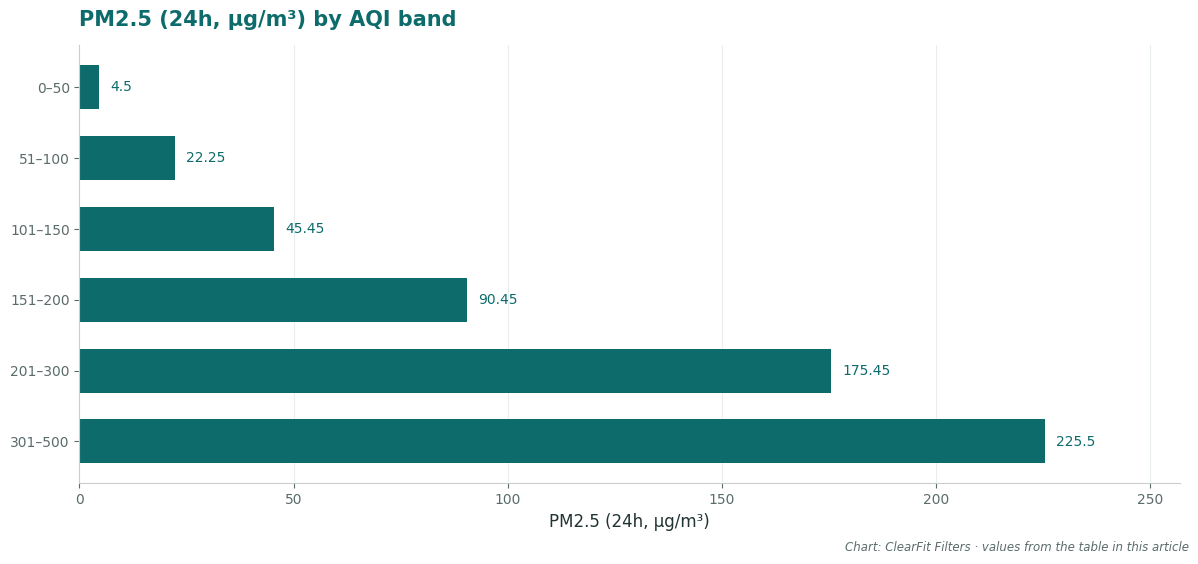
| AQI band | Label | PM2.5 (24h, µg/m³) | What to do |
|---|---|---|---|
| 0–50 | Good | 0–9.0 | nothing — enjoy |
| 51–100 | Moderate | 9.1–35.4 | unusually sensitive people take note |
| 101–150 | Unhealthy for Sensitive Groups | 35.5–55.4 | sensitive groups cut outdoor exertion |
| 151–200 | Unhealthy | 55.5–125.4 | everyone reduces outdoor exertion |
| 201–300 | Very Unhealthy | 125.5–225.4 | move activities indoors; N95 outdoors |
| 301–500 | Hazardous | 225.5+ | health emergency framing; stay indoors |
The single most common misreading, straight from Reddit’s r/airpurifiers and wildfire threads: people watch a dashboard AQI of “130” and ask whether “the air in general” is bad. The number is always one pollutant’s number wearing the overall jersey. Click through any dashboard (AirNow’s fire map, IQAir) to the pollutant breakdown — during wildfire season it’s PM2.5 ~90% of the time; during summer ozone episodes in car-centric metros, it’s O₃, and the response differs (ozone peaks mid-afternoon; PM2.5 smoke can peak at 3 a.m.).
The Sub-Index Math: One Worked Conversion

The AQI is a piecewise-linear scaling of concentration into index space. Worked example — PM2.5 at 47 µg/m³ (24-h average), using EPA’s breakpoints (35.5–55.4 µg/m³ maps to AQI 101–150):
AQI = 101 + (150 − 101) × (47 − 35.5) / (55.4 − 35.5) = 101 + 49 × 11.5 / 19.9 ≈ AQI 129
Run the same arithmetic on each pollutant measured — PM2.5 at 47 gives 129; say O₃ reads 80, PM10 reads 60, the rest lower — and the reported AQI is the maximum: 129, reported as “Unhealthy for Sensitive Groups, main pollutant PM2.5.” Every AQI number you’ve ever seen is the winner of that internal contest. This is why two days with the same AQI can feel different (different main pollutants), and why “AQI 100” during a heatwave (ozone) calls for a different response than “AQI 100” during smoke (PM2.5) — indoor filtration does nothing for outdoor ozone exposure timing but everything for PM2.5.
PM2.5 Concentrations: EPA vs WHO, Side by Side
The 2024 EPA tightening set the annual PM2.5 standard at 9.0 µg/m³ (from 12.0), and the AQI “Good” band ceiling moved to 9.0 with it. WHO’s 2021 Air Quality Guidelines are stricter still: annual 5 µg/m³, 24-hour 15 µg/m³. The two-column table that puts your dashboard reading in context:
| Standard | Annual | 24-hour |
|---|---|---|
| WHO 2021 guideline | 5 µg/m³ | 15 µg/m³ |
| EPA 2024 NAAQS | 9 µg/m³ | 35 µg/m³ |
| EPA AQI “Good” ceiling | — | 9.0 µg/m³ |
| EPA AQI “Moderate” ceiling | — | 35.4 µg/m³ |
Read: a “Moderate” AQI day (say, 70) is fully legal and fully Moderate — and also ~2–4× WHO’s guideline levels. Not a reason to panic; a reason to understand which ruler a given app is using (IQAir defaults to WHO-informed bands; AirNow uses EPA’s — the same sky, different yardsticks, and the apps rarely say so).
The Cigarette Conversion, Cited Properly
People ask for it constantly, so here it is with its provenance: Berkeley Earth’s widely-quoted equivalence treats one cigarette’s worth of PM2.5 exposure as roughly a day at 22 µg/m³ (about AQI 75, “Moderate”). By that rule of thumb, a week of AQI 150 wildfire smoke (~44 µg/m³) ≈ 14 cigarettes spread over everyone breathing it; a Beijing-style AQI 300 day ≈ ~9 cigarettes in one day. It’s an exposure accounting device from a climate-analytics group, not a toxicological equivalence — smoke chemistry differs from cigarette chemistry — but as a visceral scale, it’s the best-sourced one available.
What Each Band Should Trigger at Home

The action ladder, with the filter logic attached: at 101+ (Sensitive Groups), check your HVAC filter’s remaining life and run the fan more (filtration only filters when air moves — the fan-auto problem explained in purifier vs HVAC filter); at 151+, upgrade the next filter change to MERV 13 (MERV 13 landing) and set up a bedroom clean zone; at 201+, you’re in run-a-portable-HEPA territory — the three-equipment comparison (central MERV 13 / portable HEPA / EPA-validated box-fan DIY) with costs is in the wildfire smoke page. For the alert system that tells you tomorrow’s band in advance: what an Air Quality Alert means, and for the pollutant behind most high-AQI days, What Is PM2.5?.
FAQ
How many cigarettes is 100 AQI equal to?
By the Berkeley Earth equivalence (one cigarette ≈ 24 h at ~22 µg/m³), a day at AQI 100 (~35 µg/m³) is roughly 1.5 cigarettes’ worth of PM2.5 mass exposure. It’s a mass-accounting comparison, not a same-toxicity claim — but it’s the best-sourced gut-check scale there is.
What is the best AQI rate?
0–50 (Good). Within Good, lower is better, and the practical target for sensitive households is staying under the “Moderate” line — keeping 24-h PM2.5 under ~9–15 µg/m³ indoors aligns with the EPA annual standard and WHO guideline respectively.
What does 500 AQI mean?
The top of the scale — 24-h PM2.5 above ~225 µg/m³ (Hazardous, 301+, runs to 500 and beyond off-scale). Health message: everyone stays indoors, filtration runs continuously, N95 masks for any necessary outdoor time. Values above 500 (“beyond index”) occurred repeatedly in 2020 West Coast fire events.
What AQI should you stay inside?
For sensitive groups (children, 65+, asthma/heart disease, outdoor workers, pregnancy): minimize outdoor exertion from 101+, treat 151+ as stay-indoors. For healthy adults: 151+ reduce, 201+ effectively stay in. The full band-by-band matrix: the air quality alert page.
What does “air quality” mean — and what does AQI stand for?
“Air quality” means the measured condition of the air with respect to the pollutants that harm health — in the US framework, six of them (PM2.5, PM10, ozone, CO, SO₂, NO₂). AQI stands for Air Quality Index: the 0–500 scale that converts those raw concentrations into one number, where each number’s meaning is “the worst pollutant crossed this line.” So “air quality is 87” is shorthand for a specific pollutant — check which — has reached its 87 line; “Moderate air quality” (51–100) means the air is legally acceptable while unusually sensitive people may already react. The index definition exists precisely so a concentration table becomes a color and a sentence your phone can push at you.
Sources & References
- EPA — AQI technical assistance document (breakpoints, piecewise-linear calculation, six bands); 2024 PM NAAQS (annual 9.0 µg/m³) and updated “Good” ceiling. Official documentation.
- WHO (2021) Air Quality Guidelines — PM2.5 annual 5, 24-h 15 µg/m³. Official documentation.
- Berkeley Earth — cigarette–PM2.5 equivalence methodology (~22 µg/m³ per cigarette-day). Industry expert analysis.
- AirNow / IQAir dashboard behavior — pollutant-breakdown access paths; band-source differences. Industry analysis.
- Reddit r/airpurifiers, wildfire threads — “is the air bad in general” misreading pattern. Community discussion.
Related Guides
- What Is PM2.5 (and Why It Matters)? — the pollutant behind most red days.
- What Is an Air Quality Index Alert? — the forecast system and the action matrix.
- How Wildfire Smoke Gets Indoors — when the number goes red.