Is Well Water Safe to Drink? The EPA-Doesn’t-Regulate-Your-Well Reality and the Testing Schedule That Answers the Question

About 23 million Americans drink from private wells, and the Safe Drinking Water Act regulates exactly none of them — the law covers public systems and stops at your property line. Well water is usually safe in the geological sense (it’s been filtered through hundreds of feet of aquifer), but “usually” is a statement about statistics, and your well is a sample of one sitting in your geology, next to your septic system, under your region’s pesticide and road-salt footprint. The answer to “is my well water safe” is therefore not a fact you can look up — it’s a test result on a schedule. That schedule costs $20–150 per year for the core panel and is the entire difference between a well owner and a well gambler. Related: How to Test Water Quality at Home.
Quick Answer: Private wells serve ~23 million Americans with zero EPA regulation — testing is your job. The schedule: every year test total coliform, nitrate, pH, and TDS ($20–150); every 3–5 years add arsenic, uranium, radon, and (now) PFAS where regional geology or a nearby source warrants ($150–500); immediately after flooding, well repairs, or any change in taste/color/odor. City water is tested continuously under law; your well is tested exactly as often as you test it.
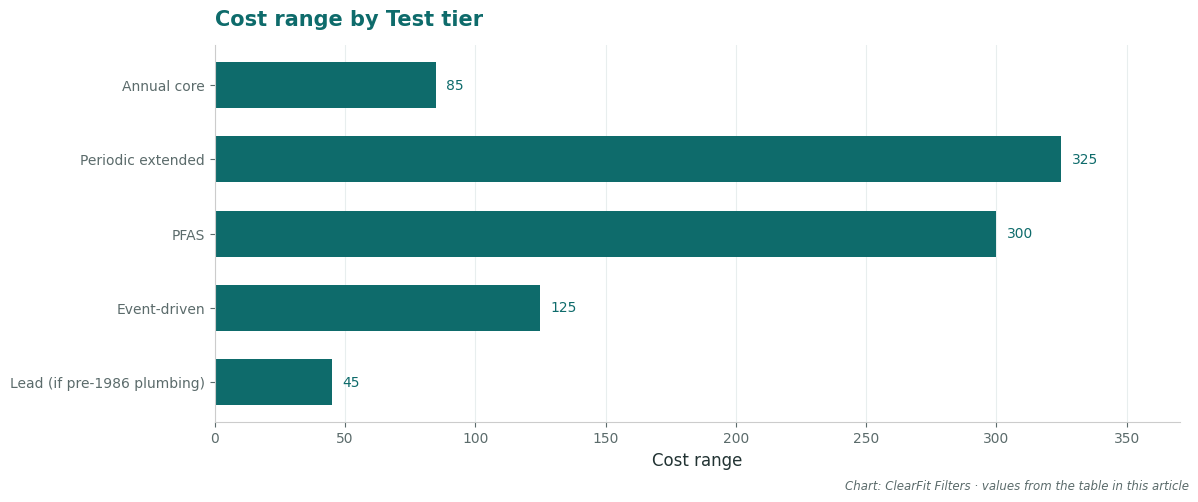
| Test tier | What | When | Cost range | What it catches |
|---|---|---|---|---|
| Annual core | Total coliform + E. coli, nitrate, pH, TDS, hardness | Every year (spring after thaw is a natural slot) | $20–150 | The failure modes that move fastest: bacterial intrusion, nitrate creep |
| Periodic extended | Arsenic, uranium, radon, fluoride, sodium, iron, manganese | Every 3–5 years; also on first fill of a new-to-you home | $150–500 | Geology-dose contaminants that accumulate knowledge-value |
| PFAS | PFOA/PFOS + panel | Once, repeat if a source is near (fire training area, landfill, industry) | $200–400 | The 4 ng/L-era question for private wells |
| Event-driven | Full bacterial + nitrate + turbidity | After flooding over the wellhead, well work, new pump, changed taste | $50–200 | The acute-risk moments |
| Lead (if pre-1986 plumbing) | First-draw lead | Once, repeat after plumbing changes | $30–60 | Your pipes, not your aquifer |
The r/wells and r/homestead threads tell the same story with house-flipping money attached: buyers who waived the well test to win the bid discover arsenic at 3× the MCL or a coliform-positive result at move-in, and the remediation (shock chlorination, treatment install, or in the worst cases a new well at $10,000–20,000) becomes their education budget. The recurring advice from actual well owners: test every year because wells change — a coliform result two years after a clean one is the single most common “it was fine when I bought the house” story.
Why EPA Regulates City Water and Not Yours

The Safe Drinking Water Act (1974, amended 1986 and 1996) gives EPA authority over public water systems — defined by serving connections to the public. Private residential wells fall outside it by design; no federal program tests them, no agency gets your results, and no notification system exists for your address. Some states offer guidance or subsidized testing programs (and USDA/Rural Development grants exist for low-income households in some counties), but the default national posture is owner-responsibility. That’s the regulatory asymmetry worth internalizing: the city plant runs continuous turbidity and residual monitoring with mandated reporting, while a typical private well gets tested once — at the property sale, if that.
The Annual Core Panel: What Each Test Is For
Total coliform + E. coli — the biology audit. Coliform bacteria are “indicator organisms”: mostly harmless themselves, their presence means a path from the surface to your water exists (cracked casing, failed well cap, flooded wellhead, cross-connection). A positive triggers shock chlorination of the well and a hunt for the entry path — not panic, but action.
Nitrate — the agriculture signature. It moves with groundwater, doesn’t boil away (boiling concentrates it), and above 10 mg/L it’s an acute infant risk (methemoglobinemia — “blue baby syndrome”). Livestock operations, septic density, and fertilizer history set your prior; annual tests catch the creep.
pH and hardness/TDS — the plumbing and appliance audit. Low pH corrodes (lead and copper mobilization — the connection to your pipes, not your aquifer), high hardness scales (water heater efficiency losses, the hard-water cleaning saga). These rarely change the safety verdict; they change the treatment and maintenance verdict.
The Extended Panel: Geology Writes Your Neighbors’ Results Too
Arsenic belts (New England, upper Midwest, Southwest), uranium and radon (granitic terrains — radon in water is a real measurement category in New England and New Jersey), fluoride (naturally ranging to above the 4 mg/L MCL in parts of the Southwest), iron and manganese (aesthetic workhorses). The rational move is asking your state’s environmental or health department what the county’s known issues are — they keep the occurrence maps — and testing the flagged list on the 3–5 year cadence. PFAS earns a one-time test everywhere now that the municipal MCLs (4 ng/L) define the health benchmark for private wells too, with repeat testing driven by proximity to fire-training sites, airfields, landfills, or industrial plumes.
What Results Map To: the Action Column
- Coliform positive → shock-chlorinate the well (a documented procedure, not a splash of bleach — state extension offices publish the protocol), fix the entry path (well cap, casing, surface drainage away from the wellhead), retest in 1–2 weeks.
- Nitrate >10 mg/L → stop using it for infant formula immediately; treatment is ion exchange or RO at the tap; investigate the source (septic, fertilizer) for the long-term fix.
- Arsenic/uranium above MCL → point-of-use RO or adsorptive media for drinking and cooking; whole-house decisions depend on which form and budget — arsenic’s entry has the treatment detail.
- Lead in first-draw → plumbing problem, not well problem: NSF 53 filtration at the drinking tap plus the interim flushing discipline on the lead-pipe page.
- pH <6.5 → acid neutralizer (protects plumbing and drops metal leaching); hardness >7 gpg → softener decision tree on the hard-water testing page.
City vs Well: the Comparison People Are Actually Asking For
The honest scorecard: regulation — city wins by law (continuous monitoring vs your annual discipline); taste — wells often win (no chloramine, mineral character from the aquifer); hardness — wells skew harder (aquifer contact), with the appliance costs that follow; contamination profile — city faces treatment-distribution issues (byproducts, main breaks, aging lead service lines), wells face geology-and-proximity issues (arsenic, nitrate, bacteria); cost — city water bills forever vs well electricity-maintenance and pump replacement ($1,000–2,500 every 10–15 years) plus your testing; outages — wells lose water with power (a generator or pressure-tank savvy matters); “artesian” wells — the term people see in listings means a confined-aquifer well where pressure pushes water up the casing on its own; it’s a geological description, not a purity grade (flowing artisanal-sounding boreholes still get the same coliform test as everything else).
FAQ
When should you not drink well water?
Right now, in these cases: after floodwater covered the wellhead; while a coliform result is pending after well work; when taste, color, or odor changed suddenly; when the annual nitrate test is above 10 mg/L in a household with infants; and indefinitely-but-until-treated when a known contaminant (arsenic, uranium, PFAS) exceeds its limit. Each of these has an action path above — “don’t drink it” is the interim state, not the conclusion.
What is the downside of having well water?
Quantified: you are the utility — testing costs ($20–150/year core), pump replacement ($1,000–2,500 per 10–15 years), power-outage water loss, treatment add-ons if geology deals you arsenic or hardness, and the septic-system proximity question a city never asks you. Non-quantified: no residual disinfectant means a bacterial event has no chemical backstop — the annual coliform test is your backstop instead.
How do you know if your well water is safe to drink?
You test it — there is no other reliable way. The minimum annual panel (coliform, nitrate, pH, TDS) plus a first-fill extended panel is the standard answer; visual and taste checks catch only the late, obvious failures. The full testing-methods comparison (strips, meters, lab kits, and what each is actually good for) is on the water-testing page.
What does well water do to your body?
Nothing categorically — millions drink it lifelong. The health questions are dose-and-contaminant specific: high nitrate and infants, arsenic and long-term cancer risk, uranium’s renal load, and the mineral upside (hard water contributes modest dietary calcium and magnesium). “Well water” is not a substance; it’s a delivery system for whatever your local geology and your well’s integrity deliver — which the testing schedule is designed to reveal.
Sources & References
- EPA — Private Drinking Water Wells program pages — ~23 million Americans; no SDWA coverage; testing recommendations. Official documentation.
- CDC — Private Wells / well testing guidance — annual core panel constituents, event-driven triggers. Official documentation.
- State extension services (university well programs) — shock-chlorination protocols; county contaminant occurrence maps. Official documentation/Industry expert analysis.
- EPA 2024 PFAS NPDWR — 4 ng/L benchmark now defining private-well PFAS context. Official documentation.
- NGWA (National Ground Water Association) — well construction, maintenance and pump service-life figures. Industry expert analysis.
Related Guides
- How to Test Water Quality at Home — the methods behind the schedule.
- Is Tap Water Safe to Drink? — the city-side question this page contrasts.