How to Change a Furnace Filter (or Any AC / HVAC Filter): Every Slot Type, Including the Ones the Manual Doesn’t Mention

Changing a furnace filter is a five-minute job with two genuine decision points: kill power at the furnace switch first (not just the thermostat), and note the old filter’s size and arrow direction before it leaves your hand. Pull the old one, slide the new one in with the arrow pointing toward the blower, write the date on the frame, power back up. The parts people actually get stuck on are finding the slot — furnaces hide filters in three different places depending on design — and handling horizontal/upflow configurations the owner’s manual glosses over.
The average furnace filter change takes less time than the average Google search for it — and people run that search under at least six different phrasings every month (“how to change furnace filter,” “change ac filter,” “replace furnace filter,” “change hvac filter”…), which tells you something: nobody is sure whether they’re doing the furnace thing, the AC thing, or the HVAC thing. It is one job on one filter — the box below untangles the vocabulary. What the top-ranking videos can’t show you is your specific cabinet. A recurring r/HVAC pattern: homeowners with upflow furnaces hunting for a filter inside the blower compartment when their filter actually lives in a slot on the return duct — twenty minutes of panel-hunting for a filter that was behind a metal flap at elbow height the whole time. Find your slot type first; everything after that is trivial.

Top Picks at a Glance (2026)

Sizing comes first (measure the old filter), but at the common 16x20x1 and 20x25x1 slots these are the three picks worth shortlisting:
| Pick | Product | Why it wins |
|---|---|---|
| Best overall | 16x20x1 MERV 8 pleated | Lowest static pressure for the standard 90-day cadence; the spec most blowers are happiest with. |
| Best for allergies & smoke | 20x25x1 MERV 13 pleated | Fine-fraction capture for smoke and pollen seasons, in the most common large slot; plan a 60-day cadence. |
| Best balance | 20x20x1 MERV 11 pleated | Pet-household middle ground between capture efficiency and pressure drop. |
Quick Answer: The 6 Steps
| Step | Action | Why it matters |
|---|---|---|
| 1 | Kill power — furnace switch (looks like a light switch on/near the unit) OFF, or breaker OFF | Moving parts + a blower that can kick on from a thermostat call mid-swap |
| 2 | Locate & open the slot — return duct, blower compartment, or grille (table below) | Three locations; you only have one |
| 3 | Record size + arrow direction from the old filter before removing it fully | Prevents the #1 re-order error |
| 4 | Slide old filter out — keep it flat, don’t drag dust off it into the slot | The dust cake on it is six months of capture |
| 5 | Slide new filter in — arrow toward blower, fully seated, no bowed edges | Partial seating = air bypass |
| 6 | Date the frame, power back on | The 90-day clock starts now |
ClearFit cuts the same 16x25x1 MERV 8 pleated media to OEM specifications – the 16x25x1 MERV 8 replacement filter, sized to confirm against your old filter before ordering.
Step 1 First: Find the Switch, Not the Slot
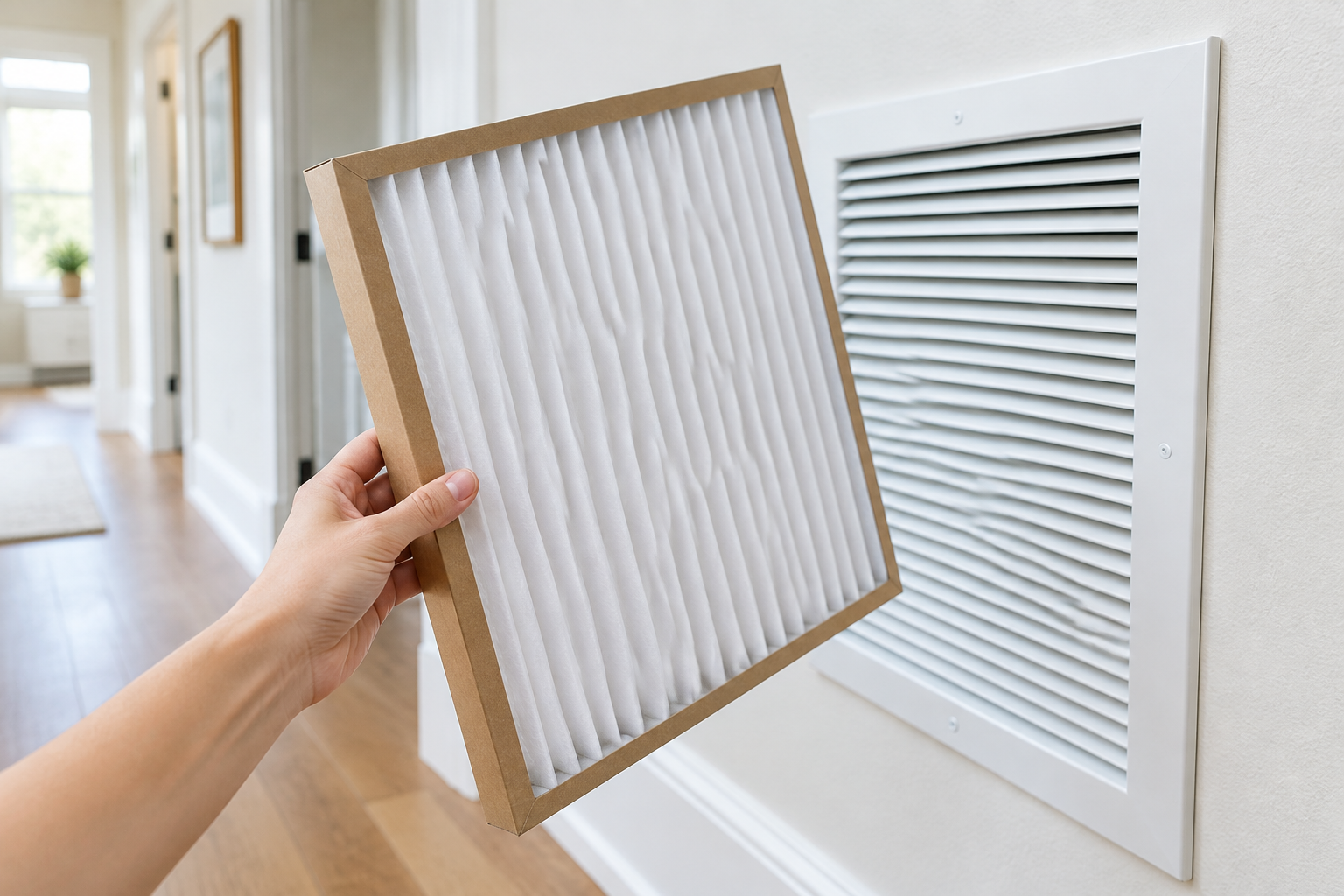
The furnace’s service switch is a standard light-style switch mounted on the unit, an adjacent wall, or sometimes the ceiling joists above it. Flip it off and confirm the thermostat isn’t calling — you do not want the blower energizing while your hand is in the cabinet. If you can’t find a switch, use the breaker labeled FURNACE/HVAC. This matters more on older units: a 20-year-old cabinet may expose fan wiring near the filter track, and PSC blower motors don’t offer much in the way of modern interlocks. The thermostat-off-only shortcut works 99 times out of 100; the switch-off method works 100 out of 100.
The Three Filter Locations (Find Yours in 30 Seconds)
| Location | What you’ll see | How to open | Common on |
|---|---|---|---|
| Return-duct slot | A 1″-wide horizontal slot in the return duct, usually with a metal flap/cover plate | Lift the flap or unscrew the thumb screw; filter slides out sideways | Upflow furnaces, most post-1990 installs |
| Blower compartment | Filter sits inside the lower cabinet door, on the return side of the blower | Remove the cabinet door (lift-and-pull or ¼-turn screws) | Older furnaces, downflow units |
| Wall/ceiling return grille | Filter pressed behind a large vent grille inside the house | Unscrew or swing open the grille (some have lever tabs) | Homes with no duct slot; filter lives at the room side |
If you find filters in both a grille and the furnace — use the furnace slot only. Two filters in series double the static pressure the blower fights; the grille slot stays empty. (If the system was commissioned that way by an HVAC pro for a specific reason, they’ll have told you.)
The airflow logic never changes: air flows from the return side through the filter toward the blower, so the arrow always points at the machinery. Full direction guide: which way does the air filter go.
Upflow, Downflow, Horizontal: Does Your Configuration Change Anything?
Upflow (most common in basements — return air enters the bottom, supply exits the top): filter slot is at the bottom of the unit or in the adjacent return duct, usually below eye level. Easiest config; everything is at arm’s reach.
Downflow (common in mobile homes and homes on slabs — air enters top, exits bottom): the filter frequently lives in the blower compartment behind the lower door, and some downflow units expect the filter above the unit in a ceiling return. Check both.
Horizontal (units hung from attic or crawlspace ceilings, furnace on its side): the filter slot is on the intake end — the end the duct feeds air into — and it’s often vertically oriented, so the filter slides in top-to-bottom or bottom-to-top rather than sideways. This is the configuration that breaks people’s mental model from vertical-unit tutorials. Same rules apply: kill power at the unit (attic units have a switch on the unit or a pull-cord disconnect nearby — find it before your hands go in over your head), arrow toward the unit, seat fully.
Changing the AC Filter vs. the Furnace Filter vs. the HVAC Filter: It’s the Same Swap
Search data says this is the most confusing part of the job, not the screwdriver work. Every month, roughly a quarter-million people type some version of this question: change ac filter, change furnace air filter, replacing a furnace filter, change furnace filter, replace furnace filter, change hvac filter, change hvac air filter. In a central forced-air system, every one of those phrases describes the identical cartridge in the identical slot:
| You call it… | What it actually is |
|---|---|
| Furnace filter | The same media cartridge — named for the heating season people first noticed it |
| AC filter | The same cartridge — your air handler’s blower moves air through it all summer |
| HVAC filter / air handler filter | The same cartridge — the trade’s umbrella term |
| Return filter / return grille filter | The same cartridge, when it lives at the grille instead of the unit |
The reason one filter wears two names: a central AC doesn’t have its own blower or ductwork — the evaporator coil sits in the furnace’s air stream, and the furnace blower pushes house air through filter → coil → ducts in both seasons. So “changing the AC filter” before summer and “changing the furnace filter” before winter is the same physical act on the same physical part, and the answer to how often to change an ac filter is the same 90-day (1″ pleated) clock. Two genuine exceptions where the filter is a different part:
- Window and through-the-wall AC units have small built-in mesh filters — those get vacuumed and rinsed, not replaced on a quarterly cadence.
- Mini-splits (ductless heads) each carry their own washable screen behind the front panel — clean monthly in cooling season; they never touch the ducted system’s cartridge.
For everyone with a thermostat and a vent in more than one room: the steps on this page are the complete procedure, whatever season and whatever you call the filter.
Steps 3–5: The Swap Itself
Pull the old filter out slowly and flat — a loaded filter carries a felted dust cake that will shed into the slot and the blower if you tilt it. Note the printed size (e.g., “16×25×1” — that’s the nominal number you reorder; if only decimals print, see how to measure air filter size). Bag the old filter immediately; it’s done.
Slide the new filter in arrow-toward-blower until the frame seats against the track stops. No gaps, no bowing — a bowed filter’s edges lift out of the track and open a bypass path. Close the flap or door, flip the switch, and set the thermostat back to AUTO. Total elapsed time if the slot is where you expected: under five minutes.
If the new filter is the wrong size
Don’t force it. An undersized filter can hold you over only with the foil-tape edge seal (metal HVAC tape wrapped around the frame-to-slot gap — an untaped gap bypasses 20–30% of your airflow unfiltered). Order the right nominal size today; use the gap-filter in the meantime. A filter larger than the slot is a return, not a project — never cut pleated media, which destroys the frame’s structural edge.
Step 6: The Date, and the Discipline That Follows
Write the month on the frame edge with a marker, and put the same date somewhere that will actually reach you in 90 days — that’s the standard interval for a 1″ pleated filter in a normal household (fiberglass: 30 days; 1″ MERV 13: often 45–60; 4″–5″ media: 6–12 months — full schedule and the six variables that shorten it in how often to change your HVAC filter). The Home Filter Calendar does this without the marker: log the change, get the reminder on email or SMS, and reorder from the reminder instead of from the dusty-frame archaeology method. Most people’s filter discipline fails on the remembering layer, not the swapping layer — the swap, as this article has now demonstrated twice, is five minutes.
FAQ
Is changing the AC filter the same as changing the furnace filter?
Yes — in a central forced-air system it is one cartridge in one slot. The furnace blower moves air through it year-round (heating season and cooling season), so whether you search “change ac filter” or “replace furnace filter,” the procedure, the arrow rule, and the 90-day interval are identical. Only window units and mini-splits have separate washable screens.
Which direction does the furnace filter go?
Arrow toward the blower — toward the furnace/air handler, away from the return duct. In a return-duct slot, the arrow points downstream along the duct; in the blower compartment, it points at the blower wheel; at a wall/ceiling grille, it points into the wall.
Where is my furnace filter located?
One of three places: a slot in the return duct next to the furnace (most common, look for a metal flap at elbow height), inside the blower compartment behind the lower cabinet door, or behind a large wall/ceiling return grille inside the house. Horizontal attic/crawlspace units put the slot on the duct-feed end, often vertically oriented.
How often should I change my furnace filter?
A 1″ pleated filter every 90 days in a normal household; 30 days for fiberglass; 45–60 days for 1″ MERV 13 in heavy use; 6–12 months for 4″–5″ media cartridges. Pets, allergy seasons, wildfire smoke, and heavy runtime all shorten the interval — track blower hours rather than dates if your thermostat supports it.
Do I need to turn off the furnace to change the filter?
Yes — at the unit’s service switch (the light-style switch near the furnace) or the breaker. The thermostat alone doesn’t protect you from a blower call mid-swap, and older cabinets expose moving parts near the filter track. It’s a two-second habit.
Can I run the furnace without a filter for a day?
You can, and in an emergency (filter wrong size, slot damaged) it won’t hurt the blower. But every hour unfiltered loads dust directly onto the evaporator coil and blower wheel, and that build-up is far more expensive to clean than any filter. Treat it as a bridge to the store, not a schedule.
Sources & References
- OEM installation manuals (Carrier/Trane/Goodman consumer literature) — filter location conventions by configuration, service-switch guidance. Official documentation (inference: general rules merged from brand manuals).
- r/HVAC filter-location & horizontal-unit threads — upflow owners hunting blower-compartment filters that live in the duct; attic-unit vertical slot confusion. Community discussion (paraphrased).
- DOE / Energy.gov filter-replacement guidance — interval baseline. Official documentation (explicit).
- ACCA maintenance practice conventions — static-pressure effects of doubled filters. inference.
Related Guides
- Which Way Does the Air Filter Go In? — the direction deep-dive.
- How to Measure Your Air Filter Size — reorder the right size the first time.
- How Often to Change Your HVAC Filter — intervals by type, thickness, and household load.
- 1 vs 4 Inch Furnace Filter — whether five minutes quarterly should become ten minutes yearly.
Shop this guide: All HVAC filter sizes · 16x25x1 – the most common size