VOCs in Your Water: the 21 Regulated Compounds, Breakthrough Physics & the Gas-Station Radius Check

Quick answer: VOCs (volatile organic compounds) are a family of 21 EPA-regulated solvents and fuel chemicals — benzene, TCE, MTBE, carbon tetrachloride among them — each with its own MCL in the single-digit-to-tens of ppb range. Carbon block is the correct treatment (NSF/ANSI 53 with VOC claim) — but the physics has teeth: adsorption media saturates, then breaks through without warning, which makes changeout schedules a safety issue rather than a maintenance preference. Wells near gas stations, dry cleaners, and industrial sites deserve the $100–200 VOC panel.
Test first — geography drives this one. City CCRs list regulated VOCs where monitored. Wells: run the VOC scan ($100–200) if you’re within roughly a mile of a gas station (current or former — abandoned stations leak for decades), dry cleaner, metal shop, or industrial parcel. The one-mile circle around underground storage tanks is the classic VOC plume zone; state leaking-tank databases are public and free to search.
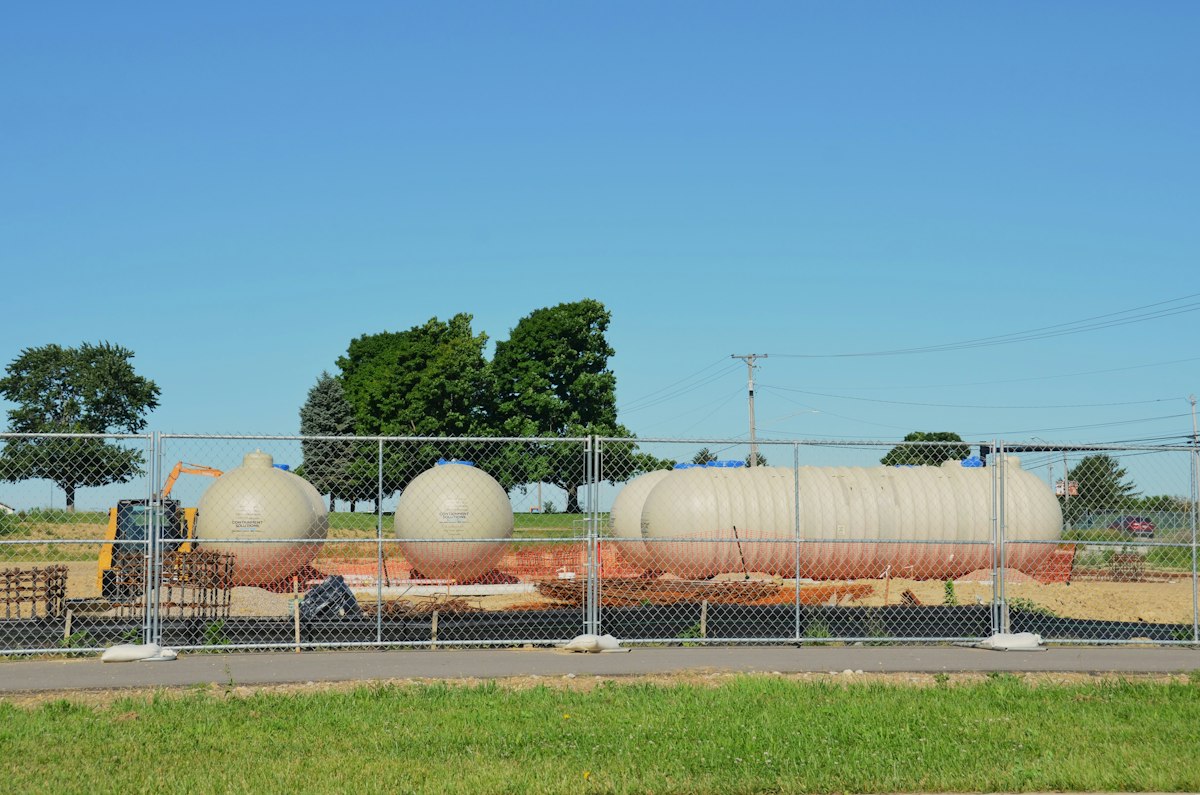
Where VOCs in Water Comes From

1. Leaking underground storage tanks (the gas-station story). Petroleum fuels and additives (benzene, MTBE, toluene, xylene) escape aging tank systems into groundwater — the single most common VOC source in both municipal and well contexts. Abandoned stations keep leaking into the 21st century; state UST databases map the entries.
2. Industrial solvents and dry cleaning. Chlorinated solvents — TCE (degreasing), PCE (dry cleaning), carbon tetrachloride (banned but persistent) — form decades-long plumes that travel far from their sources. Camp Lejeune’s TCE/PCE contamination (compensation legislation decades later) is the famous case; thousands of quieter plumes exist.
3. Agricultural and household sources. Some fumigants and pesticides register in the VOC family, and improper household disposal (paint thinner to the drain, septic-poured solvents) contaminates private systems locally.
The organic-chemical family map (this page is the hub)
| Family member | The one-line identity | Detail page |
|---|---|---|
| VOCs generally (this page) | The 21-regulated-compound umbrella and the carbon-breakthrough physics | You are here |
| Benzene | The carcinogenic fuel aromatic; smell-blind spot (odor threshold far above the MCL) | Own page |
| MTBE / TCE | The fuel additive ban saga + the dry-cleaning solvent legal epic | Own page |
| Pesticides | Agricultural SOC family; spring-runoff timing | Own page |
| Pharmaceuticals | The unregulated trace-emergent family; NSF/ANSI 401 | Own page |
Health Effects — What the Limits Are Protecting
| Number | What it is | What it means |
|---|---|---|
| 21 compounds | EPA-regulated VOC list | Each with an individual MCL — commonly 5–100 ppb; the CCR lists your system’s rows |
| 5 ppb (benzene, TCE, CCl4 examples) | The strict end of the MCL range | Set on carcinogenicity margins for the worst actors |
| No warning at the tap | Taste/odor thresholds often exceed MCLs | Several VOCs are tasteless near their limits — the nose is not the instrument here (benzene’s page explains the reversal in detail) |
What the limits protect against. The regulated VOCs carry the heavyweight endpoints: several are probable/known human carcinogens (liver, kidney, blood-cancer margins), with chronic low-level exposure driving the strict ppb lines. Acute effects belong to spill-scale concentrations; household-relevant risk is the lifetime-carcinogenicity math regulators already ran. The household action, then, is binary: know your number (test in plume zones), and if it’s nonzero-but-under — or over — treat with properly maintained carbon.
Breakthrough physics — why “change your filter” is a safety sentence on this page
Adsorption is capacity chemistry: carbon holds a finite mass of VOC molecules, and loading approaches the limit invisibly. The effluent curve holds near-zero until capacity approaches, then breaks through steeply — water that was clean Tuesday carries a measurable VOC slug Friday, with no taste cue for many compounds. Consequences we state plainly: (1) buy oversized carbon capacity for VOC duty; (2) calendar your changeouts conservatively — the cartridge doesn’t know it’s done; (3) post-filter testing (the $40 confirm panel annually) verifies what the calendar can’t. A spent VOC cartridge isn’t neutral — worst cases can desorb a pulse of what they caught. This is the chemistry behind every “replace on schedule” line this site prints.
How to Remove VOCs — The Honest Comparison
| Method | Effect | Certification to look for | Honest notes |
|---|---|---|---|
| Carbon block / GAC (whole-house or POU) | High, capacity-limited | NSF/ANSI 53 with VOC claim (the claim covers the listed compound set) | The workhorse — with the breakthrough schedule as the load-bearing caveat above |
| Reverse osmosis | Partial for VOCs alone | NSF/ANSI 58 (other claims) | Membranes pass a fraction of small VOCs; RO units rely on their carbon stages for VOC duty — honest systems pair the two rather than pretend the membrane alone suffices |
| Distillation (vented design) | High | — | Detail that matters: VOCs co-distill with steam unless the still vents volatile gases — a non-vented cheap still carries VOCs across. Vented designs genuinely remove them |
| ~~Boiling~~ | Partial, split-effect | — | Some VOCs boil off (into your kitchen air), others concentrate — compound-dependent, uncontrolled, not treatment |
| ~~Pitcher / fridge carbon~~ | Negligible-to-none at VOC scale | No VOC claims | Cartridge carbon mass is an order of magnitude short of household VOC duty |
Matched to the Numbers Above
- Testing tier ($100–200): The VOC scan panel — wells inside the plume-radius screen; annually if any history of detections; the free pre-screen is your address against the state UST database.
- Point-of-use tier ($150–400): Under-sink carbon block with VOC claim + conservative changeout calendar — the drinking-pathway standard.
- Whole-house tier ($800–2,500): Large GAC tank (oversized deliberately for breakthrough margin) for confirmed distribution-level readings — with the annual post-filter test verifying performance.
Wait — Is My Refrigerator Filter Enough for VOCs?
No. Fridge cartridges carry chlorine/taste claims; none carries the 53 VOC claim — and the carbon mass in a dispenser cartridge is a rounding error against VOC duty. Worse, in VOC-affected homes the little cartridge saturates first and earliest, sitting spent in the fridge door. This is the contaminant family where the honest answer escalates: treat it at the sink or the entry with certified capacity, and calendar the media.
Related problems worth checking while you’re here:
- Benzene — the family’s most famous carcinogen and the smell-blind-spot case
- MTBE / TCE — the fuel-additive ban saga and the dry-cleaning-solvent epic
- Well water overview — where the VOC panel slots into the annual well budget
VOC Questions, Answered Straight
What are VOCs in water? Volatile organic compounds — a family of 21 EPA-regulated carbon-based solvents and fuel chemicals (benzene, TCE, PCE, MTBE, carbon tetrachloride, xylenes…) sharing volatility and carbon-based chemistry. Each has its own MCL in the ppb range; sources are overwhelmingly fuel/industrial plumes.
How much VOC in water is too much? Each compound’s own MCL governs — the strict ones sit at 5 ppb. Any lab-detected regulated VOC above its line triggers treatment; between detection and the line, treatment is prudent for lifetime-exposure margins.
How much does a VOC water test cost? $100–200 for the standard scan panel. The free pre-screen: your address against the state leaking-underground-tank database and the one-mile radius rule.
How long do carbon filters last for VOCs? Until they don’t — that’s the physics. Rated capacities plus calendar conservatism: for continuous VOC duty, plan conservative changeouts and verify annually with the post-filter test. Breakthrough gives no taste warning.
Does boiling water remove VOCs? Compound-dependent and uncontrolled: some volatilize into kitchen air, some stay and concentrate. Not a treatment strategy on any chemistry.
Do fridge or pitcher filters remove VOCs? No — no dispenser-scale cartridge carries the VOC claim, and the carbon mass is an order of magnitude short. Certified 53-VOC carbon at the sink or entry is the honest answer.
Related: PFAS in Water · NSF 42 vs NSF 53 · Whole-House Filter Sizing Guide
Full entry: Voc – full entry & treatment options