Arsenic in Your Water: 10 ppb, the As(III) Trap & the Full Removal Cost Sheet

For a quick reference on arsenic, see our arsenic entry.
Quick answer: Arsenic’s federal limit is 10 ppb, and long-term exposure above it is a documented cancer risk — this is the contaminant worth taking seriously. The removal trap almost nobody explains: arsenic arrives in two chemical forms. As(V) filters out well with the standard media; As(III) — uncharged, common in low-oxygen wells — slips through most of them and must be oxidized first. Reverse osmosis (NSF/ANSI 58 with arsenic claim), ferric-based media (FerrIX A33E-class), and activated alumina all work when matched to your form. Boiling concentrates arsenic; carbon and softeners don’t touch it.
Test first — and test the right thing. Arsenic is colorless, tasteless, and odorless — testing is the only pathway. City water: your CCR reports it. Wells: a standard arsenic test ($40–60) tells you the total; in arsenic country, the follow-up question is the speciation test (~$120–160) that splits As(III) from As(V), because that split determines which treatment works. Skimp on the second test and you may buy the wrong $2,000 system.
Where Arsenic in Water Comes From

1. Natural geology — the main story. Arsenic is a widespread crustal element that dissolves into aquifers under specific geochemical conditions. USGS mapping marks the elevated-risk belts: the Southwest (Arizona, Nevada, New Mexico), New England (Maine, New Hampshire, Massachusetts), the upper Midwest, and patches of California’s Central Valley. Private wells in these belts exceed 10 ppb at rates worth taking personally — some townships run double-digit percentage exceedance.
2. Industrial and agricultural legacy. Historical arsenical pesticides (orchard lands, cotton country), smelter emissions, pressure-treated wood sites, and mining drainage leave localized plumes. Old orchard properties are a classic surprise for buyers of rural “former farmland.”
3. The well-construction factor. Arsenic mobilizes in low-oxygen, high-pH or high-sulfide groundwater; deep wells in problematic formations can be worse than shallow ones. Adjacent wells can differ 10x — your neighbor’s clean test is not yours.
Geography check before anything else: USGS and state geological surveys publish county arsenic maps; two minutes with your county on those maps tells you whether the $40 test is a formality or an urgent errand.
Health Effects — What the Limits Are Protecting
| Number | What it is | What it means |
|---|---|---|
| 10 ppb | Federal MCL | The enforceable line — set using cancer-risk economics, not a no-effect threshold |
| 0 | MCLG | EPA‘s health goal: zero assumed safe for chronic exposure |
| Decades | The exposure timescale | Arsenic’s harms — skin, bladder, lung cancer risks chief among them — are long-horizon statistical, which is why urgency without panic is the right register |
What the limit protects against. Chronic arsenic exposure is one of the strongest chemical-to-cancer links in drinking water epidemiology: skin lesions appear first at sustained elevated exposure, with bladder and lung cancer risk rising over decades. The MCL was tightened from 50 to 10 ppb in 2001 exactly because the older line reflected outdated risk math. The honest corollary: a reading of 12 ppb is not an emergency evacuation — it’s a “treat within the season” number, especially with children drinking the water.
The As(III) vs. As(V) engineering truth (the part academic pages state and commercial pages miss): pentavalent arsenic (As(V)) carries an electric charge at drinking-water pH, so adsorptive media — activated alumina, iron-based adsorbents — grab it effectively. Trivalent arsenic (As(III)) is neutral at neutral pH: it passes through those same media like a ghost. Low-oxygen wells (the same wells that smell sulfurous) skew toward As(III). The fixes: oxidize first (chlorine, peroxide, or manganese-dioxide media upstream converts As(III) → As(V)), or choose RO which rejects both forms, or specify media effective across species — your speciation lab result makes this decision for you.
How to Remove Arsenic — The Honest Comparison
| Method | Works on | Reduction | Certification to look for | Honest notes |
|---|---|---|---|---|
| Reverse osmosis | Both forms | ~95%+ (As(V) highest) | NSF/ANSI 58 with arsenic claim | Drinking-point solution; membrane + carbon stages need scheduled replacement — performance decays silently |
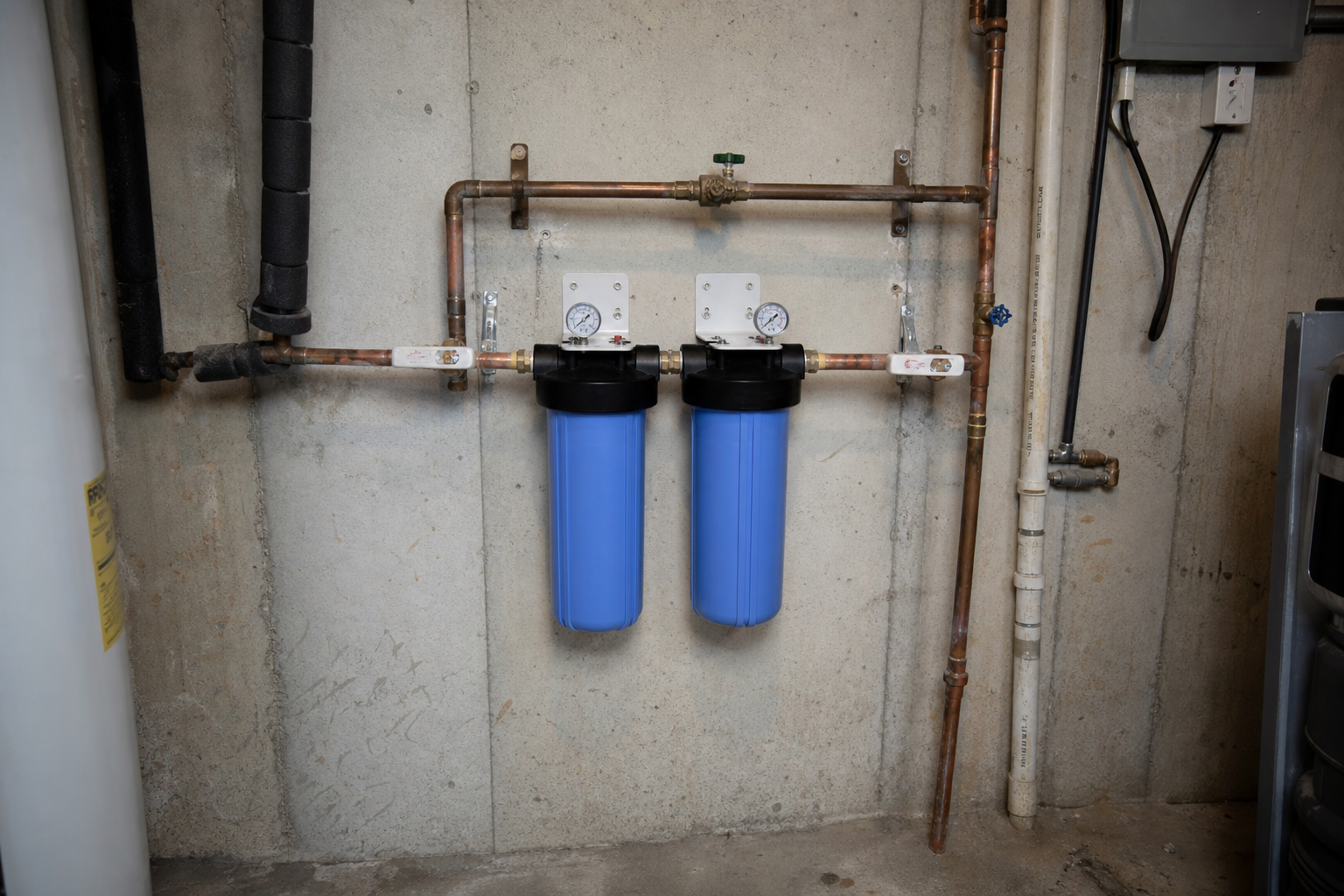
| Iron-based adsorptive media (FerrIX A33E-class) | Both, wide pH window | High | System-level arsenic reduction data | The modern whole-house well workhorse — broad pH tolerance where older alumina struggled |
| Activated alumina | As(V) strongly | High within pH 6–8 window | NSF/ANSI 53 arsenic claim (POU systems) | The classic; pH-sensitive; shared technology family with fluoride wells |
| Nano titanium oxide media | Both | High | Vendor third-party data | The premium tier; strong capacity at low concentrations |
| ~~Carbon block, fridge, pitcher~~ | ≈0 | — | No carbon claim for arsenic | Arsenic oxyanions don’t adsorb to carbon at meaningful rates |
| ~~Boiling~~ | Negative | — | Concentrates, same physics as every dissolved contaminant | |
| ~~Water softener~~ | ≈0 | — | Softener resin exchanges hardness ions; arsenic passes |
The exhausted-media trap — the cost line nobody quotes
Adsorptive media is a battery, not a barrier: it holds a finite tonnage of arsenic, then saturates — and a saturated bed stops removing (worst cases can release a pulse of what it caught). The real cost of whole-house arsenic treatment is the media change-out every 1–3 years at $300–900, sized by your raw concentration and household volume. When comparing quotes, demand the projected change-out interval for your lab number — a quote without that number is a quote without the operating cost. This single paragraph is the difference between an informed purchase and a subscription you didn’t know you signed.
Matched to the Numbers Above
- Testing tier ($40–160): Total arsenic first; speciation if any is found (it decides the media); annually for wells in the belts.
- Point-of-use tier ($250–500): Under-sink RO with the arsenic claim named — the rational move for drinking/cooking at 10–50 ppb while the whole-house decision is weighed.
- Whole-house tier ($1,800–4,000 + media): Ferric-based or alumina tank system with pre-oxidation if As(III)-dominant, sized from the lab report, with the change-out interval in writing.
Wait — Is My Refrigerator Filter Enough for Arsenic?
No. No refrigerator cartridge lists arsenic — the carbon dose and contact time aren’t in arsenic’s league, and no OEM pretends otherwise. For arsenic belts, the kitchen answer is the RO with the named claim; the whole-house answer is the media tank. The fluoride page explains the shared activated-alumina family — wells that carry one often deserve testing for the other (New England and the Southwest especially).
Related problems worth checking while you’re here:
- Fluoride in water — the other activated-alumina contaminant; the two co-occur in the same geological belts
- Uranium in water — the Southwest/New England wells’ second radioactive surprise; same lab panel catches both
- Lead in water — the other test-before-you-buy contaminant; the shared “your number decides your spend” logic
Arsenic Questions, Answered Straight
How much arsenic in water is too much? The enforceable federal limit is 10 ppb; the health goal is zero. Any confirmed well result above 10 warrants treatment planning; between 5–10, most guidance says retest seasonally and consider point-of-use RO — your household composition (kids, duration) legitimately moves that judgment.
Does boiling water remove arsenic? No — it concentrates it. Arsenic is a dissolved metalloid; steam takes the water and leaves the arsenic.
Is my refrigerator or pitcher filter enough for arsenic? No. No fridge or pitcher cartridge carries an arsenic claim; the real options are RO at the tap or adsorptive media at the entry.
How much does an arsenic water test cost? $40–60 for total arsenic; $120–160 for the As(III)/As(V) speciation that determines which treatment works. City residents: the CCR reports arsenic for free.
Does a water softener remove arsenic? No — softener resin targets calcium and magnesium; arsenic passes through essentially untouched.
Why did our well test high when our neighbor’s is clean? Arsenic mobilization depends on the aquifer zone your screen sits in — depth and oxygen chemistry can differ dramatically between adjacent wells. Neighbor data is not evidence; your own test is.
Should I retest arsenic seasonally? Annually at minimum in the belts — arsenic concentrations shift with water-table movement and pumping patterns, though less violently than nitrate’s seasonal swings. The more valuable retest is post-treatment: one sample 2–4 weeks after a system install, and annually after each media change, verifies the equipment (and its changeout schedule) is actually earning the spec sheet — the same verification discipline the VOC page prescribes for carbon beds.
Does arsenic affect pets and livestock? Chronic arsenic exposure applies across species — livestock on high-arsenic wells face the same long-horizon risks documented in veterinary toxicology, and small pets drink per-pound multiples of what adults do. Belt-County extension offices can interpret a well panel against livestock thresholds; the same lab report serves the whole barn.
Sources
- U.S. EPA — National Primary Drinking Water Regulations — the enforceable federal MCL table for every regulated contaminant
- U.S. EPA — Ground Water and Drinking Water — federal drinking-water standards, testing, and treatment guidance
- CDC — Drinking Water — health information on water contaminants, testing, and private wells
- WHO — Drinking-water — WHO drinking-water quality guidance and fact sheets
Related: Well Water Problems Overview · Radium in Water · RO Filter Replacement Schedule
Data page: Arsenic – full entry & treatment options