Washable vs. Disposable Air Filters: Who Each One Actually Suits (5-Year Math Included)

Washable filters win the sticker-price fight and lose the performance fight: they top out around MERV 8, they lose capture efficiency with repeated washing, and a filter reinstalled even slightly damp becomes a mold spore farm in your ductwork. Over five years, a $50–70 washable can beat $10–15 disposables on pure cartridge cost — but only if you actually wash it monthly, and it will never match a MERV 11–13 disposable on fine particles. The practical verdict: washable suits rentals, workshops, and low-ambition budgets; disposable suits everyone optimizing for air quality or blower health.
The washable-vs-disposable debate has a weird energy on every forum it appears. The pro-washable camp quotes a “10-year lifespan!” and the anti-camp posts photos of felted, misshapen cartridges. Both are real, because the product category is genuinely bifurcated: a washable filter maintained on schedule in a light-load home can run for years, while the same filter neglected for a summer becomes a gray felt brick that’s hurting the blower and filtering almost nothing. An r/HVAC regular’s summary of the pattern: “Every washable filter I pull in the field is either pristine or horrifying. Nobody’s ever mid-way.”
Quick Answer: The Comparison Matrix

| Washable (electrostatic/cleanable) | Disposable pleated | |
|---|---|---|
| Purchase price | $50–80 once | $8–20 × 20–30 over 5 years |
| MERV ceiling | ~6–8 (typical claim 8, tested often lower) | 8 / 11 / 13 freely chosen |
| Service interval | Clean every 30 days (labor, not optional) | Swap every 60–90 days (1″ pleated) |
| Efficiency over life | Degrades with each wash cycle | Constant until end-of-life |
| Failure mode if neglected | caked media → high static pressure → mold if damp | clogged media → high static pressure (replace fixes) |
| Reinstall-damp risk | Mold growth in duct | n/a |
| Fine-particle capture (E1/E2 band) | minimal | good at MERV 11, strong at 13 |
The interval row is the one that surprises washable buyers: the cartridge may last 5–10 years, but the service interval is monthly — wash, dry fully, reinstall. The labor never stops; only the shopping does.
The 5-Year Account (Computed, Not Vibed)
Assume a 1″ slot, normal household:
| Washable | Disposable (MERV 8–11 pleated) | |
|---|---|---|
| Year 0 | $60 (filter) + $5 (coil cleaner? no — just hose) | $12 |
| Years 1–5 consumables | $0 | ~$12 × 4/yr = $48/yr |
| 5-year cartridge total | ~$60 | ~$250 |
| 5-year labor events | 60 wash/dry/reinstall cycles | 20 swaps |
| Blower risk exposure | degrades invisibly between washes; neglect = felted brick | visible dirt cake, obvious swap trigger |
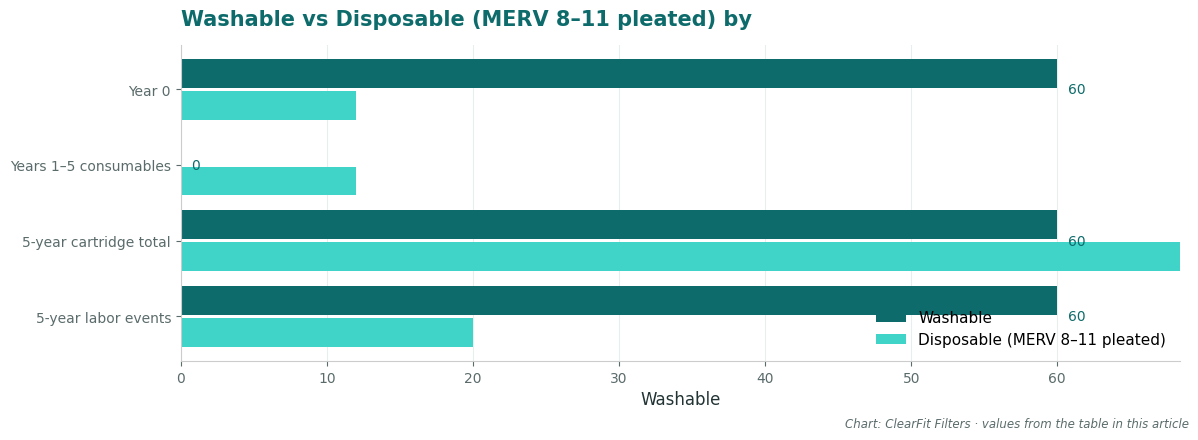
On cartridges alone, washable wins by ~$190 over five years. Now the fine print. First, $190 over five years is $38/year — the cost of one sandwich per quarter, for monthly labor and a lower MERV ceiling. Second, washable economics collapse entirely if the cartridge is damaged by aggressive cleaning (bent pleats, torn mesh) at year two — a common enough outcome that the “10-year lifespan” is a best case, not a median. Third, if your household actually needs MERV 11+ (allergies, pets, smoke), the disposable side of the table is not optional spending; washable simply can’t do the job at any price.
Why Washing Degrades an Electrostatic Filter (the Mechanism)
Most washable filters are electrostatically charged polypropylene: the media captures particles partly through mechanical straining (big particles) and partly through static attraction (fine particles sticking to charged fibers). The charge is the efficiency story — and it’s fragile.
Two degradation paths, both real:
- The charge fades. Triboelectric charge dissipates over time and handling; each wash cycle strips more. A filter sold as “MERV 8 equivalent” may perform closer to MERV 6 after a year of monthly washing — the rating on the box was the day-one number. (This is also why washables never carry a true ASHRAE 52.2 tested MERV with the confidence a pleated box does.)
- Residue clogs the media. Dust that isn’t fully rinsed out — greasy kitchen film especially — bonds to the fibers and narrows the open area. Now airflow drops and capture drops, which is the worst of both worlds. Detergent itself leaves film if it’s not fully rinsed; the cleaning guidance for these filters is stubbornly “water only” for a reason.
The compound effect: washables start mediocre on fine particles and get worse; disposables start better and stay constant until the whole cartridge goes in the trash. an inference from media mechanics, but it matches field observation: the “pristine or horrifying” bimodal pattern is what this degradation curve produces when human discipline varies.
The Mold Problem (the Reason “Dry Completely” Is Bolded)
A washable filter reinstalled damp puts a wet textile directly in your supply airstream — dark, moist, dust-laden: ideal fungal habitat. Spores colonize the media within days and then distribute through every room the system serves. The standard guidance “let it dry 24 hours” exists for this reason, and it’s the step real households skip when the old filter is already out and the HVAC is off and it’s inconvenient.
Practical protocol if you run a washable: own two cartridges. One in the slot, one clean and dry in a closet. Swap, wash the dirty one at leisure, let it dry for days, store it. This eliminates the damp-reinstall failure mode — at the cost of doubling the initial purchase, which eats most of the five-year savings shown above. (This is the point in the analysis where most readers quietly conclude disposable suits them.)
Who Should Actually Buy Washable (Three Real Cases)
- Landlords and rental stock — the property takes a $60 filter once; tenants’ filter discipline is not your problem if the filter is permanent-ish. Air quality ambitions are low, cost-per-year is low, worst case is a clogged filter rather than a missing one.
- Workshops/garages HVAC on a separate small system — high coarse-dust load, zero fine-particle ambition, easy hose access; the washable genuinely earns its keep.
- Low-load second homes — a cabin that runs the blower 200 hours a year barely loads any filter; washing annually is trivial and consumables never ship to the address.
Everyone optimizing for air quality (allergies, pets, smoke) or blower health should be on disposables — MERV 11–13, changed on schedule. For that crowd, the discipline problem washables “solve” is better solved by the Home Filter Calendar: log the system once, get a reminder every 90 days, receive the cartridge or reorder in one click. The subscription version of that idea (cross-category bundles at ~20% off single-buy pricing) exists precisely because the market’s failure mode is forgetting to buy, not buying too often — see the subscription vs one-time buying breakdown.
ClearFit cuts the same 16x20x1 MERV 11 pleated media to OEM specifications – the 16x20x1 MERV 11 replacement filter, sized to confirm against your old filter before ordering.
FAQ
Are washable air filters worth it?
On cartridge cost alone over five years, often yes (~$60 vs ~$250). On performance, no: MERV ~6–8 ceiling, efficiency that degrades with each wash, monthly labor, and a mold risk if reinstalled damp. Worth it for rentals, workshops, and low-load second homes; not for households that care about fine particles or allergies.
How long do washable air filters last?
Manufacturers claim 5–10 years; real-world life is bounded by wash discipline and damage — bent pleats, torn mesh, or a felted neglect episode end it early. The service interval is 30 days regardless: the cartridge lasts years, but the washing never stops.
Can I wash a disposable pleated filter?
No. Disposable pleated media is not designed to survive washing — the wet media delaminates, the frame collapses, and any electrostatic charge is destroyed. A washed disposable is worse than a dirty one. If you want washable economics, buy a filter built washable.
Do washable filters have a MERV rating?
Most claim “MERV 8 equivalent” but lack a current ASHRAE 52.2 tested rating; washables rarely carry true MERV certifications, and their effective performance on fine particles (the E1/E2 band) is far below a tested MERV 11 or 13 pleated filter. Treat “equivalent” claims as marketing shorthand.
Why does my washable filter smell musty?
It was reinstalled damp and has colonized with mold or bacteria in the media. Pull it immediately, wash it, dry it fully (24+ hours, airflow-assisted), and inspect the slot. Recurrence means the drying step keeps getting skipped — the two-cartridge rotation solves it.
Sources & References
- ASHRAE 52.2 test methodology — MERV as a new-condition tested rating; electrostatic media behavior. Official documentation (inference: extended reading of the standard).
- Manufacturer washable-filter guidance (AIR CARE et al.) — “water only” cleaning and 24-hour dry intervals. Official documentation (explicit).
- r/HVAC field threads — the pristine-or-horrifying bimodal pattern; felted washable photos; landlord economics. Community discussion (paraphrased).
- Consumable pricing bands (retail scan) — $8–20 pleated 1″, $50–80 washable. Industry convention (explicit range).
Related Guides
- How Often to Change Your HVAC Filter — the interval table for the disposable side.
- MERV Rating Explained — what the washable can’t claim.
- Best HVAC Filter for Pet Dander & Hair — the MERV-11 use-case.
- Filter Subscription vs One-Time Buying — the discipline problem, solved without washing.
Find your filter: All HVAC filter sizes