Is {City} Tap Water Safe to Drink? The New York Case and the 3-Step Check That Works for Any US City

New York City’s plant-level tap water is genuinely excellent — about 1 billion gallons a day, mostly from protected Catskill and Delaware watersheds, delivered under one of the few EPA filtration-avoidance waivers in the country. But “is it safe” for the person holding the glass is decided by two things the water quality report barely controls: the building’s plumbing (pre-1986 lead solder and service lines, pre-2014 brass fittings) and, in walk-ups, the rooftop tank that may not have been inspected lately. That’s why the honest answer to “is my city’s tap water safe” is never a yes/no — it’s the three-step check this page runs for NYC and then generalizes to any US city. Related: Is Tap Water Safe to Drink? and How to Read Your Water Quality Report.
Quick Answer: NYC: DEP delivers ~1 billion gallons/day from Catskill/Delaware watersheds — among the largest unfiltered supplies in the US (protected watersheds substitute for a filtration plant). Plant water meets standards. Your variables: pre-1986 buildings may carry lead solder/service lines; pre-2014 brass fixtures with more lead than the current 0.25% limit; buildings over 6 stories add rooftop tanks. Check in 3 steps: (1) EPA SDWIS violations, (2) your CCR’s lead 90th percentile, (3) building age and tank records.
| Check | What you’re looking for | Where | Time |
|---|---|---|---|
| 1. System-level violations | MCL violations, treatment technique failures, lead action-level exceedances | EPA’s SDWIS database (search “NYC DEP” or your system) or the utility’s published CCR | 10 min |
| 2. Your annual CCR | Detected contaminants table vs MCLs; lead 90th percentile (NYC’s has run ~3–6 µg/L, below the 15 µg/L action level); the water source | CCR PDF (every system must publish by July 1) | 15 min |
| 3. Your building | Year built (pre-1986 lead risk), service line material, rooftop tank inspection records (NYC requires annual) | Landlord/manager, or self-inspect per the lead-pipe scratch test | 20 min |

The r/AskNYC thread that keeps resurfacing — “How clean is NYC water really?” — runs a reliable arc: transplants from softer-water states complain the chlorination smells stronger than back home; someone posts the DEP’s watershed map; a plumber points out that half the posters’ buildings predate the 1986 lead solder ban and that their gorgeous prewar lobby should not be mistaken for their pipes’ birth certificate. The thread usually lands where this page does: great source water, check the building.
The NYC Case: Three Layers Decide Your Glass

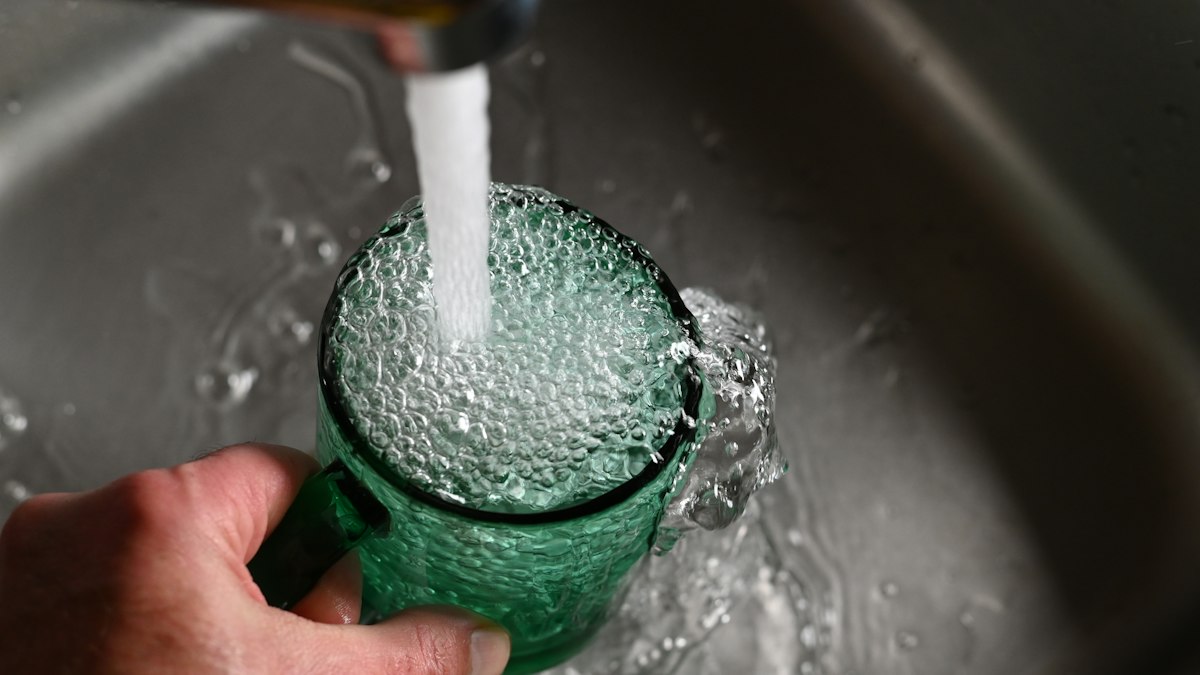
Layer 1 — the source and the plant. NYC’s water arrives from the Catskill, Delaware, and Croton systems west and north of the city. The Catskill/Delaware supply holds a Filtration Avoidance Determination: EPA allows it to skip mechanical filtration because watershed protection — land acquisition, stream buffering, strict rules in the recharge area — keeps source quality high enough that disinfection alone meets standards. That decision was economics as much as ecology: protecting the watershed cost on the order of $1–1.5 billion in land and programs versus an estimated $6–8 billion filtration plant plus operating costs — one of the largest “buy nature instead of concrete” trades in US municipal history. Water receives disinfection (and pH/corrosion control) before the tunnels; ~1 billion gallons a day move through city tunnels to roughly 8–9 million customers.
Layer 2 — the distribution grid and the street. Between plant and building sit mains — some over a century old — and the service line connecting the main to your building. Corrosion control (orthophosphate dosing) coats pipes against lead leaching citywide, and NYC’s lead 90th-percentile results have stayed below the 15 µg/L action level in recent cycles. The residual risk concentrates in lead service lines and goosenecks, which is why the city runs replacement programs and why “your building” is step 3, not step 1.
Layer 3 — your building. Two age gates matter nationally and apply here: the 1986 SDWA amendments banned lead in new solder and pipes (so pre-1986 buildings carry the risk), and the 2014 reduction to “lead-free” = ≤0.25% lead in wetted brass tightened fixtures (so 1986–2013 brass can still leach measurable lead in standing water). Above six stories, code historically required rooftop tanks, which NYC requires to be inspected and filed annually — tank records are a legitimate ask of any landlord, since neglected tanks grow sediment and occasionally worse. Practical in-unit moves: run cold water 30 seconds to 2 minutes after stagnation (overnight/vacation), use cold for drinking and cooking, and if a child or pregnancy is in the household, a $30–60 lead test of first-draw water settles the building question with data — the same first-draw protocol from the lead-pipe page.
The Method Generalizes: Any City, Same Three Steps
The reason this page is structured as a method rather than a New York trivia entry: the same three checks resolve “is my tap water safe” in Phoenix, Chicago, or a town of 4,000.
- EPA SDWIS violations search — the Safe Drinking Water Information System tracks every community water system’s violations (MCL exceedances, treatment technique, monitoring/reporting failures). Serious repeat violations change the conversation from “taste” to “what’s the advisory status.”
- The CCR’s three tables — Detected Contaminants, Violations, Source. The number to hunt first is the lead 90th percentile vs the 15 µg/L action level (and any >5 µg/L flag from the 2024 LCRI direction), then disinfectant byproducts (TTHM/HAA5, the most common aesthetic-and-health tradeoff), then nitrate if agricultural. The full annotation method is the CCR guide.
- Building and plumbing audit — construction year against the 1986/2014 gates, service line material (the scratch-and-magnet test), and for apartments, whether storage tanks exist and when they were last serviced.
What each finding maps to: a violation or advisory → follow the advisory (boil or bottled per instructions — the boiling rules and their limits are covered in the boiling page); lead in plumbing → NSF/ANSI 53-certified filter or pitcher plus first-draw discipline (see the tap-water guide’s filter-matching section); TTHM taste → NSF 42 carbon; PFAS notifications (now regulated at 4 ng/L under the 2024 national primary standards) → NSF 53/P473-class treatment or RO — the contaminant-specific routes live in the contaminant library.
The Comparison Questions, Answered With Numbers
“Does NYC have the cleanest tap water in the world?” — it’s a defensible contender for best-sourced big-city water (the Boston/San Francisco/Fraser-class watershed systems compete in the same tier), but “cleanest in the world” is unverifiable marketing-speak that depends on which metric leads (source protection? distribution age? terminal plumbing?). “Who has the cleanest tap water in the US?” — the consistent answer names the protected-watershed systems (NYC, Boston, San Francisco’s Hetch Hetchy, Portland OR’s Bull Run — another filtration-avoidance supply) rather than any purified-river system. And the odd PAA entry — “can you drink water from the tap in York” — resolves charitably: York, England is a compliant UK supply (safe by DWI standards), and York, PA runs the same three-step check as everywhere else in this framework.
FAQ
Can you drink water from the tap in York?
Yes, in both plausible readings. York, UK: public supply meeting Drinking Water Inspectorate standards — safe as distributed. York, Pennsylvania: a compliant US system; the three-step check above (SDWIS, CCR lead percentile, building age) is how you’d verify your specific property. The question’s frequent-appearance in US SERPs is a truncated-autocomplete artifact of New York queries.
Does NYC have the cleanest tap water in the world?
It’s in the conversation but “cleanest in the world” has no official metric. NYC’s distinction is delivering unfiltered surface water to ~8–9 million people at scale under a Filtration Avoidance Determination — a claim almost no megacity can make. Terminal quality at your tap depends on building plumbing everywhere, including New York.
Who has the cleanest tap water in the US?
The systems consistently cited: NYC (Catskill/Delaware), Boston (Quabbin), San Francisco (Hetch Hetchy), and Portland, Oregon (Bull Run — the other famous filtration-avoidance supply). What they share is protected wilderness watersheds; what they don’t share is your building’s pipes, which is why source prestige never ends the safety question.
Is NYC water safe right now?
The standing answer is yes with the building-level caveat — plant water compliant, corrosion control in place, lead 90th percentile below the action level in recent cycles. “Right now” questions are advisory questions: check DEP’s current notices or EPA’s SDWIS for active advisories; any boil-water or do-not-drink notice overrides everything on this page.
Sources & References
- NYC DEP — Drinking Water FAQs and annual Water Supply & Quality Report — ~1 B gal/day, watershed systems, 90th-percentile lead results. Official documentation.
- EPA — Filtration Avoidance Determination record for Catskill/Delaware; 1997 MOA watershed protection framework — program costs vs filtration-plant estimates. Official documentation.
- Safe Drinking Water Act amendments 1986/2014 — lead solder ban; “lead-free” 0.25% definition. Official documentation.
- EPA SDWIS (Safe Drinking Water Information System) — public violations database used in step 1. Official documentation.
- EPA 2024 Lead and Copper Rule Improvements & PFAS NPDWR — 2027 service-line inventory clock; 4 ng/PFAS MCLs. Official documentation.
Related Guides
- Is Tap Water Safe to Drink? — the national version of this question.
- Does Your Home Have Lead Pipes? — step 3’s lead audit in full.