What Is a Reverse Osmosis System and How Does It Work? (Stage by Stage, With the Pore-Size Numbers)

A reverse osmosis system is a staged water purifier built around a semi-permeable membrane with an effective pore size of ~0.0001 microns — small enough to reject dissolved ions — driven by ordinary household water pressure (40–100 psi) pushing water against its natural osmotic direction. That one sentence separates RO from every filter most people have owned: a fridge or pitcher filter is an adsorber/strainer working at the 0.5–5 micron scale against particles and chlorine; RO is a membrane separator working at the molecular scale against dissolved solids themselves, removing 90–98% of TDS. The stages around the membrane exist to protect it and to polish what it produces. The RO filter library → maps each stage to the cartridge your specific system takes.
Quick Answer: An RO system forces tap water through a 0.0001-micron membrane under pressure, rejecting 90–98% of dissolved solids (TDS). A standard unit is 5 stages: sediment pre-filter (5 µm) → carbon pre-filter (protects the membrane from chlorine) → RO membrane (the workhorse) → carbon post-filter (taste polish) → optional remineralization. “50–75 GPD” means gallons per day of production; tankless systems run 400–800 GPD with no storage tank.
| Stage | Media | Pore size | What it removes | Replace every |
|---|---|---|---|---|
| 1. Sediment pre-filter | Spun polypropylene | 5 µm | Dirt, rust, silt — protects stage 2–3 | 6–12 mo |
| 2. Carbon pre-filter | Carbon block | ~5–10 µm (adsorption) | Chlorine/chloramine — protects the membrane | 6–12 mo |
| 3. RO membrane | Thin-film composite polyamide | 0.0001 µm | TDS, lead, fluoride, nitrate, PFAS | 2–3 yr |
| 4. Carbon post-filter | Granular activated carbon | — | Taste/odor polish of tank water | 12 mo |
| 5. Remineralization (optional) | Calcite/MgO | — | Adds Ca/Mg back | 12 mo |
EPA maintains its own point-of-use RO explainer that ranks #1 for this topic — the agency covers the definition well. What government pages don’t do is explain the two design ideas that actually explain the machine: why the membrane needs bodyguards (stages 1–2), and why the system either needs a storage tank or a much bigger membrane. That’s the gap this page fills.
How Reverse Osmosis Works (The 60-Second Physics)

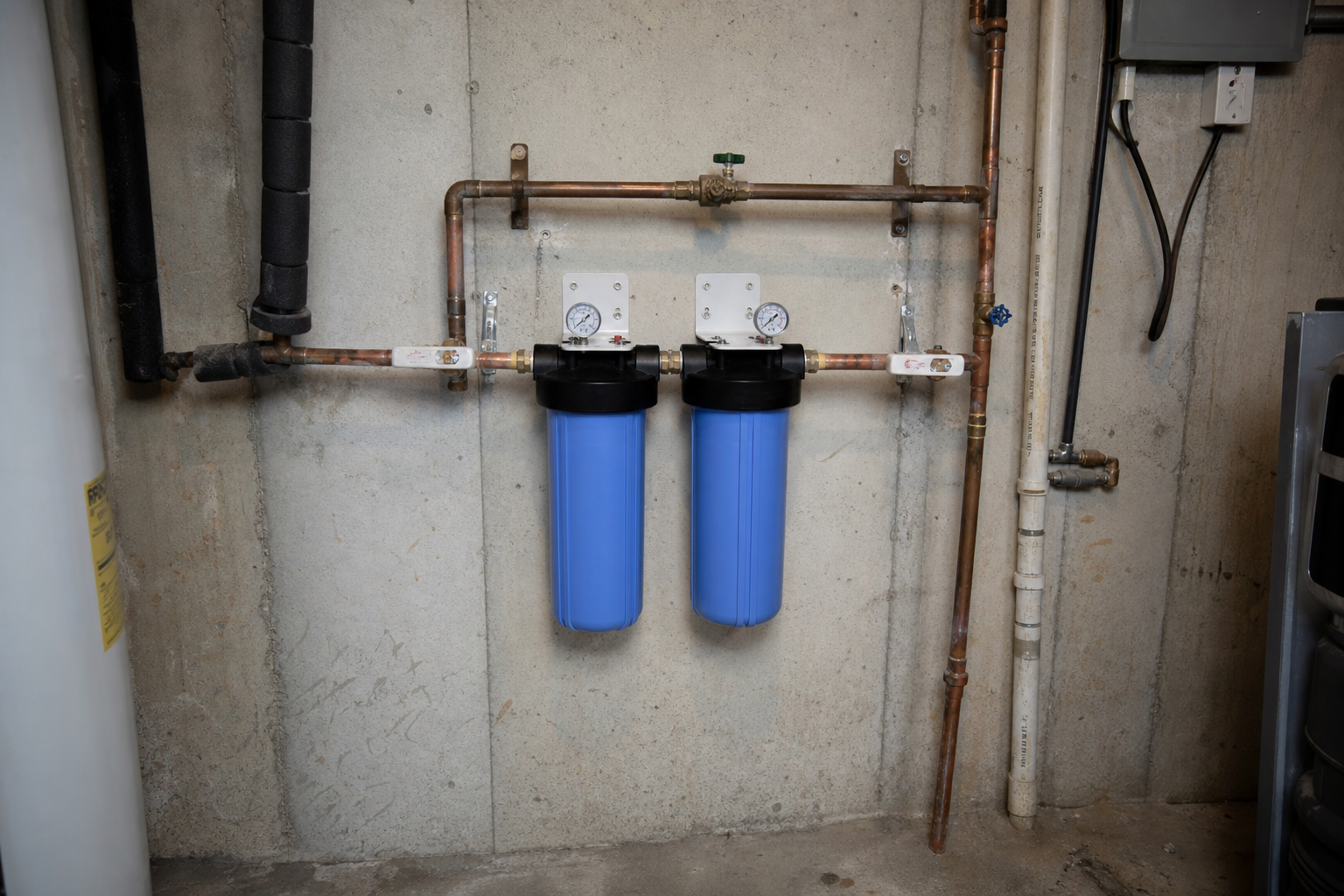
Osmosis is water’s natural habit of crossing a semi-permeable membrane from the dilute side toward the concentrated side, equalizing salinity. Reverse osmosis is exactly what the name says: household water pressure applied to the concentrated side (your tap water) pushes water molecules the wrong way, through the membrane, leaving dissolved salts, metals, and molecules behind in a concentrate stream that runs to the drain. No electricity, no chemicals, no stored media doing the separating — just pressure and a film whose openings are on the order of a water molecule’s own diameter. This is why an RO system always has a drain line: rejection has to go somewhere. The ratio of drain water to produced water (the “waste ratio,” 3–4:1 on tank systems, ~1–2:1 on tankless) is the direct engineering consequence of flushing the concentrate away from the membrane surface — without that flush, rejected salts would pile up at the film and scale it within weeks.
The membrane itself is thin-film composite (TFC) polyamide in essentially all modern residential systems — chosen for 97%+ salt rejection under NSF/ANSI 58 test conditions. Its one weakness defines stage 2: polyamide tolerates only ~0.1 ppm of free chlorine before oxidizing, so the carbon pre-filter exists to strip chlorine before it reaches the film. This dependency — covered in depth in the replacement schedule — is why “change your carbon pre-filter on time” is the single most consequential maintenance act an RO owner performs.
RO vs a Regular Water Filter (The Question Everyone Asks Next)
| Dimension | Regular filter (pitcher/fridge/faucet carbon) | Reverse osmosis |
|---|---|---|
| Mechanism | Adsorption (carbon) + mechanical straining | Pressure-driven membrane separation |
| Smallest target | ~0.5 µm particles; chlorine; some organics | Dissolved ions (0.0001 µm scale) |
| TDS reduction | ~0% (minerals pass through) | 90–98% |
| Lead reduction | Only if NSF/ANSI 53-certified for lead | 95%+ inherent |
| Fluoride/PFAS/nitrate | No (fluoride), limited (PFAS) | 85–95%, 90%+, 80–95% |
| Flow | Immediate, full faucet flow | Via dedicated faucet; tank-fed or 400–800 GPD tankless |
| Waste water | None | 1–4 gal per gal produced |
| Cost | $30–60/unit, $10–40/yr | $150–600 system, $60–120/yr |
| Best for | Chlorine taste, sediment on compliant municipal water | High TDS, lead service lines, well water, PFAS, fluoride concerns |
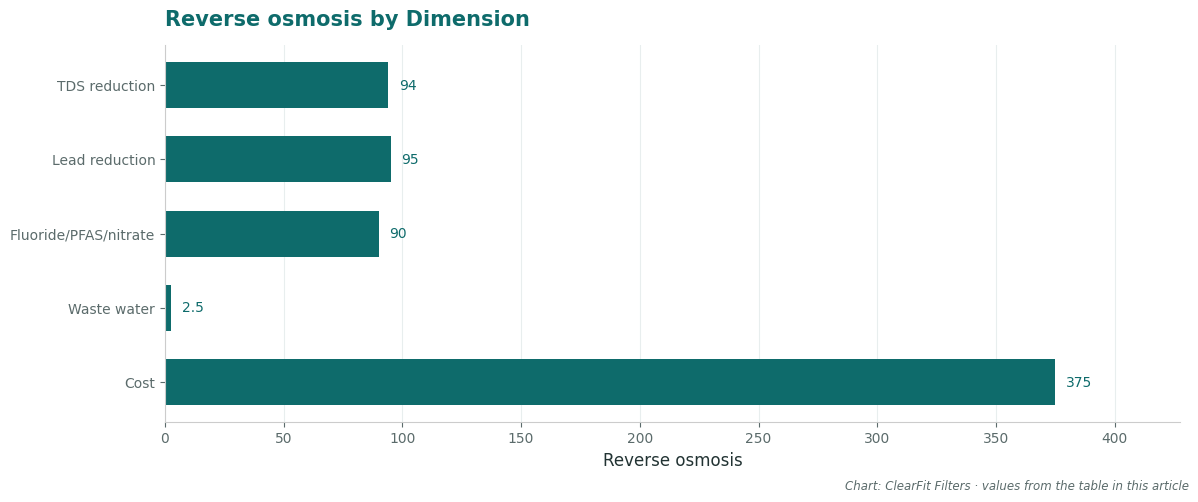
The one-line version: a carbon filter makes water taste better; RO makes water measurably different on a TDS meter. If your annual water quality report shows clean, compliant water and your complaint is chlorine taste, a good carbon filter is the right-sized tool and RO is overkill. If your report shows lead, nitrate, PFAS, or your well runs 400+ ppm TDS, RO is the residential technology that actually addresses it — the decision runs through what’s really in your tap water →.
GPD, Tanks, and Why Two Architectures Exist
A membrane’s rating — gallons per day — is its production speed under standard test pressure and temperature. A classic 50–75 GPD membrane makes 2–3 ounces per minute: far too slow to fill a glass on demand, hence the storage tank (a 2–4 gallon pressure vessel that fills slowly and dispenses quickly). Tankless designs instead run a large 400–800 GPD membrane with an internal booster pump, filtering on demand and skipping the tank — at the cost of requiring electricity and pricier cartridge sets. The full comparison lives in Tankless vs Tank RO Systems →; for system-shopping purposes the summary is: tank systems ($150–300) are the value default, tankless ($400–600) win on cabinet space and waste ratio.
What “Best Under Sink Water Filter” Means (And Doesn’t)
The phrase pulls ~170 searches/month and deserves a paragraph here rather than its own page, because the honest answer forks on your water: on clean municipal water, the best under sink filter is a simple carbon block (cheaper, zero waste, enough); on lead-line-era plumbing, high TDS, PFAS-affected supply, or fluoride concerns, the best under sink filter is an RO system, and the meaningful differences between RO models are GPD, waste ratio, and certification — not marketing stage-counts. A “7-stage” badge with no NSF/ANSI 58 certification is worth less than a certified 5-stage. Certification lookup: the NSF product listings database lets you verify any model number in two minutes.
Internal link: Once you know what an RO system is, the owning-side knowledge is the filter replacement schedule (which stage is due when) and the cost guide (what five years actually cost).
FAQ
What is the downside of reverse osmosis water?
Mineral removal (diet-replaceable — see Is RO Water Good for You?), the waste ratio on tank systems, slower dispensing than a plain faucet, and a multi-stage maintenance schedule. All four are quantified in the companion piece; none is a health hazard for a normally-fed household.
Is it healthy to drink reverse osmosis water?
Yes for healthy adults on a normal diet — water supplies single-digit-percent shares of dietary calcium and magnesium, and WHO’s caution about low-mineral water concerns desalinated supplies as primary mineral sources, not kitchen RO systems. People on medically restricted diets or preparing infant formula should route the question through their clinician, as with any water choice.
What is the difference between a regular water filter and a reverse osmosis filter?
Mechanism and scale. Regular filters adsorb and strain at the 0.5+ micron scale — chlorine, taste, sediment; dissolved minerals and most lead/fluoride/nitrate pass through. RO pushes water through a 0.0001-micron membrane that rejects dissolved ions themselves — 90–98% of TDS. That’s why RO needs a drain line (rejected concentrate) and a dedicated faucet while a carbon filter doesn’t.
Is RO water hard on the kidneys?
No evidence supports that. RO water is low-mineral, not mineral-free, and healthy kidneys regulate body fluid and electrolyte balance continuously regardless of water mineral content. For people with diagnosed kidney disease on fluid or mineral restrictions, water choices belong with their nephrologist — that’s a diet question, not a filter question. Not medical advice; see your clinician for individual guidance.
Sources & References
- US EPA — Point-of-Use Reverse Osmosis Systems explainer (the SERP #1 authority for definition). Official documentation.
- NSF/ANSI 58 — RO system certification standard (TDS rejection ≥75% floor, membrane test conditions). Official documentation.
- NSF product listings database — verification method for model-level certification claims. Official documentation.
- Wikipedia: Reverse osmosis — membrane chemistry background (TFC polyamide, chlorine tolerance). General reference.
- SERP top-10 cross-reference: epa.gov, culligan.com, wikipedia.org, tappwater.co, clearlyfiltered.com, diy.stackexchange.com (DataForSEO live SERP, US/2840, 2026-08-21). PAA questions: 4/4 incorporated.
Related Guides
- RO Filter Replacement Schedule
- How to Install an Under Sink RO System
- Does Reverse Osmosis Remove Fluoride?
Full entry: TDS in water – the full entry