Which Way Does the Air Filter Go In? (Arrow Direction, Sorted by Where Your Filter Lives)

The arrow on an air filter points in the direction of airflow — toward the blower and away from the return duct. In practice that means one of three things depending on where your filter lives: in a wall or ceiling return grille, the arrow points into the wall (air travels from the room into the duct); in a return-duct slot, arrows point downstream toward the furnace; in the blower compartment itself, arrows point at the blower wheel. The arrow is not an “in/out” marker or a “clean side/dirty side” label — it exists to keep the pleated media’s support structure facing downstream so captured dust stays put.
The direction question is the most-asked filter question on r/HVAC, and it produces a specific kind of wrong: the filter fits both ways — nothing clicks or blocks — so a reversed filter can run for months unnoticed. One homeowner’s confession from a filter-direction thread: “Two years. I had it backwards for two years, and the only clue was my dust problem wasn’t getting better and the coil guy’s face when he opened the cabinet.” The tech found a felted mat of dust on the wrong side of the media and a coil that needed a proper cleaning. That is the standard outcome of a reversed filter — silent, cumulative, and priced into your next service call.
Top Picks at a Glance (2026)

An airflow arrow pointing the right way only pays off if the media behind it is worth passing air through. The three 1-inch pleats we would slot in while the panel is open:
| Pick | Product | Why it wins |
|---|---|---|
| Best overall | 16x20x1 MERV 11 pleated (1-pack) | Mid-tier capture in the most common nominal size; spec sheet lists pet dander, mold spores and pollen at this rating, 90-day life. |
| Best for allergy season | 20x25x1 MERV 11 pleated (1-pack) | Same MERV 11 tier in the large slot, where the extra media area carries the pollen load of peak weeks. |
| Best for smoke days | 20x25x1 MERV 13 pleated (1-pack) | MERV 13 is the tier the spec sheets list for the fine-fraction particles in wildfire smoke; cadence shortens toward 60 days. |
Quick Answer: Arrow Direction by Install Location

| Where your filter is | Arrow points | How to verify on your unit |
|---|---|---|
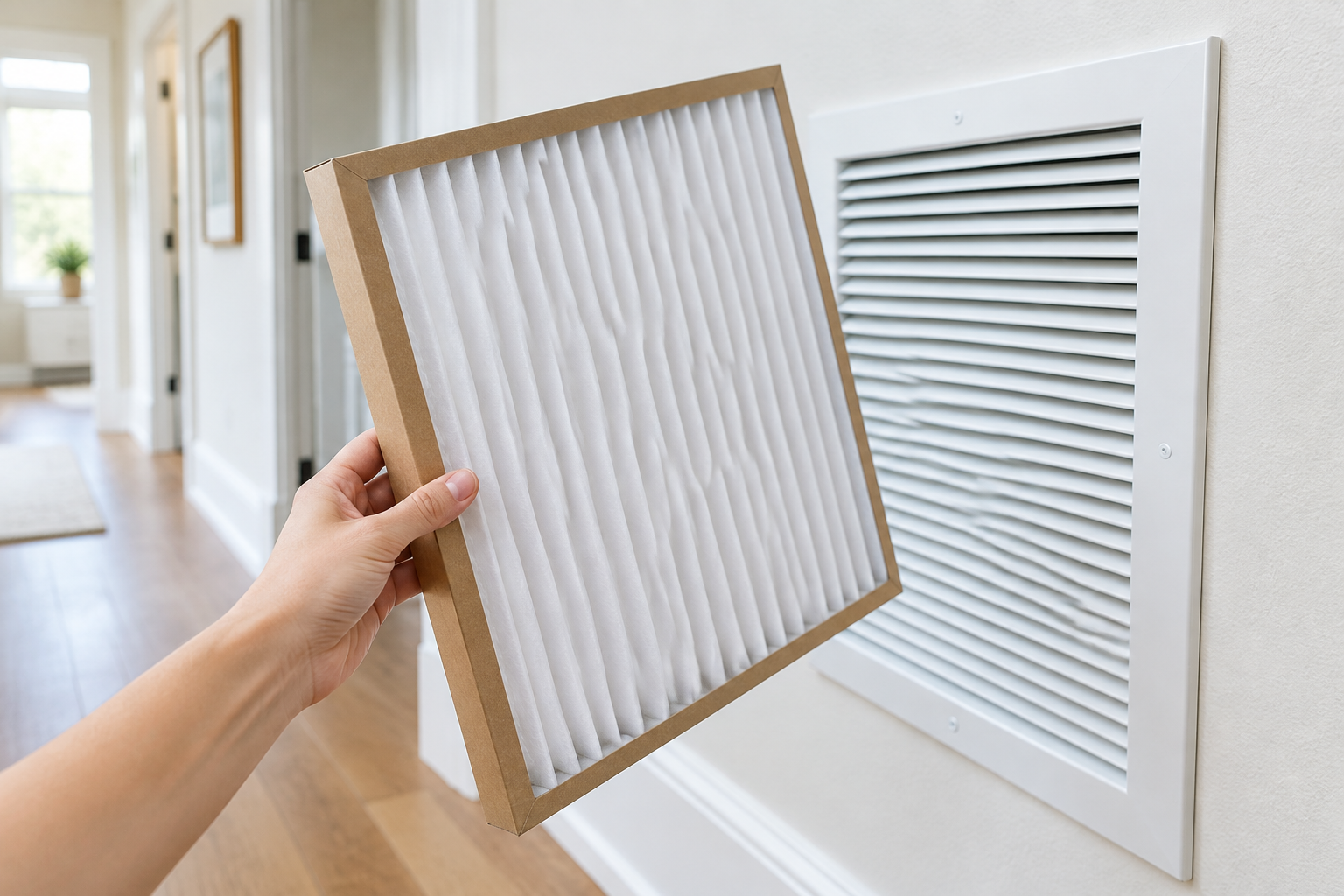
| Wall / ceiling return grille | Into the wall (away from you as you face the grille) | Air is being sucked from the room — stand there, the draft tells you |
| Return-duct slot (filter slides into the duct run) | Downstream, toward the furnace/air handler | Follow the duct: the far end is the blower |
| Blower compartment / furnace cabinet | At the blower wheel | The slot sits on the return side of the cabinet; arrows point inward, toward the machinery |
| Air handler with media cabinet (4″–5″ box bolted to the unit) | Toward the air handler | The cabinet’s door sticker shows airflow direction |
Return-grille installs are the ones people get wrong most often, because “into the wall” feels wrong — the filter looks like it should face the room. But the room side is the intake; the filter’s job starts as air leaves the room.
Why the Arrow Means Airflow (the 30-Second Physics)
Your system is a loop: return ducts pull air from the rooms → air passes through the filter → the blower pushes it across the heat exchanger or evaporator coil → supply ducts deliver it back. The filter sits between the return side and the blower, so air always moves through the filter toward the blower. The arrow printed on the frame simply matches that flow.
Why direction matters mechanically, not just ritually: a pleated filter is asymmetric. The upstream face is the filtering media — designed to catch and hold particles as air loads it. The downstream face typically carries the support structure (a metal or plastic grid on many filters) that keeps the pleats from collapsing backward under airflow. Reverse the filter and three things happen:
- Capture efficiency drops — the media loads from the wrong side, and dust that lands on the backing grid sits loose instead of embedding in the pleats.
- Loose dust sheds downstream — every blower start re-entrains particles that a correctly oriented filter would have held, straight toward your evaporator coil.
- Pleats can deform — the support grid was doing structural work; with airflow reversed, loaded pleats can flatten, which collapses the media area and spikes pressure drop.
The eBay-grade summary: the filter still “works” backwards, in the way a colander still holds some water. You will filter some air while paying the full static-pressure price.
Direction by Unit Orientation: Horizontal, Vertical, Upflow, Downflow
The arrow rule never changes — toward the blower, in the direction of airflow — but where that points in space depends on how the unit sits, and that’s where visual tutorials mislead people:
| Unit orientation | Where it lives | What the arrow does in space |
|---|---|---|
| Upflow (vertical, basement) | Return enters bottom, supply exits top | Usually points sideways (filter slot on the return duct) or upward (slot in the cabinet base) |
| Downflow (vertical, slab/mobile-home) | Air enters top, exits bottom | Points downward toward the blower section — the counterintuitive one |
| Horizontal (attic/crawlspace, unit on its side) | Duct feeds one end | Points along the duct run toward the unit; slot is often vertical, so the filter slides in top-to-bottom and the arrow may point sideways on a vertically-standing filter |
The horizontal-unit case breaks the most mental models: a filter standing on its edge with an arrow pointing left feels wrong to anyone who learned on a basement upflow. Trust the duct, not gravity — air always moves from the return duct toward the blower, and horizontal furnace filter direction is read exactly like vertical: follow the metal. When in doubt, run the system and feel which side pulls (the intake side is the return; the arrow points away from it).
“Which way does the air filter go in?” — the AC Filter Is the Same Question
Worth a direct paragraph because the search data says people ask it twice, once for the furnace and once for the AC: there is no separate AC filter direction. The air filter in an AC-equipped forced-air system is the furnace filter — the evaporator coil sits downstream of the same cartridge, the same blower pulls through it, and the arrow goes the same way (toward the blower/air handler). “Which way does the AC filter go in” and “air conditioner filter direction” resolve to the identical answer as the furnace question, including at wall/ceiling grilles (arrow into the wall). The only genuinely different hardware is a window AC unit, whose washable mesh screen has no arrow and no orientation — it just sits in its frame.
ClearFit cuts the same 16x20x1 MERV 8 pleated media to OEM specifications – the 16x20x1 MERV 8 replacement filter, sized to confirm against your old filter before ordering.
No Arrow? Read the Construction
Older filters, washables, and some generics ship with no printed arrow. You can still read the airflow direction from the build:
- Metal or plastic mesh on one face — that face is the downstream (blower) side. The mesh is a pleat support; supports always go downstream.
- Denser, fuzzier, more fibrous face — that is the upstream filtering side; it faces the return duct / the room.
- Wire backing on one side only (common on fiberglass and cheap pleateds) — wire side downstream, fiberglass media upstream.
- A foam or rubber edge gasket on one rim — the gasket seals against the slot’s dirty side (upstream), so air can’t sneak around the frame.
When both faces look identical (some synthetic media), orientation genuinely doesn’t matter for that filter — install it, mark the date on the upstream-facing edge, and move on. That class of filter is symmetric by design; the manufacturer saved the printing.
The Complete Install, Since the Filter Is Already in Your Hand
While the cabinet is open, run the four-point check that costs nothing and prevents the next service call:
- Confirm size before it goes in — nominal size on the frame edge should match the cabinet sticker. Wrong-size workarounds (undersized + foil tape) are covered in how to measure your filter size.
- Arrow toward the blower — per the table above.
- Seat it fully in the track — no bowed edges, no gaps at the corners. Air bypassing a half-seated filter is unfiltered air.
- Write the date on the frame edge, upstream face — a permanent marker turns the next check into a two-second glance. A 1″ pleated filter is due at 90 days in a normal household, sooner with pets or heavy runtime; the Home Filter Calendar automates the reminder so the date lives somewhere other than a fading marker streak.
Does It Really Matter? (What a Reversed Filter Actually Costs)
Worth being honest about the stakes, because the internet handles this question in two useless registers — “it’s catastrophic, replace your furnace” or “doesn’t matter, it’s just air.” Neither is true. A reversed filter for one season typically means:
- Measurably worse dust control in the house (the complaint that eventually surfaces the error)
- Accelerated coil fouling — loose-shed dust migrates to the wet evaporator coil, which is where the real money is; a professional coil clean runs $100–400
- No immediate damage — the blower doesn’t care, the filter doesn’t care, nothing breaks this week
The compounding risk is the coil: fouled coils reduce heat transfer, which lowers capacity, which extends runtime, which loads the filter faster. A reversed filter in a pet household over a full summer can genuinely produce a coil-clean bill. It’s a $0 fix on day one and a $200+ outcome on day 180 — the same economics as every other filter-maintenance decision.
FAQ
Which way does the AC filter go in — arrow up or down?
The AC filter is the same cartridge as the furnace filter, and the arrow points toward the blower (air handler), regardless of season. “Up or down” has no universal answer because it depends on how your unit sits: downflow furnaces point the arrow down, upflow units point it up or sideways, and horizontal attic units point it along the duct toward the unit. Follow the airflow, not the ceiling.
Which way does the arrow point on my furnace filter?
Toward the blower — the direction air is moving. On a furnace or air handler cabinet, that means arrows point inward at the machinery; on a return-duct slot, arrows point downstream along the duct toward the unit; on a wall or ceiling return grille, the arrow points into the wall.
Which way does a filter go in a ceiling or wall return grille?
Arrow into the wall. The grille is an intake: air flows from the room, through the filter, into the return duct. The room-facing side is the dirty side; the duct side is downstream.
What if my filter has no arrow?
Read the construction: metal/plastic mesh or wire backing = downstream (blower) side; denser fibrous media = upstream (return) side. If both faces are truly identical, the filter is symmetric and orientation doesn’t matter — install, date it, done.
What happens if the air filter is in backwards?
Capture efficiency drops (media loads wrong-side), loose dust sheds toward the evaporator coil, and pleats can deform without their downstream support. Nothing fails immediately, but a season of reversed installation in a dusty or pet household commonly ends in a $100–400 professional coil cleaning.
Does the dirty side face in or out when I remove the filter?
Dirty side faces the room/return duct — upstream, where the air came from. If you find dust caked on the blower-facing side of the old filter, that’s the telltale someone before you installed it backwards.
Sources & References
- r/HVAC filter-direction threads — the “two years backwards” pattern, coil-fouling outcomes, and the grille-confusion consensus. Community discussion (paraphrased).
- FilterBuy / FilterKing install-direction help pages — baseline direction guidance this page extends with the location table. Industry convention (explicit).
- ASHRAE 52.2 media-loading behavior — upstream loading vs downstream support structure. inference (media-mechanics common knowledge from standard testing).
- Coil-cleaning service pricing ranges — typical US market rates. Inference (range estimate).
Related Guides
- How to Change a Furnace Filter — the full procedure this page abbreviates.
- How to Measure Your Air Filter Size — nominal vs actual, the other number problem.
- How Often to Change Your HVAC Filter — 90 days for 1″, 6–12 months for media.
- What Is Pet Dander? — the particles a correctly oriented filter is holding back.
Find your filter: All HVAC filter sizes