How to Measure Your Air Filter Size (Nominal vs. Actual — the Half-Inch That Causes Every Wrong Order)

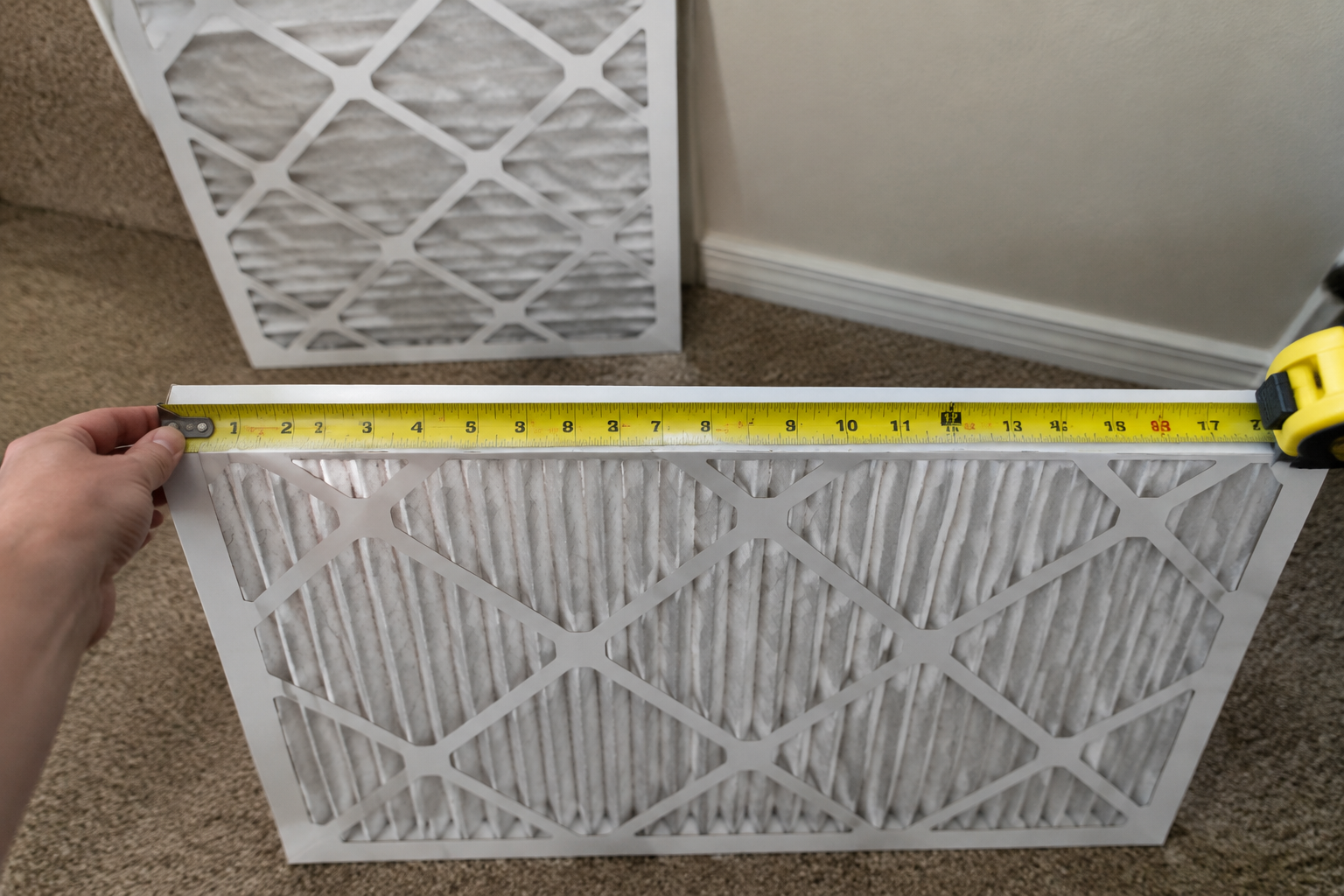
Measure the filter’s actual size — length × width × thickness to the nearest 1/8″ — then buy by its nominal (rounded) size: a filter that tape-measures 15½ × 24½ × ¾″ is sold everywhere as a 16×25×1. The industry double-labels every filter, and the gap between the two numbers is systematic, not random: for standard sizes, actual length and width run about ½″ under nominal, and “1-inch” filters are actually ¾″ (0.75″) thick. If your old filter is missing or crushed, the slot itself tells the truth — measure the housing track instead.
The half-inch gap exists because nominal sizes describe the slot, and actual sizes describe the filter that must slip into it with clearance. Every retailer repeats “measure your filter” without explaining the offset, which is how people measure 15½ × 24½, search for that number, find nothing (nobody sells a “15.5×24.5”), and conclude their filter is some oddball custom size. It is not. It is the single most common filter in America. A homeowner on r/HomeImprovement summarized the moment perfectly after measuring three times: “15.5 by 24.5 by 0.75 — is this even a real size?” The thread’s top reply was one line: it’s a 16x25x1.
Top Picks at a Glance (2026)

Once you have the real measurement (nominal minus roughly half an inch per side), most slots resolve to three sizes across three MERV tiers. The picks:
| Pick | Product | Why it wins |
|---|---|---|
| Best overall | 16x20x1 MERV 8 pleated — measured 19-1/2 x 19-1/2 in | The spec sheet prints the actual size next to the nominal, which is the number your tape measure produced; 90-day rated life. |
| Best for pets and pollen | 20x20x1 MERV 11 pleated — actual 19-1/2 x 19-1/2 in | MERV 11 tier with pet dander, mold spores and pollen listed as the capture class on the spec sheet. |
| Best for smoke and PM2.5 | 20x25x1 MERV 13 pleated — actual 19-1/2 x 24-1/2 in | The fine-capture tier in the large nominal size; the spec-sheet 60-to-90-day window tightens in smoke season. |
Quick Answer: Nominal → Actual Conversion Table
| Nominal (what you buy) | Actual (what your tape shows) | Notes |
|---|---|---|
| 16×25×1 | 15½ × 24½ × ¾″ | One of the highest-volume sizes in the US (~8,100 searches/mo) |
| 20×20×1 | 19½ × 19½ × ¾″ | The single most-searched size (~14,800/mo) |
| 20×25×1 | 19½ × 24½ × ¾″ | Same face as the 4″ media below |
| 14×20×1 | 13½ × 19½ × ¾″ | |
| 20×25×4 | 19½ × 24½ × 3¾″ | Generic 4″; OEM cabinets vary — see brand exceptions |
| 20×25×2 | 19½ × 24½ × 1¾″ |
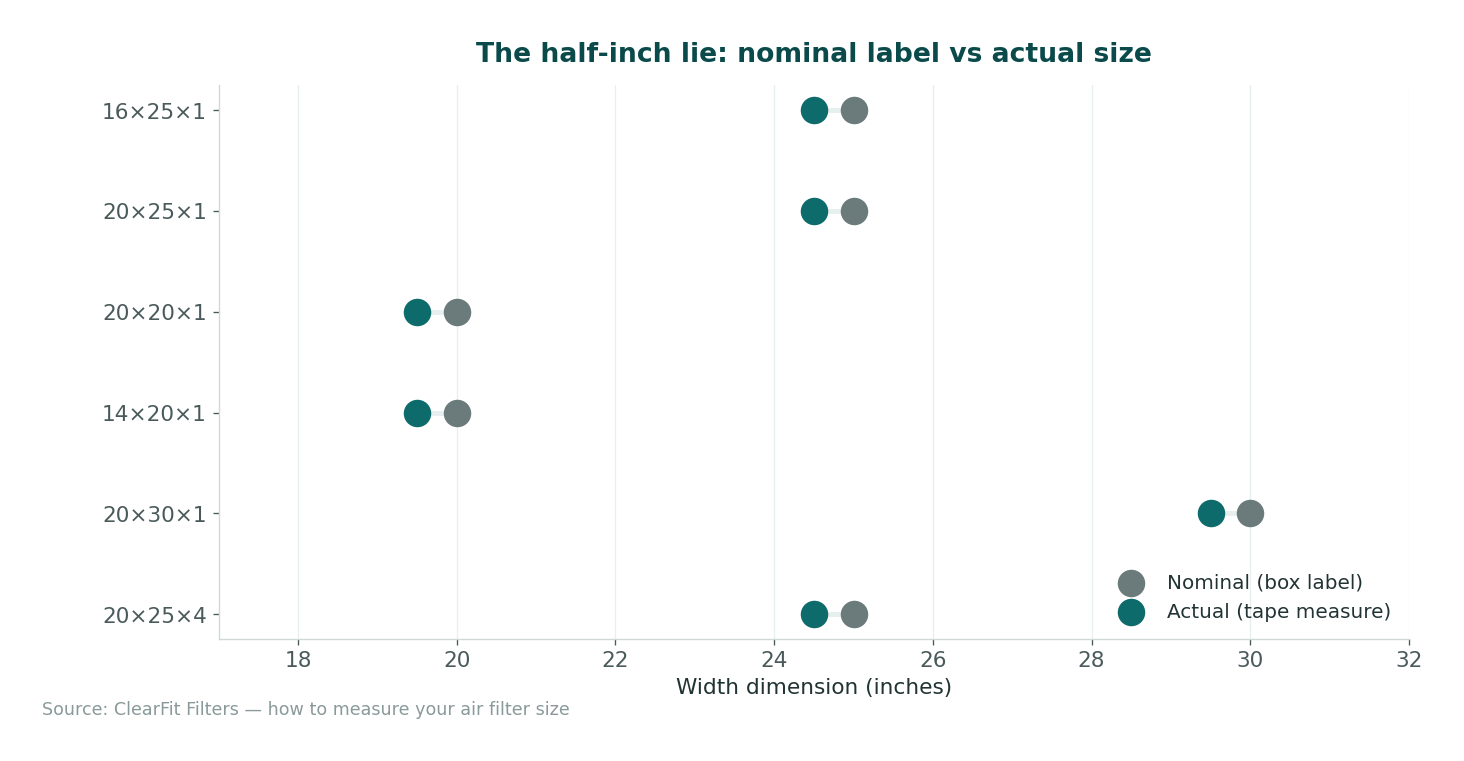
The rule: actual = nominal minus ½″ on length and width; thickness rounds down to ¾″ (sold as 1″), 1¾″ (sold as 2″), 3¾″ (sold as 4″). Exceptions below are real and cost people money.
Step-by-Step: Measuring the Filter (Text-Only Walkthrough)
- Pull the old filter and lay it flat on a table, dirty side up. Measuring in the slot gives you the track, not the filter.
- Length first — hook the tape on the outside edge of one cardboard frame, read at the far outside edge. Round to the nearest ⅛″. Frame edges, not the pleated paper, define the size.
- Width the same way. Write both numbers down before you forget one — the #1 re-order error is transposing them (a 16×25 is not a 25×16 in stock terms).
- Thickness across the frame edge, not the pleat depth. A true 1″-nominal filter reads ¾″; if you read a full 1.00″, you likely have an oddball size — check the brand exceptions before ordering.
- Add the arrow direction while you’re holding it — note which way the airflow arrow pointed. You’ll need it on install day.
Measuring the slot when the filter is gone
If there is no old filter, measure the inside track of the housing: the channel the filter slides into. Length and width inside the track, then add ⅜″ back to each — the filter is nominally larger than its actual body but slightly smaller than the open slot. The track depth also confirms thickness: a 1″ slot takes a 1″ nominal even though the filter is ¾″ thick, because the retaining rail eats the difference.
How to Judge the Size Without Measuring: the Label System
The tape measure is actually the backup method. Filters self-identify in print if you know where to look:
- The frame edge printing. Most filters print the nominal size (e.g., “16x25x1” or “16x25x1 MERV 8”) on the long edge of the cardboard frame. Some premium brands print both: “Nominal 16×25×1 / Actual 15.50×24.50×0.75.” If you see a decimal-point number, that’s the actual size — order the paired round number next to it, not the decimal.
- The slot or blower-compartment sticker. Air handlers and furnace cabinets ship with a factory sticker inside the filter door or on the return-side rail stating the design filter size. It may be 15 years old and sun-faded, but the number doesn’t change.
- The return-grille screw-hole card. Filter-backed return grilles (wall/ceiling) usually have a size card tucked behind the grille frame, visible when you swing it open.
- Your last receipt or subscription box flap. The shipping label often carries the SKU, which maps 1:1 to nominal size.
This label-first order (print → sticker → measure) is reversed on most competitor pages because measurement makes a better photo tutorial. In practice the print is faster and immune to the three measurement traps below.
ClearFit cuts the same 16x25x1 MERV 8 pleated media to OEM specifications – the 16x25x1 MERV 8 replacement filter, sized to confirm against your old filter before ordering.
Three Ways a Measured Old Filter Lies to You
1. The compressed filter. A loaded filter bows inward under months of airflow suction — the frame can measure ¼″ narrow on the concave face. Measure along the rigid top/bottom rails, never across a bowed middle, and square the filter up on the table first.
2. The wrong filter someone installed before you. People force slightly-wrong filters into slots all the time (a 16×25 shoved into a 20×25 slot with the gap stuffed, or a 1″ filter in a 2″ slot with a spacer). If you measure the inherited filter, you inherit the error. Cross-check against the cabinet sticker; when the filter and the sticker disagree, the sticker wins.
3. The label that fell off. Cardboard-frame labels peel on old filters, and hand-me-down houses come with mystery filters. Here the slot measurement in the section above is your only honest source.
Brand Exceptions: When “4 Inches” Is Not 3¾″
The −½″ rule covers standard 1″ and 2″ retail filters almost perfectly. The genuine trap zone is OEM media cabinets at 4″ and 5″, where manufacturers built their own housings with their own clearances:
| Platform | Nominal | Actual (typical) | The trap |
|---|---|---|---|
| Generic / most retail 4″ | 20×25×4 | 19½ × 24½ × 3¾″ | Fits generic cabinets and most aftermarket boxes |
| Honeywell FC100A-series cabinet | 16×25×4 | ~15⅞ × 24⅞ × 4⅜″ | Thicker than generic 4″; a 3¾″ filter rattles and bypasses |
| Lennox Healthy Climate 20×25×5 | 20×25×5 | ~19⅞ × 24¾ × 4⅜″ | Sold as “5-inch,” measures well under 5″ — the classic wrong-order story |
| Carrier/Trane media cabinets | varies | check cabinet door sticker | OEM cartridge dimensions are per-cabinet, not per-rule |
The takeaway is not to memorize the exceptions — it is that for 4″+ cabinets, order by the OEM part number on the cabinet sticker or old cartridge end-cap (e.g., FC100A1027, X6673), not by rounded nominal size. Cross-referenced equivalents keyed to those part numbers guarantee the fit; nominal size alone does not.
Oddball Sizes: Two Ways Out
If your actual measurement maps to nothing on any size chart (common in 1960s–80s furnaces and oddball apartment units):
- Buy the closest smaller nominal size and seal the gap — the r/HVAC contractor method: a filter ½″ undersized on one dimension, secured with 2″ metal HVAC foil tape around the edge. Ugly, effective, airtight. Air takes the path of least resistance, and an untaped gap lets 20–30% of airflow bypass the media entirely, so the tape is not optional cosmetics — it is the difference between filtered and unfiltered air.
- Order a custom-size filter — several US makers cut custom filters to ⅛″ increments, roughly $25–40 each in singles, cheaper in packs. Worth it for slots you’ll be feeding for a decade.
From Measurement to Order: the Size Pages
The 92 highest-volume filter sizes — from 20×20×1 (about 14,800 searches a month) down through 16×25×1, 20×25×1, and the 4″ media sizes (20×25×4 ≈ 6,600/mo, 16×25×4 ≈ 2,900/mo, 20×20×4 ≈ 2,400/mo) — each have a dedicated size page with every MERV option and the actual-dimension spec confirmed: start at /air-filters/16x25x1/ or use the air filter finder — enter your actual measurement and it returns the nominal size and in-stock options. While you’re ordering, a 1″ pleated filter’s clock starts the day it goes in: the 90-day discipline (and the six variables that shorten it) are covered in How Often to Change Your HVAC Filter, and the Home Filter Calendar tracks the date for you so this becomes the last time you think about it.
FAQ
What size air filter do I need?
Either read the nominal size printed on your current filter’s frame edge, or measure its actual length × width × thickness and round up: 15½ × 24½ × ¾″ rounds to a 16×25×1. If both are unavailable, measure the housing track and consult your cabinet sticker.
What does “actual size” mean on an air filter?
Actual size is the true tape-measure dimension of the filter; nominal size is the rounded industry number used for ordering. Actual runs about ½″ under nominal on length and width, and thickness reads ¾″ on a “1-inch” filter. Both numbers printed on one filter (e.g., “Nominal 16×25×1, Actual 15.50×24.50×0.75”) refer to the same product.
Can a filter be the wrong size by half an inch?
A ¼–½″ gap on one edge can be taped (smaller filter, foil tape around the frame). A filter larger than the slot simply cannot be installed — never force or cut a pleated filter, which damages the frame and the media pack. Order the nominal size that matches the slot, not the old filter.
Do all brands’ “16x25x1” filters measure the same?
Within 1″ retail filters, yes to within about ⅛″ — 15½ × 24½ × ¾″ is effectively universal. The brand variance that bites is at 4″–5″ OEM media cabinets (Honeywell 4⅜″-thick “4-inch,” Lennox 4⅜″-thick “5-inch”), which is why those should be ordered by part number.
Sources & References
- Retailer size charts (FilterBuy, FilterKing, AirFiltersDelivered sizing pages) — the nominal/actual pairs in the conversion table. Industry convention (explicit).
- Honeywell FC100A / Lennox Healthy Climate X6673 product data — OEM cartridge actual dimensions (4⅜″ thickness exceptions). Official documentation (inference: per the latest spec sheet).
- r/HomeImprovement & r/HVAC size-identification threads — the “15.5×24.5×0.75 is this real” confusion pattern; foil-tape undersized-filter workaround from contractor replies. Community discussion (paraphrased).
- DataForSEO search-volume pull (2026-08-19, 92-size set) — search demand figures cited for size pages. API data (explicit).
Related Guides
- How Often to Change Your HVAC Filter — the schedule that starts today.
- Which Way Does the Air Filter Go In? — the arrow, solved in one diagram’s worth of words.
- 1 vs 4 Inch Furnace Filter — whether your slot should stay 1″.
- MERV Rating Explained — the other number on the box.