How to Backwash a Pool Filter: All Six Valve Positions Explained (Sand & DE)

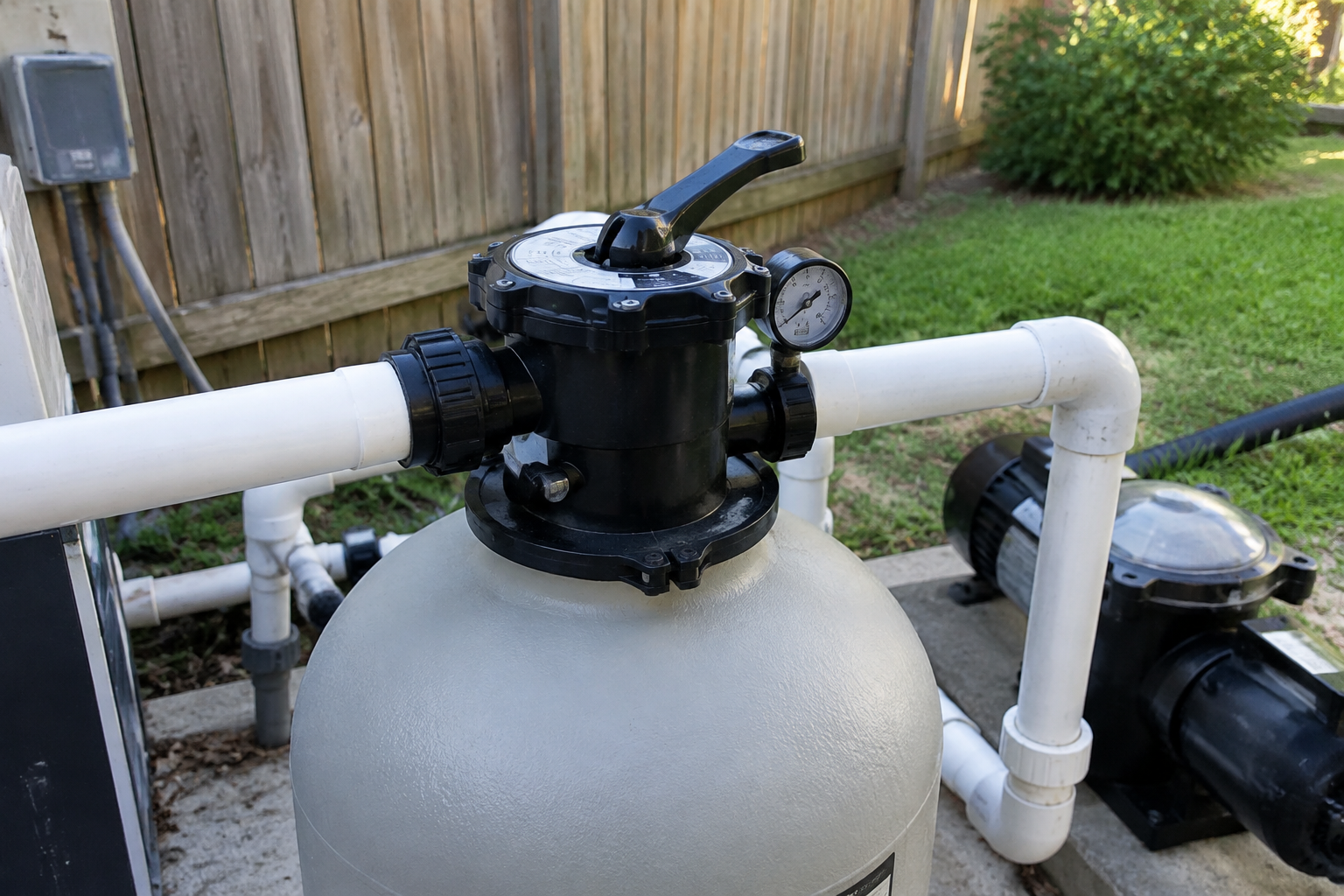
Backwashing reverses water flow through the filter to flush trapped debris out to waste, and the procedure is stop pump → valve to BACKWASH → run 2–3 minutes until the sight glass runs clear → stop pump → valve to RINSE for 20–30 seconds → back to FILTER — with the trigger being 8–10 psi above your filter’s clean baseline, not the calendar. The part of this skill nobody teaches is the valve itself: the multiport’s six positions each route water differently, two of them can destroy equipment if used wrong, and understanding all six is what separates backwashing from hoping. DE filters follow the same sequence and add one step — recharging powder after the rinse — covered in full below.
The Reddit energy around this topic is seasonal panic: May threads titled “pool is cloudy, did I backwash wrong?” and the replies always ask the same diagnostic question — what’s your clean pressure and what did the gauge read before you started? The owners who know their baseline number backwash calmly on trigger; the ones who don’t are performing a valve ritual they found on a forum. The gauge-first discipline is the difference (the full pressure guide), and this page assumes it: know your clean psi before you touch the valve.

Top Picks at a Glance (2026)
Sand and DE get backwashed; cartridges get hosed off and eventually replaced on the same 8-10 psi trigger. The three picks for that side:
| Pick | Product | Why it wins |
|---|---|---|
| Best overall | CCP 200-class cartridge (200 sq ft) | 200 sq ft pleated polyester, same flow and fit as OEM; also Pleatco PAP200 / Filbur FC-0688. |
| Best for 420-class tanks | CCP 420-class cartridge (105 sq ft) | Rinses clean with a garden hose between cycles; replace when pressure rises 8-10 psi over clean — the cartridge-world backwash trigger. |
| Best Pentair-pattern spare | Pentair-pattern replacement cartridge | Built to the OEM part number’s dimensions with the 100% fit guarantee behind it. |
Quick Answer: The Core Sequence
| Step | Valve position | Pump | Duration | What’s happening |
|---|---|---|---|---|
| 1 | (any) | OFF | — | Never turn the valve with the pump running — water hammer can crack the valve spider gasket or worse |
| 2 | BACKWASH | ON | 2–3 min, until sight glass clears | Reversed flow lifts the sand/DE bed and carries debris out the waste line |
| 3 | (hold) | OFF | — | Settle before the next move |
| 4 | RINSE | ON | 20–30 sec | Settles the bed and flushes the rinse channel so dirty water doesn’t backfeed the pool |
| 5 | FILTER | ON | — | Normal operation; log the new psi; DE filters: recharge powder now |
Two readings tell you everything: the waste water’s clarity (backwash until the sight glass or waste stream runs clear — typically 2–3 minutes, longer after storms or algae events) and the gauge after the cycle (should land back near your clean baseline; if it doesn’t, that’s a diagnosis, not bad luck — pressure troubleshooting).
The Six Valve Positions (the Part Every Guide Skips)
The multiport valve is a rotor diverting flow between internal ports. Each position, what it does, and when it’s for:
- FILTER — the default. Water top-to-bottom through the media, returning to the pool. 95% of the valve’s life is spent here.
- BACKWASH — reversed flow, bottom-to-top, out the waste port. The cleaning cycle itself. When: gauge +8–10 psi over baseline, or after heavy debris/algae events.
- RINSE — forward flow, but routed to waste instead of the pool. After every backwash, it resettles the bed and clears the lateral/ manifold of the last dirty water. Skip it and the first seconds of returned water carry exactly what you just flushed — the classic “why is my pool cloudy after backwashing” thread.
- WASTE — water bypasses the media entirely and drains to waste. For vacuuming fine debris (algae, silt — sends it out of the pool instead of through the filter), for lowering water level, and for discharging after chemical oversights. It drains the pool — watch the level, especially vacuuming on waste.
- CLOSED — all ports blocked. For servicing equipment downstream of the pump (heaters, chlorinators). Never run the pump on CLOSED — deadheading a pump against a closed valve builds pressure and heat fast; it’s the position most likely to cause real damage.
- RECIRCULATE — water bypasses the media and returns to the pool. For circulating chemicals (clarifiers, some algaecides) when you don’t want them loading the filter, or for keeping water moving with a media problem (a torn laterals situation while you wait on parts).
The meta-rule above all six: pump OFF before every valve turn. The rotor seals against a spider gasket that doesn’t survive being rotated under flow — and a damaged spider gasket announces itself as mystery leaks and position cross-feed (leak diagnosis).
When to Backwash (Trigger, Not Calendar)
The manufacturer-standard trigger is 8–10 psi above your clean baseline — the number you wrote down after the last fresh/clean cycle. On top of that, event triggers: after storms (debris load), after vacuuming a significant algae event, and after any chemical process that loads the media. What’s not a trigger: the calendar, the neighbor’s schedule, or “it’s been a while” (why the gauge outranks all three).
The counterintuitive caution: over-backwashing is real. Each cycle stirs the media bed and flushes out some of the fines that do fine capture work; backwashing weekly “just to be safe” in a lightly-loaded pool keeps the bed perpetually unsettled and can contribute to cloudy water and channeling. Trigger-based owners backwash less and filter better. And for sand filters, the deeper maintenance cycle — full media replacement every 3–5 years — is its own job: how to change pool filter sand.
ClearFit manufactures OEM-equivalent cartridges on the same media spec – for example the Hayward C-ool.
DE Filters: Same Sequence, Plus the Recharge
DE (diatomaceous earth) filters backwash with the same valve sequence, but the media is powder pre-coating grids, not a sand bed — so every backwash strips some or all of the coating, and the filter runs unfiltered until you replace it. After returning the valve to FILTER:
- Recharge with DE at roughly 1 pound per 10 square feet of grid area (a 48 sq ft filter takes ~5 lbs; check the tank label for its number) — added through the skimmer with the pump running, or pre-mixed and poured.
- Backwashing only “bumps” partially-cleaned DE on some filter designs (the Perflex-style flexible-tube filters use a bump handle rather than a full backwash — the DE guide covers both styles).
- Running a DE filter without its powder coat makes the grids do work they weren’t designed for; the recharge is not optional.
Where the Waste Water Goes (and Brand Notes)
Backwash and rinse water goes to the waste line — plumbed to sewer/drainage, or a hose dragged to a code-approved spot. Not to the lawn in quantity: the stream carries concentrated debris, and in pools, chlorine and chemistry your landscaping didn’t order (and some municipalities have opinions about it — check local discharge rules). Also note what backwash costs: 100–300 gallons per cycle in typical setups, which is part of the water-economics case for cartridge systems that never backwash (the three-system comparison).
Brand notes are short because the procedure doesn’t vary: Hayward, Pentair, and Jandy multiports use the same six-position logic with the same labels (Hayward’s Vari-Flo, Pentair’s 6-way, Jandy’s standard multiports all read BACKWASH/RINSE/WASTE/CLOSED/RECIRCULATE/FILTER). What differs is handle style (lever vs. rotating knob) and where the sight glass sits. If your “multiport” has only push-pull two-position operation, that’s a slide valve — BACKWASH and FILTER only, no RINSE position: run the pump to waste for a few extra seconds before returning to filter to get the rinse effect manually.
FAQ
How many minutes should I backwash my pool?
Until the sight glass or waste stream runs clear — typically 2–3 minutes, 4–5 after storms or algae cleanup, and until clear is the only real answer. Minutes are a proxy; clarity is the measurement. Then 20–30 seconds on RINSE before returning to FILTER. If it’s taking dramatically longer than usual for the glass to clear, the media itself is the suspect (sand-change timing).
How do I backwash my pool pump?
Backwashing happens at the filter’s valve, not the pump — the pump just runs on high during the cycle: pump off, valve to BACKWASH, pump on 2–3 minutes until clear, pump off, RINSE 20–30 seconds, valve to FILTER, pump on, log the psi. The pump’s role is providing the reversed flow the valve directs; its own basket gets cleaned separately (pump off, open the strainer lid, clear the basket).
Should you backwash before or after shocking?
After. Shocking sends dead algae and oxidized debris toward the filter; backwashing afterward clears what the filter caught. If you shock because of an algae bloom, the sequence is: vacuum on WASTE if there’s settled algae, shock, run FILTER, then backwash once the gauge climbs and the water clears. Backwashing before shocking cleans the filter that’s about to do the work — reasonable if the gauge is already high — but the common pattern is backwash-after, so the media you shock through isn’t already loaded.
How do I backwash a Hayward pool filter?
Identically to any sand filter with a multiport: pump off, rotate the Hayward Vari-Flo valve to BACKWASH, pump on until the sight glass clears (2–3 min), pump off, RINSE 20–30 seconds, FILTER, pump on, note the psi. Hayward’s Pro-Series sand filters and their DE filters both use this sequence; the only Hayward-specific detail is the sight-glass location on the valve body. Pentair, Jandy, and every other major brand run the same six-position procedure.
Sources & References
- Retailer catalog multiport valve data (Hayward/Pentair/Jandy) — six-position routing, RINSE purpose, psi triggers. Official documentation (explicit).
- The +8–10 psi cleaning-trigger convention — the industry-standard gauge discipline. Official documentation (explicit, manufacturer-universal).
- DE recharge rates — ~1 lb/10 sq ft guidance. Official documentation (explicit; per tank label).
- r/pools seasonal threads — cloudy-after-backwash, valve-turned-under-flow casualties, the gauge-first consensus. Community discussion (paraphrased).
Related Guides
- Why Is My Pool Filter Pressure High? — read the gauge before touching the valve.
- How to Change Sand in a Pool Filter — the media replacement backwashing postpones.
- Sand vs Cartridge vs DE Pool Filters — whether backwashing is even your system’s job.
Find your filter: Pool & spa filter cartridges