What Is a HEPA Filter? (99.97% of What, at Which Size — and Why Your HVAC Probably Can’t Have One)

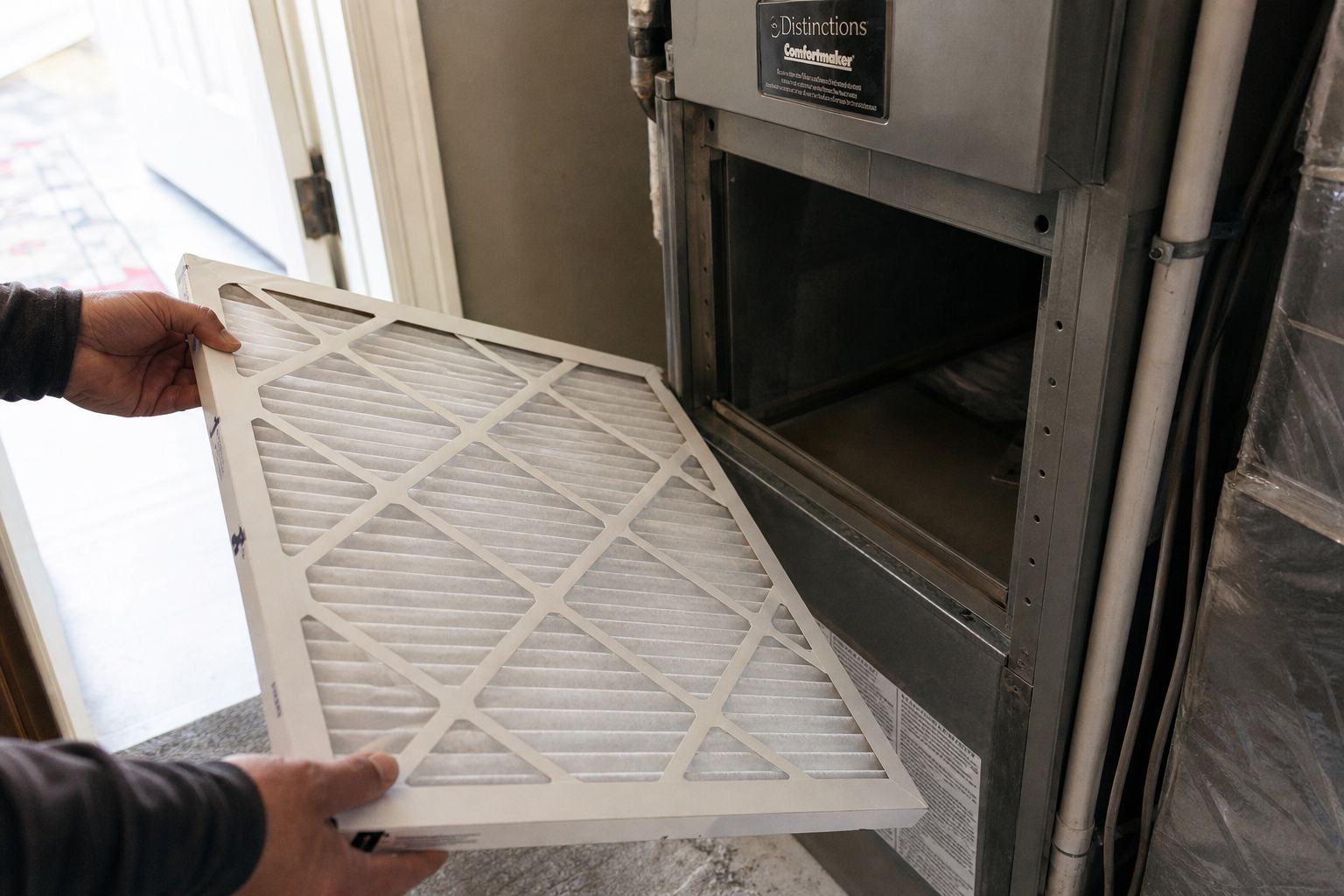
A HEPA filter is a defined media standard, not a brand or a style: any media that captures 99.97% of particles 0.3 microns and larger qualifies — the specification descends from mid-century federal/nuclear air-cleaning work (the DOE standard lineage) and today governs everything from hospital air to vacuum exhaust. The 0.3-micron figure isn’t marketing: it’s the most-penetrating particle size (MPPS) — the point where the three capture mechanisms (interception, impaction, diffusion) hand off and each is at its weakest, so a filter that beats 0.3 µm beats everything else by construction. And the twist most “HEPA” shopping content skips: a true HEPA can’t run inside a standard residential HVAC system (the pressure drop is several times the blower’s entire static budget), so for whole-home air the practical ceiling is MERV 13 — HEPA belongs in the room-scale devices (portable purifiers, vacuums) where a dedicated fan pushes air through it.
This is one of the highest-volume filtration searches there is, and the results are a label swamp: “True HEPA,” “HEPA-type,” “HEPA-like,” “HEPA-grade” — only the first is a claim anyone certifies. This page gives you the standard itself, the physics that makes 0.3 µm the magic number, the label decoder, and the honest placement advice (which rooms and devices deserve HEPA, and what to run in the ducts instead). If you came for the head-to-head with ducted filtration, HEPA vs MERV 13 is the companion page; this one is the foundation.
Quick Answer: The Standard, the Labels, the Placement

| Term | What it actually means | Certifiable? |
|---|---|---|
| HEPA | 99.97% capture of particles ≥0.3 µm, per the federal-lineage spec | Yes — testable, certified, listed |
| True HEPA | Same standard; “true” exists to fight the imposters below | Yes (the word “true” adds nothing technical) |
| HEPA-type / HEPA-like / HEPA-style | Media that resembles HEPA with unpublished or lower efficiency (often 95–99% at unlisted sizes) | No — self-declared |
| Sealed HEPA system | HEPA media plus a housing that doesn’t leak around it (purifiers/vacuums) | The seal matters as much as the media |
| MERV 13 (for contrast) | ASHRAE residential-scale tier: ≥50% at 0.3–1.0 µm, >85% at 1–3 µm | Yes, ASHRAE 52.2 tested |
Placement shorthand: ducts = MERV 13; rooms and devices = HEPA. The two are complements, not competitors — the reasons fill the rest of this page.
The Definition, Precisely
HEPA stands for High Efficiency Particulate Air (filter). The qualifying performance: 99.97% of particles 0.3 micrometers in diameter, at the media’s rated airflow. Three clarifications that keep the claim honest:
- “0.3 microns and larger” is shorthand for a subtler truth — the spec tests at the hardest size (see MPPS below), and capture is typically even better both above and below it. The number isn’t a floor that larger particles barely clear; it’s the bottleneck.
- The standard has a family tree: US federal procurement specs (DOE STD-3020’s lineage) define it for government/nuclear use; the European EN 1822 framework grades the same class as E10–H14 by integral efficiency, with H13/H14 bracketing the HEPA band. Retail “HEPA” in the US and “H13” in Europe are cousins describing the same physics.
- Rated airflow is part of the claim. HEPA efficiency holds at the designed face velocity — which is why the standard implies big fans: pushing meaningful air volume through 99.97%-dense media takes pressure, and that fact organizes the entire product landscape (more below).
Origins, briefly, because it explains the stringency: the filter class was engineered for mid-20th-century atomic-era containment — capturing airborne radioactive particles where per-pass failure was unacceptable. The household market inherited a battle-tested standard; the “True HEPA” qualifier is the market’s own scar tissue from decades of softer imitators.
Why 0.3 Microns Is the Magic Number (the MPPS Paradox)
Counterintuitive but central: 0.3 µm is the hardest particle size to catch — not the easiest. Filters capture by three mechanisms, each dominant at a different size:
- Diffusion (smallest particles, ≲0.1 µm): Brownian motion bounces them around until they wander into a fiber. The smaller the particle, the wilder the wander, the likelier the catch.
- Interception (mid-range): a particle following an airstream passes close enough to a fiber that it sticks.
- Impaction (larger, ≳0.5–1 µm): momentum carries a particle across a curving airstream straight into a fiber.
Plot capture efficiency against particle size and you get a U-shape with its minimum near 0.3 µm — the size too big for maximal diffusion and too small for reliable impaction/interception. That minimum is the most-penetrating particle size. HEPA specs the test at the bottom of the U on purpose: certify the worst case, and every other size is covered with margin. This is why a HEPA that captures 99.97% of 0.3 µm particles isn’t merely “fine-particle rated” — it’s bounded worst-case certified, and why claims that don’t name a particle size are claims about nothing.
The Label Swamp: “HEPA-Type” and Its Cousins
The second-highest-value skill in this market is refusing uncertified labels:
- “True HEPA” = HEPA. The “true” prefix exists purely to distinguish from the imposters — a real filter’s certificate doesn’t need the word, but the word helps shoppers.
- “HEPA-type / like / style / grade” = none of the certified performance. These media often test somewhere between 95% and 99% at unspecified sizes — which can mean excellent, mediocre, or untested. The phrase to look for instead of adjectives: “99.97% at 0.3 microns”, ideally with a test-report reference.
- Sealed-system claims matter as much as the media: an unsealed “HEPA” purifier or vacuum can leak 10–20% of airflow around the media, quietly converting your 99.97% into something like 85%. In appliances, sealed HEPA is the phrase worth paying for.
The vacuum case is the clearest everyday example: a vacuum with sealed HEPA exhaust keeps fine dust in the machine; one without aerosolizes a fraction of what it just collected back into your breathing air — the HEPA-vs-MERV page covers why the same label earns opposite verdicts in vacuums vs ducts.
Why Your HVAC Can’t Have One (and What To Do Instead)
The physics, short version: HEPA media at residential duct velocities costs on the order of an inch of water-column pressure clean — against a home blower’s ~0.5″ total external static budget for everything (ducts, coil, registers, filter). Confronted with that, airflow collapses or bypasses; there’s no third option. In-duct “HEPA” that actually works is a dedicated bypass unit: a sealed HEPA module with its own fan, plumbed as a side-loop — a $600–1,500 appliance, not a filter swap.
The functional residential stack, then:
- Whole home: MERV 13 (ideally in a 4″ media cartridge — the depth economics; compatibility first via the airflow data).
- The rooms that need more: a true-HEPA portable, sized to at least 2/3 of the room’s clean-air-delivery requirement, run continuously — the standard tool for severe allergy, post-surgical, and smoke-event rooms (wildfire playbook).
- The MERV-13-vs-HEPA decision in one line: MERV 13 cleans all the house’s air well; HEPA cleans one room’s air best. Run both if the need is real; neither substitutes for the other.
FAQ
What are the two disadvantages of HEPA filters?
First, airflow resistance: the same density that captures 99.97% demands far more fan power than standard media — the reason HVAC integration requires dedicated bypass units and the reason portable purifiers are their own appliances. Second, HEPA captures particles, not gases: odors, VOCs, and smoke gases pass through untouched — gas-phase capture needs activated carbon (a different media class entirely; see filter types). The honorable-mention third: replacement cost, since certified media doesn’t come cheap.
Do you really need a HEPA filter?
For most homes: no — MERV 11–13 in the HVAC system covers whole-house particulate needs at a fraction of the cost and complexity. The real-need cases are room-scale: severe allergies or asthma in a bedroom, post-surgical or immunocompromised occupancy, smoke events, and any device (vacuum) whose exhaust you don’t want re-aerosolizing fines. In those cases HEPA earns its price — the placement section above draws the line.
What is the difference between a HEPA filter and a regular filter?
Capture efficiency at the finest sizes: a “regular” residential filter (MERV 8–11) captures coarse dust and pollen well but passes a meaningful share of 0.3–1 µm fines, while HEPA captures 99.97% of everything ≥0.3 µm. The practical differences follow: HEPA costs more, restricts airflow more, needs its own fan in most applications, and is certified to a defined standard rather than a tier on the residential MERV scale (MERV explained; the full matchup: HEPA vs MERV 13).
When should a HEPA filter be used?
Room-scale, continuously, when the occupant’s stakes justify it: diagnosed allergies or asthma overnight, immunocompromised or post-surgical recovery rooms, wildfire-smoke weeks, and any sealed appliance whose exhaust handles fine dust (vacuums above all). Also in any setting with regulatory-grade air requirements — hospitals, cleanrooms, labs — which is the standard’s home turf. Not as a residential duct upgrade, where the physics votes no.
Sources & References
- EPA indoor-air HEPA guidance — definition, applications, limitations. Official documentation (explicit).
- DOE-lineage HEPA specification / EN 1822 framework — test aerosol, MPPS-based efficiency grading. Official documentation (explicit; lineage description includes inferred synthesis).
- Filtration-capture mechanism literature — diffusion/interception/impaction size dominance and the U-shaped efficiency curve. Industry analysis (explicit mechanism).
- Wikipedia HEPA entry + manufacturer documentation — standard history and label conventions. Public sources (cross-checked).
Related Guides
- HEPA vs MERV 13 — which belongs where, with the blower-budget physics.
- MERV Rating Explained — the residential scale.
- Best HVAC Filter for Allergies — the room where HEPA actually earns it.
Find your filter: MERV 13 filters – closest ducted grade