Manganese in Your Water: 0.05 mg/L, the Black Stains & the 2021 Health Advisory You Should Know About

For a quick reference on manganese, see our manganese entry.
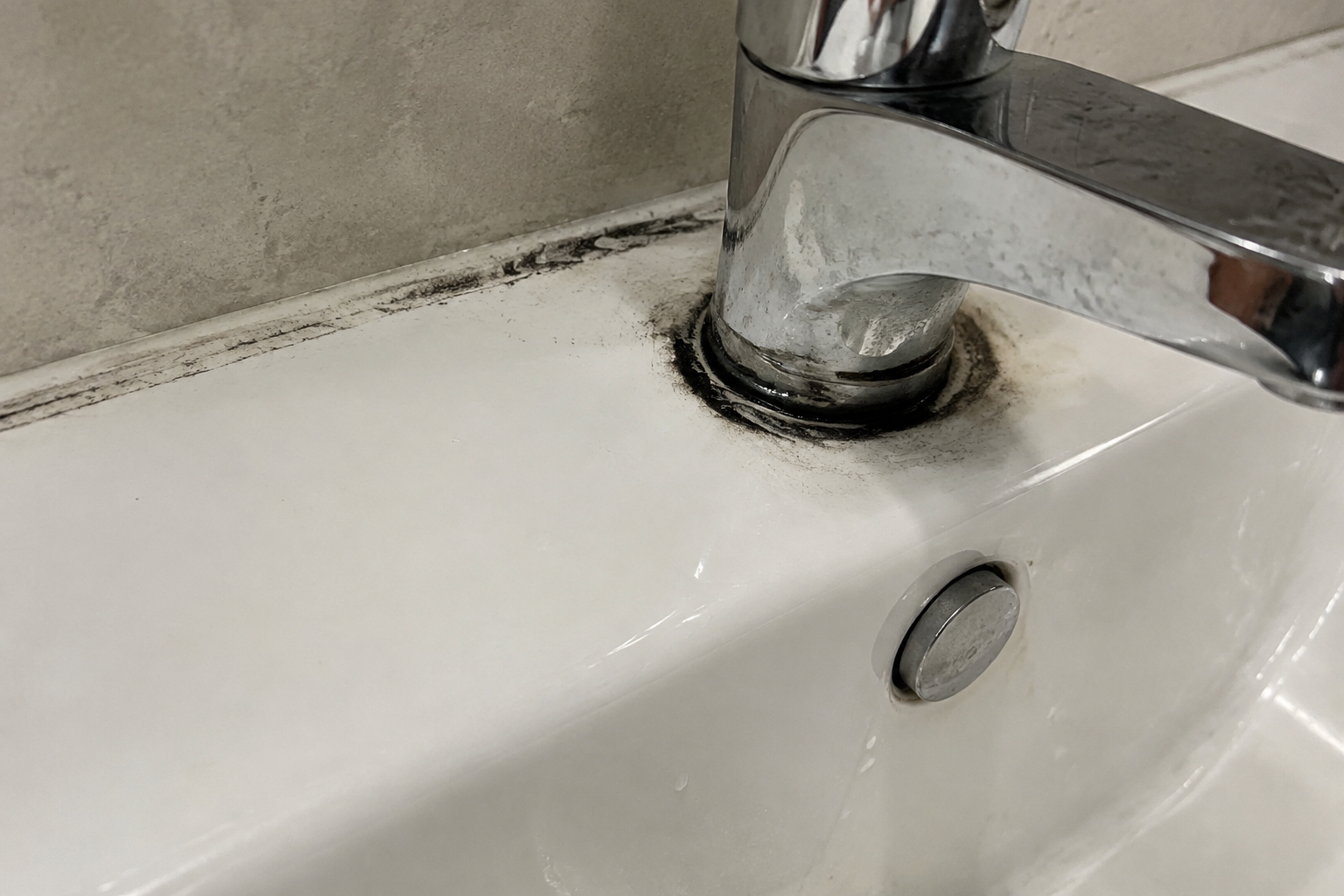
Quick answer: Manganese carries two numbers, and most pages blur them: the aesthetic secondary standard of 0.05 mg/L (black staining, gray laundry, bitter taste) and EPA’s health reference around 0.3 mg/L for chronic exposure, sharpened by 2021-era advisories flagging children’s neurodevelopment as the sensitive endpoint. It almost always arrives with iron, and the same manganese-dioxide media (Katalox-class) treats both in one tank. Carbon filters and boiling do nothing; softeners handle only small amounts.
Test first. If your toilets show black film, coffee cups gray rings, or laundry grays regardless of detergent — that’s the free test already run. Confirm with a lab panel ($40–80) that includes iron, manganese, hardness, and pH together: manganese treatment is iron treatment (same media), so the combined numbers size the system once instead of twice.
Where Manganese in Water Comes From

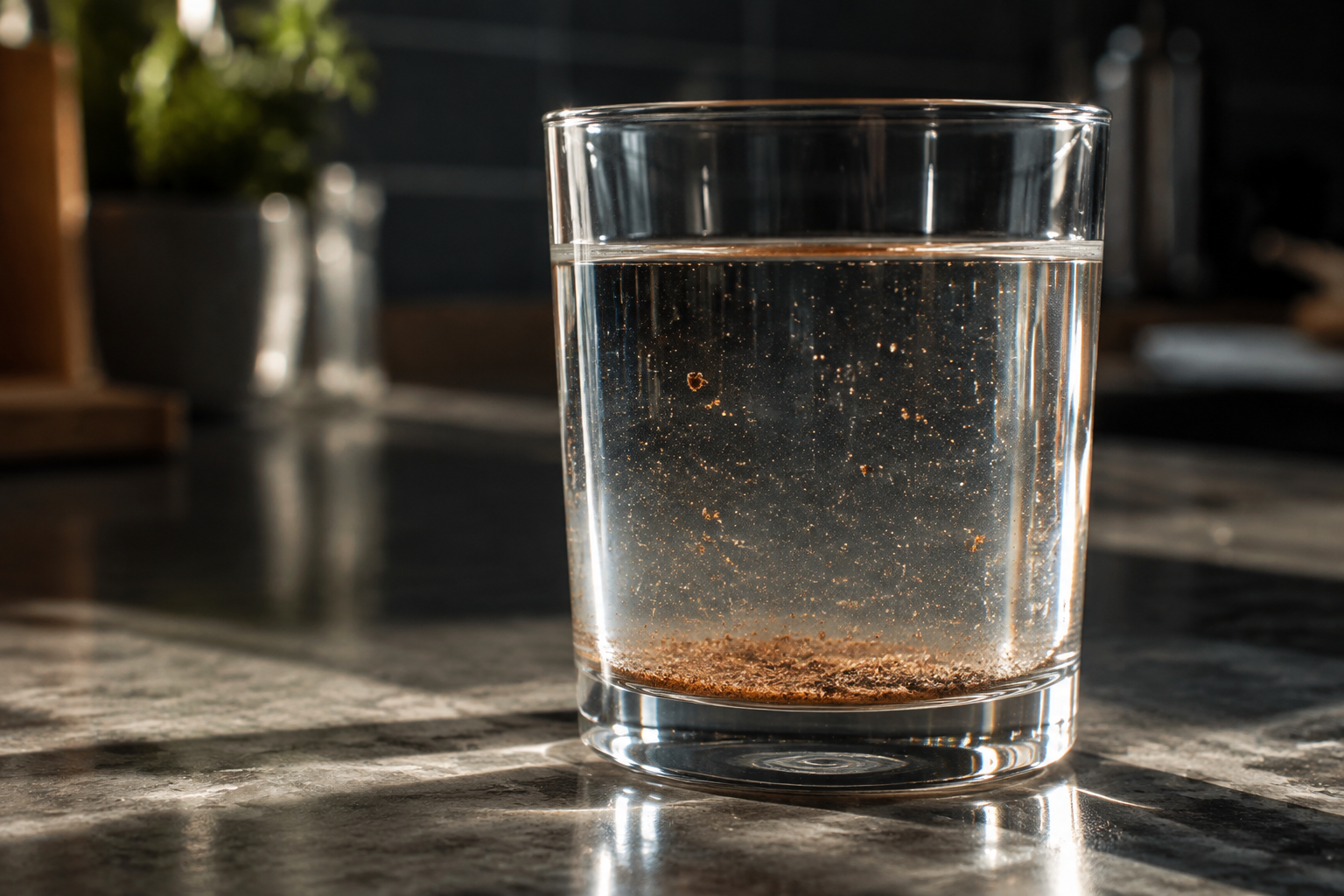
1. Natural geology (again, the well-water story). Manganese accompanies iron in most aquifers — New England, the Midwest, and the Southeast are the classic belts. Wells deliver it dissolved (clear from the tap, blackening on standing) or already oxidized (black particulate at the tap).
2. The water-heater and pipe contribution. Manganese scale sheds from aging heaters and galvanized plumbing — a black-sediment-in-hot-water-only pattern that points at the tank, not the aquifer (same diagnostic logic as the sulfur split test).
3. Stagnation chemistry inside the plumbing. Long pipe runs and infrequent-use fixtures let dissolved manganese oxidize inside the house — first-draw blackness that clears after running, a plumbing-hygiene issue rather than a source-water one.
The stain-color chart (the 10-second black/red/green ID)
| Stain color | Element | Companion page |
|---|---|---|
| Black film, gray water, gray dish marks | Manganese | You are here |
| Orange/rust/red | Iron | Iron in water |
| Blue-green | Copper (corrosion — check pH) | Copper in water |
| Tea-colored (transparent brown, no settling) | Tannins | Tannins in water |
Stains are the cheapest diagnostic instrument you own — the color names the element before any lab does.
Health Effects — What the Limits Are Protecting
| Number | What it is | What it means |
|---|---|---|
| 0.05 mg/L | EPA Secondary standard (SMCL) | The aesthetic line — staining, gray laundry, metallic-bitter taste |
| ~0.3 mg/L | EPA lifetime health advisory level | The chronic-health reference; the 2021-era toxicological review centered infants and children as the sensitive population |
| ~0.1–0.2 mg/L | Practical staining threshold | Fixtures and laundry show manganese well below the health line |
The two-layer story, stated plainly. Regulatory pages traditionally treated manganese as purely cosmetic. The newer health literature changed the register: manganese is an essential nutrient with a narrow window — a neurological concern in infants (formula exposure) at sustained elevated intake, and a research-active question for children generally. What this means practically: the aesthetic line triggers cleaning costs; the health line triggers urgency for bottle-fed-infant households. Adults at ordinary levels are squarely in essential-nutrient territory — the anxiety is misplaced, the stains are not.
How to Remove Manganese — The Honest Comparison
| Method | Fit | Certification/evidence to look for | Honest notes |
|---|---|---|---|
| Manganese dioxide media (Katalox-class) | The default whole-house answer | System reduction data at your levels | Same media as iron/H2S — one tank treats the trio; pH above ~6.5 wanted |
| GreensandPlus (KMnO4-regenerated) | Classic; heavier maintenance | Long field track record | The older technology: effective, with a potassium-permanganate regeneration routine some owners dislike |
| Oxidation (air/chlorine) + filtration | High concentrations, bacterial forms | Sized from lab data | The engineering-grade path for severe wells |
| Reverse osmosis | Drinking-point removal | NSF/ANSI 58 | Covers the drinking pathway plus arsenic/TDS; doesn’t fix the stains on the shower door |
| ~~Water softener~~ | Marginal — yellow row | — | Softeners remove small dissolved manganese (below ~1 mg/L, like iron) as a side benefit; above that, resin fouls. It is a bonus, never a plan |
| ~~Carbon / fridge / pitcher~~ | ≈0 | — | Carbon does not remove dissolved metals at these levels |
| ~~Boiling~~ | Negative | — | Oxidizes some to black particulate — in your kettle |
Matched to the Numbers Above
- Testing tier ($40–80): The iron+manganese+hardness+pH panel — one draw sizes the whole trio treatment.
- Point-of-use tier ($250–450): RO at the kitchen tap for drinking/cooking while stains argue for whole-house.
- Whole-house tier ($1,200–2,800): Manganese-dioxide backwashing filter sized to combined iron+manganese load; softener downstream if hardness also rides along (media first, resin second — protected, not poisoned).
Wait — Is My Refrigerator Filter Enough for Manganese?
No. Carbon cartridges have no dissolved-manganese claim; black particulate will additionally cake the cartridge the way sediment does. Manganese belongs to the whole-house oxidation/filtration family — protect the fridge filter from it upstream and the filter returns to its actual job.
Related problems worth checking while you’re here:
- Iron in water — its inseparable twin; one media system, one test panel
- Sulfur smell — the third member of the classic well trio
- Metallic taste — which metal your mouth is actually reporting (the taste-descriptor table is there)
Manganese Questions, Answered Straight
How much manganese in water is too much? Two answers by design: 0.05 mg/L is the staining/taste line; ~0.3 mg/L is the chronic-health reference with infants and children as the sensitive group. Treat between them for comfort; treat above the health line with urgency if formula is in the house.
Does boiling water remove manganese? No — it partially oxidizes it into black particles and concentrates the rest. The black grit in the kettle is the manganese you already had.
Is my refrigerator or pitcher filter enough for manganese? No — no carbon claim exists, and particulate manganese clogs cartridges. Whole-house media (or RO at the tap for drinking only).
Is manganese in water dangerous? At typical well levels it’s an essential nutrient with nuisance effects; the health conversation concerns sustained levels near or above ~0.3 mg/L for infants and children. Test, then match the response to the number and the household.
How do I tell manganese from iron stains? Color: manganese stains black/gray, iron stains orange/red — and the lab panel is cheap enough that the two never need guessing apart.
What filter removes manganese? Manganese-dioxide media (Katalox-class) as the whole-house standard; greensand-class with permanganate as the classic; RO for the drinking tap. Softeners only at low levels; carbon not at all.
The news-and-research timeline (why this page reads differently than a 2015 article)
Manganese’s regulatory register shifted within the last several years, and pages written before the shift still treat it as purely cosmetic:
| When | What happened | What it changed |
|---|---|---|
| Long-standing | SMCL 0.05 mg/L — staining/taste framework | The cosmetic era; most plumbing sites still stop here |
| 2003–2004 | EPA health advisory reference (lifetime ~0.3 mg/L) formalized | First federal number tied to health, not aesthetics — with infants flagged |
| 2020–2021 | EPA Integrated Risk Information review work advanced (reference-dose update) | Sharpened the developmental-toxicity basis; the “children’s neurodevelopment” framing entered guidance documents |
| 2021–2023 | State advisories and pediatric-environmental-health commentary spread the infant/formula guidance | Bottle-fed infants recognized as the population with the least margin |
| Ongoing | USGS and state surveys keep mapping exceedance patterns | The testing cadence recommendation (annual, belt counties) keeps its footing |
The takeaway for a household reader: a manganese page that quotes only 0.05 mg/L and calls the issue “cosmetic” is quoting half the modern record. The two-number structure at the top of this page — aesthetic line and health line, separated on purpose — is the current honest framing.
Is manganese dangerous for children specifically? The health-reference literature centers early-life exposure: infants on formula (powder mixed with the household’s water) take in the most per body weight, and the developmental-endpoint studies that drove the ~0.3 mg/L reference focus on exactly that window. For a formula household on a 0.4+ mg/L well, the response order is: alternate water for bottles now, test to confirm the number, treat the supply — the same sequence the nitrate page teaches for blue-baby risk, applied with manganese’s calmer margins.
Will a whole-house manganese filter also help my water heater? Yes, and it’s part of the honest economics: the same black scale that stains fixtures plates onto heating elements and settles in tank bottoms, so a media tank upstream extends heater and dishwasher life the way a softener protects hard-water homes. Between stain removal, laundry rescue, and appliance protection, the system earns on three lines at once — the same bundled case as the iron page’s appliance math.
Sources
- U.S. EPA — National Primary Drinking Water Regulations — the enforceable federal MCL table for every regulated contaminant
- EPA — Contaminant Candidate List (CCL) — unregulated contaminants under evaluation for future drinking-water rules
- CDC — Drinking Water — health information on water contaminants, testing, and private wells
Related: Well Water Problems Overview · Whole-House Filter Sizing Guide · Tannins in Water
Full entry: Manganese – full entry & treatment options