Does Your Refrigerator Water Filter Remove Fluoride? (Tested Claims, Straight Answer)

No. Every mainstream refrigerator water cartridge — GE, Whirlpool, Samsung, LG, Frigidaire, and the aftermarket equivalents — is an activated carbon block, and no OEM or aftermarket fridge cartridge on the market carries a fluoride reduction claim. Not “reduces some fluoride,” not “up to X%” — the claim simply does not exist, because the physics doesn’t allow it. If you want fluoride-free water at your fridge dispenser door, there are four real ways to get it (covered below, with costs), and replacing your current cartridge with a “better” one is not among them.
This page is the evidence-first version of that answer: what each major cartridge is actually certified to remove, why carbon can’t touch fluoride chemically, and what works instead. For the broader contaminant picture — health limits, the policy debate, whole-house options — the parent page is Fluoride in Your Water.
The 30-Second Answer


| Question | Answer |
|---|---|
| Does a refrigerator water filter remove fluoride? | No — no fridge cartridge has a fluoride claim |
| Does a Brita or pitcher filter remove fluoride? | No standard model claims it |
| Does boiling remove fluoride? | No — it concentrates it (steam leaves, fluoride stays) |
| What actually removes fluoride? | Reverse osmosis (92–95%+), distillation (95%+), activated alumina (85–95%), bone char (80–95%) |
| Can I still get fluoride-free water from the fridge door? | Yes — an under-sink RO feeding the fridge line is the standard route (details below) |
One more 30-second point before anything else: check whether you need fluoride removal at all. Your utility’s annual Consumer Confidence Report lists your measured fluoride level — most fluoridated systems run ~0.7 mg/L, well below every federal threshold (4.0 mg/L enforceable MCL, 2.0 mg/L cosmetic SMCL). Households with specific reasons to remove fluoride — pediatric guidance they’ve weighed, high natural well fluoride, personal conviction — have real options below. Households buying a $400 system against a 0.7 mg/L supply without checking the number are solving a problem they haven’t measured. Read the CCR first; it’s free.
Why Carbon Can’t Catch Fluoride — the 200-Word Chemistry
Refrigerator cartridges are sintered activated carbon block — coconut-shell carbon compressed into a cylinder with a labyrinth of microscopic pores. Carbon removes contaminants by adsorption: molecules passing through stick to those pore surfaces like dust to a TV screen. The mechanism is fundamentally physical-chemical attraction, and it is selective about what it attracts.
Carbon’s pore surfaces are non-polar carbon — they hold non-polar, larger, carbon-based molecules beautifully. That’s chlorine (technically via a surface reaction), volatile organic compounds, solvents, pesticides, many taste and odor molecules: the entire cast list of fridge-filter claims.
Fluoride is the opposite of that cast. The fluoride ion is a tiny, single-atom, electrically charged ion wrapped in a shell of water molecules. It has no affinity for non-polar carbon surfaces; it passes through the pore maze without ever touching anything that could hold it. Removing a dissolved ion requires a different mechanism entirely — a membrane that rejects ions by charge and size (RO), a mineral media with surface chemistry that binds fluoride specifically (activated alumina, bone char), or a phase change (distillation).
That’s why the “fluoride claim absence” across every cartridge brand isn’t an industry conspiracy or a certification gap — it’s chemistry doing exactly what chemistry does. Any aftermarket cartridge advertising fluoride removal via carbon, without published third-party test data for that specific product, is making a claim the underlying material can’t support.
What the Major Cartridges Actually Claim
The honest way to answer “does my fridge filter remove X” is the claims sheet, not the marketing page. Each cartridge family’s NSF certification lists the specific contaminants it was tested against. Here is the consolidated picture:
GE — XWFE / RPWFE (and older MWF/MSWF)
GE’s current XWFE and RPWFE cartridges are certified to NSF/ANSI 42 for chlorine, taste, and odor, and to NSF/ANSI 53 — with select models claiming specific health contaminants. The RPWFE’s documentation lists claims including lead (on compatible models with the firmware-authenticated cartridge), plus cysts, asbestos, and select VOCs/pharmaceutical-class compounds on specified units. Fluoride: not listed. GE’s own spec sheets do not include a fluoride claim on any refrigerator cartridge.
Whirlpool — EDR series / EveryDrop (Filter 1–5)
EveryDrop cartridges (EDR1RXD1 through EDR5RXD1 and the UKF8001 lineage for Maytag/KitchenAid) carry NSF/ANSI 42 claims for chlorine taste/odor and, model-dependent, NSF/ANSI 53 claims for lead, cysts, and a set of VOCs — EveryDrop Filter 3 and others publish the certified-contaminant list on the carton. Fluoride: not on any EveryDrop claim sheet.
Samsung — HAF series (HAF-CIN, HAF-QIN/EXP, DA29 series)
Samsung’s HAF-family cartridges certify to NSF/ANSI 42 and 53 with claims covering chlorine, taste/odor, lead, cysts, and select organics depending on the model. Fluoride: not listed across the family.
LG — LT series (LT700P, LT800P, ADQ36006101)
LG’s LT cartridges carry NSF/ANSI 42 (chlorine, taste, odor) and 53 claims for cysts, lead (model-dependent), and specified organics. Fluoride: not listed.
The pattern, stated once
Across all four OEMs (and the major aftermarket brands that mirror them), the certified claim lists converge on the same carbon-friendly families: chlorine/taste, cysts, lead on listed models, select VOCs and pesticides. Fluoride appears on none of them — the consistent output of the chemistry section above. When a filter-shopping page shows you a fluoride-removal table with a checkmark next to a fridge cartridge, check whether that table links a certification document. It won’t.
So What IS Your Fridge Filter For?
This is the fair question, and the answer deserves the same precision: refrigerator cartridges are chlorine-and-taste polishers with a genuinely useful side portfolio.
- Chlorine and taste/odor — the core competency, certified across every cartridge above. If your water department chlorinates, this is what the dispenser is doing for you.
- Lead — real on claim-listed models (the certified 53 claim). See the lead page for why lead is the honorable exception among carbon’s health claims.
- Cysts (giardia/crypto) — rated at 0.5-micron-class absolute on listed cartridges; see giardia and cryptosporidium.
- Select VOCs and pharmaceutical-class compounds — on the models that list them.
That’s a useful tool, honestly described. It is not, and cannot be, a fluoride device — and knowing exactly which side of that line each contaminant falls on is the entire point of this article series.
Four Real Ways to Get Fluoride-Free Water at the Fridge Door
1. Under-sink RO feeding the refrigerator line (the mainstream solution)
A standard under-sink reverse osmosis system (NSF/ANSI 58 with fluoride claim) installs beneath the kitchen sink and can send its output two ways: to a dedicated faucet and to the refrigerator’s water supply line via a tee fitting. Result: RO water at the sink and at the dispenser/ice maker — one system, both outlets. Cost: $200–450 plus an hour of plumbing; the fridge-line tee is routine for any installer. This is the configuration most families land on, because it answers the sink and the fridge simultaneously.
2. Inline activated-alumina cartridge before the fridge (the niche option)
Inline T-56-style housings with fluoride-specific media (activated alumina or bone char blends) exist as aftermarket add-ons for refrigerator and ice-maker lines — plumbed in before the fridge. They’re real, they work within media capacity, and they are honest about limits: capacity is finite and typically modest, flow rate is reduced, and you must replace on schedule because saturated media stops removing. A workable niche answer for “I only care about the fridge” households — verify any inline cartridge you buy against published test data for that product, not the media type in general.
3. The dedicated RO faucet (skip the fridge entirely)
If plumbing the fridge line feels ambitious, the plain under-sink RO with its own faucet covers drinking and cooking, and the fridge keeps doing what it does (chlorine/taste). Many households discover they don’t actually need the dispenser door once the RO faucet is habitual — the ice maker remains the fridge’s one irreplaceable trick.
4. Distilled or delivered water for the fridge-adjacent uses
Countertop distillers ($100–200) produce 95%+ fluoride-free water a gallon at a time; delivered bottled water (ideally fluoride-checked) fills the same niche. For low-volume needs — formula, coffee, one heavy drinker in the house — this is the zero-plumbing answer, with the standing cost of bottles or electricity as the trade.
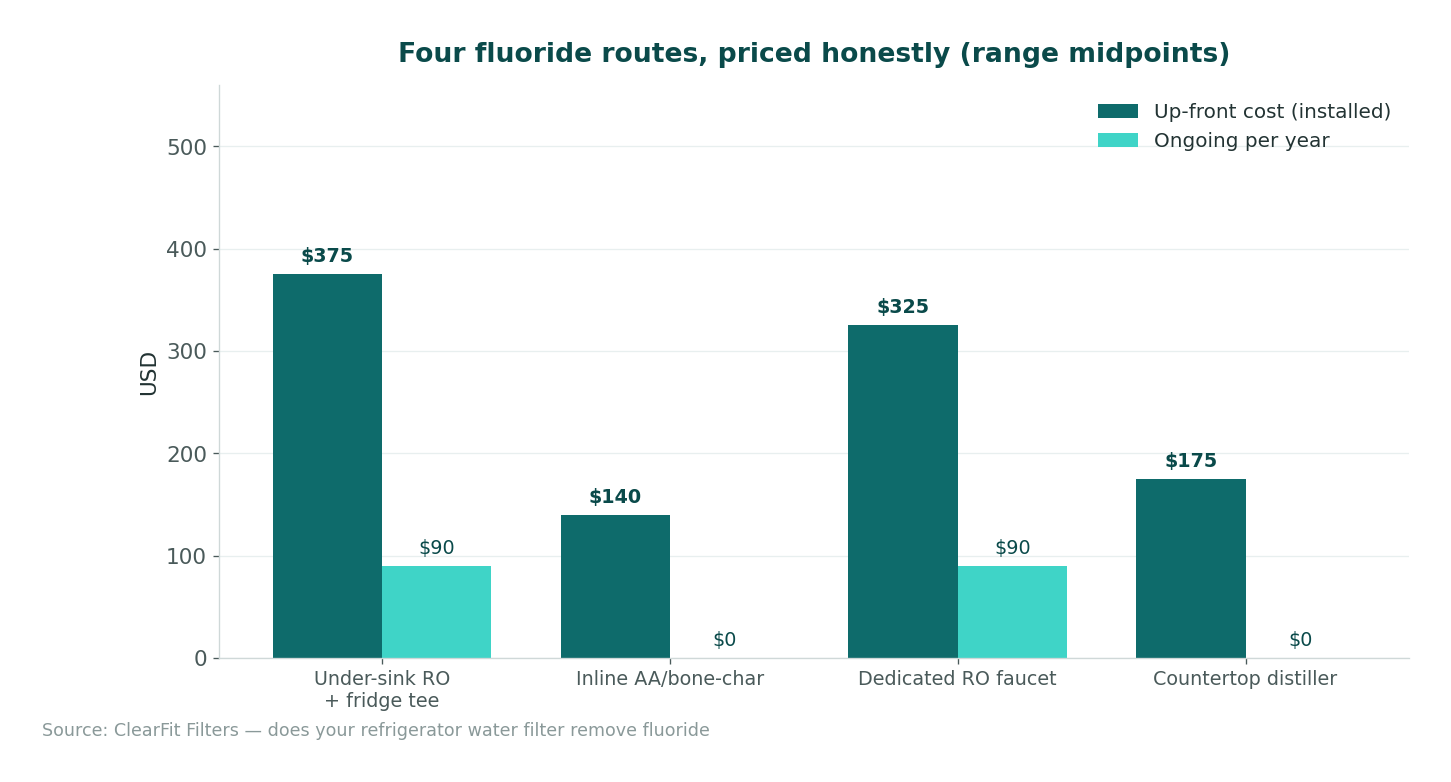
The four routes at the fridge door — cost and effort compared
| Route | Up-front | Ongoing | Effort | Honest verdict |
|---|---|---|---|---|
| Under-sink RO + fridge line tee | $250–500 installed | $60–120/yr filters | One plumber hour | The mainstream answer — sink and dispenser covered by one system |
| Inline AA/bone-char cartridge before the fridge | $80–200 | Cartridge on measured schedule | DIY fitting, tight access | Niche but real — demand product-specific lab data; capacity is modest |
| Dedicated RO faucet (fridge unchanged) | $200–450 | Same RO economics | Under-sink install | Simplest plumbing; many households stop missing the dispenser |
| Countertop distiller | $100–250 | ~$0.25–0.40/gal electricity | Zero install | Small-volume answer — formula and one heavy drinker |
The column that decides most households is the last one’s first row: if you’re buying an RO anyway for the sink, the extra tee to the refrigerator is the cheapest fluoride-free ice you’ll ever own. The sizing math and full method-by-method breakdown live in Fluoride Removal Methods Compared.
FAQ
Are there any refrigerator water filters that remove fluoride? No OEM cartridge (GE, Whirlpool, Samsung, LG, Frigidaire) claims fluoride reduction, and we are aware of no aftermarket fridge cartridge with credible third-party fluoride data. Inline AA/bone-char add-ons plumbed before the fridge are the closest real thing — a separate device, not a cartridge swap.
What is the cheapest way to remove fluoride from drinking water? For volume: an under-sink RO with a verified fluoride claim ($200–450, near-universal availability). For small volumes: a countertop distiller ($100–200). For one person’s coffee: honestly, a jug of distilled water. Match the spend to the volume, not the anxiety.
What water filter will remove fluoride? Reverse osmosis (NSF/ANSI 58 with fluoride claim — 92–95%+), steam distillation (95%+), activated alumina systems (85–95%), bone char systems (80–95% with lab data). Not carbon — in any form, at any price, under any brand.
How do I find out how much fluoride is in my water? City water: your annual CCR lists measured fluoride (usually ~0.7 mg/L where fluoridated). Wells: a lab mail-in test ($30–50). Full method breakdown, including the test-strip resolution trap, in How to Test Fluoride in Water at Home.
Does boiling water remove fluoride — what about the fridge’s hot-water dispenser? No, nowhere, no appliance. Fluoride ions don’t evaporate: every boiling path (kettle, dispenser, formula prep) concentrates fluoride as water leaves as steam. Boiling is a disinfection tool, and fluoride isn’t a microbe — the full physics is on the fluoride contaminant page.
What about aftermarket “fluoride-grade” fridge cartridges I see online? Apply the claim-sheet test from this article: a cartridge that genuinely removes fluoride would carry third-party test data for that specific product (and ideally an NSF-listed fluoride claim). If the listing shows a generic compatibility chart instead of a certification document, the chemistry section above already told you what carbon can and cannot do — and no marketing page amends physics.
If fluoride can’t be filtered at the fridge, what IS my cartridge still doing? Chlorine and taste/odor (its core certified job), plus — on claim-listed models — lead, cysts, and select organics. Replacing it on schedule keeps those real benefits intact; expecting fluoride performance from it just leads to replacing it in frustration. The claim sheet for your exact model is the two-minute check that sets expectations correctly.
Sources
- CDC — Community Water Fluoridation — CDC’s public-health position and data on water fluoridation
- U.S. EPA — National Primary Drinking Water Regulations — the enforceable federal MCL table for every regulated contaminant
- NSF — Certified Drinking Water Treatment Systems — the official lookup database for NSF/ANSI certified filter claims
Next steps: Fluoride in Your Water (full contaminant page) · Fluoride Removal Methods Compared: RO vs Alumina vs Bone Char · How to Change a GE Refrigerator Filter · Fridge Filter Replacement Schedule