OEM vs Aftermarket Pool Filter Cartridges: The Part-Number Savings Math

The pool-cartridge market has a structure most pool owners never see, and knowing it changes the math: your “OEM” Pentair or Hayward cartridge is often made by one of three filter-media manufacturers (Unicel, Pleatco, Filbur) anyway — so the real choice isn’t “genuine vs knockoff,” it’s “which part number, from which of the actual manufacturers, at what price.” Rule of thumb: inside warranty on a new system, buy OEM; after that, buy a cross-referenced quality cartridge and cut the seasonal cost roughly in half. The method is part-number driven (section below), the quality check is four spec-sheet metrics (fabric weight, antimicrobial treatment, end-cap material, gasket), and the savings compound — a typical cartridge pool runs 1–2 replacements a season, and the OEM-to-quality-aftermarket spread at the same part number runs 40–60%. The general OEM-vs-aftermarket framework (warranty law, certification bodies) is covered in the water-filter master article; this page is pool-specific and part-number specific.
Quick answer: Find the OEM part number on your filter housing or old cartridge (e.g., Pentair 178584, Hayward CX580, Jacuzzi 01358000-class). New system under warranty → buy that number as OEM. Everything else → cross-reference it to a Unicel/Pleatco/Filbur equivalent (or our compatible line, listed by the OEM number it replaces) and check the four quality metrics before buying the cheapest option.
Quick Decision Table


| Your situation | Buy |
|---|---|
| New system, manufacturer warranty active | OEM part number (warranty-period prudence) |
| Standard cartridge filter, 2+ years old | Quality cross-referenced cartridge (Unicel/Pleatco/Filbur tier) |
| Heavy pool use / long season | Quality tier with 4+ oz/sq ft fabric (see metrics) |
| Light seasonal use, budget priority | Mid-tier compatible — inspect fabric weight first |
| Non-standard size with no cross-reference | OEM (the one place OEM is the only option) |
| You clean your cartridges regularly (see cleaning guide) | Either — cleaning discipline affects life more than brand |
The Three-Layer Market (Who Actually Makes Your Cartridge)
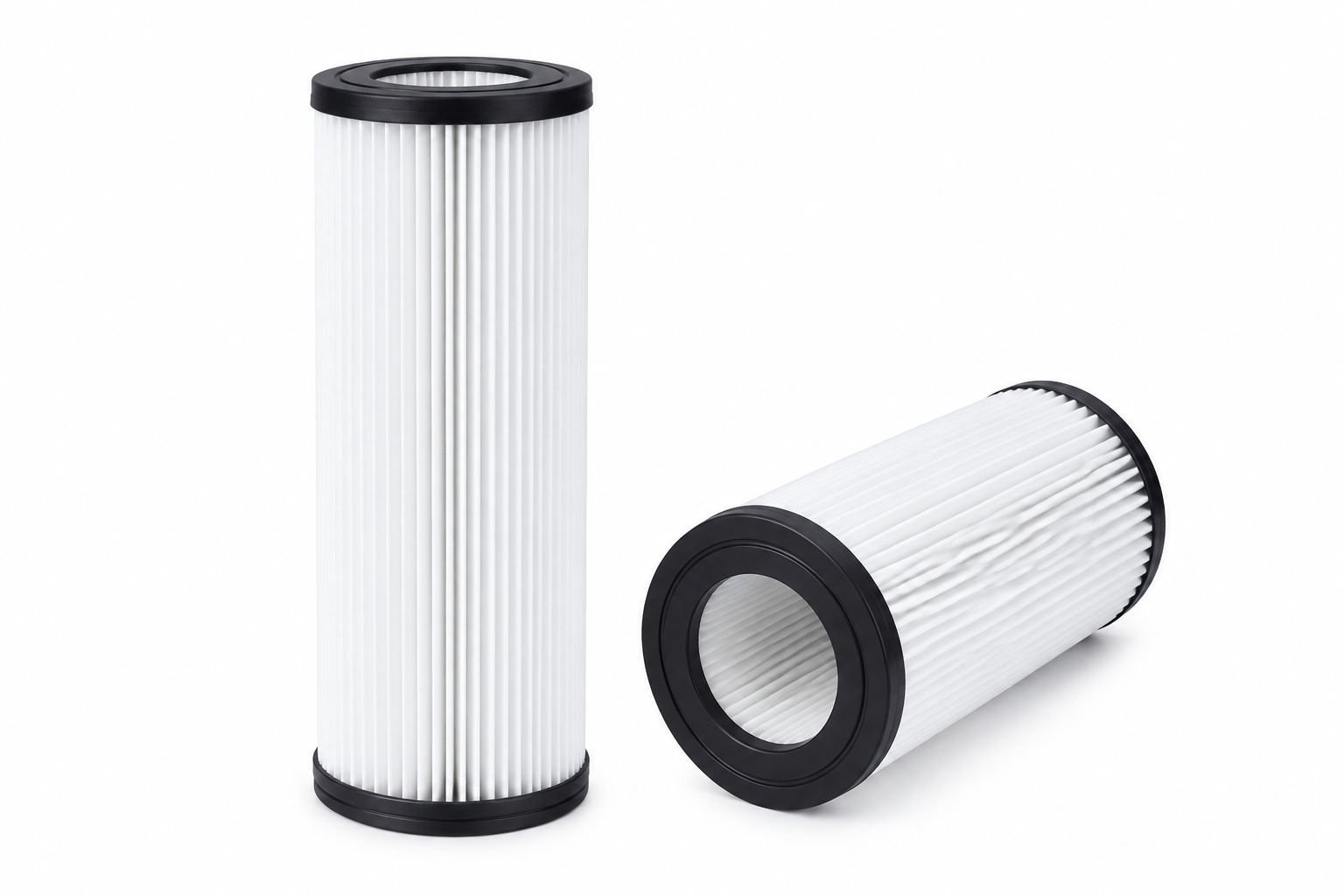
Pool owners routinely over-pay from a misunderstanding of “OEM,” so here is the structure:
- Equipment OEMs — Pentair, Hayward, Jacuzzi, Zodiac/Jandy: they make pumps, filters, and the housings. For the cartridges inside, they specify part numbers and either manufacture in-house lines or source from media manufacturers.
- Cartridge OEMs / media manufacturers — Unicel, Pleatco, Filbur: these companies engineer and manufacture replacement cartridges, publish full cross-reference catalogs mapping their part numbers to equipment-OEM numbers, and supply the industry. A Pleatco or Unicel cartridge isn’t an “aftermarket copy” in any derogatory sense — these are the filtration specialists, and their cartridges are routinely equal-or-better spec than the equipment brand’s boxed version.
- White-label compatibles — unbranded or store-brand cartridges at the same dimensions, quality varying from fine to flimsy. This is the tier where the four-metric check (below) does its work.
Once you see the layers, the shopping question transforms: not “genuine vs generic” but “which layer, verified by spec, at the best price for my part number.” The cartridge-OEM layer usually wins on value; the equipment-OEM box sometimes wins on convenience (in-store availability of the exact number); white-label wins on price and loses on durability if you don’t check the fabric weight.
How to Cross-Reference Part Numbers (The Actual Method)
- Find your OEM number. Best source: the filter housing label (tank label carries the model, e.g., Pentair Clean & Clear 320 → CCP320 cartridges; Hayward Pro-Grid/Star-Clear series names map to cartridge numbers like CX580). Second: the old cartridge’s end cap, usually embossed or stickered with the number. Third: your owner’s manual’s parts diagram.
- Look up the number’s dimensions. Every cartridge spec: top/bottom handle style (open top vs closed with handle, threaded vs spring), inner diameter, outer diameter, length (closed height), fabric area (sq ft). Example class: a “CCP320-style” cartridge is ~4 oz fabric class, 120-ish sq ft, ~19¾” — the numbers you’ll compare.
- Use cross-reference tools. Unicel, Pleatco, and Filbur each publish full cross-reference charts (their number ↔ equipment OEM number); our pool filter cross-reference tool aggregates them — enter the OEM number, get the equivalent part numbers and current pricing side by side.
- Verify dimensions against your old cartridge before ordering. Cross-reference errors almost always come from assuming the housing model instead of measuring the cartridge (measure OD with a tape across the pleats’ outside, ID at the core, height with the cap seated). Two minutes with a tape measure prevents the #1 return reason.
The Savings Math (Season and 5-Year)
Typical street pricing by tier (US, August 2026 — verify current):
| Tier | Example part class | Typical price/cartridge | Seasonal cost (1.5 replacements, mid-size cartridge) |
|---|---|---|---|
| Equipment OEM (Pentair/Hayward boxed) | CCP320-class, CX580-class | $60–120 | $90–180 |
| Cartridge OEM (Unicel/Pleatco/Filbur) | same, cross-referenced | $35–60 | $52–90 |
| White-label compatible (checked specs) | same dimensions | $25–50 | $37–75 |
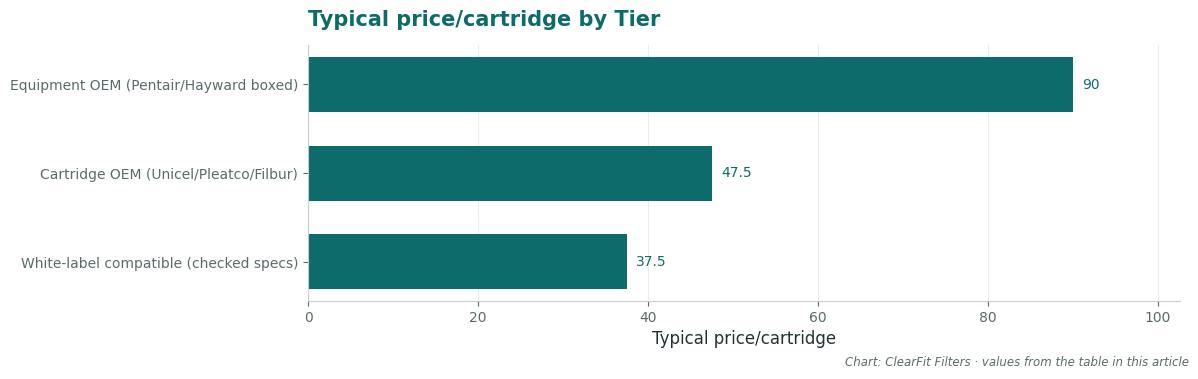
Price bands are typical US retail ranges as of Aug 2026 across the major pool retailers; individual part numbers vary (large 500-sq-ft cartridges run higher than the example classes). The stable pattern: cartridge-OEM tier at roughly 40–60% below the equipment-OEM box for the same cross-referenced number.
Five-year view (assuming 1.5 cartridges/season and 5 seasons): OEM-only ≈ $450–900; cartridge-OEM tier ≈ $260–450; checked white-label ≈ $185–375. The delta between diligence tiers is a family pool-chemicals budget — for the same part number and, when the metrics below check out, comparable filtration.
The Four-Metric Quality Check (Before Buying Any Non-OEM Cartridge)
These four specifications separate durable cartridges from cheap ones, regardless of tier, and all four appear on spec sheets (or their absence is itself an answer):
- Fabric weight (oz/sq ft). Entry cartridges run ~3 oz/sq ft; quality runs 4–4.5+. Higher weight = more polyester per square foot = finer effective filtration, more dirt-holding capacity, and longer life between cleanings. This is the single most predictive spec.
- Antimicrobial / chlorine-resistance treatment. Reputable media is treated against algae and microbial growth in the pleats (Pleatco and Unicel both advertise treated media; white-labels vary). Untreated media biofouls faster and shortens life — a hidden cost multiplier on “cheap.”
- End-cap material: PVC vs ABS. Both are rigid plastics; PVC caps resist pool-chemical exposure better over years of sun and chlorinated water, ABS is adequate but more prone to UV/chemical embrittlement. Check which the spec sheet names — unnamed plastic is a yellow flag.
- Gasket/band material. The outer gasket and break bands take the pressure cycling. Look for specified elastomers (EPDM-class) rather than “plastic band”; worn bands let bypass and show up as cloudy water no matter how good the media is.
A cartridge that names all four is almost never bad; a listing that names none is almost never good. The same check applies to OEM boxes — occasionally the equipment brand’s boxed cartridge is a lighter spec than the cartridge-OEM equivalent, which is exactly the comparison the cross-reference tables let you make.
When OEM Is the Right Call
- Warranty period on new equipment — the prudence play, same logic as the water-filter article covers; after warranty, the calculus flips.
- Odd-size or discontinued housings with no cross-reference entry — rare, but real; OEM (or used-market OEM) is then the only fit-correct option.
- You value the in-store exact-number experience over price — a legitimate preference; the premium buys certainty and immediacy.
Clean vs. Replace: The Variable Nobody Prices Into the Savings Math
The OEM-vs-aftermarket table above assumes each cartridge lives exactly one season. In practice, cartridge cartridges life is partly in your control: a mid-season rinse (hose off the pleats, no pressure washer — it flattens the media) stretches usable life, and most pool owners can run one cartridge per season plus a mid-season clean rather than two fresh cartridges. That moves the five-year math another notch in favor of whichever tier you buy — the absolute savings shrink, but the ratio stays OEM-expensive.
One warning that cuts the other way: a cartridge that is plainly at the end of its media life (collapsing pleats, fraying end caps, cloudy water returning) is past rinsing — stretched cleaning discipline is how pools end up with a $300 pump repair behind a $30 cartridge. The full cleaning method and the “when is it actually done” checklist: How to Clean a Pool Filter Cartridge.
FAQ
Are aftermarket pool filter cartridges as good as OEM? The cartridge-OEM tier (Unicel, Pleatco, Filbur) is regularly equal or better spec than equipment-brand boxed cartridges — these companies are the filtration specialists and publish cross-references to prove dimensional equivalence. The white-label tier ranges from fine to poor; the four-metric check (fabric weight 4+ oz/sq ft, antimicrobial treatment, PVC caps, specified gaskets) separates it reliably. “Aftermarket” spans both, which is why spec-checking beats tier labels.
Why are pool filter cartridges so expensive? Three cost drivers: the media itself (pleated polyester, area-priced — a big cartridge is 100–500 sq ft of engineered fabric), the molded end-cap/core assembly, and the equipment-brand boxed premium (distribution + brand margin, typically the 40–60% delta in the table above). The first two are real product costs; the third is the optional part.
Unicel vs Pleatco vs Filbur — which is better? All three are legitimate cartridge OEMs with full cross-reference catalogs, and quality differences are model-by-model, not brand-wide. Practical differentiators: availability for your part number, fabric weight in the specific SKU’s spec (some run 3.5, some 4.5 — check, don’t assume by brand), and price that week. Filbur tends to compete on price; Pleatco on treated-media marketing; Unicel on catalog breadth — but the spec sheet, again, outranks the logo.
How long do generic cartridges last? A quality cross-referenced cartridge, cleaned on a proper schedule (rinse monthly, deep-clean/soak per the cleaning guide), typically lasts 1–2 seasons; the same cartridge neglected (never soaked, pressure-washed at close range, or run past the pressure gauge’s clean-me line) dies in months regardless of brand. Fabric weight drives the ceiling; maintenance determines where in the range you land. White-labels at 3 oz/sq ft sit at the bottom of every range.
Sources & References
- Unicel/Pleatco/Filbur official cross-reference catalogs — part-number interchange tables and published specs (public catalogs).Official documentation (explicit)
- Pentair/Hayward/Jacuzzi cartridge part-number system (CCP/CX series) — equipment-makers’ public parts documentation.Official documentation (explicit)
- Price bands (OEM $60-120/OEM cartridges $35-60/white-label $25-50) — typical US pool retail shelf ranges 2026-08 (typical ranges, individual part numbers vary, labeled).Industry data (inference-based)
- Fabric oz/sq ft layering vs service life / PVC-ABS chlorine resistance — filter-media engineering and retailer catalog technical data consensus.Industry analysis (inference-based)
- troublefreepool forum — SERP-ranking (authoritative pool forum), cited as a user-experience signal, not a fact source.Community discussion (position cited)
- SERP interpretation——DataForSEO 2026-08-21(
_work_serp_terms.json)。Competitor cross-check (verified live)
Related Guides
- Pool Filter Cross-Reference Tool — enter an OEM number, compare equivalent cartridges and pricing.
- How to Clean a Pool Filter Cartridge — the maintenance schedule that extends any cartridge’s life.
- OEM vs Aftermarket Water Filters — the master framework (warranty law, certification).
- OEM vs Aftermarket Furnace Filters — the air-side counterpart of this series.
Shop this guide: Pool & spa filter cartridges