Does Bottled Water Expire? The FDA Answer, the New Jersey Law That Started the Dates, and What Heat Actually Does

The date on a bottle of water is a quality date, not a safety date — water does not spoil, and the FDA does not require bottled water to carry any expiration date at all. The two-year dates you see exist because of a 1987 New Jersey state law that required date stamps on all food products, and the bottled-water industry found it cheaper to print one label for every state than to print two. That origin story, the material science of PET aging, and the heat-exposure research on microplastics — this page runs the timeline. Related: How Long Can Water Sit Out? and Microplastics in Water.
Quick Answer: Bottled water doesn’t expire in a safety sense — the FDA requires no expiration date, and sealed water stays drinkable for years. The printed 2-year date is a “best quality” label tracing back to a 1987 New Jersey law mandating dates on all foods. The real variables are heat and time: hot storage (a summer car) accelerates PET leaching of microplastics and taste compounds into the water.
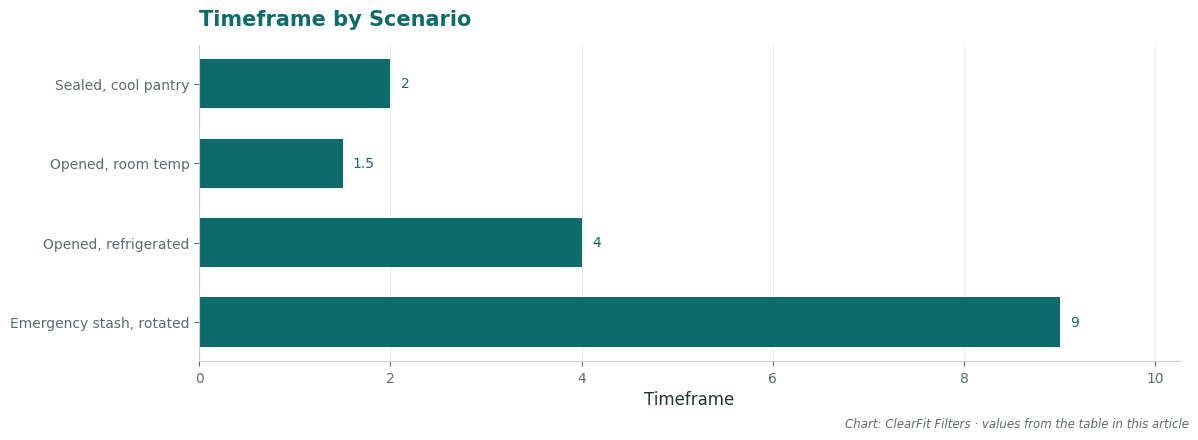
| Scenario | Timeframe | What changes |
|---|---|---|
| Sealed, cool pantry | 2 years (label) to 5+ | essentially nothing; taste may flatten |
| Sealed, hot garage/summer car | weeks–months | microplastic & antimony leaching accelerates |
| Sealed, direct sunlight | days–weeks | same as above, faster |
| Opened, room temp | 1–2 days | bacterial clock starts (from your mouth) |
| Opened, refrigerated | 3–5 days | slower bacterial growth |
| Emergency stash, rotated | 6–12 months | the prepper practice — replace, don’t trust forever |
The r/preppers threads on water storage are where this topic gets serious: the consensus advice isn’t “bottled water is good for two years” — it’s “store commercial bottles as the easy layer, but the real stash is tap water in proper containers with 6–12 month rotation, and know how to treat more.” The expiration-date question that starts the thread is the wrong question; the rotation habit that ends it is the right one.
Why the Date Exists at All: The 1987 New Jersey Chain Reaction


Federal law: the FDA regulates bottled water as a packaged food, and FDA regulations require no shelf-life dating for bottled water — water is not a perishable in any microbiological sense.
Enter New Jersey, 1987: a state law requiring date labels on all food products sold in the state. Bottled water is legally a food. Rather than print New Jersey-specific two-year labels and separate undated labels for the other 49 states, the major bottlers stamped every bottle for every market — one label, one production line, one legal department’s good night’s sleep. When New Jersey later relaxed the requirement, the industry-wide dates stayed: consumers had learned to expect them, and a “best by” date provides legal cover for taste complaints.
This is regulatory archaeology almost no water brand’s own FAQ page tells (the filling-plant trade press knows it well), because “the date is a legal relic” is a harder sentence to put next to a shopping cart than “fresh taste guaranteed.”
What Actually Degrades: The Bottle, Not the Water
Water in a hermetically sealed container is microbiologically stable indefinitely — commercial bottling runs ozone or UV sterilization and seals under sanitary conditions. The bottle is the perishable item:
- PET (most single-serve bottles): a porous plastic that, over long times and especially with heat, migrates small amounts of its constituents — antimony (a catalyst residue) and acetaldehyde (the source of that faintly sweet “plastic” taste) — plus growing counts of micro- and nanoplastic fragments shed from the bottle walls themselves.
- HDPE (the cloudy gallon jugs): tougher on taste, thinner on research, generally the budget choice for short-cycle storage — it’s also the container most likely to sit in a hot warehouse.
- Glass: essentially inert. Glass-bottled water has no meaningful leaching timeline — it costs and weighs more for exactly this reason.
The 2024 Columbia/Houston study using new nanoplastic-detection methods found bottled water averaging on the order of 240,000 plastic fragments per liter (mostly nanoplastics) — a revision upward of prior estimates by two orders of magnitude. Not all of that is shed after bottling (some enters with the water and packaging process), but heat and time move the number in the wrong direction, which is why storage conditions dominate the quality story. The full particle-size and health-context discussion: Microplastics in Water.
The Hot Car Question, Quantified as Far as the Science Allows
The honest summary of the heat research: studies exposing PET bottles to elevated temperatures (70°C-class conditions and microwave-range experiments) consistently measure increased release of microplastics and antimony into the water — by orders of magnitude versus room-temperature controls. Real-world translation: a sealed case in a 100°F garage for a summer is a different product from the same case in a 70°F pantry — not acutely toxic by regulatory measures, but measurably further along the leaching curve, and taste will tell you first.
If a case has been through a hot season and you’ve been drinking it without noticing, there’s no established cause for alarm at regulatory levels — the accumulated-dose question is genuinely unsettled science. The cheap fix is storage discipline: cool, dark, and rotated. Bottled water is a convenience purchase and an emergency layer, not a doomsday asset that improves with age.
The Prepper Layer: Rotation Beats Expiration Dates
FEMA/American Red Cross household guidance is the practical anchor: store at least one gallon per person per day, for a minimum of three days (two weeks is the upgraded recommendation). Commercial bottled water is the easy layer; the date on it matters less than the habit:
- Rotate the stock every 6–12 months — drink it, replace it.
- Tap water in food-grade containers, sealed and stored dark, treated with unscented household bleach per EPA emergency instructions (8 drops per gallon, 6% sodium hypochlorite) when the source is questionable.
- Know the treatment ladder for beyond-the-stash scenarios: rolling boil 1 minute (microbial), and for chemical contamination, activated carbon — which is also why emergency filtration lives in the same drawer as this discussion: carbon’s actual capabilities.
FAQ
Is 2 year old bottled water safe to drink?
If it was stored sealed, cool, and out of sunlight — yes. The 2-year date is a quality label, not a safety cliff. Taste for plastic is your practical test; a bottle that’s been through a hot summer should be rotated out rather than worried over.
Is expired bottled water still safe to drink?
“Expired” bottled water (sealed, properly stored) is a taste question, not a poisoning risk. The FDA does not require expiration dates on bottled water at all. The exceptions: damaged/leaking bottles, obvious algae (light-exposed), or off smells — those go regardless of date.
Is bottled water safe after 10 years?
There’s no safety standard for a 10-year-old bottle because it was never a safety timeline — but practically, a decade of PET aging plus unknown storage history makes it a poor choice for drinking while still fine for sanitary/washing uses in an emergency. Rotate long-stored stock into utility duty and refresh the drinking supply.
Why do cardiologists say don’t drink bottled water?
The claim circulating in headlines isn’t about the water — it’s about microplastics and BPAs/antimony from plastic exposure generally, framed by some clinicians as a cardiovascular-risk reduction argument. The evidence is associative and evolving, not a clinical directive; the defensible personal takeaways are avoiding hot-stored bottles and not reusing single-serve PET as a daily bottle.
Sources & References
- FDA — 21 CFR 165.110 (bottled water standard of quality); no expiration-date requirement for bottled water. Official documentation.
- New Jersey state food-dating law, 1987 — historical origin of industry-wide 2-year labels (trade-press documented). Official documentation (historical regulation).
- Qian N. et al. (2024), PNAS — nanoplastic content of bottled water (~240,000 fragments/L, NMR-based method). Peer-reviewed research.
- Antimony migration studies (PET, elevated temperature) — Westerhoff et al. and subsequent literature. Peer-reviewed research.
- FEMA / American Red Cross — household water storage guidance (1 gal/person/day; 3-day minimum; bleach treatment ratios). Official documentation.
- Reddit r/preppers — rotation-practice consensus in storage threads. Community discussion.
Related Guides
- How Long Can Water Sit Out? — the opened-bottle half of the timeline.
- Microplastics in Water — particle sizes, sources, and what filtration does about them.
- Is Fridge Water as Good as Bottled Water? — the per-gallon cost account.