How Often to Replace a Pool Filter Cartridge (1–2 Seasons, Decided by Three Variables and a Wash Budget)

Plan on one to two swim seasons per cartridge — roughly 1–2 years — adjusted by three variables: bathing load (how many swimmers and how often), debris load (leaves, pets, landscaping), and wash cycles (media has a finite cleaning life; manufacturers quote ~20–30 cleanings before the pleat structure degrades). A cartridge that’s structurally sound but pressure-rebounds after every cleaning is at end of life; a cartridge at two seasons in a heavy-use pool is beating the odds.
The replacement-timing question gets a lazy answer across the pool internet: “replace every 1–2 years” — true on average, useless in particular. A screened single-swimmer pool and a leaf-dumped, three-kid, two-dog pool share nothing about cartridge economics except the SKU. The honest version is a budget calculation: your cartridge arrives with about two dozen cleanings in it, and your pool spends those cleanings at a rate set by load. This page does that arithmetic.
Quick Answer: Replacement Timing by Load Profile

| Load profile | Cleanings per season | Realistic cartridge life | Typical calendar |
|---|---|---|---|
| Light (screened pool, 1–2 swimmers, low debris) | 2–3 | 3+ seasons possible | 2–3 years |
| Standard (unscreened, family use, weekly maintenance) | 4–6 | 1–2 seasons | 12–24 months |
| Heavy (high bather load, trees, dogs, phosphate-rich water) | 6–10+ | 1 season | Replace at spring opening |
| Scale-prone (hard water, high calcium) | — (scale embeds regardless) | shortened by 30–50% | Inspect each spring |
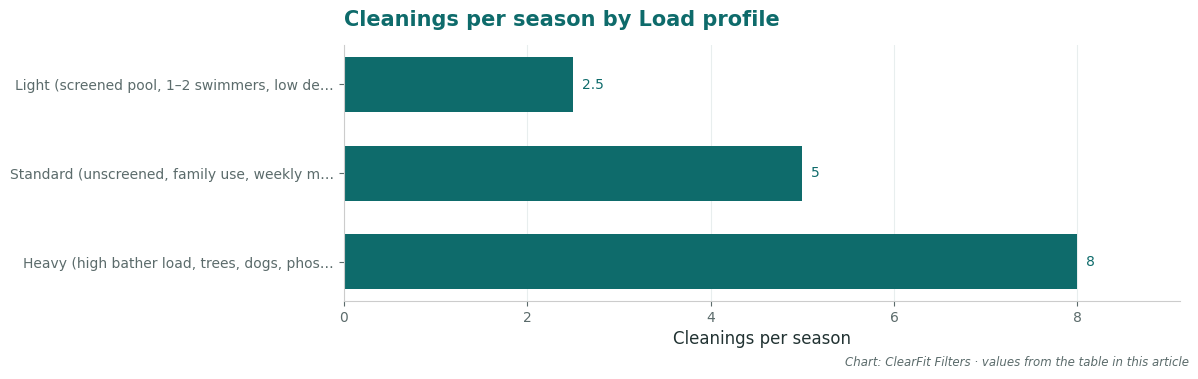
The middle two rows are the market norm — and the bottom row is the pool-store revenue stream: hard-water pools kill cartridges through embedded scale that no soaking fully reverses.
ClearFit manufactures an OEM-equivalent C 9419 replacement cartridge with the same filter-media square footage.
The Wash-Life Budget (the Accounting Nobody Does)
Cartridge media is pleated polyester engineered to flex, load, and release through a finite number of cycles. Every cleaning does two things at once: removes the captured mass (good) and fatigues the pleat pack slightly (unavoidable). The manufacturer-quoted figure of 20–30 cleaning cycles is the point where the pleats have lost enough structural integrity that they no longer hold their spacing under pump pressure — pleats flatten or fuse at the roots, effective filtration area collapses, and the cartridge’s clean pressure drop starts climbing even when it looks fine.
Run the arithmetic on your own pool: if you clean four times a season (a standard unscreened pool’s summer), a cartridge is at ~24 cycles after three seasons — past budget, or at it. Six cleanings a season (heavy pool) burns the budget in under two years. Two cleanings (screened, light) stretches a cartridge toward three. This is why “how long do cartridges last” has no single answer — the unit of life is cleanings, and seasons are just cleanings × your load.
The field tell that the budget is spent: pressure rebound. A freshly cleaned healthy cartridge pulls the gauge back to its clean baseline; an exhausted one recovers half the gap, or rebounds within days. The rebound pattern — not the calendar, not appearance — is the replacement signal. Full psi diagnostics: why is my pool filter pressure high.
How Often to Clean (the Other Clock This Question Hides)
“How often to replace” and “how often to clean” are two clocks on the same cartridge, and the second one runs the first: cleaning frequency is what spends the wash budget, so the clean schedule deserves its own line in the plan. The trigger is not the calendar — it’s 8–10 psi over your clean baseline on the filter gauge. In practice that lands every 2–6 weeks in season for a typical unscreened pool, every 4–8 weeks screened, and after every heavy event (pool party, storm debris, algae treatment — the unplanned cleanings are what blow the annual budget arithmetic above).
A cleaning schedule that actually holds looks like: log the clean baseline psi at spring opening → check the gauge weekly during swim season → clean at +8–10 psi → full degrease soak every 2–3 rinses → inspect pleats and caps each time you’re already holding the cartridge. That sequence — not “rinse monthly” — is what stretches a cartridge toward its full 20–30-cycle life, and it’s the rhythm the Home Filter Calendar automates (cleaning events and the replacement clock share one log, so the wash-budget math happens by itself). The cleaning chemistry itself — rinse angle, soak ratios, the pressure-washer mistake — is how to clean a pool filter‘s subject; the sand and DE systems run entirely different service clocks and live in their own guides.
The Three Variables, Weighted
1. Bather load (oils + sunscreen + waste). Every swimmer-hour contributes organics that bond to media fibers and only come out with alkaline soaks (cleaning guide). A pool that hosts weekend parties spends its wash budget faster and deep-loads the media between cleanings. Heaviest single contributor in most family pools: sunscreen, which is engineered to be water-resistant and therefore resists rinsing.
2. Debris load (leaves, pollen, pets). Coarse debris fills pleat valleys and adds physical mass that accelerates the pressure-rise trigger — more cleanings per season, budget spent sooner. Dogs add both hair (coarse) and dander/oils (fine + greasy), the full spectrum. A pool skimmer worn as a hat is cheaper than a cartridge per pound of leaf.
3. Water chemistry (scale and metals). High calcium hardness or pH drift produces the white crust whose proper removal is acid soaking — and every acid pass slightly etches fiber surfaces. Scale-prone pools replace more often not because anyone swims more, but because the water itself is a wear mechanism. Iron in well water adds staining that becomes permanent in the media past a point.
Replacement Timing: the Spring-Opening Economics
When in the year you replace changes what you get from the cartridge. The comparison that matters:
| Timing | What happens | Verdict |
|---|---|---|
| Replace at spring opening | Fresh cartridge runs the entire swim season at full capacity, with its whole wash budget available for the season’s cleanings | Best value — the standard recommendation |
| Replace mid-season (July failure) | The new cartridge enters service at peak load; you buy again next spring anyway | Necessary evil when failure forces it |
| Replace at fall closing | New cartridge sits idle all winter; worst of both — money spent, season not served | Avoid |
The spring-first rule also pairs naturally with the opening sequence — the cartridge you find at opening (dirty from last season’s close, or the one you dried and stored) gets its inspection before the season depends on it: pool opening checklist builds that inspection into step order. A cartridge that passes spring inspection but is past ~two seasons old should be flagged: buy the replacement before the July weekend it fails, not during.
Buying the Replacement: Number First, Tape Measure Second
The end-cap number is the ordering key. A Pentair Clean & Clear 200 cartridge prints Unicel C-9419 on the cap; the exact-fit equivalents by cross-reference are Pleatco PAP200 and Filbur FC-0688 — same 200 sq ft, same 10-1/16″ × 31-1/8″ body. Hayward Star-Clear C900 owners want the C-8409 / PA90 / FC-1292 / CX900RE set. The number system and the lookup paths: pool filter cross-reference; the interactive version is the cross-reference tool. Measurement matters only when no number survives on the cap — how to measure a pool filter cartridge covers that fallback, including the square-footage trap.
For the load profiles above, the timing discipline is a calendar problem: the Home Filter Calendar tracks pool cartridges alongside HVAC and fridge filters, and a subscription shifts the spring cartridge to your door at opening season — the “seasonal rhythm delivery” model the pool filter market has essentially never offered (subscription math).
FAQ
How long should a pool filter cartridge last?
One to two seasons (1–2 years) in a standard unscreened family pool; up to three in light, screened use; one season under heavy load. The precise unit of life is cleaning cycles — manufacturers quote roughly 20–30 — so your bather and debris load set the calendar.
How do I know when to replace rather than clean?
Replace when pressure rebounds within days of a thorough cleaning, when pleats are torn/fused/flattened, when end-caps crack, or when the cartridge is past ~20–30 lifetime cleanings. Cleaning is the answer until those signals appear; past them, cleaning is theater.
Can a pool filter cartridge last 3 years?
In a screened, lightly used pool with disciplined chemistry — yes, three seasons is realistic. In an unscreened family pool, expecting three years means running a degraded cartridge through its final summer; the pressure-rebound test tells you where you actually stand.
Does cleaning a cartridge extend its life?
Yes — cleaning is how a cartridge reaches its rated life at all. But cleaning is also the wear mechanism: each cycle fatigues the pleat pack slightly. The correct frame is that a cartridge arrives with ~20–30 cleanings of budget; cleaning spends the budget efficiently, skipping cleanings wastes the cartridge early through deep loading.
Should I replace at pool opening or closing?
Opening. A cartridge replaced in spring runs the whole season at full capacity; one replaced at closing sits idle all winter and serves no season. The exception is a cartridge that fails mid-season — replace when forced, but reset your cycle to spring.
Sources & References
- Cartridge manufacturer specifications (Unicel/Pleatco/Filbur) — 20–30 cleaning-cycle media life, structural degradation modes. Official documentation (explicit).
- TroubleFreePool & pool-industry maintenance guidance — load factors, pressure-rebound diagnostics. Industry expert analysis (explicit).
- r/pools & r/swimmingpools threads — real service lives by pool type; the three-year screened-pool claim pattern. Community discussion (paraphrased).
- Cross-reference dataset — Unicel/Pleatco/Filbur/Hayward OEM equivalences cited. Cross-reference database data (explicit).
Related Guides
- How to Clean a Pool Filter Cartridge — spending the wash budget correctly.
- Why Is My Pool Filter Pressure High? — the diagnostic behind “rebound”.
- Pool Filter Cross-Reference — buying by number.
- Pool Opening Checklist — the spring reset.
Find your filter: Pool & spa filter cartridges