Best HVAC Filter for Allergies: MERV 11 Default, MERV 13 Upgrade — and the Two-Week Seasonal Shift Nobody Teaches

For seasonal allergies, MERV 11 is the evidence-based default, and MERV 13 is the upgrade — if your blower can carry its static pressure. Pollen itself (10–100 µm) is easy; any MERV 8+ handles it. The harder targets are the fragments and spores under 10 µm — pollen fragments, mold spores, dust-mite fecal pellets, pet dander fines — and that’s the band where MERV 11 captures well and MERV 13 excels. Two details the store shelf won’t tell you: check the MERV-A suffix (a variant of the rating that matters for precisely this use case), and consider seasonally shifting grades — up to 13 two weeks before your pollen season, back to 8 or 11 after — which captures the worst air exactly when it matters without paying MERV-13 pressure penalties year-round.
Allergy sufferers are the most overpromised audience in the filter market. Every box implies relief; the physics is more specific. What actually drives symptom relief is keeping sub-10 µm allergen fragments out of the air you breathe for the months your trigger is active — which is a solvable engineering problem with three variables: rating, thickness, and timing. This page works all three.
Quick Answer: Allergen → MERV Map


| Allergen | Particle size | MERV needed | Notes |
|---|---|---|---|
| Pollen (whole grains) | 10–100 µm | MERV 8+ | The easy case — any pleated filter |
| Pollen fragments (the real irritants) | 0.5–10 µm | MERV 11 | Grains rupture in humidity; fragments are the sneeze drivers |
| Mold spores | 2–10 µm | MERV 11–13 | MERV 13 catches the smallest spore classes |
| Dust-mite debris (fecal pellets, fragments) | 0.5–10 µm | MERV 11–13 | Year-round indoor allergen |
| Pet dander fines + allergen proteins | <1–10 µm | MERV 13 | Sub-micron fraction needs E1-band capture |
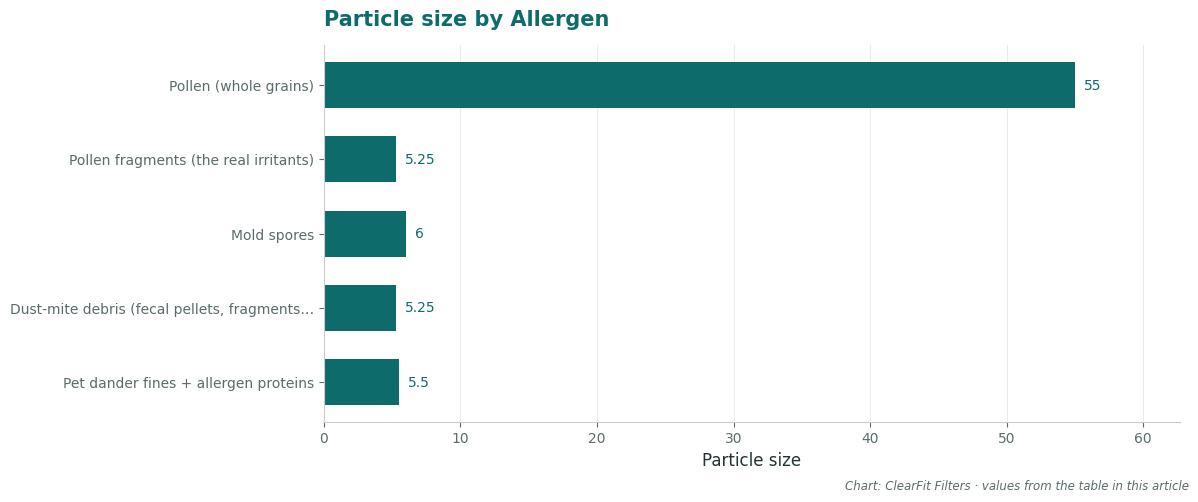
The pattern: if your allergy has a name you know (birch, ragweed, Alternaria, dust mites, cat), you’re fighting particles smaller than whole pollen grains, and MERV 11 is the floor, not the ceiling. Particle-size science: what is pet dander covers the sub-micron allergen story in depth.
ClearFit cuts the same 16x20x1 MERV 13 pleated media to OEM specifications – the 16x20x1 MERV 13 replacement filter, sized to confirm against your old filter before ordering.
MERV 11 vs 13: the Honest Trade-off
MERV 11 captures the E2 band (1–3 µm) at 65–80% and E3 (3–10 µm) above 85%. MERV 13 pushes E2 above 85% and brings genuine E1 (0.3–1 µm) capture under 50% — meaningfully better air, at a mechanical cost:
- Static pressure. A clean 1″ MERV 13 runs roughly 0.05–0.15 in. WC more resistance than a MERV 8 of the same size, and a loaded MERV 13 climbs faster because the media is denser. If your system’s total external static pressure budget is 0.50 in. WC (standard residential design), a 1″ MERV 13 at end-of-life can consume most of the filter-side allowance.
- Compatibility check. Older blowers with PSC motors feel high-MERV resistance as airflow loss. Variable-speed ECM motors compensate by ramping — drawing more power and running hotter. If your system is 15+ years old, start with MERV 11 before trying 13, and check register airflow after the swap: noticeably weaker supply air means step back or change more often.
- The 4-inch loophole. In a media cabinet, MERV 13 runs at roughly half the pressure drop of the same rating in 1″ (more media area, lower velocity). If you’re serious about MERV 13, the 1 vs 4 inch upgrade math is the right way to run it — many allergy households conclude the media cabinet pays for itself in exactly this use.
The MERV-A note: filters rated under the standard’s Appendix K (the “A” in MERV 11A / 13A) are tested after a conditioning step that discharges electrostatic enhancement — meaning the rating holds for the life of the filter, not just day one. Non-A ratings on some synthetic media reflect new-filter performance that fades as the electrostatic charge dissipates. For allergy use, where you care about performance in month two as much as day one, prefer the A-suffixed rating when two products otherwise tie. Full scale: MERV rating explained.
Store-shelf translation: MPR and FPR
3M Filtrete uses MPR (Micro Particle Performance Rating) and Home Depot’s house brands use FPR. Rough equivalence: MPR 600 ≈ MERV 6–7, MPR 1000–1080 ≈ MERV 10–11, MPR 1500–1550 ≈ MERV 12, MPR 1900–2800 ≈ MERV 13–14; FPR 7 ≈ MERV 11–12, FPR 10 ≈ MERV 13. A Filtrete MPR 1500 is a MERV 12-class filter — reading the cross-rating keeps you from double-buying performance you already have.
The Seasonal Shift Strategy (“Winter Tires” for Your HVAC)
The underused play: run MERV 8 or 11 most of the year, and shift to MERV 13 two weeks before your pollen season starts, holding it through the season, then drop back. Why it works economically and mechanically:
- Timing beats grade-loyalty. Eight to twelve weeks of MERV 13 during your trigger season captures the air that actually bothers you; the other forty weeks at MERV 8–11 cost less per cartridge and run lower static pressure.
- The two-week head start matters. Filters don’t lower allergen counts that have already accumulated in ducts and rooms — starting the high-grade filter before the first pollen lets the system hold the line from day one. (Tree pollen starts surprisingly early — February–March in much of the US; ragweed runs August–October; check your regional calendar.)
- Cost math. Shifting 13→8→13 costs about the same per year as running 11 year-round, and out-captures it during the weeks that count. Running 13 year-round in a 1″ slot is the worst of both: premium cartridge prices at 45–60-day change intervals.
Set the swap dates as reminders rather than memory: the Home Filter Calendar supports seasonal grade shifts alongside the change-date tracking — spring swap (typically early March) and fall swap-back (late June, or post-ragweed in your region).
The Non-Filter Half of Allergy Season (Briefly, Because It Doubles the Filter’s Work)
A filter only cleans air that passes through it. Source control multiplies its effectiveness: bedroom door closed + purifier during peak weeks (the one room you spend eight hours in matters more than the whole house average), windows closed on high-count days (a cracked window during pollen peak undoes the filter’s day of work in an hour), and MERV 13 + fan-ON circulation during peak season rather than AUTO (the blower only filters when it runs — ON mode trades a little energy for continuous filtration exactly when you need it). The purifier-vs-HVAC division of labor, with the ACH math, is its own article: air purifier vs HVAC filter.
FAQ
Do I need a HEPA filter for allergies?
Not in your ducts — “HEPA air filter for allergies” searches resolve to two different products, and only one is real. True HEPA (99.97% at 0.3 µm) cannot be ducted onto a residential furnace: its pressure drop is so extreme that no standard blower can push through it. The HVAC-side answer for allergy-grade capture is a MERV 13 (ideally in a 4-inch cabinet), which reaches the low end of HEPA-class particle capture at duct-compatible resistance. The place HEPA genuinely belongs in an allergy plan is a portable room purifier — pound for pound the bedroom HEPA unit does more for symptom nights than any whole-house upgrade.
What’s the best air filter for allergies, overall?
A MERV 11 pleated (1-inch, changed every 60–90 days) for seasonal pollen and mold; a MERV 13 — in a 4 or 5-inch media cabinet where its static pressure is manageable — for year-round symptoms, asthma, or pet-allergen households. That recommendation holds whether you phrase it as the best furnace filter for allergies, the best HVAC filter for allergies, or the best AC filter for allergies: same system, same cartridge, same physics. The variable that actually changes the answer is your blower (PSC vs ECM), not the season you’re shopping in.
Do higher MERV filters really help with allergies?
Yes, up to the physics: MERV 11 captures most pollen fragments, mold spores, and mite debris (the sub-10 µm irritants); MERV 13 adds meaningful capture of the sub-micron fraction (allergen protein fragments). But the filter must match your system — a 1″ MERV 13 in an older blower can cost airflow — and it must be changed on time, since a loaded filter’s capture and airflow both degrade.
What MERV rating is best for allergies?
MERV 11 as the default for pollen/mold/mite allergies; MERV 13 for cat allergies, asthma, or the most sensitive households — preferably in a 4″ media cabinet where its static pressure is manageable. Look for the MERV-A suffix (conditioned rating) when comparing otherwise-equal filters.
MERV 11 vs 13 for allergies — which should I buy?
Buy 11 if your symptoms are seasonal pollen/mold and your system is older or unknown — it’s the safe performance-per-dollar point. Buy 13 if allergen proteins or asthma are in play, your blower is variable-speed or under ten years old, or you can run it in a 4″ cabinet. Then change it on schedule; a loaded 13 underperforms a fresh 11.
Should I run my HVAC fan ON during allergy season?
Yes — fan ON circulates air through the filter continuously instead of only during heating/cooling calls, which is exactly what you want during peak pollen weeks. The trade is blower energy (typically a few dollars a week) and slightly faster filter loading, which is why ON-for-the-season beats ON year-round.
What is Filtrete MPR 1500 in MERV terms?
Approximately MERV 12 — above the MERV 11 band, just under MERV 13. MPR 1900+ maps to MERV 13–14. If you’re grade-shopping across brands, convert to one scale before comparing prices (conversion table above).
Sources & References
- ASHRAE 52.2-2017 + Appendix K — E1/E2/E3 capture bands and the conditioned-test MERV-A rating. Official documentation (explicit).
- Pollen fragmentation literature (aerobiology studies on ruptured-grain fragments as the active irritant fraction). Industry expert analysis (explicit: particle-size findings).
- ACCA residential design practice — 0.50 in. WC TESP convention; PSC vs ECM blower behavior under resistance. Industry convention (explicit).
- Regional pollen calendars (AAFA/Weather Channel seasonal data) — February tree-pollen starts, August ragweed. Industry expert analysis (explicit).
- r/HVAC & r/Allergies threads — the MERV-13-and-weaker-airflow report pattern; fan-ON seasonality. Community discussion (paraphrased).
Related Guides
- MERV Rating Explained — the scale behind every claim here.
- Best HVAC Filter for Pet Dander & Hair — the year-round pet version.
- 1 vs 4 Inch Furnace Filter — running MERV 13 the low-pressure way.
- Air Purifier vs HVAC Filter — the bedroom complement.
Shop this guide: MERV 13 filters – allergy grade