Fluoride Removal Methods Compared: RO vs Activated Alumina vs Bone Char vs Distillation

Four home methods genuinely remove fluoride from drinking water: reverse osmosis, activated alumina, bone char, and steam distillation. Every other category — carbon cartridges in any form, pitcher filters, fridge filters, water softeners, “alkaline” additions — does not, a claim-sheet fact we’ve documented claim-by-claim elsewhere. This page is the honest engineering comparison of the four that work: what each removes, what certification to demand, what each really costs per gallon once you count consumables (the number affiliate roundups never compute), and — the section most sellers skip — who should not buy any of this at all.
The one-paragraph version for the impatient: under-sink RO with a verified NSF/ANSI 58 fluoride claim is the default right answer for most households ($200–450, 92–95%+ reduction, covers the drinking pathway). Whole-house activated alumina serves high-fluoride wells ($1,200–2,800, requires pH-aware sizing and scheduled media changes). Distillation is the small-volume purist option. Bone char is the natural-media niche with a vegetarian footnote. If your water tests below ~2.0 mg/L and you have no children under 8, the most honest recommendation in this entire article may be “test confirmed you don’t need this.”
The Four Methods That Actually Work — Master Table

| Method | Typical reduction | Certification to demand | Up-front cost | True ongoing cost | Where it works |
|---|---|---|---|---|---|
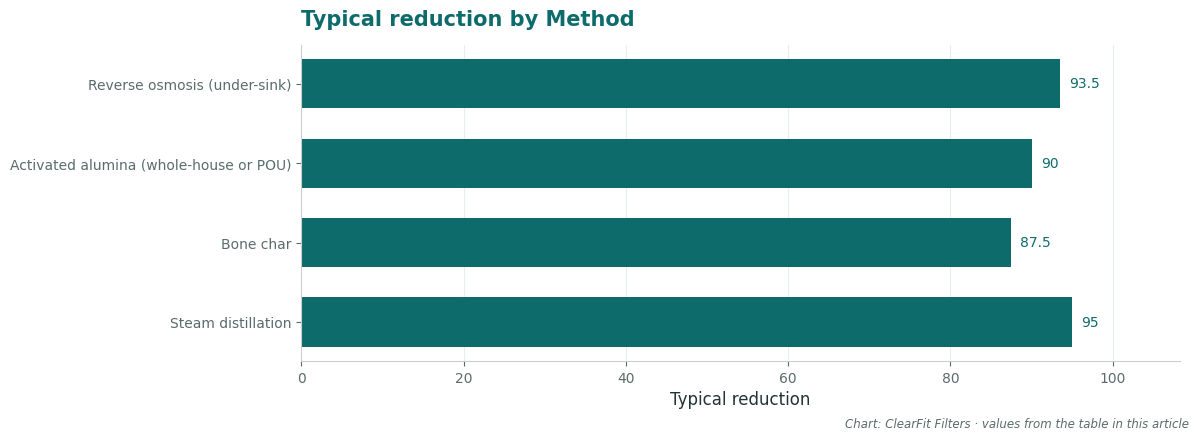
| Reverse osmosis (under-sink) | 92–95%+ | NSF/ANSI 58 with fluoride claim named | $200–450 | $60–120/yr filters, membrane every 2–3 yrs | The default: drinking + cooking + formula at one tap |
| Activated alumina (whole-house or POU) | 85–95% | NSF/ANSI 53 fluoride claim (POU systems); system data for tanks | $1,200–2,800 (POE tank) / $100–250 (POU cartridge) | Media change-out every 1–3 yrs ($300–900 at POE) | High-fluoride wells feeding a whole house |
| Bone char | 80–95% | No unified NSF fluoride standard — buy only with third-party lab data for that product | $80–200 (POU/inline) | Media replacement on measured exhaustion | Natural-media preference; GAC-blend housings |
| Steam distillation | 95%+ | — (physical process, no claims framework) | $100–250 counter units | $0.25–0.40 electricity + cleaning per gallon | Small volumes: one drinker, formula, irons, CPAP |
Read the certification column with discipline: NSF/ANSI 58 without a named fluoride claim means nothing for this question. 58 is the RO standard covering many claims (TDS, lead, arsenic, nitrate…); fluoride must appear on the specific model’s claim sheet. Same logic for 53 and alumina systems. The two-minute verification ritual — manufacturer spec sheet or NSF’s public certification database, model number, fluoride named — is the single most valuable habit this article can teach.
Reverse Osmosis — the Default Answer, Priced Honestly
How it earns its numbers: an RO membrane rejects dissolved ions by charge and size — fluoride rejection on certified systems runs 92–95%+, turning a 1.0 mg/L supply into ~0.05 or less at the faucet. A typical system ships as sediment prefilter → carbon prefilter(s) → membrane → carbon post-filter, with or without a remineralization stage for taste.
The honest cost math affiliate pages skip:
- Purchase: $200–450 (quality under-sink systems; expect $350–450 installed by a plumber if you don’t DIY).
- Annual consumables: $60–120 (prefilters/post-filters, annually).
- Membrane: $80–150 every 2–3 years.
- The wastewater ratio: conventional RO units send 3–4 gallons to drain per clean gallon (modern efficient designs improve this to 1–2:1; check the spec — this is both an environmental line-item and, on metered water, a cost line-item nobody prices). Per-gallon all-in, RO drinking water typically lands under $0.10 even counting everything — but only if you count everything.
The maintenance truth: an RO left unmaintained doesn’t hold at “pretty good” — membrane and carbon performance decay, and fluoride rejection slides with them. The calendar (and a $15 TDS meter reading output a couple times a year, per the trick on our TDS page) is part of the purchase, not an accessory.
Choose RO when: you want one faucet delivering treated water for everything the household drinks; your fluoride is municipal-level (0.7–2.0) or a moderate well reading; you’d also value the lead/arsenic/nitrate/TDS reduction riding in the same membrane.
Activated Alumina — the Whole-House Workhorse, with Two Honest Caveats
Activated alumina is a porous aluminum-oxide media with surface chemistry that binds fluoride ions — the treatment family shared with arsenic wells (see the arsenic page for the sibling application).
Caveat 1 — pH performance. Alumina’s fluoride affinity peaks in slightly acidic water: performance is best in the pH 5.5–6.5 window and falls off as water approaches neutral-to-alkaline. Your well’s pH (it’s on the same lab panel as your fluoride number) is part of the sizing decision — a competent vendor asks for both numbers, and a vendor who doesn’t ask is selling by SKU.
Caveat 2 — media exhaustion. Alumina is an adsorption battery, not a barrier: it holds a finite mass of fluoride and then saturates. A saturated bed doesn’t just stop — worst cases can release a pulse of what it held (the breakthrough chemistry our VOC page explains in full). At point-of-entry scale, media change-outs run every 1–3 years ($300–900) depending on your raw number and household volume — and the change-out interval, quoted against your lab number, is the number that turns a $1,800 purchase into an honest $1,800-plus-subscription decision.
Choose alumina when: a well serving the whole house runs high (2 mg/L+), every tap matters (bathing children, taste throughout), and you want one system handling all of it — sized from a lab report that includes pH.
Bone Char — the Natural Media, with Its Footnotes
Bone char — carbonized cattle bone — removes fluoride through hydroxyapatite’s affinity for the ion (the same calcium-phosphate chemistry that makes bone a fluoride sink in our own bodies). It’s the traditional media with a genuine track record and two footnotes:
- Not vegetarian. It’s an animal product; households avoiding that pass to alumina or RO.
- No unified NSF fluoride standard. Performance is real but product-variable — buy bone char with third-party lab data for that specific product, typically blended with GAC in housings ($80–200). The claim-sheet discipline that protects you on RO protects you identically here.
Reduction on documented products: 80–95%. Choose bone char when natural media matters to you, volumes are modest (POU/inline applications), and you’ve seen the lab sheet.
Distillation — Maximum Purity, Minimum Throughput
A countertop still boils water and condenses the steam — fluoride (and essentially all dissolved solids) stay behind in the boiling chamber. Reduction 95%+, effectively total for dissolved ions; nothing to certify because the physics doesn’t need a claim.
The honest limits: ~4 hours per gallon, electricity at roughly a quarter to forty cents per gallon, a counter footprint, and periodic cleaning of the boiling chamber (the residue your water leaves behind is the visible tally of what the still removed). For a one-person household, formula prep, or specialty uses (irons, CPAP, humidifiers), it’s the cheapest entry into near-pure water. For a family’s drinking volume, it’s a lifestyle choice most households regret — the RO covers 10x the volume at a tenth of the fuss.
Point-of-Use vs Whole-House — the Decision Matrix
| Your situation | The honest answer |
|---|---|
| City water at 0.7, adult household, taste/values preference | Under-sink RO (or do nothing — see the don’t-buy row) |
| City or well at 1.5–4.0, children under 8 | Under-sink RO now, whole-house decision later |
| Well at 4.0+, whole family | Whole-house alumina (sized with pH) + RO at the kitchen tap as final polish |
| Renter, one drinker, small volume | Countertop distiller, or the largest documented bone-char POU |
| Budget floor, formula-prep only | Distiller — $100–150 covers the actual need |
| Below 2.0, no kids, no clinical reason | Don’t buy — the test already answered your question. We’re a filter retailer telling you the cheapest honest option is none. |
That last row is the trust asset this article carries: a certain share of fluoride-filter shoppers need to hear “your number doesn’t justify $400” more than they need a cart link — and the ones who do need equipment deserve the sizing logic above.
How to Verify a Fluoride Claim in Two Minutes
The affiliate-review economy runs on unverifiable claims (“up to 97%!”). The counter-ritual takes 120 seconds:
- Find the model number on the product or spec sheet (not the marketing page).
- Open the NSF certification database (info.nsf.org/Certified/DWTU) or the manufacturer’s official claim sheet PDF.
- Match the exact model and read its claim list. Fluoride must be named, under NSF/ANSI 58 (RO systems) or 53 (alumina POU). “Tested to NSF standards” without a listing is not a claim. “Removes fluoride” on a $30 carbon cartridge is contradicted by the chemistry and by every certification database simultaneously.
The same ritual verifies lead, cyst, arsenic, or PFOA/PFOS claims — the habit generalizes to everything this site sells or reviews.
A note on affiliate “test data”: several popular review sites publish their own strip-based “before/after” fluoride numbers. Given the strip-resolution trap our testing page documents, strip-diff tests cannot meaningfully verify 92% vs 0% removal — treat those tables as marketing, and the certification database as the record.
FAQ
Which water filters get rid of fluoride? Four technologies with real reduction data: reverse osmosis (92–95%+, NSF/ANSI 58 fluoride claim), activated alumina (85–95%, 53 claim on certified POU systems), bone char (80–95%, demand product-specific lab data), and distillation (95%+). Carbon — fridge, pitcher, faucet, any brand — does not and claims no such thing.
How effective are water filters at removing fluoride? Effective when matched and maintained: certified RO at 92–95%+ while the membrane is healthy; alumina at 85–95% within its pH window and before media exhaustion. The failure modes are maintenance-shaped — decay and saturation — which is why the cost tables above price consumables, not just boxes.
What is the cheapest way to remove fluoride from drinking water? By use-case: one person/small volume — a countertop distiller ($100–250). A household’s drinking water — an under-sink RO with the named claim ($200–450), the cheapest per household gallon despite the higher sticker. The cheapest of all — reading your CCR and confirming you’re at 0.7 with no children’s-dose concern, which costs nothing and is the right answer for a real share of searchers.
Does a Brita or refrigerator filter remove fluoride? No — no mainstream pitcher or OEM fridge cartridge carries a fluoride claim. The full claim-by-claim cartridge breakdown is our fridge filter fluoride article.
Is reverse osmosis water safe to drink? Yes — RO output is low-mineral, highly pure water; the health conversation around long-term low-mineral water is thin and mostly theoretical, and remineralization stages exist for taste preference. The TDS page covers the mineral question with the same honesty as the rest of this cluster.
How often do fluoride filter media need replacing? By system: RO — annual prefilters/post-filters, membrane every 2–3 years; alumina POE — media every 1–3 years by your raw number and volume (demand the interval in writing, sized to your lab report); bone char — per product data; distillers — no media, periodic chamber cleaning. The unified principle: fluoride media exhausts silently — the calendar is the instrument.
Can I install an under-sink RO system myself? If you’ve assembled furniture and shut off a supply valve, yes: the standard kit is a saddle valve or tee on the cold line, a drain saddle, a mounted tank, and push-fit tubing — an afternoon at moderate confidence, or a plumber’s quick hour if you’d rather outsource it. The fridge-line tee (from our fridge article) adds one fitting to the same visit. What you should not DIY is the verification: after install, run the system per the manual and check output with your $15 TDS meter — numbers, not faith.
Does an RO system waste water — and does the waste matter? Conventional units send 3–4 gallons to drain per clean gallon; efficient modern designs run 1–2:1. On a municipal supply that’s a cost and ethics line-item rather than a practical problem, and the captured fluoride leaves in that concentrate stream — the honest accounting (including where the removed fluoride actually goes) is in the cost-math section above and on the PFAS page’s equivalent discussion.
Next steps: Fluoride in Your Water (contaminant page) · How to Test Fluoride First · The Health Evidence, Both Sides · NSF 42 vs NSF 53