How Many Ounces in a Gallon? 128 — Plus the Two Other Gallons Nobody Mentions

1 US liquid gallon = 128 US fluid ounces. That is the answer, exact by definition. But the ranking pages — water-bottle brands and recipe sites — all stop there, which is why they all silently fail you at the two places this question actually bites: the imperial gallon (160 fl oz) used in UK and older Canadian recipes, and the US dry gallon (~148.95 fl oz) still living on produce labels. Add the weight-versus-volume ounce trap and this page covers the unit engineering the recipe sites skip. Companion: How Much Does a Gallon of Water Weigh?.
Quick Answer: 1 US liquid gallon = 128 US fluid ounces (= 4 quarts = 8 pints = 16 cups ≈ 3.785 L). The imperial (UK) gallon is different: 160 imperial fl oz (4.546 L). A third unit, the US dry gallon, holds ~148.95 fl oz — it still appears in agriculture for berries and produce.
| Unit | US fluid ounces | Milliliters (approx.) |
|---|---|---|
| 1 gallon | 128 | 3,785 |
| 1/2 gallon | 64 | 1,893 |
| 1 quart (1/4 gal) | 32 | 946 |
| 1 pint (1/8 gal) | 16 | 473 |
| 1 cup (1/16 gal) | 8 | 237 |
| 1 fluid ounce | 1 | 29.6 |
| Imperial gallon | 160 (imperial) | 4,546 |
| US dry gallon | ~148.95 (US fl oz) | 4,405 |
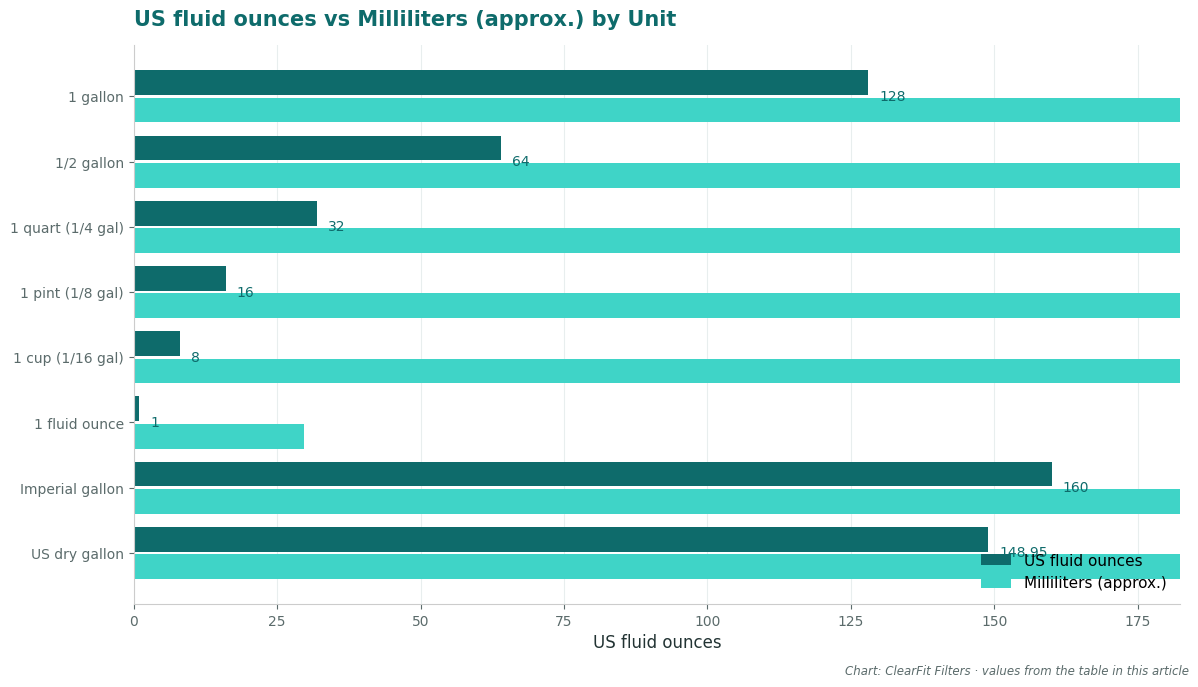
The SERP for this question is Yeti and Stanley (water-bottle content pages) plus recipe sites — the hydration-counter angle and the cooking angle. Both treat “gallon” as one universal thing. The r/HydroHomies regulars filling a 128-oz marked bottle daily have the US number right; the baker following a 1970s British cookbook does not, and that discrepancy — 20% per gallon — is where the recipe quietly fails.
The Binary Ladder: Why 128 Is Easy to Memorize

The US system converts by halving, all the way down: 128 → 64 → 32 → 16 → 8. Gallon, half-gallon, quart, pint, cup — each step divides by two. If you remember one anchor (a pint is 16 fl oz, “a pint’s a pound the world around” for water’s near-enough 16 oz ≈ 1 lb at refrigerator temperatures), the entire table reconstructs itself.
The quick hydration math the bottle brands lean on: eight 16-oz bottles = one gallon; four 32-oz bottles = one gallon; two 64-oz growlers = one gallon. A gallon of water per day is a common training target (and, for most adults, more than the National Academy reference — that discussion lives in How Much Water Should You Drink?).
The Three Gallons: Why They All Still Exist
The US liquid gallon descends from the English wine gallon — 231 cubic inches, standardized 1706, kept by the American colonies.
The imperial gallon was Britain’s 1824 reform: defined as exactly 10 lb of distilled water at 62°F — 4.54609 liters, 160 imperial fluid ounces. Canada officially metricated, but older recipes, some fuel economy (mpg-Imperial), and UK cooking content still use it. When a British source says “add a gallon,” it means 20% more than a US source.
The US dry gallon (268.8 cubic inches, ~4.405 L, 148.95 US fl oz) survives from a separate English dry-measure lineage and persists in agriculture — berries, produce, and some farm-stand pricing — precisely because “a gallon of berries” packs differently than a gallon of liquid. Nobody converts it correctly in recipe or fitness content; almost nobody even names it. Full volume-weight background in the companion page, including the 1824 weight-anchored definition.
The Kitchen Trap: Ounces by Weight vs Ounces by Volume
This is the single most expensive ambiguity in home cooking, and recipe sites rarely flag it: “8 oz” can mean weight (8 oz = 227 g) or volume (8 fl oz = 1 cup), and for most ingredients they are not the same.
- Water and milk: 8 fl oz ≈ 8.3–8.6 oz by weight — close enough that nobody notices, which is exactly the problem, because it trains false confidence.
- Flour: 1 cup (8 fl oz) ≈ 4.25 oz by weight — half. This is why “cup” recipes for flour swing ±20% by scooping style, and why bakers weigh.
- Cream cheese, butter: the coincidence ingredients — one standard package (8 oz weight) happens to equal one cup — which cements the confusion for everything else.
- Honey: 1 cup ≈ 12 oz weight (50% heavier than the false pattern suggests).
The rule: if the ingredient is measured with a scale marking on its package (butter, cream cheese, chocolate), “8 oz” means weight. If a recipe from a serious baking source, it means weight for flour and sugar. “fl oz” always means volume.
The Filter-Flush Account (Where Gallons Meet Your Kitchen Tap)
New refrigerator water filters ship with a flush instruction: run 2–4 gallons through the cartridge before drinking. In the units people actually picture at the sink: that is 256–512 fl oz, i.e., 16–32 eight-ounce cups, or 8–16 refills of a typical 32-oz bottle — ten to twenty minutes of running, not a symbolic splash.
The reason is carbon fines: new compressed-carbon media sheds microscopic dust in first use, plus the first gallons carry the air and manufacturing residue trapped in the media bed. NSF-certified filters are tested after this initial flush; skipping it is why brand-new filters sometimes produce gray or oddly-tasting first water. The full procedure and schedule logic: the filter flush guide.
FAQ
Is 1 gallon the same as 64 oz?
No — 64 oz is a half gallon. A full US liquid gallon is 128 fl oz. (The confusion is common because 64 oz is itself a popular bottle and growler size.)
How many 32 oz bottles make a gallon?
Four. 4 × 32 fl oz = 128 fl oz = 1 US liquid gallon. This is the standard “big bottle” math for hydration tracking.
How many 16 oz water bottles make a gallon?
Eight. 8 × 16 fl oz = 128 fl oz. A gallon-a-day target in bottled terms is eight standard single-serve bottles.
How many 32 oz is a gallon?
32 oz is one quarter of a gallon (128 ÷ 32 = 4) — one 32-oz bottle is a quart. Flip the question to “how many bottles” and the answer is four 32-oz bottles per US gallon. (The UK gallon is a different unit entirely — 160 fl oz — covered above.)
Sources & References
- NIST Handbook 44 / US customary units — US liquid gallon = 231 in³ = 128 fl oz (exact); dry gallon 268.8025 in³. Official documentation.
- UK Weights and Measures Act 1824 — imperial gallon = 10 lb water at 62°F = 4.54609 L = 160 fl oz. Official documentation (historical regulation).
- USDA / King Arthur baking references — weight-per-cup values for flour (~4.25 oz/cup) and honey (~12 oz/cup). Industry expert analysis.
- NSF/ANSI 42 & 53 test protocols — initial-flush convention for certified filters. Official standard.
- Reddit r/HydroHomies, r/Baking — bottle-count tracking behavior; weight-vs-volume recipe failures. Community discussion.
Related Guides
- How Much Does a Gallon of Water Weigh? — the pound answer (8.34) and the temperature table.
- How Much Water Should You Drink a Day? — where “a gallon a day” came from and whether it applies to you.
- How to Flush a Refrigerator Water Filter — the 2–4 gallon flush, step by step.
Further reading: Water Temperature Guide