How to Clean a Humidifier Filter: The Wick vs Water-Panel Split, the Vinegar Protocol, and the Timeline From New Filter to Pink Spots

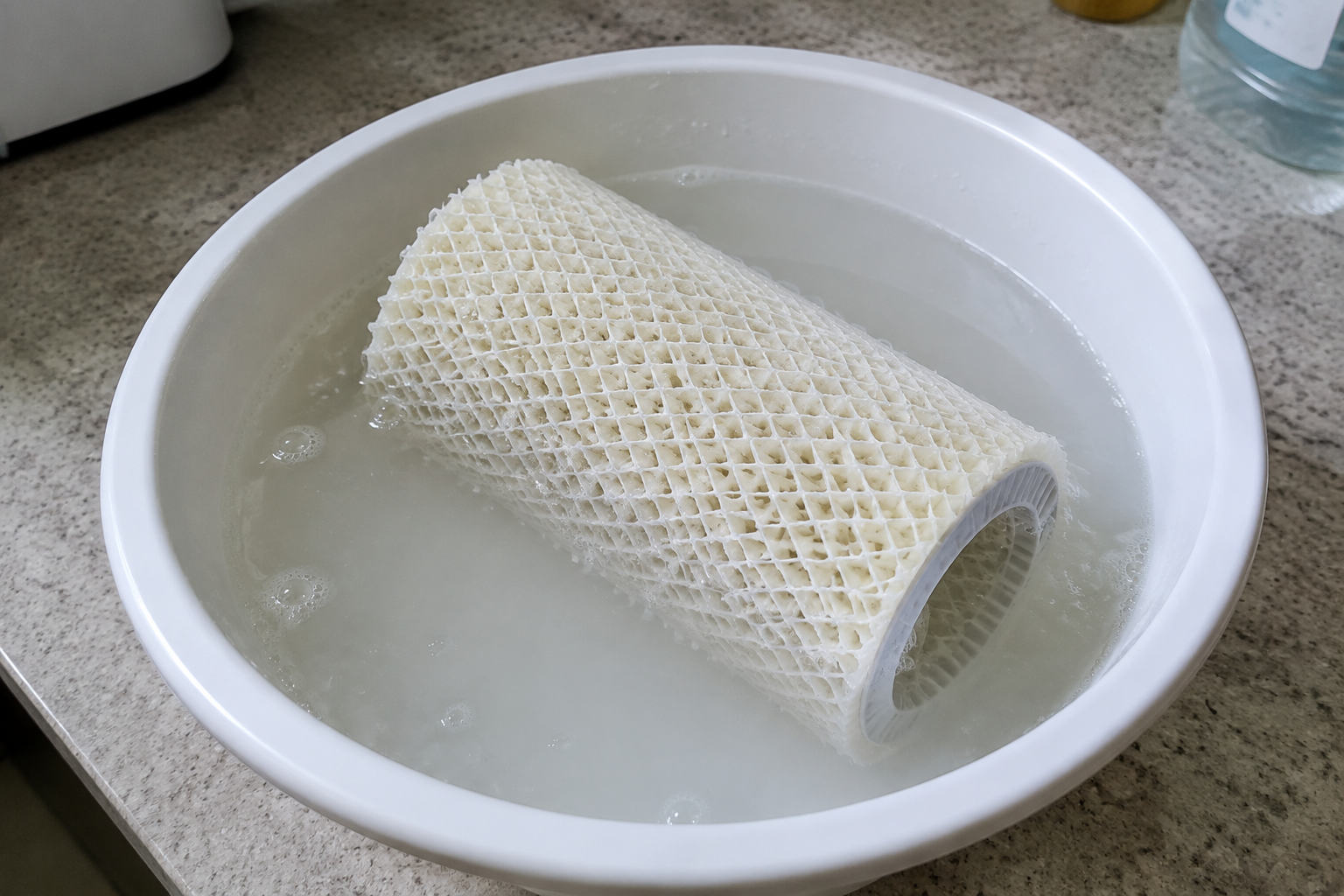
“Not cleaning the humidifier filter” is really two different jobs on two different machines, and the internet’s advice mixes them constantly. Portable console wick filters (Levoit, Vicks, Honeywell evaporative units) can be revived: a 20–30 minute white-vinegar soak dissolves the mineral scale, a rinse, a full air-dry, repeat every 1–2 weeks, and expect 1–3 months of total life regardless — wicks are consumables. Whole-house water panels (the Aprilaire-style pads in furnace humidifiers) are designed one-season consumables: the manual’s instruction is replace each season, cleaning buys weeks at most, and the honest maintenance move is ordering the panel before heating season, not scrubbing after it. The failure signs cross over: yellowing is mineral loading, and pink or black spotting is biofilm — that’s a replacement, not a cleaning. Related: Can You Use Tap Water in a Humidifier?.

Quick Answer: Portable wick filters: soak 20–30 min in white vinegar (dissolves the CaCO₃ scale — same chemistry as the hard-water stain reaction), rinse under cool water, brush gently with a soft brush, air-dry fully before reinstalling. Repeat 1–2 weeks in hard-water households; wick life 1–3 months — stiff, yellowed, or spotted wicks get replaced, not rescued. Whole-house water panels (Aprilaire-type): replace every season by design; cleaning extends little. Pink or black spots = biofilm = replace immediately, and clean the tank with it.
| Filter type | Machine examples | Cleanable? | Method | Realistic life |
|---|---|---|---|---|
| Evaporative wick | Levoit/L Vick’s/Honeywell consoles, most “filter” humidifiers under $80 | Yes, partially | Vinegar soak 20–30 min, rinse, dry fully | 1–3 months (hard water: shorter) |
| Ultrasonic “filter” | Most ultrasonic units have demineralization cartridges, not wicks | Cartridge: no | Replace cartridge per manual | 1–3 months |
| Water panel | Aprilaire, Honeywell whole-house bypass/powered humidifiers | Not meaningfully | Replace each season (or 2×/season for hard water) | One heating season by design |
| Mesh/scale-stop inserts | Various | Rinse only | Water rinse, no detergent | Per manual |
The forum scene that writes this page’s opening: October’s first cold snap, and r/hvac fills with photos of opened-up furnace humidifiers — a homeowner holding a water panel furred white like a coral reef, asking “can I just wash this?” The contractors’ consensus reply, consistent for years: you can vinegar it and squeeze a few more weeks, but the panel costs $15–25, the season is six months, and the failure mode of a scaled panel (water cascading past blocked sections, scale dust downstream, the humidistat calling for more water than the panel can carry) costs more than the part. Meanwhile r/humidifiers runs the portable twin of the thread — wicks yellowed at three weeks — with the same answer softened by the fact that wicks genuinely respond to vinegar, a few times, before they don’t.
The Vinegar Protocol, Stepwise (Portable Wicks)

- Remove and shake out — over a sink or trash; loose mineral grit comes off dry first.
- Soak 20–30 minutes in white vinegar — straight or 1:1 for maintenance, straight for heavy scale. You’re running the hard-water chemistry in reverse: acetic acid dissolves the calcium/magnesium carbonate loading the paper (CaCO₃ + 2CH₃COOH → soluble calcium acetate + water + CO₂ — the fizz you’ll see; the same reaction that cleans shower glass on the hard-water stains page).
- Rinse under cool running water — thorough; residual vinegar aerosolizes into the air stream otherwise.
- Soft-brush gently if scale remains — an old toothbrush, with the grain of the paper; never scrub aggressively (crushed wick paper stops wicking, which is the whole function).
- Air-dry completely before reinstalling — a damp stored wick grows the biofilm you were trying to avoid; when the machine is off for the season, dry the wick fully or discard it.
- Frequency: every 1–2 weeks in hard-water areas, longer intervals with distilled/softened water — the hardness decision upstream (W2-13’s table) is the single biggest lever on how often this job comes around.
Hard limits of the protocol: a wick that stays stiff after treatment (the paper’s capillaries are scale-locked), has collapsed pleats, is yellowed through-and-through, or shows pink/black spotting has crossed from “scaled” to “spent” — replacement, and check the tank for the same biofilm while you’re in there.
The Water-Panel Answer (Whole-House)
Aprilaire-style humidifiers (and their Honeywell/BestAir equivalents) evaporate water off a coated aluminum or paper-frame water panel as furnace air passes through. The naming matters — it’s not marketed as a “filter” because it’s a disposable evaporation surface: scale accumulates as a natural consequence of the water flow (hard water accelerates it per the same mg/L arithmetic), the coating degrades, and the engineering assumption is replacement — once per heating season in normal conditions, twice in very-hard-water households. Cleaning with vinegar restores a fraction of the surface for a few weeks; it doesn’t restore the coating or the flow-distributing function, which is why every contractor answer converges on “replace it, and calendar it before the season starts.” The water-choice lever applies here too: hard water is the panel’s aging clock, and a softener upstream extends panel life proportionally (the softener sodium trade-offs are priced on the water-sources page).
Reading the Filter: Color as Diagnostic
White chalky: mineral scale — the vinegar case, cleanable in wicks, end-of-life in panels. Yellow to tan: aged mineral-plus-organics loading — late-stage cleanable at best. Pink or orange spots: that’s Serratia marcescens and friends — biofilm. Not a cleaning candidate: biofilm lives in the material, and a humidifier is an aerosol-generating device pointed at your family’s airway. Replace the wick/panel, disinfect the tank (the CDC daily-rinse/weekly-disinfect cadence), and fix the moisture source that let it establish — usually a machine that sat wet, or tap-water mineral loading feeding the ecology. Black spotting: mold or heavy biofilm — same verdict, faster. The respiratory-risk framing is the reason for the bright line: a scaled wick underperforms, a biofilmed wick broadcasts.
The Prevention Stack (Which Is Mostly Water Choice and Calendar)
Rank order: use distilled or softened water in portable machines (mineral loading is the cleaning schedule — W2-13’s hardness bands); empty and dry daily, disinfect weekly (tank biology is independent of mineral status); calendar the panel/wick — order before heating season or before the winter dry-cough season, so the replacement arrives before the old one fails; and hygrometer as referee (30–50% RH — a humidifier fighting to hold 45% in a 20 gpg household is eating wicks, and the hard-water pages’ softener math starts applying to the humidifier line item). The full humidifier-vs-purifier decision context is on A2-05.
FAQ
What is the best way to clean a humidifier filter?
For cleanable wick filters: 20–30 minutes in white vinegar (straight or 1:1), cool rinse, gentle soft-brush with the grain, complete air-dry, reinstall. The vinegar is doing real chemistry — dissolving the calcium carbonate scale the water left — which is why it outperforms soap (soap doesn’t dissolve mineral) and why the filter comes out visibly whiter. Water panels (Aprilaire-style) skip straight to replacement: they’re designed as one-season consumables.
Can I clean and reuse a humidifier filter?
A wick filter, yes — a few times: vinegar restores water flow through the paper until the scale locks the capillaries or the paper fatigues (1–3 months total life in practice). A whole-house water panel, not meaningfully — cleaning buys weeks on a $15–25 part designed for seasonal replacement. And the boundary cases — stiff felt, collapsed structure, yellow-through, or any pink/black spotting — are past cleaning regardless of type.
Can I run vinegar through my humidifier to clean it?
Not through the working machine, and not as the cleaning method for the wick itself in place. Vinegar in the reservoir (diluted 1:1, brief soak with the machine off, then thorough rinse) is a legitimate tank descale; running it through operation aerosolizes acetic acid — irritating to breathe and pointless (the wick needs contact time, not flow). The wick comes out and soaks; the tank soaks separately; the machine runs only clean water.
What happens if you don’t clean your humidifier?
Three escalating tiers: performance — scale chokes the wick, output drops, the humidistat calls for more water, and you’re paying for mist that isn’t coming; hygiene — the tank and wick grow biofilm (the pink/black spots), which the machine then aerosolizes into the room — the genuine health-relevant failure, and the reason CDC’s daily-empty/weekly-disinfect guidance exists; machine — mineral scale kills sensors and small orifices, shortening the unit’s life. White-dust furniture film is the visible symptom of the same mineral story (the tank arithmetic on W2-13); biofilm is the invisible one that matters more.
Sources & References
- Aprilaire water-panel replacement documentation (seasonal replacement by design; hard-water 2×/season guidance). Official documentation.
- Honeywell/Levoit/Vicks wick-filter care instructions (soak-and-rinse method, 1–3 month wick life). Official documentation.
- CDC / CPSC humidifier care guidance — daily empty-rinse-dry, weekly disinfect; biofilm and aerosolization rationale. Official documentation.
- Calcium carbonate dissolution chemistry (acetic acid) — shared with hard-water cleaning literature. Official documentation (chemistry literature).
Related Guides
- Can You Use Tap Water in a Humidifier? — the upstream decision that sets this schedule.
- Air Purifier vs Humidifier — which machine, and the humidity band to hold.
Data page: Hard water – scale cleanup